

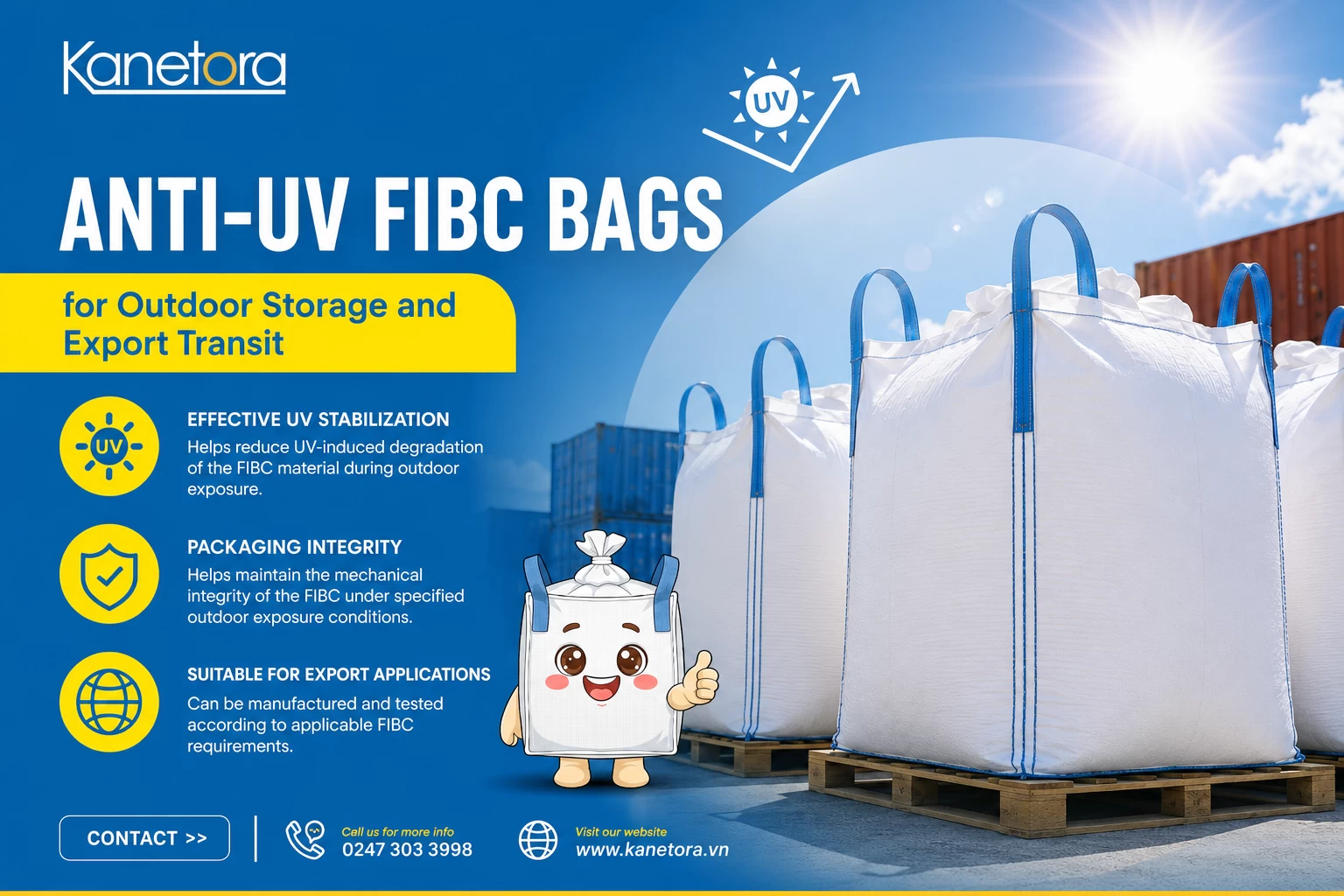
FIBC bags are widely used to store and transport dry bulk materials because woven polypropylene offers a practical combination of strength, flexibility and cost efficiency. However, polypropylene is also a polymer that can gradually lose mechanical performance when exposed to ultraviolet radiation for extended periods.
For export cargo that may remain at an outdoor yard, port, construction site, open warehouse or staging area, UV exposure therefore becomes an important part of packaging specification.
Anti-UV FIBC bags, also known as UV-stabilized FIBCs or UV-resistant bulk bags, are manufactured using materials formulated to improve resistance to degradation caused by sunlight and weathering.
However, “UV stabilized” does not mean that a bulk bag can remain outdoors indefinitely. It also does not automatically mean that the bag is waterproof or moisture-proof.
A reliable outdoor-storage specification should consider the actual exposure conditions, bag construction, UV stabilization system, testing method and cargo-protection requirements as a complete packaging system.
For buyers who are new to bulk packaging, Kanetora’s industrial FIBC and packaging solutions provide an overview of available jumbo bags, sling bags, block-bottom valve bags and multilayer plastic films.
Quick Answer: When Should You Consider Anti-UV FIBC Bags?
| Use Condition | Should Anti-UV FIBC Be Considered? |
|---|---|
| Fully enclosed indoor warehouse | Depends on storage duration and operating conditions |
| Near warehouse doors or direct sunlight | Recommended |
| Outdoor staging before container loading | Recommended |
| Port or ICD outdoor storage | Recommended |
| Construction-site storage | Strongly recommended |
| Export cargo kept inside closed containers | Evaluate exposure before and after containerization |
| Long-term outdoor storage | Requires a suitable specification and UV test method |
| Exposure to sunlight, rain and humidity | Combine UV stabilization with moisture/weather protection |
One important point is that long transit time does not automatically mean high UV exposure.
An FIBC may spend several weeks inside a closed shipping container with minimal direct sunlight exposure. In contrast, another shipment may spend only a few days at an open port yard under strong sunlight.
For this reason, buyers should evaluate the actual UV exposure profile throughout the supply chain, rather than using transit duration alone.
What Is an Anti-UV FIBC Bag?
An Anti-UV FIBC is a flexible intermediate bulk container manufactured with materials that have been stabilized to improve resistance to ultraviolet radiation and weather-related ageing.
Most conventional FIBCs are manufactured from woven polypropylene because PP offers:
- High strength-to-weight ratio
- Good flexibility
- Efficient woven-fabric production
- Customizable coating and liner options
- Good compatibility with industrial filling systems
- Cost-efficient bulk handling
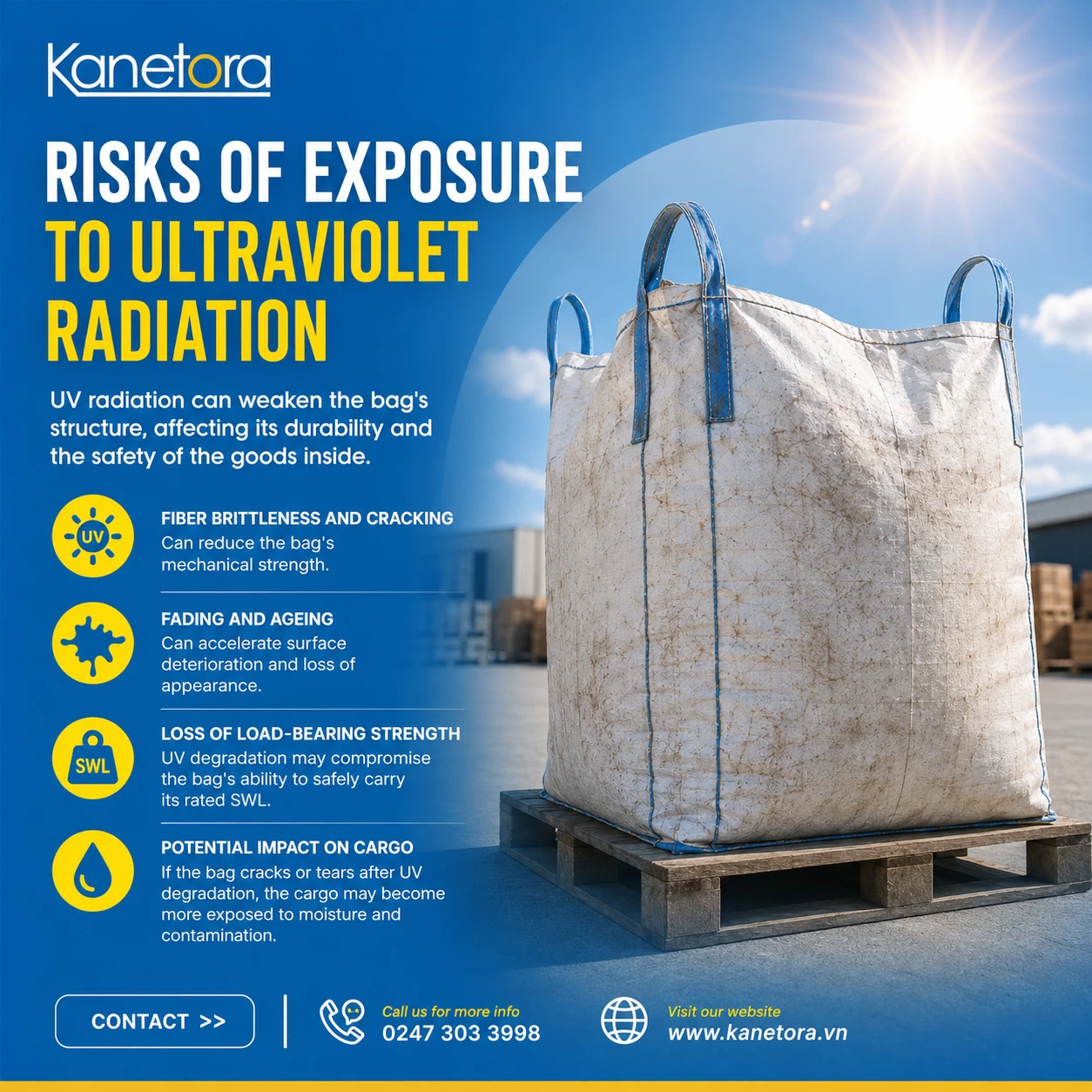
However, prolonged exposure to ultraviolet radiation can gradually affect polypropylene.
Possible effects include changes in:
- Fabric tensile strength
- Elongation at break
- Yarn strength
- Lifting-loop and webbing performance
- Flexibility of the polymer
- Long-term mechanical reliability
For an FIBC, UV degradation is therefore more than a cosmetic issue.
The fabric body, lifting loops and other load-bearing components are responsible for safely supporting hundreds or even thousands of kilograms of product.
UV resistance should therefore be treated as part of the technical design of the FIBC, rather than simply as an optional additive requested by percentage.
Why Can UV Radiation Affect Woven PP FIBC Fabric?
When polypropylene is exposed to UV radiation, photo-oxidative reactions may gradually alter the polymer structure.
The rate of degradation depends on many factors, including:
- UV intensity
- Ambient temperature
- Surface temperature of the bag
- Humidity
- Geographic location
- Season
- Fabric color
- Pigment system
- UV stabilizer formulation
- Fabric weight and yarn characteristics
- Direct or indirect sunlight exposure
- Whether the bag is covered
- Storage configuration
This is why two FIBC shipments described as being “stored outdoors for 30 days” may experience very different ageing conditions.
A bag stored outdoors during a mild European winter will not necessarily experience the same UV stress as a bag exposed to intense sunlight in Southeast Asia, Australia or the Middle East.
For the same reason, buyers should avoid simple assumptions such as:
300 hours of accelerated UV testing = X months outdoors
or:
1,000 UV test hours = Y years of service life
Accelerated weathering testing provides standardized and repeatable conditions for evaluating material performance. It is not an exact clock that converts laboratory hours into outdoor service life.
Where Does UV Exposure Occur During Export Transit?
A typical FIBC export shipment may pass through several stages:
Filling at factory → warehouse storage → inland transport → port staging → container loading → ocean freight → destination port → unloading → customer warehouse
Direct UV exposure may occur during:
- Factory-yard staging
- Outdoor warehouse operations
- Inland container depots
- Port terminals
- Loading areas
- Construction sites
- Open customer yards
- Temporary outdoor storage at destination
For example, a plastic resin exporter may fill FIBCs inside a factory and store them under cover. If the bags must wait outside before the container becomes available, UV exposure may become a significant packaging consideration.
For polymer applications, buyers can also review Bulk Bags for Plastic Resin Export: Safe Packaging for PP, PE & PET to evaluate liner, coating, contamination control, UV protection and container-loading requirements together.
The issue can be even more relevant for cement, calcium carbonate, minerals and construction products, where outdoor storage is common.
Kanetora’s guide to FIBC Bags for Cement & Construction Materials explains additional considerations such as dust control, moisture resistance, load capacity and outdoor handling.
How Do UV Stabilizers Work in FIBC Materials?
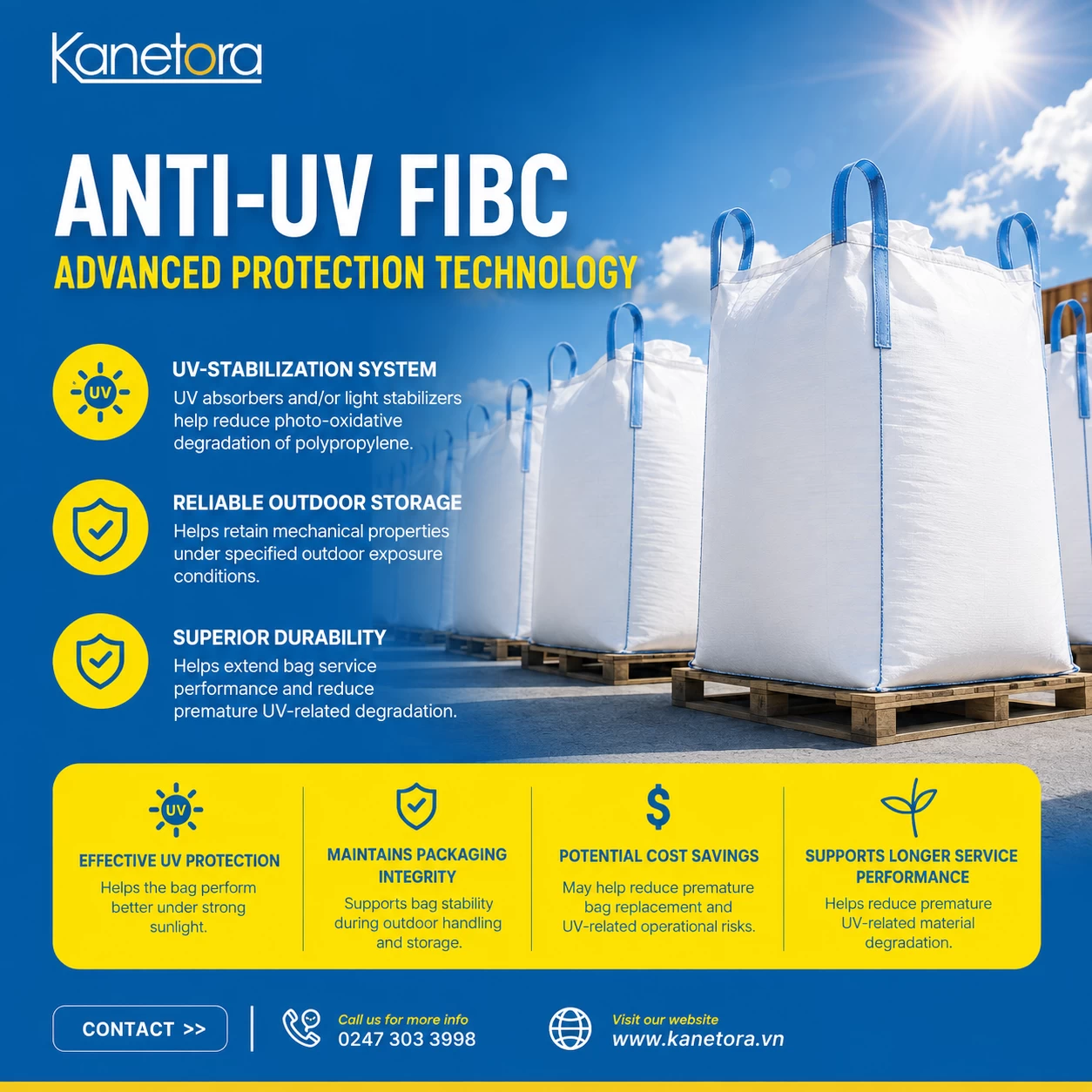
UV protection in polypropylene is generally achieved through a suitable stabilization system incorporated into the material formulation.
Depending on the application, formulations may use:
- UV absorbers
- Light stabilizers
- UV inhibitors
- HALS – Hindered Amine Light Stabilizers
- Suitable pigment systems
- Combined additive systems
Their purpose is to reduce or slow degradation caused by UV radiation and environmental ageing.
However, buyers should not evaluate an Anti-UV FIBC only by asking:
“What percentage of UV additive is used?”
An additive percentage alone does not define final bag performance.
Actual UV resistance may also depend on:
- Polymer grade
- Additive formulation
- Masterbatch quality
- Yarn denier
- Fabric GSM
- Weaving density
- Fabric color
- Pigment type
- Webbing construction
- Bag design
- Exposure conditions
Pigment selection can also interact with the UV stabilization system.
If a buyer significantly changes the fabric color, pigment or material formulation, previous UV test data should not automatically be assumed to represent the modified specification.
For customized packaging projects, buyers can review OEM/ODM Jumbo FIBC Bags: What Businesses Need to Prepare before requesting samples or commercial production.
What Does ISO 21898:2024 Say About FIBC UV Resistance?
For FIBCs intended for non-dangerous solid materials, ISO 21898:2024 – Packaging — Flexible Intermediate Bulk Containers (FIBCs) for Non-Dangerous Goods is an important international reference.
The standard specifies requirements relating to:
- Materials
- Construction
- Design
- Type testing
- Marking
- Selection
- Safe use
UV resistance is addressed as part of the material-performance requirements.
Under ISO 21898:2024, load-bearing materials subjected to the specified UV evaluation are required to retain at least 50% of their initial values for force at rupture and elongation at rupture.
UV Testing for General-Use FIBCs
The Annex A method uses alternating UV irradiation and condensation conditions.
A test cycle consists of approximately:
8 hours of UV irradiation + 4 hours under condensation conditions
For general use, the cycles are repeated for a total duration of at least 300 hours.
This is particularly important when reviewing older FIBC specifications.
Some historical documents and supplier specifications refer to “200 hours UV”. The 2024 edition clarifies the total cycle duration, helping remove ambiguity regarding UV exposure time.
For a new RFQ, buyers should therefore ask:
Which standard is being used?
Which edition of the standard?
What is the complete exposure cycle?
What acceptance criteria are applied after exposure?
A standalone number such as “UV 500 hours” is much less useful when the test method is not identified.
What About FIBCs for Long-Term Outdoor Storage?
ISO 21898:2024 also provides a procedure for FIBCs expected or designed for long-term outdoor storage.
Where this procedure is agreed between relevant stakeholders, the UV and condensation cycles can be continued for a total duration of at least 1,500 hours.
This is an important distinction.
A standard FIBC manufactured with UV stabilization is not automatically equivalent to an FIBC that has been specifically designed and evaluated for long-term outdoor storage.
For projects involving prolonged outdoor exposure, buyers should communicate this requirement before production rather than adding a generic note such as:
“UV treated”
to the purchase order.
Do 300 or 1,500 UV Test Hours Equal a Specific Number of Months Outdoors?
No direct conversion should be assumed.
Accelerated laboratory weathering and natural outdoor weathering do not create identical degradation conditions.
Real-world performance may vary depending on:
- Solar radiation level
- Geographic location
- Temperature
- Rainfall
- Humidity
- Surface temperature
- Dust
- Cargo chemistry
- Bag color
- Stacking pattern
- Pallet arrangement
- Protective covers
- Seasonal variation
The more useful procurement question is therefore not:
“How many outdoor months does a 300-hour test represent?”
but:
“Does this specification and UV test method adequately represent the expected exposure profile of our shipment?”
For long-term outdoor-storage projects, the manufacturer and buyer should agree on the intended use, testing method and acceptance criteria during the specification-development stage.
Is More UV Additive Always Better?
Not necessarily.
UV additives must work effectively with the polymer, pigment system and other formulation components.
Simply increasing the percentage of one additive does not guarantee a proportional increase in service performance.
It may also influence:
- Processing behavior
- Mechanical properties
- Color
- Material cost
- Overall formulation balance
A more reliable approach is performance-based:
Application conditions → UV requirement → material formulation → testing → performance evaluation
rather than:
Fixed additive percentage → assumed outdoor service life
This distinction is particularly important for international buyers comparing FIBC quotations from multiple suppliers.
Does an Anti-UV FIBC Also Protect Against Water and Moisture?
Not automatically.
This is one of the most common misunderstandings in outdoor FIBC applications.
UV stabilization primarily addresses deterioration of the packaging material caused by ultraviolet radiation.
Moisture, rain, dust, oxygen and contamination require separate packaging controls.
| Protection Requirement | Packaging Solution to Consider |
| UV degradation | UV stabilization |
| Powder leakage | Coated fabric and suitable seam design |
| Moisture protection | PE inner liner |
| High moisture/oxygen barrier | Barrier liner |
| Pallet-level external protection | Stretch Hood / pallet cover |
| Better square shape | Baffle FIBC |
| Electrostatic control | Suitable Type C / Type D system or compatible liner |
For moisture-sensitive cargo, buyers should consider the complete bag-and-liner configuration.
Kanetora’s FIBC Bag with Liner: When and Why to Use explains when PE liners, form-fit liners, tabbed liners and other structures may be appropriate.
For cargo that is both UV-exposed and moisture-sensitive, a combination of solutions is often more appropriate than relying on UV additives alone.
Should Anti-UV FIBCs Be Combined with Stretch Hood Film?
They can be, depending on the logistics model.
Stretch hood film is applied around the complete pallet load to improve load stability and provide an additional external protection layer.
A packaging system may therefore be designed as:
Product → Inner Liner → Anti-UV FIBC → Pallet → Stretch Hood Film
Each layer performs a different function.
Inner liner: Helps protect the cargo against moisture, contamination or leakage depending on the liner structure.
FIBC: Provides the primary load-bearing packaging structure.
UV stabilization: Helps maintain the properties of exposed FIBC materials.
Stretch hood: Helps stabilize the pallet and provides additional external protection.
For more detail, see Stretch Hood Film for Industrial Pallet Packaging.
Stretch hood should not automatically be considered a replacement for UV stabilization.
The stretch hood may be damaged, removed at an intermediate warehouse or provide different levels of UV shielding depending on the film specification. The FIBC itself may still be exposed during parts of the logistics process.
Which Industries Should Consider Anti-UV FIBC Bags?
Anti-UV FIBCs are particularly relevant for industries where bulk bags may remain in outdoor yards, ports, construction sites or open-storage areas.
Plastic Resins and Chemicals
PP, PE, PET, masterbatch, compounds and other polymer products are frequently exported in bulk bags.
Outdoor staging at a production facility or port can expose the outer FIBC to sunlight.
Where the resin is also moisture- or contamination-sensitive, an inner liner should be evaluated separately.
Read more: Bulk Bags for Plastic Resin Export.
Minerals and Construction Materials
Common FIBC applications include:
- Calcium carbonate
- Silica
- Cement
- Gypsum
- Dry sand
- Fly ash
- Construction additives
- Mineral powders
These materials are often handled or stored in open industrial environments.
In addition to UV exposure, buyers may need to assess:
- SWL
- Fabric strength
- Dust leakage
- Seam construction
- Moisture protection
- Filling performance
- Discharge efficiency
Read more: FIBC Bags for Cement & Construction Materials.
Agriculture and Fertilizers
Seeds, fertilizers, feed ingredients and agricultural commodities may pass through open warehouses or outdoor staging areas.
For these applications, UV exposure should often be evaluated together with moisture sensitivity and product-quality requirements.
Recycling and Industrial Raw Materials
Recycled pellets, flakes, regrind and other industrial materials are frequently processed and stored in outdoor yards.
Their packaging may therefore experience substantial cumulative sunlight exposure before final use.
Long-Term Outdoor Storage Projects
These projects should be identified clearly at the beginning of the sourcing process.
If the buyer expects extended outdoor storage, the specification should go beyond a generic statement such as:
“UV stabilized FIBC required.”
The manufacturer may need to evaluate:
- Material formulation
- Fabric construction
- Webbing
- Bag color
- Coating
- Liner
- UV exposure requirement
- Test method
- Acceptance criteria
- Secondary protection
What Information Should Buyers Provide When Ordering Anti-UV FIBCs?
A precise RFQ helps the manufacturer recommend a more appropriate bag structure and UV specification.
1. Packed Product
Specify whether the material is:
- Powder
- Granule
- Pellet
- Flake
- Mineral
- Fertilizer
- Agricultural product
- Chemical
- Food ingredient
- Other industrial material
2. Target Filling Weight and SWL
Typical project requirements may include:
- 500 kg
- 1,000 kg
- 1,250 kg
- 1,500 kg
- 2,000 kg
The correct SWL must be determined from the actual application.
3. Safety Factor
The required Safety Factor should match intended handling and reuse conditions.
4. FIBC Construction
Specify or discuss:
- U-panel
- Circular
- 4-panel
- Baffle
- Coated or uncoated
- Lined or unlined
- Filling-spout design
- Discharge-spout design
- Lifting-loop configuration
Where container utilization is important, buyers may also consider Baffle Bulk Bags for improved container loading efficiency.
5. Expected Outdoor Exposure
Provide the realistic exposure scenario:
- A few days of outdoor staging
- Several weeks
- Several months
- Long-term outdoor storage
6. Destination Market and Climate
UV intensity and environmental conditions differ significantly by market.
The destination country and actual storage environment can therefore be useful information during packaging development.
7. Storage Method
Will the filled bags be:
- Stored indoors?
- Kept under a roof?
- Fully exposed outdoors?
- Covered by tarpaulin?
- Palletized?
- Stored directly on the ground?
- Stacked?
8. UV Test Requirement
If applicable, state:
- ISO 21898:2024
- Customer-specific standard
- General-use UV evaluation
- Long-term outdoor-storage evaluation
- Required test report
- Acceptance criteria
9. Moisture-Protection Requirement
If the product is hygroscopic or contamination-sensitive, specify whether a liner or barrier structure is required.
Read: FIBC Bag with Liner: When and Why to Use.
10. Export Logistics
The manufacturer should understand:
- Factory staging time
- Inland transport
- Port waiting time
- Containerization
- Destination handling
- Outdoor storage after arrival
- Palletization
- Customer unloading method
This information turns a vague request such as:
“We need UV-resistant bulk bags.”
into a technical specification that can be manufactured, tested and controlled.
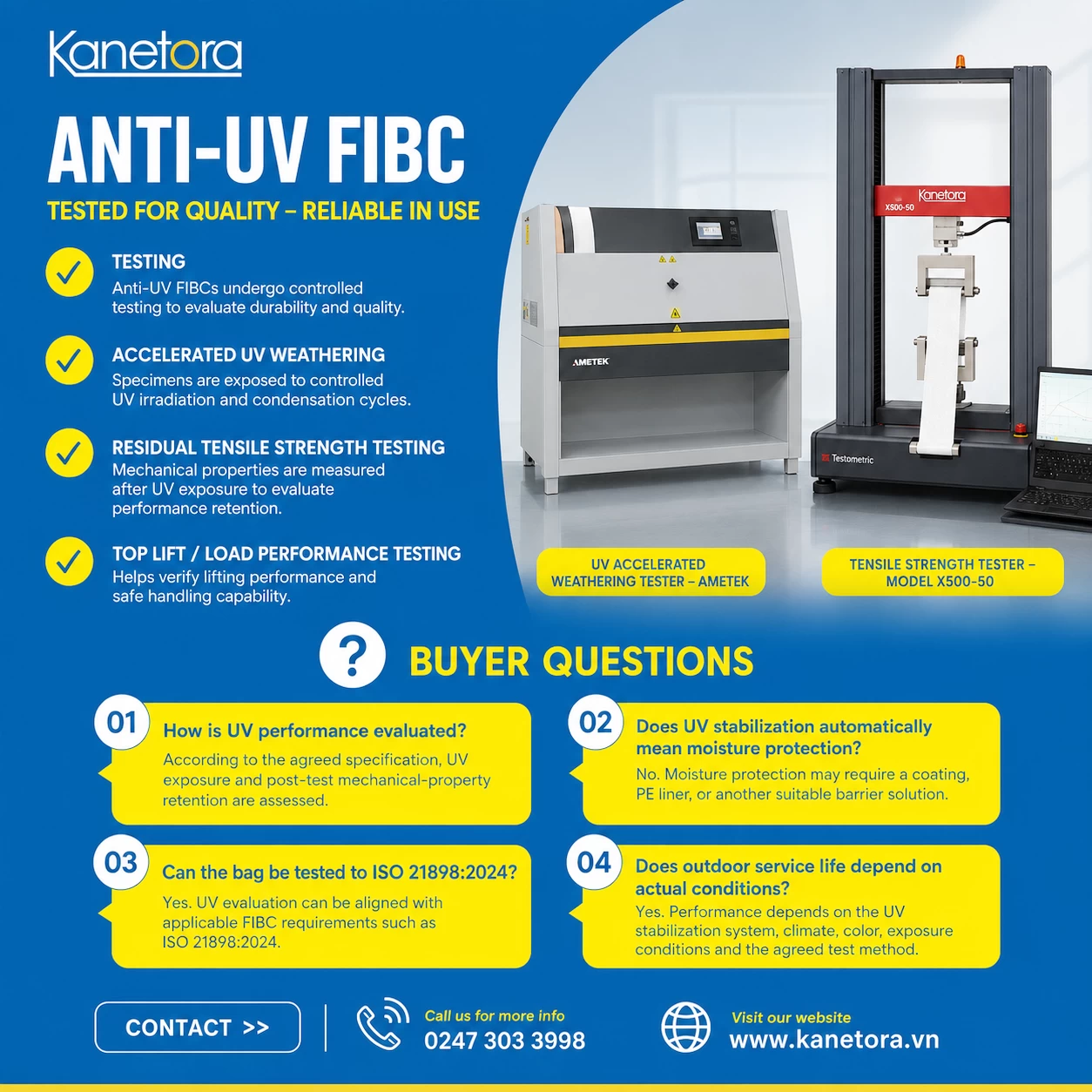
7 Questions Buyers Should Ask an Anti-UV FIBC Supplier
1. Which Components of the FIBC Are UV Stabilized?
Do not evaluate only the body fabric.
Load-bearing components such as lifting loops, webbing and other relevant PP components should also be considered in the overall design.
2. Which UV Test Method Is Used?
If a supplier only states:
“500-hour UV”
or:
“1,000-hour UV”
ask for more information.
A meaningful specification should identify:
- Test standard
- Standard edition
- Exposure cycle
- Temperature conditions
- Total exposure duration
- Acceptance criteria
- Properties measured after exposure
Different accelerated-weathering methods cannot automatically be compared by hours alone.
3. How Is Performance Evaluated After UV Exposure?
A useful test report should provide measurable performance information rather than simply stating:
PASS
For ISO-based evaluation, retained mechanical properties are an important consideration.
4. Does the UV Test Apply to the Actual Fabric Color and Formulation?
Different pigment and additive systems may behave differently.
If the color or formulation changes substantially, the buyer should confirm whether the previous test data remains representative.
5. Is the Bag Designed for General Outdoor Exposure or Long-Term Outdoor Storage?
These are not the same requirement.
A bag containing UV stabilizer should not automatically be marketed as suitable for indefinite or long-term outdoor storage.
6. Does the Cargo Need Coating or an Inner Liner?
UV resistance does not directly solve:
- Moisture ingress
- Powder leakage
- Oxygen exposure
- Contamination
- Electrostatic risk
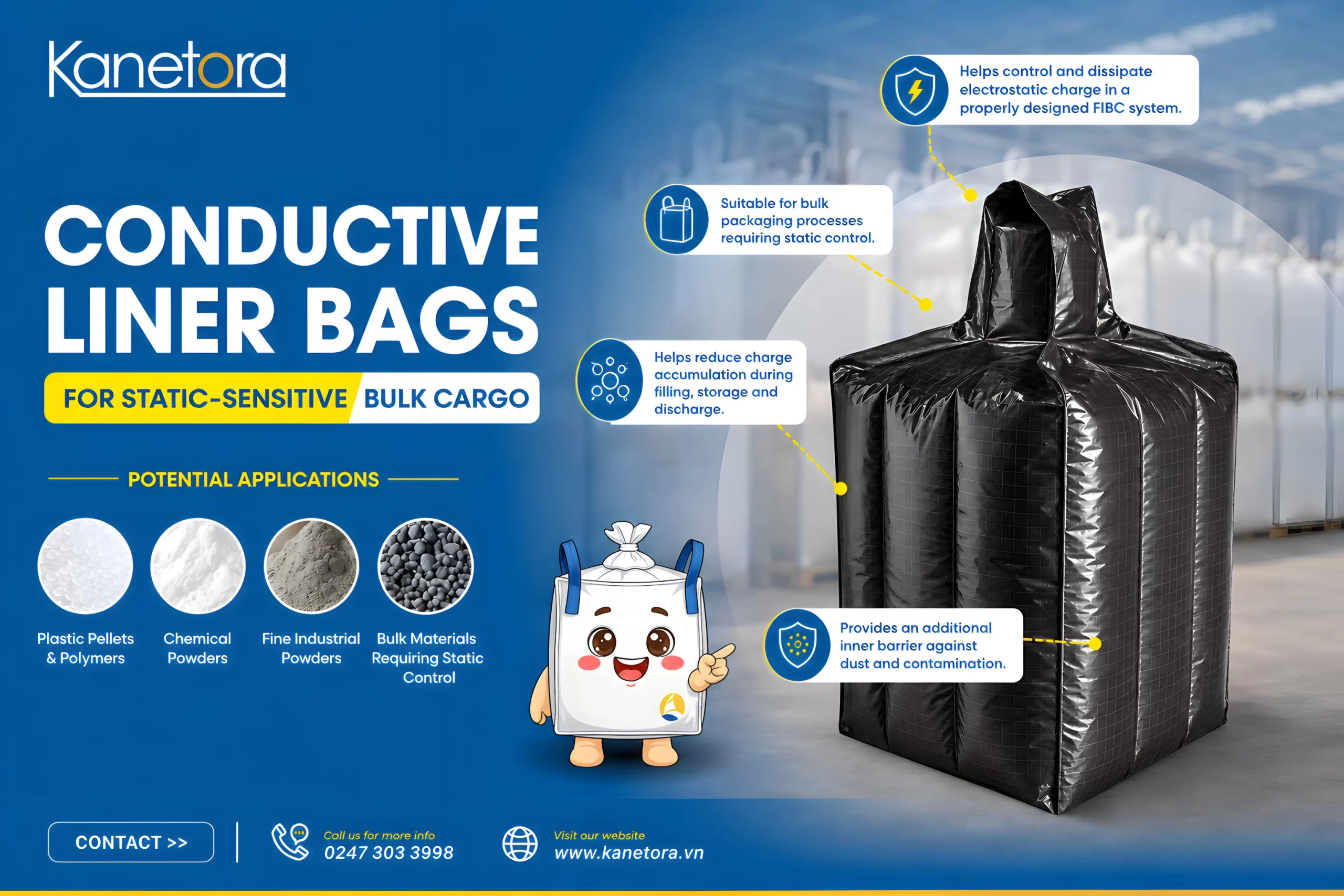
Where static electricity is also a concern, buyers should separately assess the FIBC classification and liner compatibility. See Type C vs Type D FIBC Bags for Export Cargo and Conductive Liner Bags for Static-Sensitive Bulk Cargo.
7. Does the Manufacturer Have Suitable Testing and QC Capability?
International buyers should evaluate the supplier’s ability to control:
- Incoming materials
- Yarn and fabric properties
- Webbing
- Sewing quality
- Tensile strength
- UV resistance
- Top-lift performance
- Liners
- Batch traceability
- Finished-bag inspection
Supplier selection should therefore be based on manufacturing and quality-control capability, not only unit price.
Anti-UV FIBC Manufacturing and Testing at Kanetora Bach Dang
Located in Ninh Binh Province, Vietnam, Kanetora Bach Dang is part of Kanetora’s industrial packaging manufacturing system and has an FIBC production capacity of approximately 300,000 bags per month.
The factory operates an integrated production flow covering:
Extrusion → Webbing Weaving → Fabric Weaving → Lamination → Cutting & Printing → Sewing → Inspection → Packing
In-house and integrated production capabilities help Kanetora control key FIBC components and adapt specifications to customer requirements.
The factory’s FIBC testing capability includes equipment such as:
- UV Accelerated Weathering Tester
- Tensile Strength Tester
- Top Lift Test Machine
- Yarn and webbing testing equipment
- Liner tensile testing equipment
- Liner visual inspection systems
- Puncture-resistance testing
- Coefficient-of-friction testing
- Heat-seal strength testing
This allows Anti-UV FIBC development to follow a performance-oriented process:
Application analysis → bag construction → material formulation → testing → evaluation → final specification
Kanetora can manufacture multiple FIBC configurations, including:
- U-panel FIBCs
- Circular FIBCs
- 4-panel FIBCs
- Baffle bulk bags
- Coated FIBCs
- Uncoated FIBCs
- FIBCs with inner liners
- Food-grade FIBCs
- FIBCs for plastic resin
- FIBCs for minerals and construction materials
- Customized export bulk bags
Buyers requiring customized dimensions, filling and discharge systems, liner structures or special technical specifications can also review Kanetora’s OEM/ODM Jumbo FIBC guide.
Frequently Asked Questions About Anti-UV FIBC Bags
What is an Anti-UV FIBC bag?
An Anti-UV FIBC is a bulk bag manufactured with materials stabilized to improve resistance to degradation caused by ultraviolet radiation and weathering.
Its performance should be evaluated using an appropriate specification and test method rather than additive percentage alone.
How long can a UV-stabilized FIBC stay outdoors?
There is no universal outdoor service life based solely on the amount of UV additive or accelerated-test hours.
Actual exposure performance depends on climate, sunlight intensity, temperature, fabric color, formulation, bag construction and storage conditions.
What does ISO 21898:2024 require for UV testing?
For general-use FIBCs, Annex A specifies alternating UV irradiation and condensation cycles with a total duration of at least 300 hours.
The 2024 edition also provides a procedure that may be applied, with stakeholder agreement, for FIBCs expected or designed for long-term outdoor storage, using a total duration of at least 1,500 hours.
What is the UV-test acceptance criterion?
ISO 21898:2024 requires load-bearing materials to retain at least 50% of their initial force at rupture and elongation at rupture following the specified evaluation.
Does 300 hours of accelerated UV testing equal three months outdoors?
No.
Accelerated-weathering hours should not be converted directly into months or years of natural outdoor exposure.
Geography, radiation level, temperature, moisture, rainfall and other environmental factors can significantly affect real-world ageing.
Are Anti-UV FIBC bags waterproof?
Not automatically.
UV stabilization protects the FIBC material against UV-related ageing. Moisture protection may require coated fabric, a PE liner, a barrier liner, stretch hood film or another suitable packaging layer.
Does every ocean-export FIBC need UV stabilization?
Not necessarily.
If the bags remain indoors and inside closed containers throughout the logistics chain, direct UV exposure may be limited.
However, UV stabilization should be evaluated when bags may spend time outdoors at factories, ICDs, ports, warehouses or customer yards.
Is “UV 500 hours” sufficient information for an RFQ?
No.
The buyer should also specify or request:
- Test method
- Applicable standard
- Standard edition
- Exposure cycle
- Acceptance criteria
- Intended outdoor-use conditions
Can FIBC color affect UV performance?
Yes. Pigment and color systems may interact with the UV stabilization system.
A significant change in fabric color should therefore be reviewed as part of specification approval.
Does an Anti-UV FIBC still need an inner liner?
That depends on the cargo.
UV stabilization protects the bag material against sunlight-related degradation, while an inner liner may be used to provide additional protection against:
- Moisture
- Dust
- Leakage
- Contamination
- Oxygen
- Odor transmission
For additional guidance, see FIBC Bag with Liner: When and Why to Use.
Anti-UV FIBC Is a Performance Requirement, Not Just an Additive
An Anti-UV FIBC should not be defined simply as:
“A jumbo bag with some UV additive.”
For export cargo staged at ports, stored outdoors, used at construction sites or handled through supply chains with significant sunlight exposure, UV resistance is part of both packaging engineering and risk management.
A good Anti-UV FIBC specification should answer four questions:
Where will the bag be exposed to UV?
Under what environmental conditions?
What level of performance is required?
How will that performance be tested and verified?
Instead of selecting FIBCs only by UV-additive percentage or a marketing claim expressed in test hours, buyers should evaluate the complete exposure profile and required mechanical performance.
Where other risks are present, UV stabilization should form part of a broader packaging system incorporating appropriate FIBC liners, baffle designs, static-control solutions or stretch hood film according to the cargo and supply chain.
With integrated FIBC, liner and flexible-film manufacturing capabilities together with dedicated testing equipment, Kanetora Bach Dang in Ninh Binh, Vietnam can support international buyers in developing Anti-UV FIBC specifications according to cargo type, SWL, storage environment, export route and testing requirements.
Looking for Anti-UV FIBC Bags for Outdoor Storage or Export?
To develop a suitable specification, send Kanetora information about:
- Packed product
- Target filling weight
- Required SWL and Safety Factor
- FIBC dimensions
- Bag construction
- Expected outdoor exposure
- Destination country
- Storage conditions
- Transportation method
- Coating requirement
- Liner requirement
- Moisture-protection requirement
- UV test requirement
- Applicable technical standard
Our team can review the application and support the development of an FIBC specification suited to your actual storage and export conditions.
Kanetora Joint Stock Company
Hotline: +84 (0) 247 303 3998
Email: info@kanetora.vn
Website: www.kanetora.vn