

In industrial manufacturing and international trade, product protection does not end when the goods are packed into bags, drums, cartons or containers.
Before reaching the final customer, a pallet may undergo multiple stages of forklift handling, warehouse storage, truck transportation, container loading and long-distance shipping. During this journey, an inadequately secured pallet may experience load shifting, package deformation, dust exposure, water splash or damage to the outer packaging.
Stretch hood film is designed to provide an additional protective and stabilizing layer around palletized cargo. Unlike conventional pallet wrapping, stretch hood uses tubular film that is stretched open and pulled down over the load from above.
The film then recovers toward its original dimensions, creating holding force around the pallet without requiring heat.
This solution is particularly suitable for industrial packaging lines with relatively consistent pallet dimensions, high throughput and demanding requirements for load stability, presentation and transport protection.
Quick Answer: What Is Stretch Hood Film?
Stretch hood film is a highly elastic tubular polyethylene film that is mechanically stretched, opened and applied over an entire pallet load.
Once the stretching force is released, the film contracts around the load and creates containment force across the top and four sides of the pallet.
A properly specified stretch hood system can help:
- Stabilize products and packages on the pallet;
- Cover the top and four sides of the load;
- Limit exposure to dust and water splash;
- Reduce cargo movement during handling and transportation;
- Create a clean and consistent pallet appearance;
- Optimize film consumption when matched correctly to the load;
- Support automated end-of-line packaging operations.
Unlike shrink hood film, stretch hood film does not require a heating process. It relies on the film’s elasticity and recovery force to contain the pallet load. Kanetora has developed commercial stretch hood film using multilayer co-extrusion technology for industrial packaging applications.
How Does Stretch Hood Film Work?
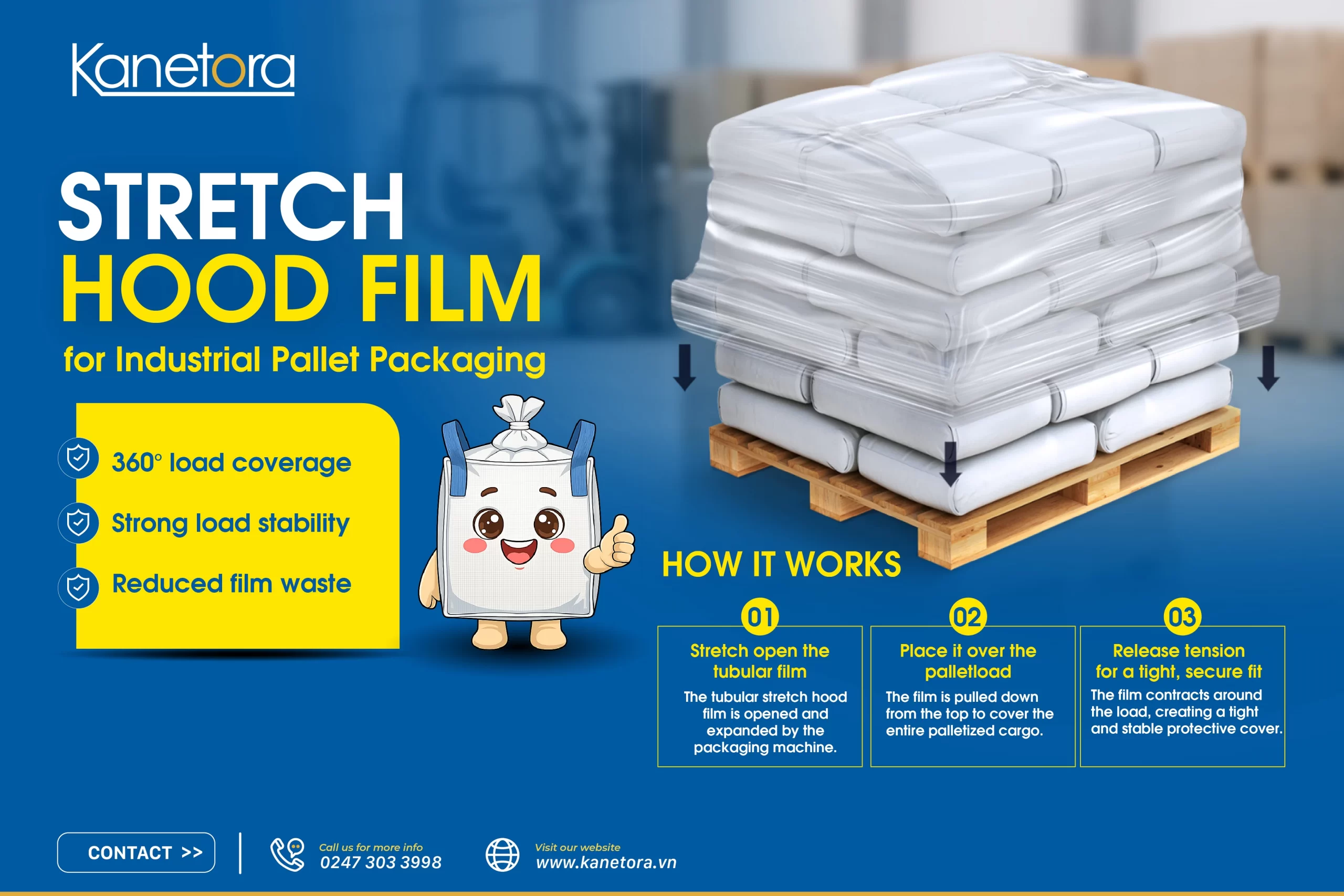
Stretch hood film is typically applied using an automatic or semi-automatic hooding system. Although equipment configurations may vary, the process generally includes three main stages.
1. Opening and stretching the tubular film
Stretch hood film is supplied as a continuous tubular roll.
The packaging machine unwinds the film, cuts it to the required length and seals the upper end to form a closed hood. Mechanical stretching arms then open and expand the film horizontally.
Because the film’s original circumference is normally smaller than the pallet load, it must provide sufficient stretchability without tearing, puncturing or losing its recovery performance.
The relationship between film dimensions, stretch ratio, elasticity and machine settings is therefore critical.
2. Pulling the hood over the pallet load
Once expanded, the hood is moved downward from the top of the pallet.
The sealed upper section covers the top surface, while the film is gradually drawn down along the four sides. Depending on the selected packaging program, the lower section may extend close to or around the base of the pallet.
During this stage, the machine must prevent the film from catching on sharp corners, lifting loops, straps, uneven cartons or protruding components.
3. Releasing the stretching force
When the film reaches the programmed position, the stretching arms release it.
The film attempts to recover toward its original dimensions, creating horizontal containment force around the pallet load. The downward stretching of the film can also help connect the cargo more securely to the pallet base.
This combination helps turn individual bags, boxes or containers into a more stable unit load.
The final performance depends on multiple variables, including:
- Film formulation;
- Number of film layers;
- Film thickness;
- Tubular film dimensions;
- Stretch ratio;
- Recovery force;
- Pallet geometry;
- Load weight;
- Surface condition;
- Machine settings;
- Storage and transport conditions.
For this reason, stretch hood film should be developed according to the actual machine and pallet configuration rather than selected solely by film thickness.
Stretch Hood vs Stretch Wrap: What Is the Difference?
Stretch hood and stretch wrap both use elastic plastic film to stabilize palletized cargo. However, their film structures, application methods and levels of coverage are different.
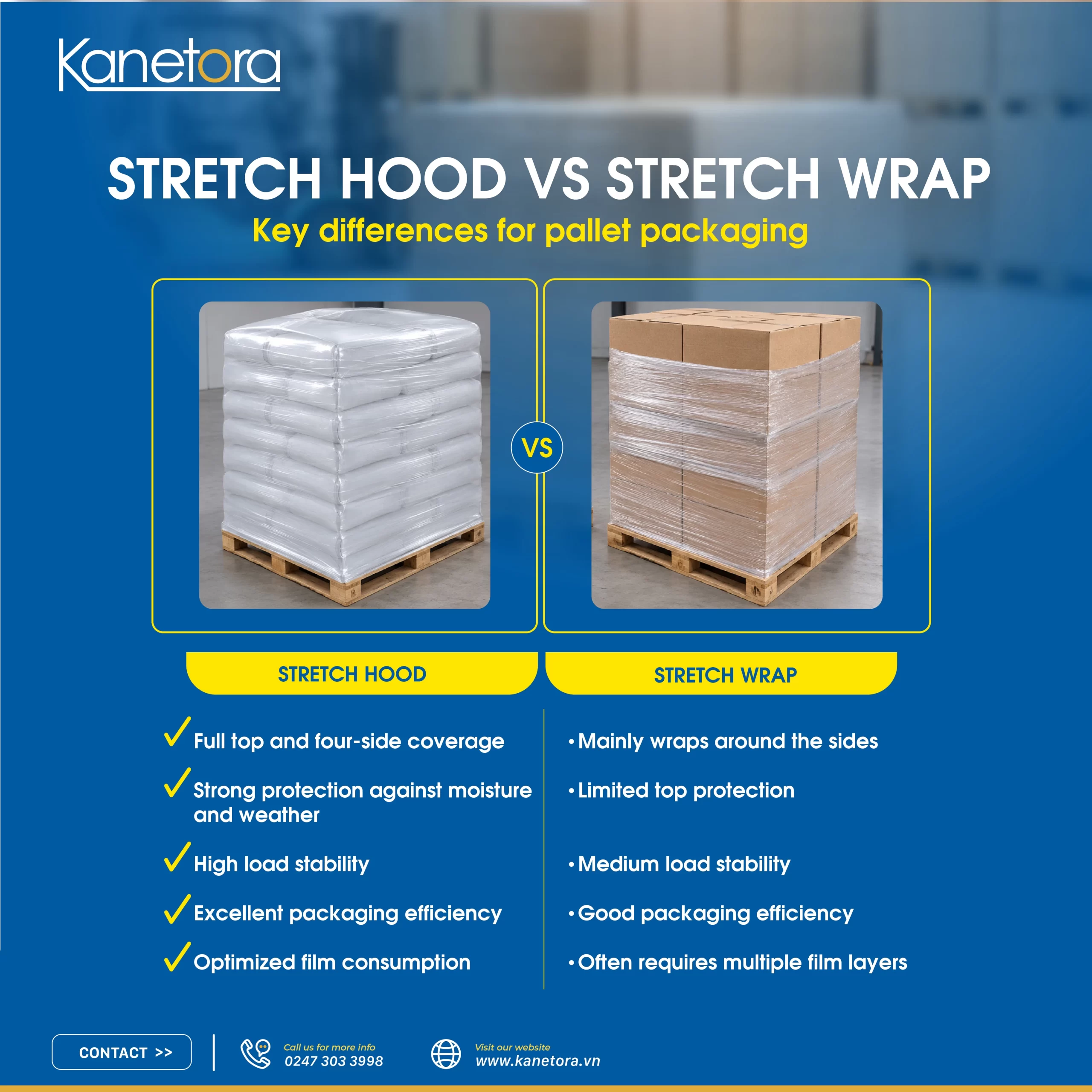
| Comparison criterion | Stretch Hood Film | Stretch Wrap Film |
|---|---|---|
| Film structure | Tubular film | Flat film roll |
| Application method | Stretched open and pulled down over the load | Wrapped repeatedly around the pallet |
| Top coverage | Can fully cover the top | Usually requires a separate top sheet |
| Side coverage | Continuous coverage across four sides | Created through overlapping film layers |
| Heat required | No | No |
| Load containment | Strong when the film, load and machine are properly matched | Depends on film tension, wrapping pattern and number of rotations |
| Film overlap | Limited | Multiple overlapping areas are common |
| Automation level | Primarily used with automatic equipment | Manual, semi-automatic or automatic |
| Pallet-size flexibility | Requires suitable film dimensions and machine programs | More flexible for varying pallet sizes |
| Suitable operations | High-volume, standardized pallet loads | Low- to high-volume operations with more variable loads |
When does stretch hood offer an advantage?
Stretch hood may be more suitable when a company has:
- Large and consistent pallet volumes;
- Standardized load dimensions;
- Automated packaging lines;
- A requirement to cover the top of the pallet;
- Long-distance transportation;
- High expectations for load presentation;
- A need to reduce unnecessary film overlap;
- Repeatable products and packaging specifications.
When is stretch wrap still a practical choice?
Stretch wrap may remain more appropriate when:
- Pallet dimensions change frequently;
- Production volume is relatively low;
- Load shapes are highly irregular;
- Packaging is performed manually;
- The company has not invested in hooding equipment;
- Operational flexibility is more important than high-speed automation.
Stretch hood should therefore not be considered a universal replacement for stretch wrap. The most suitable option depends on pallet volume, equipment investment, load characteristics and total packaging cost.
Stretch Hood vs Stretch Wrap – Key Differences in Pallet Packaging.
Key Benefits of Stretch Hood Film
Coverage across the top and four sides
A key advantage of stretch hood film is its ability to cover both the upper surface and all four sides of a pallet load.
This creates a relatively continuous protective layer that can help limit:
- Dust exposure;
- Water splash;
- Dirt accumulation;
- Surface contamination;
- Direct contact with the surrounding environment;
- Packaging abrasion during handling.
Stretch hood should not automatically be described as completely waterproof. The actual level of protection depends on:
- Top-seal quality;
- Film puncture resistance;
- Coverage at the pallet base;
- Sharp edges on the load;
- Damage during forklift handling;
- Outdoor storage duration;
- Wind and rain exposure;
- Temperature and humidity conditions.
Where cargo is highly moisture-sensitive, stretch hood should be used as one element within a broader moisture-control system rather than as the only protective layer.
Improved pallet load stability
After stretching force is released, the film distributes recovery force around the pallet load.
This can reduce movement between individual bags, cartons, drums or containers and help maintain the overall shape of the load.
Load stability is particularly important for pallets that:
- Include multiple stacked layers;
- Have slippery packaging surfaces;
- Are relatively tall;
- Contain deformable bags;
- Travel by sea container;
- Undergo frequent forklift handling;
- Pass through multiple warehouses or transshipment points.
Stretch hood performance should still be evaluated through practical testing, as excessively low containment force may fail to stabilize the cargo, while excessive force could deform sensitive products.
Cleaner and more consistent presentation
Stretch hood film can create a smooth and uniform outer appearance with fewer visible overlaps than conventional wrapping.
When transparent film is selected, warehouse personnel and customers can still view:
- Product labels;
- Barcodes;
- Batch identification;
- Handling instructions;
- Packaging condition;
- Tampering or external damage.
This can support warehouse control and improve the presentation of export-ready pallet loads.
Easier identification of external interference
If the film is torn, cut or punctured, the damage is often visible during warehouse inspections.
Stretch hood is not a specialized security seal, but it can help operators identify unexpected interference or packaging damage before the pallet is shipped or accepted at its destination.
No heating system required
Stretch hood uses mechanical stretching and film recovery rather than thermal shrinkage.
Eliminating the heating stage may provide several operational advantages:
- No heat tunnel is required;
- No direct heat is applied to the goods;
- Energy consumption associated with shrinking is avoided;
- The risk of heat damage to sensitive packaging is reduced;
- The process can be integrated into automated packaging lines.
Kanetora’s existing stretch hood development is based on highly elastic tubular PE film and a multilayer co-extrusion production system.
Can Stretch Hood Be Integrated with FIBC and Jumbo Bags?
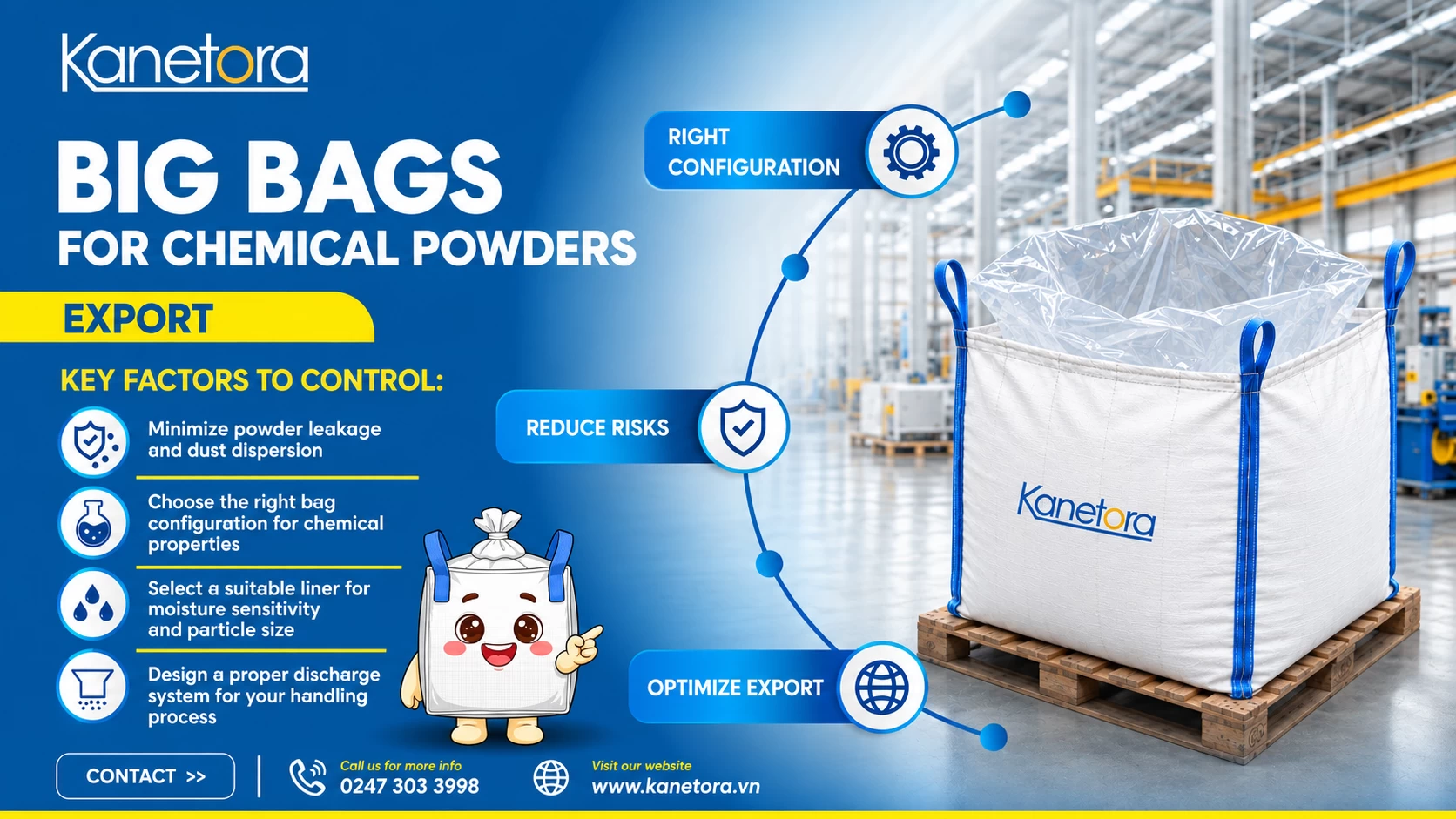
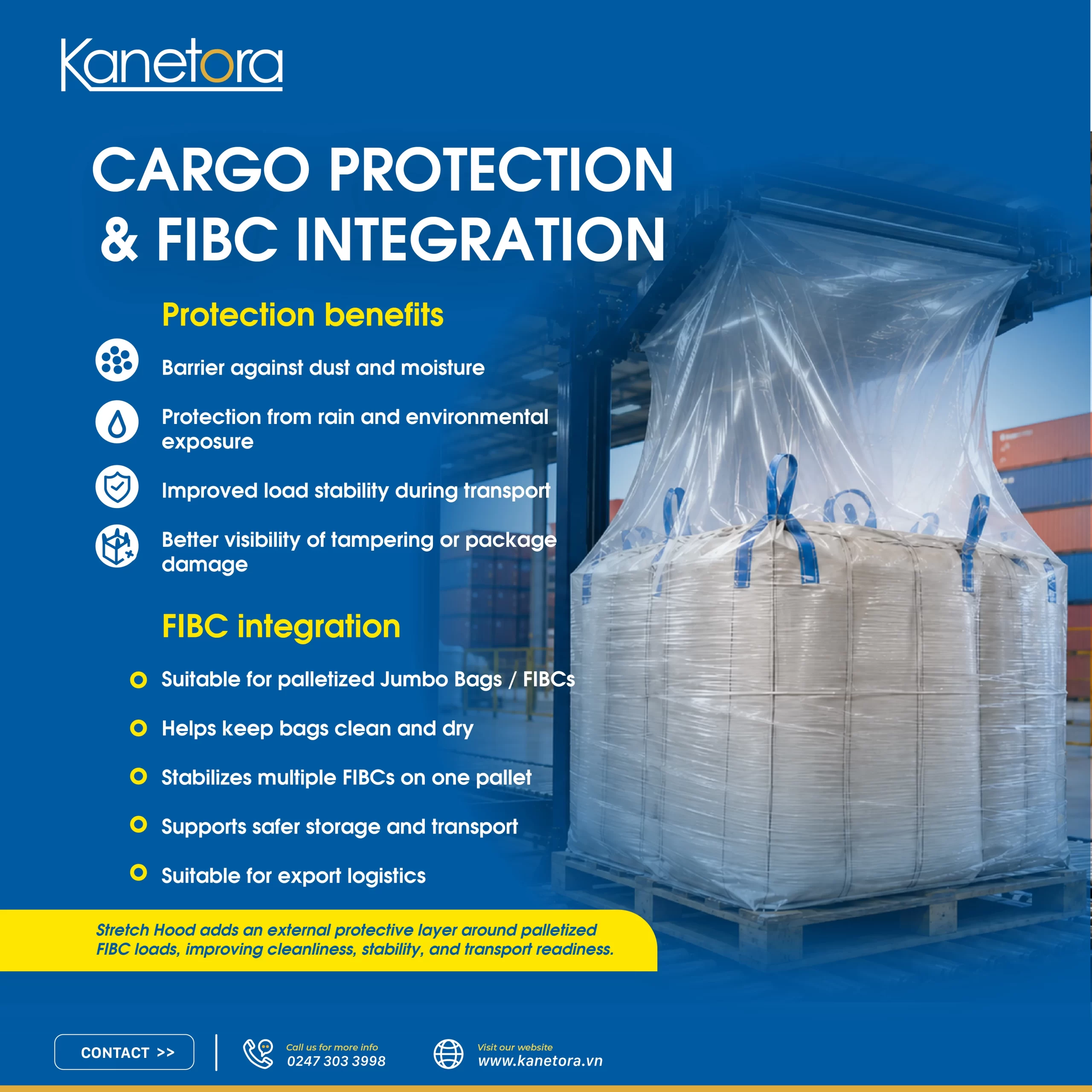
Yes. Stretch hood can be used as an external protective layer for one or more FIBC or jumbo bags placed on a pallet.
However, each element within the packaging system performs a different function:
- The FIBC bag is the primary load-bearing package used to contain, lift and transport bulk products.
- The FIBC inner liner protects the packed product more directly against moisture, contamination, leakage or product loss.
- The pallet provides a stable base for forklift handling.
- The stretch hood film covers and stabilizes the complete external unit load.
Stretch hood does not replace the load-bearing function of an FIBC. It also does not replace a properly selected liner for moisture-sensitive, contamination-sensitive or fine-powder products.
For a deeper explanation of the liner’s function, see What Is an FIBC Liner? The Essential Protection Layer Inside Jumbo Bags. An FIBC liner acts as an additional layer inside the jumbo bag and may help protect the product during storage and transportation.
Stretch hood may be considered for:
- A single large FIBC placed on a pallet;
- Multiple smaller FIBCs arranged on one pallet;
- FIBC bags that need to remain clean during warehousing;
- Export cargo requiring additional external protection;
- Pallets passing through several logistics stages;
- Applications requiring lifting loops to remain grouped and protected;
- Pallet loads exposed to dust or occasional water splash.
With free-flowing products, bag bulging may reduce pallet stability and loading efficiency. In these cases, a baffle bulk bag can help maintain a more square shape before the pallet is covered with stretch hood film.
A practical trial should be conducted before full production. Lifting loops, filling spouts, discharge spouts and protruding seams must be assessed to ensure that they do not puncture or interfere with the film during application.
Cargo Protection and Integration with FIBC Bags.
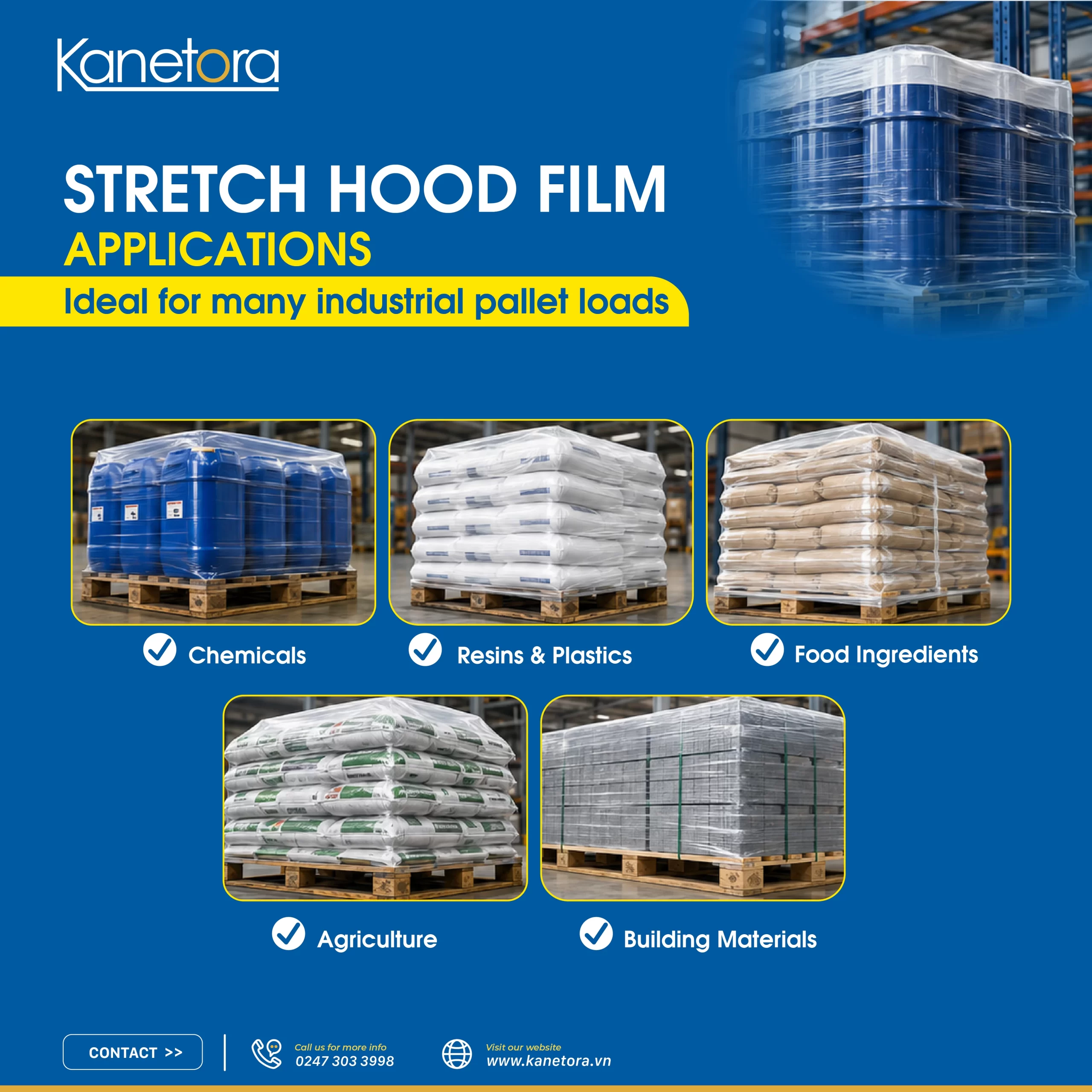
Industrial Applications of Stretch Hood Film
Plastic resin and polymer materials
PP, PE, PET, compounds and other polymer materials are commonly transported in stacked bags or FIBCs.
Because plastic packaging surfaces can be relatively smooth, bags may move during:
- Vehicle braking;
- Cornering;
- Forklift handling;
- Container transport;
- Repeated warehouse movement.
Stretch hood film can help connect individual bags into a more stable pallet load while reducing exposure to dust and water splash.
For an integrated resin-packaging approach, see Bulk Bags for Plastic Resin Export: Safe Packaging for PP, PE & PET. The appropriate solution may combine an FIBC, liner, coating, discharge structure and pallet-protection method depending on the resin and logistics route.
Chemicals and industrial materials
Stretch hood can be used around pallets containing:
- Chemical bags;
- Industrial drums;
- Jerry cans;
- Plastic containers;
- Mineral products;
- Additives and compounds.
However, stretch hood does not replace technical requirements related to:
- Chemical compatibility;
- Dangerous-goods classification;
- UN-certified packaging;
- Leakage containment;
- Hazard labels;
- Electrostatic protection;
- Transport regulations;
- Product-specific handling instructions.
Where combustible dust, flammable gas or vapor may be present, the electrostatic classification of the FIBC and liner must be assessed separately.
Kanetora’s article on Type C vs Type D FIBC Bags for Export Cargo explains how Type C bags rely on grounding, while Type D bags use specialized static-protective fabric without a grounding connection.
Food ingredients and agricultural products
Stretch hood film can provide an external transport layer around pallets containing:
- Flour;
- Starch;
- Sugar;
- Salt;
- Grains;
- Seeds;
- Animal-feed ingredients;
- Dairy powders;
- Food additives;
- Processed agricultural materials.
However, stretch hood is generally not the primary packaging in direct contact with the product.
Food-grade requirements must still be controlled through:
- The primary FIBC or bag;
- Food-contact raw materials;
- Inner-liner selection;
- Production hygiene;
- Foreign-material control;
- Traceability;
- Inspection and packing conditions.
For detailed selection guidance, see Food Grade FIBC Bags for Export Food & Agriculture Products.
Agricultural inputs
Stretch hood may also be used around palletized:
- Fertilizer bags;
- Animal feed;
- Seeds;
- Agricultural additives;
- Grains;
- Processed crops.
The film helps keep the pallet organized and can limit surface contamination during intermediate handling.
For products that are sensitive to humidity, a suitable inner liner, coating or barrier structure should be used. The external stretch hood layer alone should not be treated as the complete moisture-protection system.
Cement and construction materials
Cement, dry mortar, calcium carbonate, gypsum, mineral powder, tiles, bricks and other construction products often create heavy pallet loads.
Stretch hood film can support these applications by helping to:
- Stabilize stacked bags;
- Limit external dust contamination;
- Improve pallet presentation;
- Reduce load movement;
- Protect the outer packaging during transportation;
- Support warehouse and container handling.
Construction-material exporters may also combine FIBCs, PE liners and stretch hood film as part of an integrated export-packaging system. More information is available in FIBC Bags for Cement & Construction Materials.
When Should a Company Consider Stretch Hood Film?
Stretch hood film is generally worth evaluating when a company has:
- High and repeatable pallet volume;
- Standardized pallet dimensions;
- Automated end-of-line packaging;
- Long-distance transportation requirements;
- Cargo that undergoes repeated forklift handling;
- A need to cover the pallet top;
- Strict pallet-presentation requirements;
- A target to control film consumption per load;
- FIBC, valve-bag, paper-bag or carton packaging;
- The ability to perform industrial trials before final approval.
Stretch hood may be less suitable when:
- Pallet dimensions change continuously;
- Production volumes are very low;
- Loads are extremely irregular;
- Products contain many sharp edges;
- Protruding components cannot be controlled;
- Manual packaging flexibility is required;
- Appropriate hooding equipment is unavailable.
The decision should consider the complete packaging operation rather than only the film price.
Information Required to Develop the Right Stretch Hood Film
Stretch hood film should not be specified only by width and thickness.
The manufacturer needs to understand the complete packaging system, machine configuration and logistics environment.
Pallet and load dimensions
Provide:
- Pallet length;
- Pallet width;
- Minimum load height;
- Maximum load height;
- Load circumference;
- Dimensional variation between pallets;
- Required coverage at the pallet base;
- Actual load photographs or drawings.
Total load weight and stacking pattern
Important information includes:
- Total pallet weight;
- Number of product layers;
- Number of bags, cartons or containers per layer;
- Interlocking or column stacking pattern;
- Product bulk density;
- Possibility of settling after packing;
- Package deformation;
- Friction between individual layers.
Surface and structural characteristics
Identify whether the pallet load includes:
- Sharp corners;
- Metal components;
- Lifting loops;
- Tensioning straps;
- Protruding labels;
- Filling spouts;
- Uneven upper surfaces;
- Dust, oil or moisture;
- Large gaps between packages.
Stretch hood machine information
Film performance is closely related to the machine being used.
Provide:
- Machine manufacturer;
- Machine model;
- Tubular-film width;
- Roll dimensions;
- Core dimensions;
- Stretching-arm configuration;
- Programmed stretch ratio;
- Packaging speed;
- Cutting method;
- Sealing system;
- Hooding sequence;
- Operating temperature.
Storage and transportation conditions
The packaging supplier should also understand:
- Domestic or international transportation;
- Road, rail or sea transport;
- Expected journey duration;
- Number of handling cycles;
- Indoor or outdoor storage;
- Temperature range;
- Relative humidity;
- UV exposure;
- Water-splash risk;
- Container-loading method;
- Destination-market requirements.
What Should Be Evaluated During a Stretch Hood Trial?
Before approving commercial production, the film should be tested on the customer’s actual machine and representative pallet loads.
A practical trial should evaluate:
- Film unwinding performance;
- Opening of the tubular film;
- Stability of the top seal;
- Stretchability without tearing;
- Film behavior on the stretching arms;
- Coverage of the pallet top;
- Coverage at the pallet base;
- Containment force around the load;
- Puncture resistance at corners and edges;
- Load stability after forklift movement;
- Film recovery over time;
- Pallet condition after storage;
- Pallet condition after transportation;
- Ease of film removal;
- Film collection and disposal procedures.
A successful result on one pallet is not sufficient to approve an entire product range.
Trials should include:
- The smallest pallet;
- The largest pallet;
- The lightest load;
- The heaviest load;
- The tallest configuration;
- The most irregular configuration;
- The most demanding transport condition.
Stretch Hood Film and Sustainable Packaging
The sustainability of stretch hood film should not be assessed solely by asking whether the film is recyclable.
A broader evaluation should include:
- Film weight per pallet;
- Reduction in damaged cargo;
- Avoided product loss;
- Energy consumed by the packaging process;
- Mono-material or multi-material structure;
- Type and quantity of additives;
- Printing requirements;
- Recycled-content potential;
- Film collection after use;
- Local recycling infrastructure;
- Material traceability;
- Packaging performance over the complete logistics journey.
A thicker film is not automatically more sustainable if it uses unnecessary material. Conversely, reducing film thickness without maintaining puncture resistance or load stability may increase cargo damage and total environmental impact.
For further analysis, see Sustainable Industrial Packaging Trends in 2026, which discusses ESG requirements, recycling and export-oriented industrial packaging.
Companies exporting goods to the European Union should also review the implications of the Packaging and Packaging Waste Regulation.
Kanetora’s update, EU PPWR Applies from August 2026: What FIBC, Liners and Plastic Film Suppliers Need to Prepare, outlines relevant considerations concerning material composition, recyclability, packaging reduction, recycled content and supporting technical records.
Stretch Hood Film Manufacturing Capability at Kanetora Packaging
Kanetora Packaging develops stretch hood film as part of a broader industrial-packaging portfolio that includes:
- Jumbo bags and FIBCs;
- Sling bags;
- Block-bottom valve bags;
- FIBC inner liners;
- Multilayer PE films;
- Stretch hood film;
- Pallet covers;
- Customized industrial-film solutions.
Kanetora Packaging currently operates two packaging factories in Northern Vietnam. The Kanetora Bach Dang factory in Ninh Binh has listed production capacities of approximately:
- 300,000 FIBC bags per month;
- 10 million block-bottom valve bags per month;
- 500 tons of multilayer plastic film per month.
The factory also holds certifications including BRC Grade A, ISO 9001:2015, ISO 14001:2015 and ISO 22000:2018.
Kanetora’s packaging documentation identifies stretch hood film as one of the applications of its multilayer-film production capability, alongside FIBC liners and other industrial films.
The existing stretch hood development has included commercial production on a five-layer co-extrusion blown-film line, testing and material optimization. The targeted performance includes consistent elasticity, recovery, thickness control and puncture resistance.
This integrated manufacturing structure allows Kanetora to approach pallet packaging as a complete system:
- Analyze the packed product;
- Select the appropriate primary FIBC or bag;
- Evaluate liner requirements;
- Assess pallet dimensions and load stability;
- Develop the stretch hood film structure;
- Match the film to the hooding machine;
- Perform practical trials;
- Evaluate transportation conditions;
- Finalize the technical specification.
Additional information about the company’s packaging capabilities is available on the Kanetora Packaging page.
Readers can also review the earlier product-development update: Stretch Hood Film – Expanding Industrial Packaging Capabilities at Kanetora Packaging.
Why Stretch Hood Should Be Evaluated as a Packaging Solution, Not Only as Film
The lowest film price per kilogram does not necessarily result in the lowest packaging cost.
Companies should also evaluate:
- Film consumption per pallet;
- Machine speed;
- Film-break frequency;
- Pallet rejection rate;
- Production downtime;
- Labour requirements;
- Packaging consistency;
- Load instability;
- Cargo-damage rate;
- Film waste;
- Customer claims;
- Repacking cost;
- Logistics delays.
A low-cost film that repeatedly tears, punctures or causes machine stoppages can create significantly higher operational costs.
In contrast, a film properly matched to the equipment and pallet load may improve the total packaging process even when its price per kilogram is higher.
The commercial evaluation should therefore be based on total cost per successfully packed and delivered pallet, not only the film purchase price.
Conclusion
Stretch hood film is an elastic tubular-film solution designed to protect and stabilize industrial pallet loads without requiring heat.
By covering the top and four sides of the pallet, the film can provide additional protection against dust and water splash while creating containment force around the load.
Compared with stretch wrap, stretch hood can offer advantages in:
- Top coverage;
- Pallet appearance;
- Load containment;
- Automated packaging;
- Reduction of overlapping film layers;
- High-volume standardized operations.
However, successful application depends on the compatibility between:
- Film formulation;
- Tubular-film dimensions;
- Stretch hood machine;
- Pallet dimensions;
- Cargo geometry;
- Load weight;
- Packaging surface;
- Storage conditions;
- Transportation route.
Companies should therefore verify performance through practical industrial trials rather than selecting stretch hood film solely by thickness or price.
With manufacturing capabilities covering FIBCs, inner liners and multilayer PE films in Vietnam, Kanetora Packaging can support customers from primary bulk packaging to complete pallet-load protection.
Request a Stretch Hood Film Consultation
To develop a suitable stretch hood film specification, businesses should provide:
- Pallet dimensions;
- Minimum and maximum load height;
- Total load weight;
- Photographs of the stacking pattern;
- Primary packaging type;
- Stretch hood machine manufacturer and model;
- Packaging speed;
- Storage environment;
- Transportation method;
- UV-resistance requirements;
- Transparency or color requirements;
- Recycled-content requirements;
- Destination market.
Kanetora Packaging
Hotline: +84 (0) 247 303 3998
Email: info@kanetora.vn
Website: www.kanetora.vn
Frequently Asked Questions About Stretch Hood Film
What material is stretch hood film made from?
Stretch hood film is normally produced from polyethylene materials selected for elasticity, stretchability and recovery performance. Its formulation may use multiple co-extruded layers and specialized additives depending on puncture resistance, transparency, friction and machine requirements.
Does stretch hood film require heat?
No. Stretch hood film is mechanically stretched before being applied over the pallet. It then uses elastic recovery to contain the load without a heating process.
Is stretch hood film completely waterproof?
It should not automatically be considered completely waterproof. It can help limit exposure to water splash, but performance depends on top-seal integrity, film condition, coverage at the pallet base and actual storage conditions.
Can stretch hood replace stretch wrap?
It can replace stretch wrap in some high-volume operations with standardized pallet dimensions and suitable machinery. Stretch wrap may remain more practical for low-volume or highly variable pallet loads.
Can stretch hood be used with FIBC bags?
Yes. Stretch hood can be applied over one or more FIBC bags placed on a pallet. A practical trial is required to ensure that lifting loops, seams and filling spouts do not puncture the film.
Can stretch hood replace an FIBC inner liner?
No. The inner liner protects the product inside the FIBC, while stretch hood protects and stabilizes the external pallet load. They perform different functions.
Is stretch hood suitable for food products?
It can be used as an external transport-packaging layer around palletized food ingredients. Food-contact requirements for the primary bag and liner must still be evaluated separately.
What information is needed for a quotation?
Buyers should provide pallet dimensions, load height, total weight, product type, stacking pattern, machine model, roll requirements, storage conditions, transport route and any special technical requirements.
Can stretch hood film contain recycled material?
Potential recycled content depends on performance requirements, film structure, applicable regulations and the quality of the recycled raw material. The final formulation should be validated through machine and pallet testing.
Why is a machine trial necessary?
Stretch hood performance depends on the interaction between the film, stretching system, sealing unit, pallet dimensions and cargo surface. A trial confirms whether the film can run reliably and maintain the required load stability.