

In international agricultural supply chains, packaging plays an important role in protecting product quality, improving handling efficiency, optimizing logistics costs and meeting importers’ requirements.
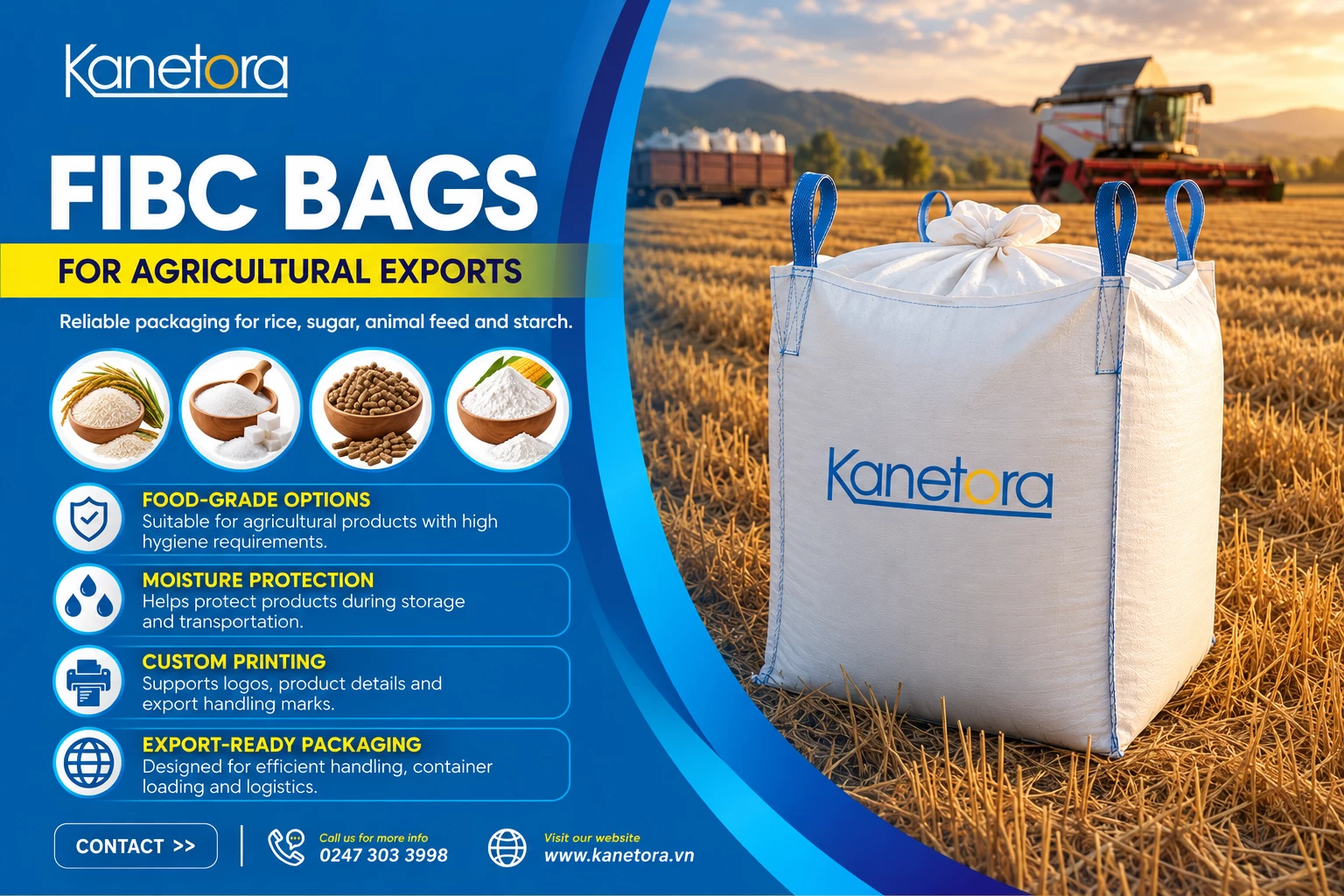
For bulk commodities such as rice, sugar, animal feed and starch, selecting the right FIBC bags for agricultural exports is an essential part of preparing products for international shipment.
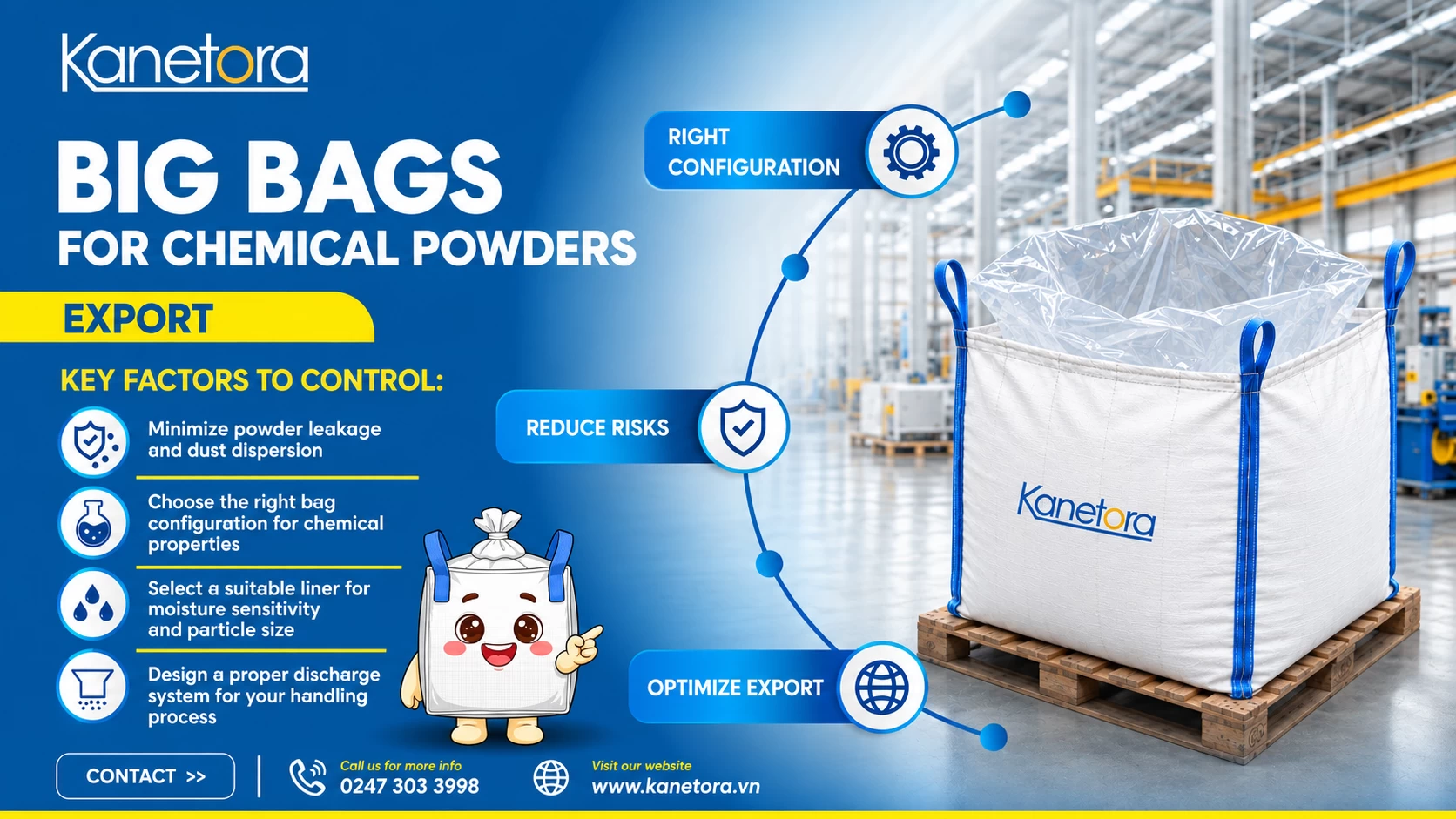
Flexible Intermediate Bulk Containers (FIBCs), commonly known as jumbo bags or bulk bags, are flexible industrial containers primarily manufactured from woven polypropylene (PP). Depending on the characteristics of the product, they can be customized with protective coatings, polyethylene (PE) liners, food-grade construction, internal baffles and various filling and discharge configurations.
However, no single FIBC design is suitable for every agricultural commodity.
Rice packaging requires careful attention to hygiene and storage conditions. Sugar is particularly sensitive to moisture. Animal feed ingredients vary widely in particle size and handling requirements, while starch demands effective dust control and moisture protection.
This guide explains the key technical considerations and recommended FIBC configurations for these four major agricultural product categories.
For a broader understanding of food-contact packaging requirements, explore Kanetora’s guide to food-grade FIBC bags for food and agricultural products.
1. What Are the Key Requirements for Agricultural Export FIBC Bags?
FIBC bags for agricultural exports should be selected according to the product’s physical characteristics, filling weight, storage environment, handling procedures and destination-market requirements.
Beyond load-bearing capacity, five factors deserve particular attention.
1.1. Food-Grade Materials and Product Safety
For rice, sugar, food-grade starch and other products that come into direct contact with packaging materials, hygiene and material suitability are essential considerations.
A food-grade FIBC is not simply a white jumbo bag or a container manufactured from virgin polypropylene.
Food-contact suitability depends on several factors, including the composition of the materials, additives, liners, production environment, contamination-control procedures and supporting quality documentation.
Depending on the destination market and intended application, buyers may request documentation related to:
-
ISO 22000 food safety management systems.
-
BRCGS Packaging Materials certification.
-
European Union food-contact material regulations.
-
Applicable US FDA requirements for food-contact polymers.
-
Material traceability and relevant testing reports.
Importers should review the scope of each certificate or test report to ensure that it applies to the actual packaging material and intended use.
For further information, read our article on food-grade jumbo bags, hygiene requirements and contamination control.
1.2. Moisture Protection
Moisture exposure is a significant concern for agricultural commodities during storage and international transportation.
During ocean freight, cargo may experience temperature fluctuations, humidity changes and condensation inside shipping containers.
If the packaging system is not suitable, products may absorb moisture, form lumps or deteriorate in quality.
Depending on product sensitivity, exporters may consider:
-
Coated polypropylene fabric.
-
Polyethylene inner liners.
-
Multilayer barrier liners.
-
Additional protective measures for pallets and containers.
It is important to understand that a coated FIBC or a standard PE liner does not automatically provide complete waterproof protection.
Performance also depends on the closure design, seams, discharge outlet, liner sealing method and overall storage conditions.
1.3. Load Capacity and Mechanical Strength
FIBCs are designed and tested according to their Safe Working Load (SWL), which represents the maximum load permitted under specified operating conditions.
Commonly requested capacities include 500 kg, 1,000 kg, 1,500 kg and 2,000 kg, depending on the application.
In addition to SWL, buyers should consider the Safety Factor (SF), lifting-loop construction, filling characteristics and intended handling procedures.
The correct bag should be selected based on the complete operating conditions rather than nominal filling weight alone.
1.4. Filling and Discharge Configurations
Efficient bulk packaging must be compatible with both the exporter’s filling equipment and the end user’s discharge system.
Common options include:
Filling Spout: A tubular inlet designed for controlled filling and connection to suitable filling equipment.
Duffle Top: A wide skirt-style opening that can be tied or closed after filling.
Flat Bottom: A closed base for applications where discharge through a bottom outlet is not required.
Discharge Spout: A tubular outlet designed to facilitate controlled material discharge.
Baffle Construction: Internal panels that help maintain the bag’s shape after filling.
The final configuration should reflect the product’s flowability and the operating requirements of the customer’s facility.
1.5. Traceability and Export Labeling
Printing and labeling on FIBC bags support product identification, warehouse management and shipment traceability.
Depending on customer and market requirements, the packaging may carry product information, batch identification, handling instructions and manufacturer details.
Exporters should confirm all mandatory labeling requirements with their importers before approving the final artwork.
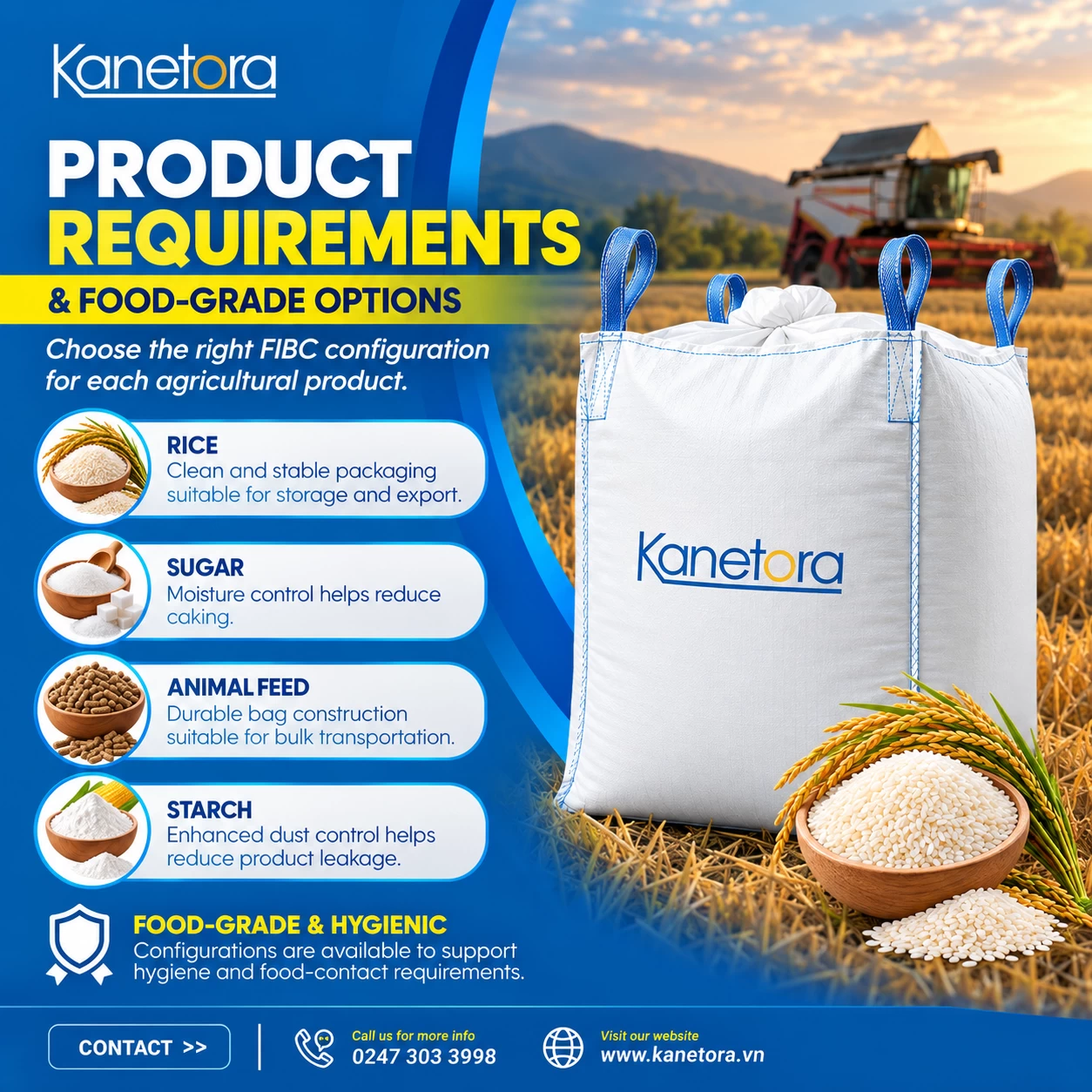
2. FIBC Bags for Rice Exports: Hygiene and Storage Protection
Rice is traded internationally in large quantities and requires careful handling throughout storage and transportation.
While smaller PP woven sacks remain common, FIBC bags can be an efficient alternative for bulk rice shipments destined for industrial processors, repacking facilities or large-volume buyers.
Key Packaging Considerations for Rice
Rice quality can be affected by excessive moisture, contamination and unsuitable storage conditions.
When selecting FIBC packaging, exporters should prioritize material cleanliness, product protection and food-contact suitability.
Bag dimensions should also be determined according to the required filling weight and the actual bulk density of the rice variety.
Recommended FIBC Configuration for Rice
| Specification | Recommended Option |
|---|---|
| Fabric | Suitable woven PP |
| Hygiene requirements | Food-grade construction for direct food contact |
| Bag construction | U-Panel, Circular or 4-Panel |
| Filling option | Filling Spout or Duffle Top |
| Discharge option | Flat Bottom or Discharge Spout |
| Inner liner | PE liner where additional protection is required |
| Printing | Logo, batch details, weight and customer-specific information |
Do Rice FIBC Bags Require PE Liners?
Not every rice shipment requires an inner liner.
However, PE liners should be considered when additional protection against dust, moisture exposure or environmental contamination is necessary.
A PE liner provides an additional layer between the rice and the outer woven fabric.
Depending on the design, liners may be secured using fixing tabs, flanges or other configurations compatible with the filling and discharge systems.
For a detailed explanation of available options, explore our guide to FIBC bags with inner liners and their applications.
For long-distance ocean shipments, liner selection should also be supported by appropriate grain moisture control, clean container conditions and suitable storage practices.
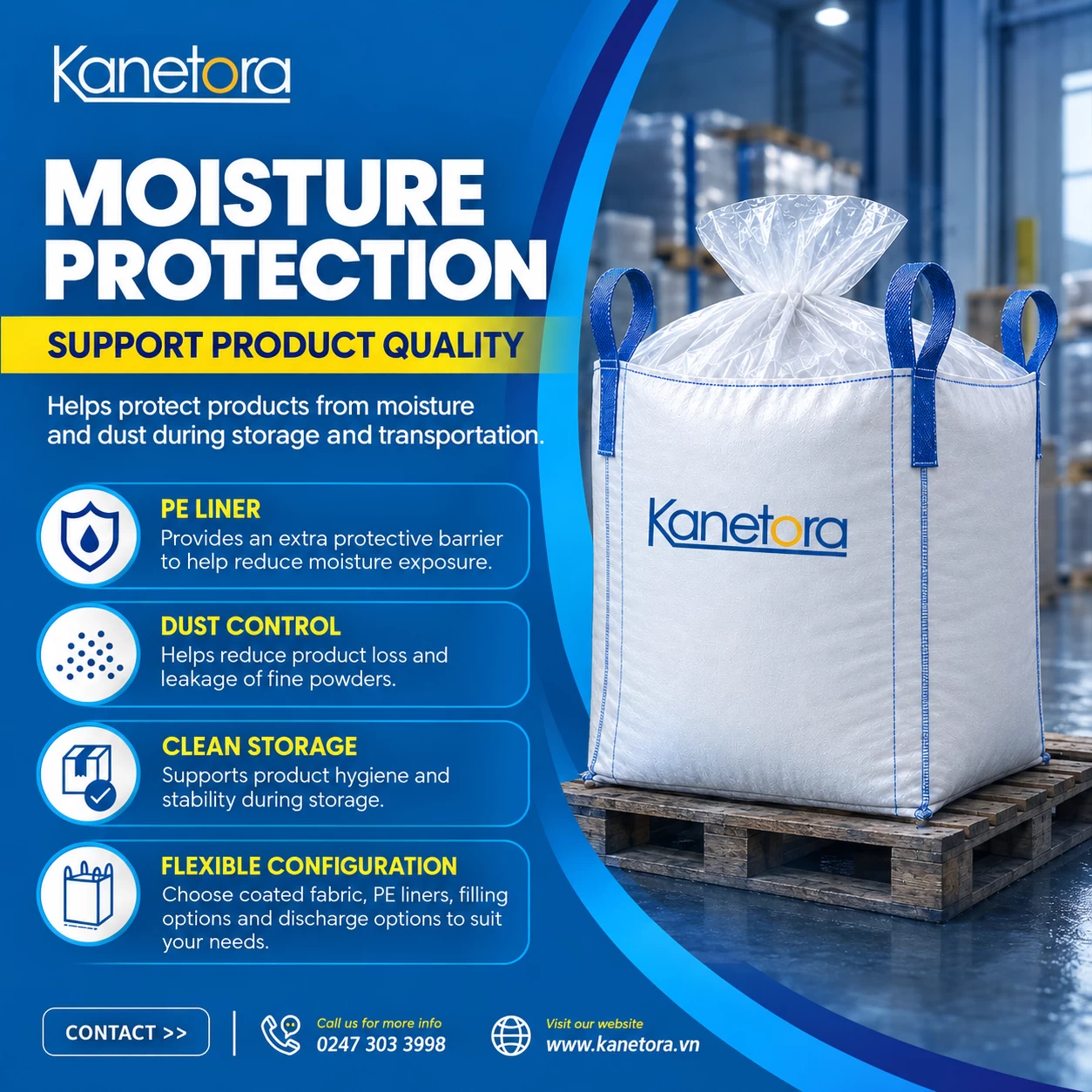
3. FIBC Bags for Sugar Exports: Improving Moisture Protection
Sugar is particularly sensitive to humidity.
Under unsuitable environmental conditions, sugar may absorb moisture, become compacted or form lumps, potentially affecting handling efficiency and product quality.
For this reason, moisture protection should be a major consideration when selecting FIBC bags for bulk sugar exports.
Important Features of Sugar Bulk Bags
Food-Contact Safety
Packaging materials that come into direct contact with sugar should be suitable for the intended food-contact application.
Moisture Protection
The packaging system should be evaluated according to storage duration, humidity exposure and transportation conditions.
Dust and Contamination Control
Filling openings, seams, discharge outlets and liner closures should be designed to minimize unwanted material ingress or leakage.
Handling Efficiency
The selected FIBC should be compatible with the customer’s filling, lifting and discharge equipment.
Coated FIBC or PE Liner: Which Is Better for Sugar?
Coated polypropylene fabric reduces the permeability of the woven surface and can help limit dust leakage and moisture exposure.
A PE liner provides an additional internal protective layer.
Where higher moisture-barrier performance is required, multilayer barrier liners may be considered according to the desired protection level.
For many applications, a food-grade FIBC with a suitable PE liner and properly designed filling and discharge closures can be an effective packaging option.
However, the complete packaging design must be evaluated to ensure that the intended protection is achieved.
Kanetora also offers different liner configurations, including standard PE liners, reinforced liners and multilayer barrier solutions for specialized packaging applications.
4. Jumbo Bags for Animal Feed: Balancing Cost and Handling Efficiency
The animal feed industry handles a wide range of ingredients, including corn, bran, soybean meal, plant proteins, feed additives and blended products.
These materials differ in particle size, bulk density, moisture sensitivity and flow characteristics.
Therefore, selecting an animal feed FIBC requires more than choosing a standard filling capacity.
Selecting FIBCs According to Feed Characteristics
Dry Granular Ingredients
Standard woven PP FIBCs may be suitable for certain dry granular materials when they meet the required strength and quality specifications.
Fine Powder Ingredients
For powdered feed materials, attention should be given to dust leakage through the fabric, seams and filling or discharge openings.
Coated fabric or PE liners may provide additional protection depending on the application.
Moisture-Sensitive Ingredients
Feed materials that absorb moisture may require protective liners and more carefully controlled storage conditions.
Ingredients with Higher Hygiene Requirements
For applications requiring stricter hygiene controls, packaging materials and production processes should be assessed against the applicable feed safety requirements.
When Should Animal Feed Exporters Consider UV-Resistant FIBCs?
Animal feed ingredients may occasionally be stored in staging areas, ports or warehouses where packaging is exposed to sunlight.
Prolonged ultraviolet exposure can affect the mechanical properties of polypropylene, potentially reducing fabric and lifting-component strength.
Where outdoor exposure is anticipated, UV-resistant FIBC materials should be considered.
However, UV resistance does not automatically mean waterproof or moisture-proof performance.
Additional measures may be required for moisture-sensitive cargo.
Learn more about UV-resistant FIBC bags for outdoor storage and international shipping.
5. FIBC Bags for Starch: Dust Control, Moisture Protection and Hygiene
Tapioca starch, corn starch and other agricultural starch products are typically handled as fine powders.
Their physical characteristics create different packaging challenges compared with larger granular commodities.
Fine starch particles may generate dust during filling and discharge, while moisture exposure can cause lump formation or changes in product flowability.
Key Packaging Challenges
Dust Leakage
Fine particles may escape through unsuitable fabric constructions, seams or openings.
Moisture Sensitivity
Moisture exposure should be controlled, particularly during long-term storage and ocean transportation.
Food-Contact Hygiene
Starch intended for food applications requires packaging materials suitable for the applicable food-contact requirements.
Discharge Efficiency
The outlet design should be compatible with the powder’s flow characteristics and the receiving equipment.
Recommended FIBC Configuration for Starch
A commonly considered solution is a food-grade FIBC with a PE inner liner, filling spout and discharge spout.
The liner provides an additional barrier against external dust and moisture exposure.
The filling spout can be connected to suitable loading equipment, while the discharge spout supports more controlled emptying.
For particularly fine powders or specialized filling systems, the risks associated with electrostatic charge generation and combustible dust atmospheres may also need to be evaluated.
Where electrostatic protection is required, the appropriate FIBC type must be determined through a risk assessment of the overall operating environment.
Type C or Type D FIBCs should not automatically be specified for every starch application.
For additional technical guidance, read our comparison of Type C vs. Type D FIBC bags for export cargo.
6. Comparing FIBC Requirements for Rice, Sugar, Animal Feed and Starch
Although these agricultural commodities may be transported in similar bulk packaging formats, their protection and handling requirements vary significantly.
The following table provides a practical starting point for international buyers.
| Agricultural Product | Main Packaging Priority | Recommended FIBC Options |
|---|---|---|
| Rice | Hygiene, storage protection, moisture control | Food-grade FIBC with optional PE liner |
| Sugar | Moisture protection, reducing lump formation | Food-grade FIBC with suitable liner |
| Animal Feed | Mechanical strength, cost efficiency, versatility | Standard, coated or baffle FIBC |
| Starch | Dust control, hygiene, moisture protection | Food-grade FIBC with liner and suitable closures |
These recommendations are indicative only.
The final FIBC specification should be determined according to actual product properties, filling weight, operating conditions and customer requirements.
7. Are Baffle FIBC Bags Suitable for Agricultural Exports?
Baffle FIBCs incorporate internal fabric panels that help minimize bulging and maintain a more rectangular shape after filling.
Compared with conventional FIBC constructions, a well-designed baffle bag can provide better shape stability and help improve space utilization during storage and container loading.
For agricultural powders and granular products, this may offer advantages when large quantities need to be transported efficiently.
Potential benefits include:
-
Improved bag shape stability.
-
More efficient warehouse space utilization.
-
Better compatibility with certain pallet configurations.
-
Potential improvements in container loading efficiency.
However, baffle construction is not necessarily suitable for every agricultural product.
Flowability, bulk density, particle characteristics and filling methods can affect how efficiently the bag fills and retains its shape.
For a detailed explanation, explore our article on baffle jumbo bags for improved warehouse and container loading efficiency.
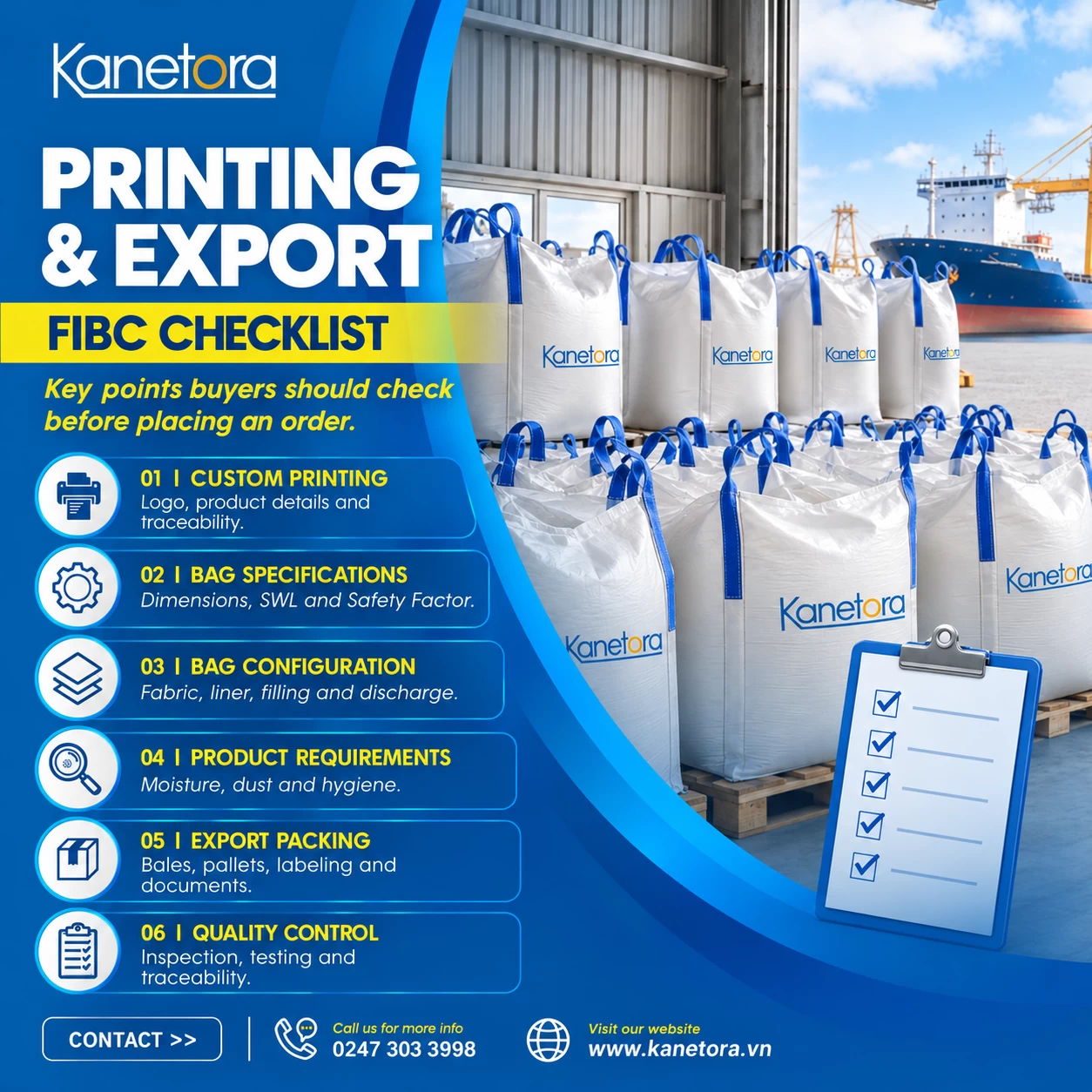
8. Printing Agricultural Export FIBC Bags: What Information Should Be Included?
Printing on FIBC bags serves both branding and operational purposes.
For agricultural exporters, printed information may help identify the product, manage inventory, facilitate handling and support batch traceability.
Common Information Printed on FIBC Bags
| Printed Information | Purpose |
|---|---|
| Product Name | Product identification |
| Net Weight | Net product weight |
| Gross Weight | Total weight including packaging |
| Country of Origin | Origin identification |
| Lot / Batch Number | Shipment traceability |
| Handling Symbols | Handling instructions |
| Company Logo | Brand identification |
| Storage Instructions | Recommended storage conditions |
The exact information required depends on the destination market, product category and buyer specifications.
What Should Buyers Confirm Before Approving Artwork?
Before bulk production, buyers should confirm the number of printing colors, artwork dimensions, positioning, wording and technical specifications.
It is also important that claims such as “Food Grade”, “UN Certified” or references to specific certifications are supported by appropriate product documentation.
Printed claims alone do not establish compliance with any certification or technical standard.
For more information, read our guide to custom printed FIBC bags and bulk packaging options.
9. FIBC Purchasing Checklist for Agricultural Exporters
Preparing a complete Request for Quotation (RFQ) helps packaging manufacturers recommend suitable technical specifications and minimize unnecessary sample revisions.
International buyers should provide the following information whenever possible.
| Item | Information Required |
|---|---|
| Product | Rice, sugar, starch, animal feed or other |
| Product Form | Powder, granules, pellets or other |
| Bulk Density | Product bulk density |
| Filling Weight | 500 kg, 1,000 kg, 1,500 kg or customized |
| Bag Dimensions | Width × Length × Height |
| Bag Construction | U-Panel, Circular, 4-Panel or Baffle |
| Filling Option | Open Top, Duffle Top or Filling Spout |
| Discharge Option | Flat Bottom or Discharge Spout |
| Fabric | Coated or Uncoated PP |
| Inner Liner | None, PE liner or barrier liner |
| UV Protection | Required or not required |
| Food-Grade Requirements | Applicable hygiene and material documentation |
| Printing | Artwork, logo and number of colors |
| Logistics | Palletization, container type and destination |
| Order Quantity | Estimated quantity and purchasing schedule |
| Testing | SWL, safety factor and additional testing requirements |
The more complete the technical information, the easier it is for manufacturers to propose a suitable combination of safety, cost efficiency and production lead time.
For buyers without a finalized specification sheet, Kanetora can provide technical guidance based on the intended packaging application.
10. Agricultural FIBC Manufacturing Capabilities at Kanetora Bach Dang
Kanetora Bach Dang is an industrial packaging manufacturer within the Kanetora Group, supplying FIBC jumbo bags, block-bottom valve bags and multilayer polyethylene films.
Located in the Cau Mai area of Ninh Binh Province, Vietnam, the manufacturing facility supports domestic and international packaging requirements.
According to the company’s 2026 profile, production capacities include:
-
FIBC Bags: Approximately 300,000 pieces per month.
-
Block-Bottom Valve Bags: Approximately 10 million pieces per month.
-
Multilayer Plastic Films: Approximately 500 metric tons per month.
Integrated Manufacturing Processes
Kanetora Bach Dang operates an integrated FIBC production process covering:
-
Polypropylene yarn extrusion.
-
Webbing production.
-
Fabric weaving.
-
Coating and lamination.
-
Cutting and printing.
-
Sewing and assembly.
-
Quality inspection.
-
Packing.
In-house production capabilities for supporting components, such as webbings, liners, labels and packaging accessories, help improve manufacturing flexibility and product consistency.
Quality Control and Testing Capabilities
The factory implements Quality Control (QC) and Quality Assurance (QA) procedures throughout manufacturing and before shipment.
Its technical capabilities include testing equipment for fabric tensile strength, lifting performance, liner sealing strength and other relevant material characteristics.
The manufacturing facility maintains documentation relating to ISO 9001:2015, ISO 14001:2015 and food safety or packaging management certifications described in its company profile.
Buyers should verify the current validity and scope of relevant certificates for their specific order requirements.
Customized Agricultural Packaging Solutions
Depending on the product, Kanetora Bach Dang can help customers evaluate suitable options such as:
-
Standard woven PP FIBCs.
-
Food-grade bulk bags.
-
FIBCs with PE inner liners.
-
Coated FIBC constructions.
-
Baffle bulk bags.
-
Customized filling and discharge systems.
-
Printed FIBC bags with customer-specific artwork.
For international buyers evaluating manufacturers in Vietnam, our guide on how to choose a reliable FIBC supplier in Vietnam outlines additional purchasing and quality assessment considerations.
11. Frequently Asked Questions About Agricultural FIBC Bags
Can a 1,000 kg FIBC be used for all agricultural products?
No. Rice, sugar, starch and animal feed have different bulk densities and flow characteristics. Bag dimensions and construction must be selected according to the actual product and handling conditions, even when the nominal filling weight is identical.
Do FIBC bags for rice require PE liners?
Not always. PE liners are recommended for consideration when additional protection against moisture, dust or environmental contamination is needed. The final decision depends on storage conditions, transportation requirements and buyer specifications.
Which FIBC type is suitable for bulk sugar exports?
Food-grade FIBCs with appropriate moisture-protection features are commonly considered for sugar applications. Depending on the required performance, these may include coated PP fabric, PE liners or specialized barrier liners.
Can jumbo bags be used for food-grade starch?
Yes, provided that the packaging materials and manufacturing conditions are suitable for the intended food-contact application. Dust control, moisture protection and discharge compatibility should also be evaluated.
Are FIBC bags with PE liners completely waterproof?
Not necessarily. Moisture-barrier performance depends on the liner material, construction, sealing method, closure design and actual handling conditions. Highly moisture-sensitive products may require specialized barrier systems.
Can baffle FIBC bags reduce logistics costs?
They may help improve storage and container space utilization by maintaining a more stable bag shape. Actual cost savings depend on bag dimensions, cargo characteristics and the loading arrangement.
Can Vietnamese FIBC manufacturers provide custom-printed bags?
Yes. FIBC manufacturers can offer customized dimensions, constructions, colors, printing and labeling according to customer specifications and production capabilities.
12. Conclusion: Choosing the Right FIBC to Protect Agricultural Export Value
Selecting suitable FIBC bags for agricultural exports is about more than packaging products in large quantities.
The right bulk packaging solution helps protect product quality, support safe handling and improve supply chain efficiency.
For rice, hygiene and storage protection are major priorities.
For sugar, moisture control plays an important role in maintaining product quality.
For animal feed, packaging should balance material characteristics, strength, handling efficiency and cost.
For starch, effective dust control, hygiene and moisture protection require particular attention.
Rather than selecting FIBCs solely based on filling capacity or unit price, agricultural exporters should evaluate the complete packaging system, including product characteristics, fabric construction, liner selection, filling and discharge equipment, storage conditions and destination-market requirements.
With integrated FIBC manufacturing, liner production, multilayer PE film capabilities and quality management procedures, Kanetora Bach Dang provides customizable industrial packaging solutions for agricultural exporters, processors and international bulk packaging buyers.
Looking for FIBC Bags for Agricultural Exports?
Whether you need jumbo bags for rice, sugar, animal feed or starch, Kanetora can help you evaluate appropriate bag construction, materials, liners and technical specifications based on your application.
Share your product details, filling weight, bulk density, preferred bag design, destination market and estimated order quantity with our team.
KANETORA JOINT STOCK COMPANY
Website: www.kanetora.vn
Hotline: +84 (0) 247 303 3998
Email: info@kanetora.vn
Manufacturing Facility: Kanetora Bach Dang, Cau Mai, My Loc, Ninh Binh Province, Vietnam.