

Updated October 7, 2026
The Asian plastic resin market entered October 2026 under a new set of pressures. High crude oil and feedstock costs are supporting polymer prices, while downstream demand remains too cautious to trigger a broad-based rally in polypropylene (PP) and polyethylene (PE).
Energy costs, Middle East supply risks and higher replacement costs continue to provide a floor for resin prices. On the other hand, buyers across China and Southeast Asia remain selective, with the Chinese market also experiencing reduced trading activity during the National Day Golden Week holiday.
As a result, the key theme for October is unlikely to be a straightforward surge in PP and PE prices.
Instead, the market is expected to remain range-bound at relatively elevated levels, with significant differences between polymer grades, origins and applications.
Quick Answer: Will PP and PE Prices Increase in October 2026?
As of October 7, 2026, the market outlook can be summarized as follows:
- PP: Supported by elevated crude oil, propane and propylene costs, but weak downstream demand is limiting the upside. Prices may remain stable or increase moderately.
- PE: The outlook is more mixed. High crude oil prices are increasing production costs, while weaker Asian ethylene prices are limiting producers’ ability to raise PE prices across all grades.
- Vietnam and Southeast Asia: Buyers continue to purchase mainly against actual production requirements rather than aggressively building inventories.
- The next major market signal: China’s return after Golden Week, particularly restocking activity, polymer futures and inventory levels.
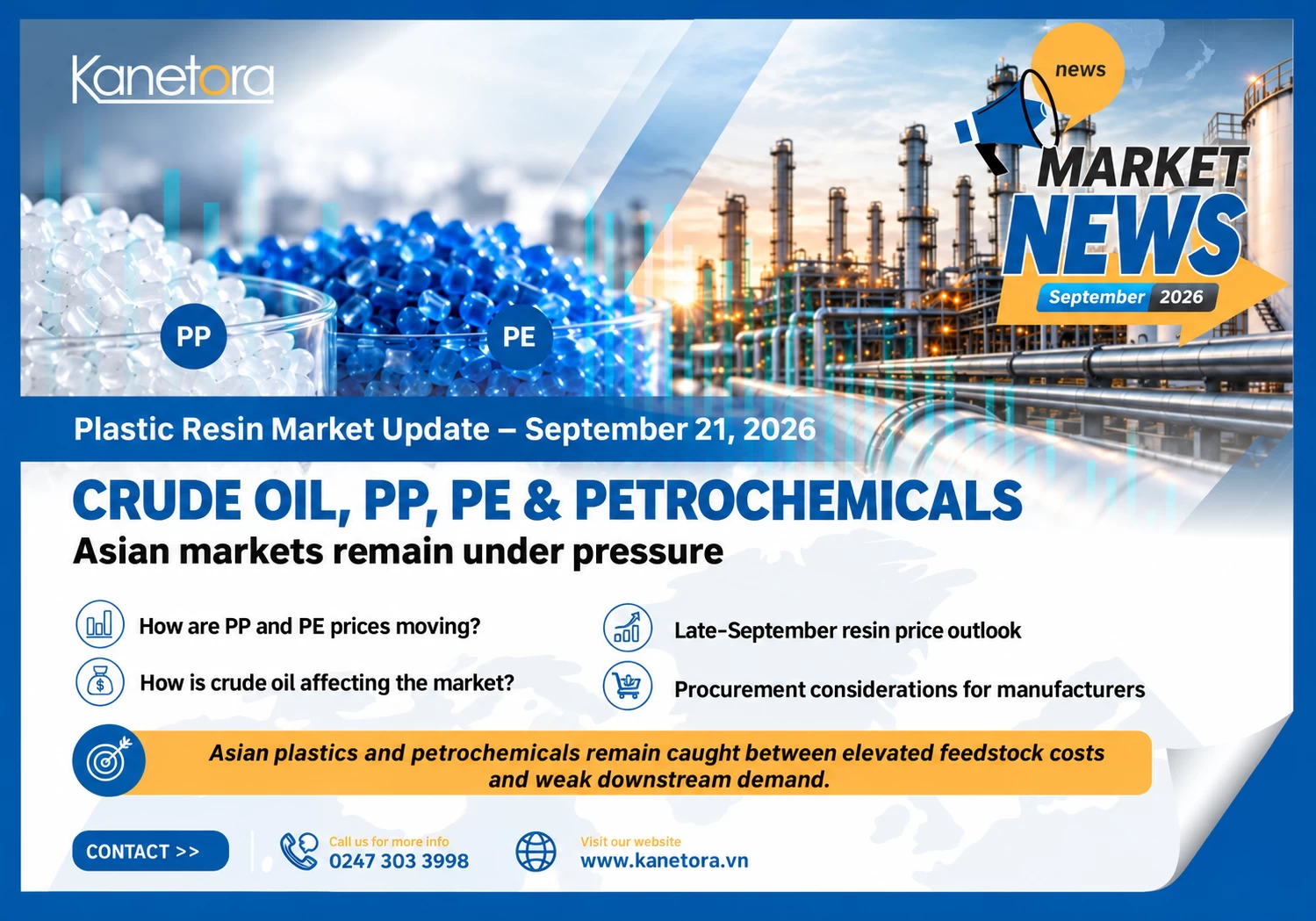
These developments follow the trends identified in Kanetora’s previous analysis, Plastic Resin & Petrochemical Market Update – September 21, 2026.
1. Crude Oil Is Once Again a Key Driver of the Plastic Resin Market
One of the most important differences between October and the softer market conditions seen earlier in 2026 is the level of energy costs.
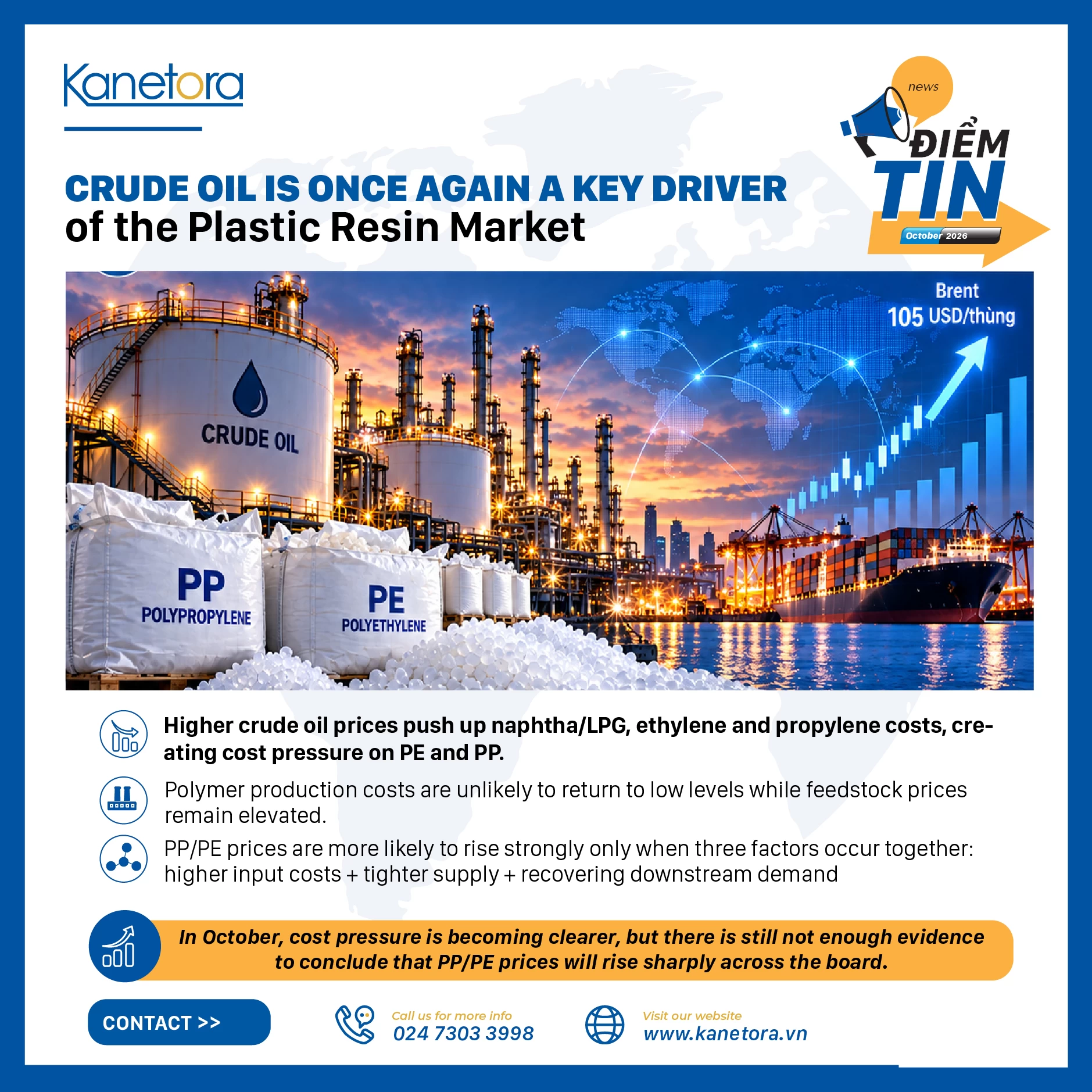
Higher crude oil prices directly affect major petrochemical feedstocks such as naphtha and LPG, which ultimately influence ethylene, propylene and polymer production costs.
The Asian petrochemical value chain can be simplified as:
Crude Oil → Naphtha / LPG → Ethylene / Propylene → PE / PP
When crude oil and feedstock prices remain elevated, polymer producers face higher replacement costs.
However, the relationship is not entirely linear.
A sustainable increase in resin prices generally requires three factors to occur simultaneously:
Higher feedstock costs + constrained supply + stronger downstream demand
At the beginning of October, the first factor is clearly present, while the other two remain less certain.
This explains why higher crude oil prices do not automatically translate into an equivalent increase in PP or PE prices.
2. PP Market in October: Supported by Costs, Limited by Demand
The Asian polypropylene market entered October with relatively strong cost support.
During September, PP prices in several Asian markets moved higher as crude oil, propane and propylene costs increased.
Higher production costs at propane dehydrogenation, or PDH, facilities also contributed to stronger market sentiment.
Other factors supporting PP prices included:
- Elevated crude oil prices;
- Higher propane costs;
- Increased propylene production costs;
- Tighter availability from selected producers;
- Higher freight and replacement costs.
However, downstream buyers have increasingly resisted higher offers.
Converters and manufacturers remain cautious about accumulating large inventories, particularly when demand for finished products has not strengthened at the same pace as raw material costs.
This creates a clear ceiling for PP price increases.
PP Raffia and Yarn Remain Important for Packaging Manufacturers
For manufacturers of:
- PP woven bags;
- FIBC / Jumbo Bags;
- PP woven fabric;
- Industrial packaging;
- PP straps and related products,
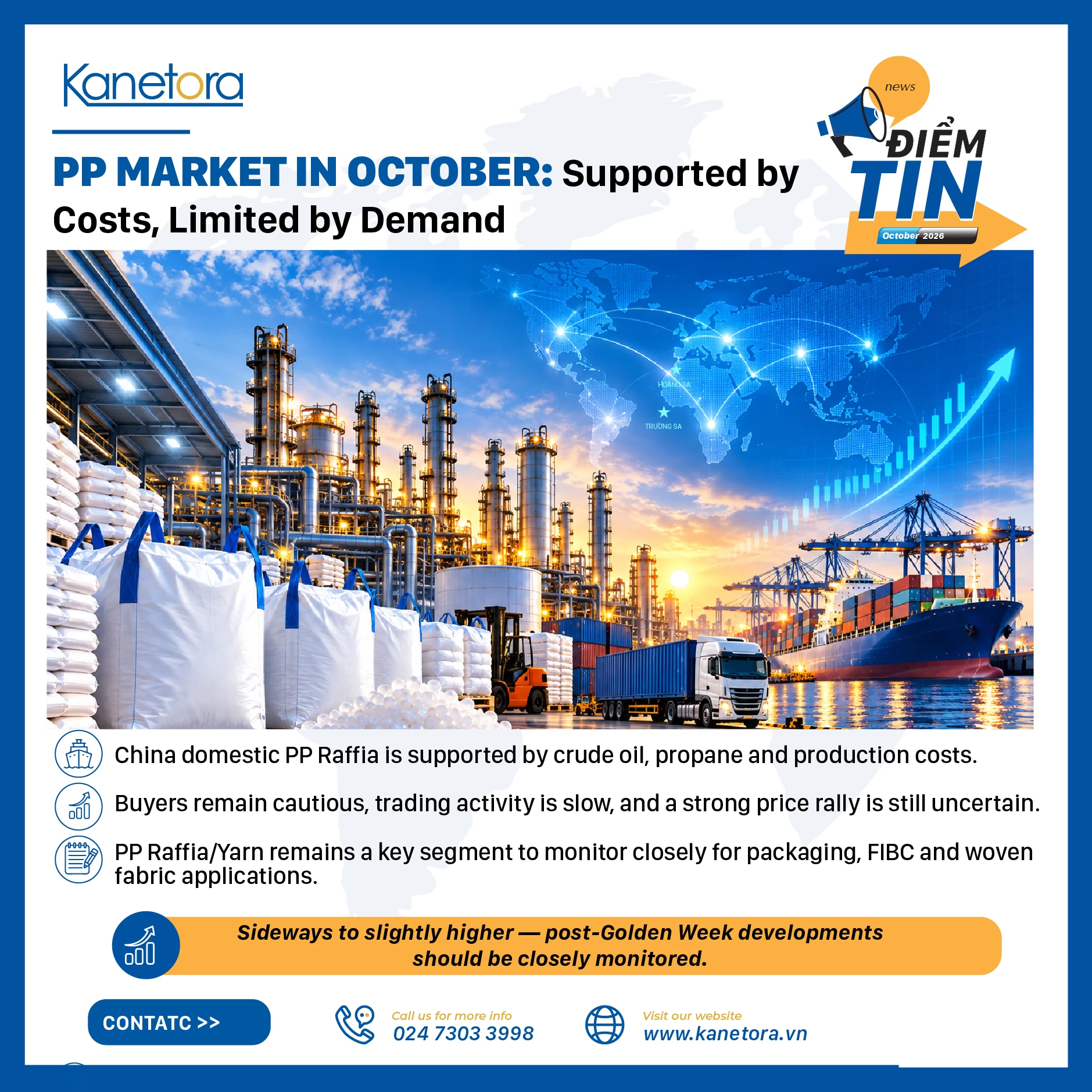
PP Raffia and PP Yarn remain among the most important grades to monitor during October.
If Chinese buyers return after Golden Week with strong restocking activity, PP Raffia prices may react relatively quickly.
However, if buyers continue purchasing only for immediate production requirements, prices may move sideways rather than entering another sustained rally.
3. Propylene Costs Support PP, but Downstream Consumption Remains Weak
The propylene market provides another important signal for polypropylene buyers.
Relatively high propylene costs continue to support PP production economics.
At the same time, lower operating rates at selected propane dehydrogenation plants could restrict additional propylene supply if feedstock availability becomes tighter.
However, demand from major downstream sectors, particularly polypropylene production, remains relatively cautious.
This creates the current PP market structure:
Strong upstream costs → support PP prices
while
Weak downstream demand → limits further increases
Unless there is another significant shock to crude oil, propane, freight or regional supply, PP prices in October are therefore more likely to remain firm but range-bound rather than rise continuously.
4. PE Market Outlook: Lower Ethylene Prices Limit the Upside
The polyethylene market is currently more complex than PP.
Although high crude oil prices are increasing production costs throughout the petrochemical chain, Asian ethylene prices showed signs of correction at the beginning of October.
Spot demand remained relatively limited during China’s Golden Week holiday, while additional prompt cargoes were available in parts of Southeast Asia.
This highlights an important market principle:
Higher crude oil prices do not necessarily mean that every PE grade will rise immediately.
If ethylene remains soft while demand from film, packaging and other downstream industries remains moderate, PE sellers may struggle to fully pass higher energy costs on to buyers.
As a result, the October PE market is expected to remain highly differentiated by grade.
5. LDPE, LLDPE and HDPE May Follow Different Price Trends
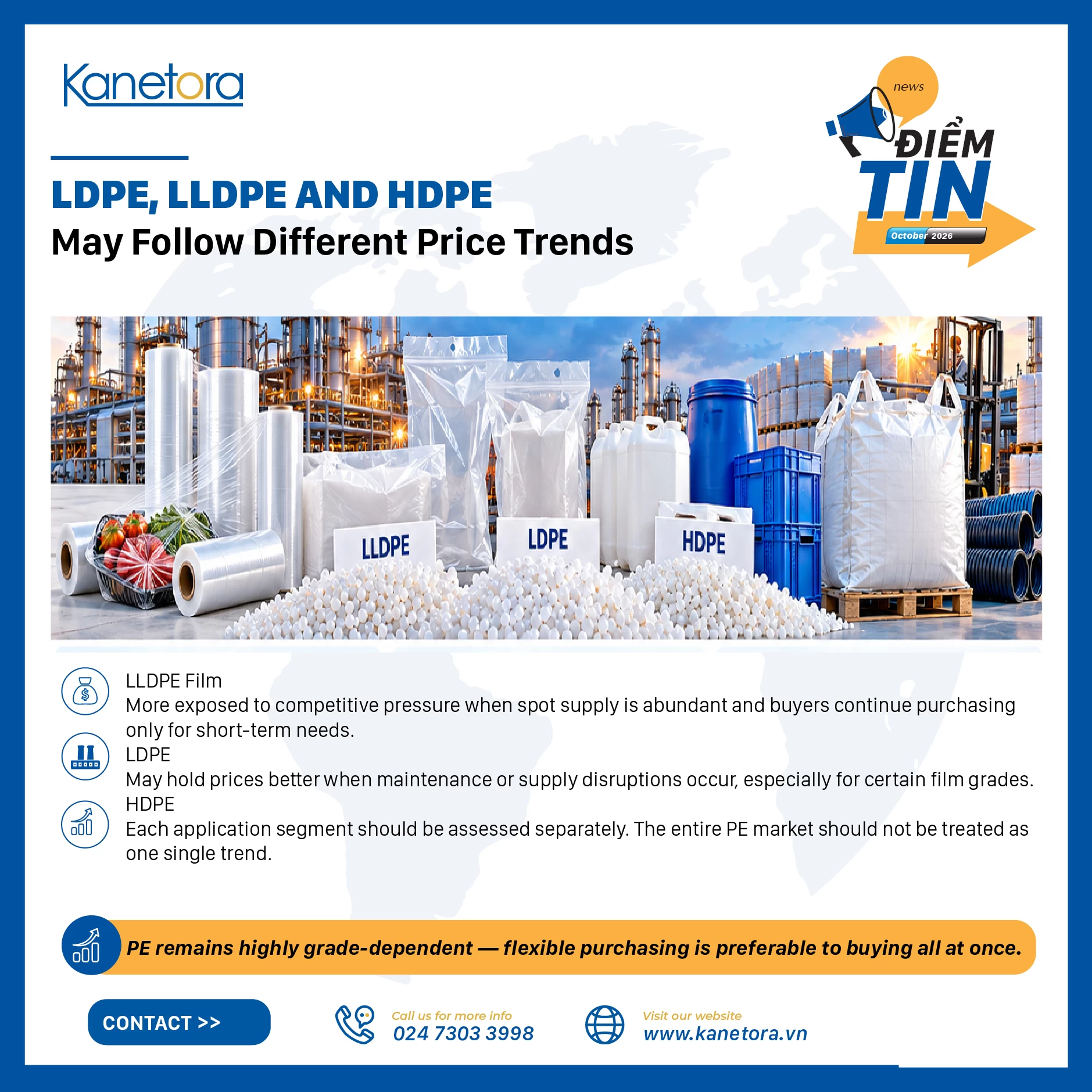
Companies should avoid treating polyethylene as one single market.
LDPE, LLDPE and HDPE have different production structures, applications, availability and supply-demand conditions.
LLDPE Film
LLDPE demand is closely linked to applications including:
- Flexible packaging;
- Stretch film;
- Industrial liners;
- Agricultural film;
- General-purpose film production.
If spot supply remains sufficient while converters continue buying conservatively, LLDPE could face stronger price competition.
This may limit the potential for significant increases during October.
LDPE Film
LDPE has a different supply structure from LLDPE.
Prices can react relatively quickly when regional plants enter maintenance or experience unexpected production disruptions.
Selected LDPE Film grades may therefore remain firmer than LLDPE, particularly where local availability is limited.
HDPE
HDPE should also be evaluated by individual grade rather than as a single product category.
Major applications include:
- HDPE Film;
- HDPE Blow Molding;
- HDPE Injection;
- HDPE Pipe.
The price movement of HDPE Film, for example, should not automatically be used to forecast HDPE Pipe or Blow Molding grades.
For procurement teams, a more effective sourcing approach is:
Polymer → Grade → Origin → Producer → Availability → Lead Time → Landed Cost
rather than simply asking:
“Is PE going up or down?”
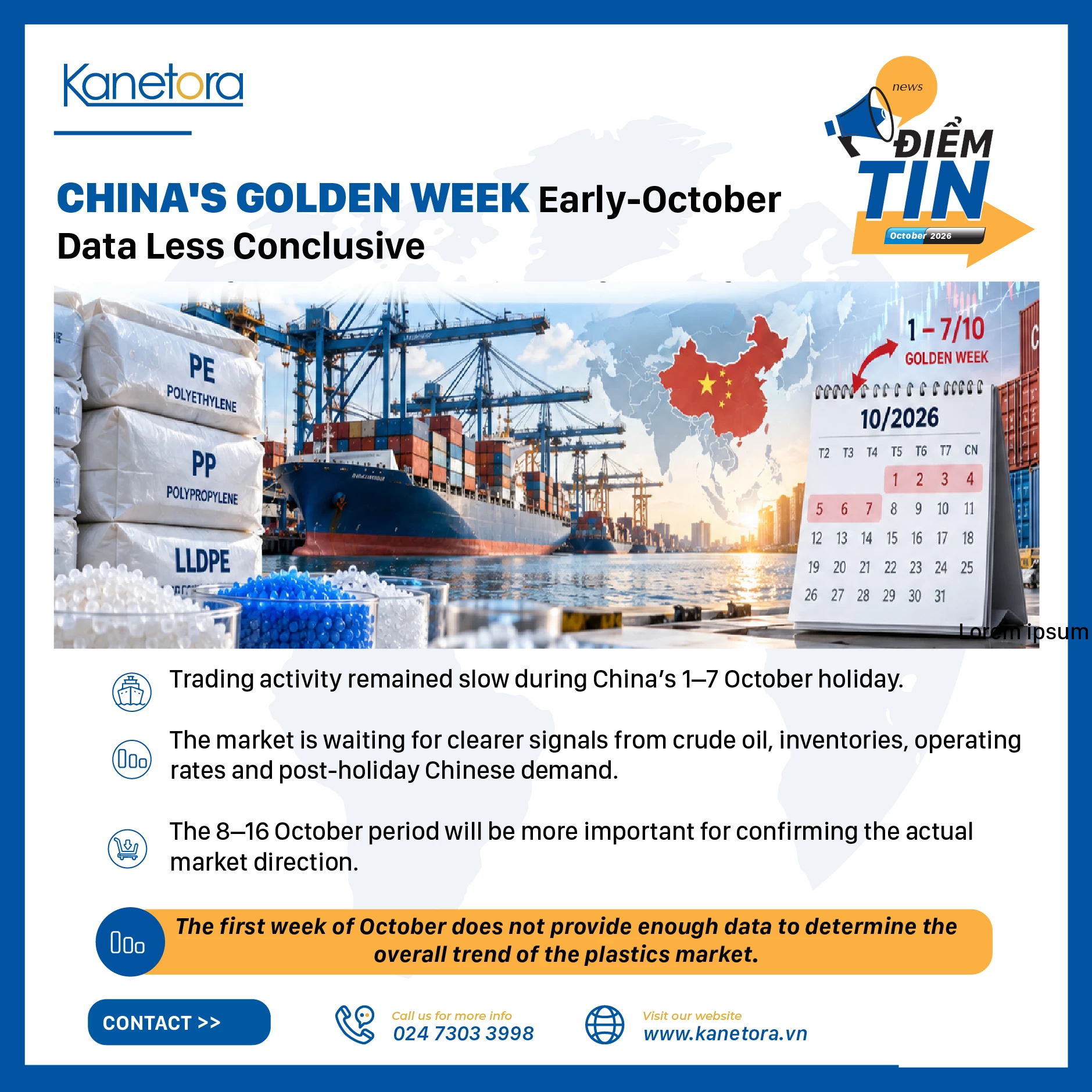
6. China’s Golden Week Makes Early-October Data Less Conclusive
China’s National Day Golden Week has significantly reduced petrochemical trading activity during the first week of October.
This means that market movements recorded before October 8 may not fully reflect the underlying demand picture.
The period immediately following Golden Week will therefore be critical.
Buyers and suppliers should monitor whether:
- Chinese converters begin restocking raw materials;
- PP and LLDPE futures strengthen;
- Buyers accept higher polymer offers;
- Producer inventories decline or continue building;
- Export activity from China changes.
The period from approximately October 8 to October 16 could provide a much clearer indication of the direction of the Asian resin market for the remainder of the month.
7. Middle East Risks Continue to Add a Premium to Polymer Costs
Geopolitical developments remain one of the largest external risks for the petrochemical market.
The impact extends far beyond crude oil.
Potential disruptions can move through the entire value chain:
Crude Oil → Naphtha / LPG → Ethylene / Propylene → Polymer → Freight → Insurance → Landed Cost
For Southeast Asian buyers, this is particularly relevant because the region remains highly connected to Middle Eastern energy and petrochemical supply chains.
Any escalation affecting energy production, shipping routes or insurance costs could therefore produce rapid changes in resin replacement costs.
This risk is one reason why PP and PE prices may find it difficult to return to the lower levels seen during weaker parts of 2026, even when downstream demand remains moderate.
8. October 2026 Plastic Resin Price Outlook
Based on market conditions as of October 7, the base-case outlook is for PP and PE to trade at relatively elevated levels, with PP receiving stronger short-term cost support and PE showing greater variation between grades.
| Resin Grade | October 2026 Outlook | Key Drivers |
|---|---|---|
| PP Raffia / Yarn | Stable → Slightly Higher | Crude oil, propylene, supply availability and downstream demand |
| PP Injection | Stable → Slightly Higher | Production costs vs. converter demand |
| LLDPE Film | Mostly Stable / Selective Corrections | Ethylene, spot availability and film demand |
| LDPE Film | Stable → Slightly Higher depending on origin | Supply availability and plant maintenance |
| HDPE Film | Mostly Stable / Differentiated | Import supply and packaging demand |
| HDPE Blow Molding | Mostly Stable | Finished-product demand and regional supply |
| PVC | Stable → Slightly Higher | Feedstock costs and Chinese market sentiment |
| PET | Mixed | PX/PTA costs, packaging demand and inventories |
Note: These are directional market assessments rather than transaction prices. Actual resin prices in Vietnam may vary significantly depending on producer, grade, origin, volume, Incoterms, shipping costs, exchange rates and delivery schedule.
9. Three Possible Scenarios for the Rest of October
Scenario 1: Base Case – Stable to Slightly Higher
This currently appears to be the most likely scenario.
Crude oil remains high, but downstream consumption does not accelerate significantly.
Under this scenario:
- PP remains firm;
- PE becomes increasingly grade-specific;
- Buyers continue purchasing against immediate demand;
- Prices have limited downside but also struggle to rally aggressively.
Scenario 2: Stronger Price Increase
PP and PE prices could rise more significantly if several factors occur simultaneously:
- Brent crude moves higher;
- Middle East supply disruptions intensify;
- Freight or marine insurance costs increase;
- Chinese buyers restock aggressively after Golden Week;
- Petrochemical producers reduce operating rates.
Under these conditions, imported resin prices could respond quickly because of higher replacement costs.
Scenario 3: Market Correction
Prices could also undergo a correction if:
- Chinese demand remains weak after Golden Week;
- Producer inventories increase;
- Ethylene and propylene prices soften;
- Buyers continue rejecting high offers.
In this case, selected polymer grades could decline even while crude oil remains relatively elevated.
10. How Should Vietnamese Manufacturers Purchase PP and PE in October?
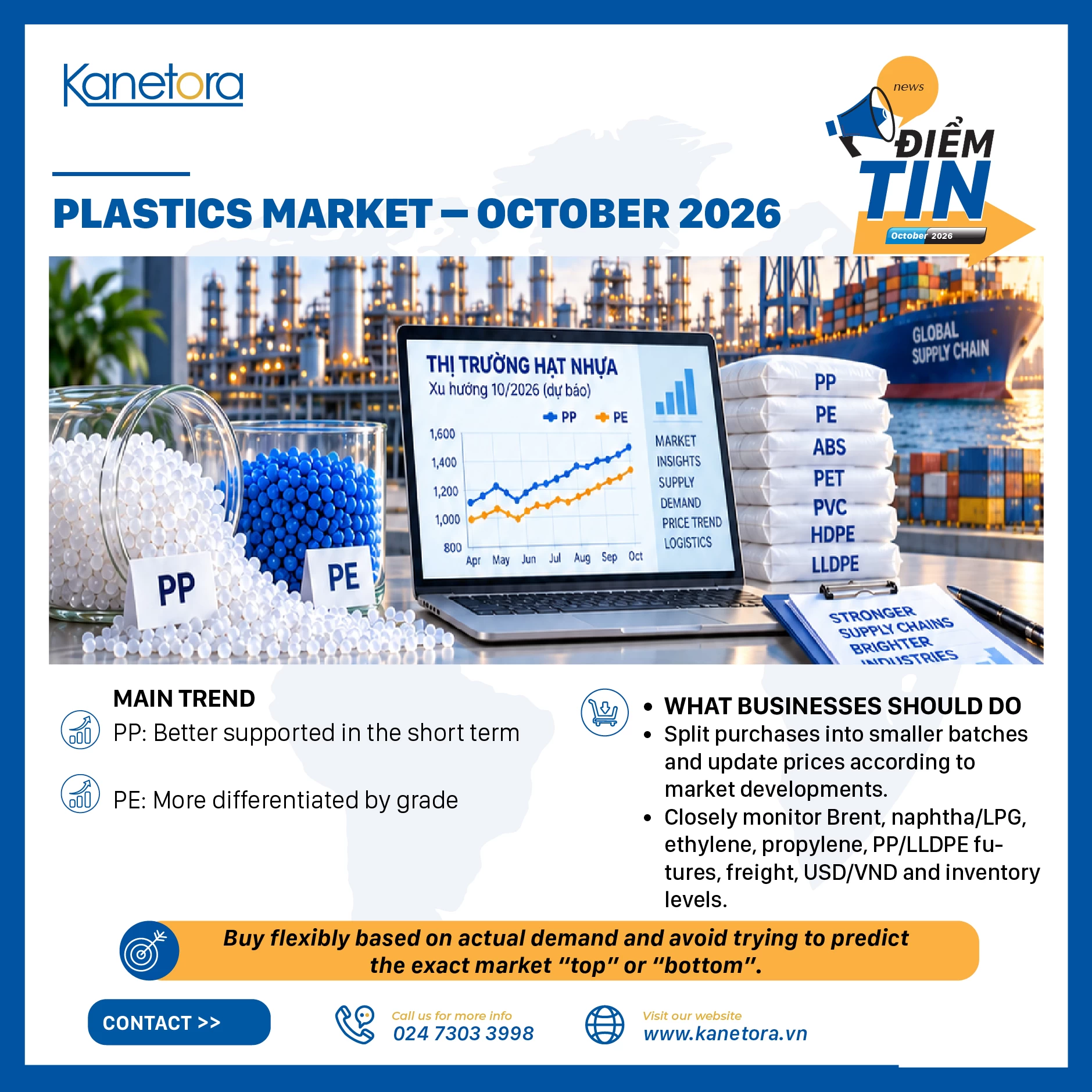
In the current market, trying to identify the exact price bottom or peak may create unnecessary procurement risk.
A more practical strategy is to separate raw-material requirements by production horizon.
Immediate demand: 0–2 weeks
Priority should be given to securing enough material to fulfill confirmed production orders.
Availability and delivery reliability may be more important than attempting to save a small amount through market timing.
Short-term demand: 2–6 weeks
Companies may consider splitting procurement volumes into several purchases.
This provides greater flexibility while waiting for clearer signals from China after Golden Week.
Medium- and long-term demand
For larger requirements, buyers may consider:
- Staggered delivery schedules;
- Contract pricing;
- Alternative producers;
- Multiple origins;
- Backup supply arrangements.
Procurement teams should monitor several indicators simultaneously:
- Brent crude oil;
- Naphtha and LPG;
- Ethylene;
- Propylene;
- PP and LLDPE futures in China;
- Asian PP/PE offers;
- Ocean freight;
- USD/VND exchange rates;
- Delivery lead times;
- Factory inventory levels.
For additional context, see Kanetora’s previous September 2026 Plastic Resin & Petrochemical Market Update.
11. The Lowest Resin Price Is Not Always the Lowest Production Cost
For industrial manufacturers, particularly producers of PP woven packaging, FIBC, PE film and plastic products, raw material prices represent only one part of total production costs.
A lower-priced resin with unstable processing performance may lead to:
- Higher yarn breakage;
- Increased scrap rates;
- Machine downtime;
- More frequent parameter adjustments;
- Film defects;
- Lower production efficiency;
- Finished-product quality claims.
Procurement decisions should therefore consider:
Price + Quality + Lot Consistency + Lead Time + Alternative Supply + Total Landed Cost
rather than purchase price alone.
Kanetora operates a large-scale plastic resin and petrochemical distribution business serving domestic and international markets. Its portfolio focuses on PP, PE and specialized polymers for industrial packaging and manufacturing applications, with distribution capacity of up to approximately 100,000 tons per year. Profile Kanetora 2026 – Tiếng…
Frequently Asked Questions: Plastic Resin Market October 2026
Will PP prices increase in October 2026?
PP prices may remain firm or increase moderately because crude oil, propane and propylene costs remain relatively high.
However, downstream demand is still insufficient to confirm a broad and sustained PP price rally.
China’s market performance after Golden Week will be an important indicator.
Will PE prices rise together with crude oil?
Not necessarily.
Although higher crude oil prices increase petrochemical production costs, ethylene prices and supply-demand conditions also influence PE pricing.
LDPE, LLDPE and HDPE may therefore move differently during October.
Should manufacturers build PP or PE inventories in October?
Companies should not increase inventory solely because crude oil prices are rising.
Purchasing decisions should also consider:
- Confirmed production orders;
- Existing stock;
- Lead times;
- Supplier availability;
- Replacement costs;
- Alternative sources.
A staggered purchasing strategy may reduce exposure to short-term market volatility.
Could plastic resin prices increase after China’s Golden Week?
Yes.
Prices could strengthen if Chinese converters return with significant restocking demand.
However, if downstream demand remains weak and inventories build, the market could instead remain stable or undergo a correction.
What are the most important indicators for October?
The four major groups of indicators are:
Energy and feedstocks – Chinese demand – regional polymer supply – logistics costs.
Within those categories, crude oil, naphtha, LPG, ethylene, propylene, Chinese polymer futures, inventory levels and freight rates are particularly important.
Conclusion: October Is More Cost-Driven Than Demand-Driven
The plastic resin market has entered October 2026 with a clear imbalance:
production costs are high, while downstream demand remains cautious.
Crude oil and geopolitical risks are limiting the downside for PP and PE.
At the same time, cautious buying in China and Southeast Asia is restricting producers’ ability to push prices significantly higher.
The most appropriate description of the October market is therefore:
Relatively high price levels → grade-specific movements → selective increases rather than a broad-based rally.
For manufacturers, the priority should not simply be to buy at the theoretical market bottom.
A stronger procurement strategy should focus on:
Supply security → inventory control → staggered purchasing → alternative suppliers → total landed cost
rather than short-term resin prices alone.
Kanetora will continue monitoring developments across the Asian plastic resin and petrochemical markets to provide manufacturers and industrial buyers with timely market insights.