

Updated: September 21, 2026
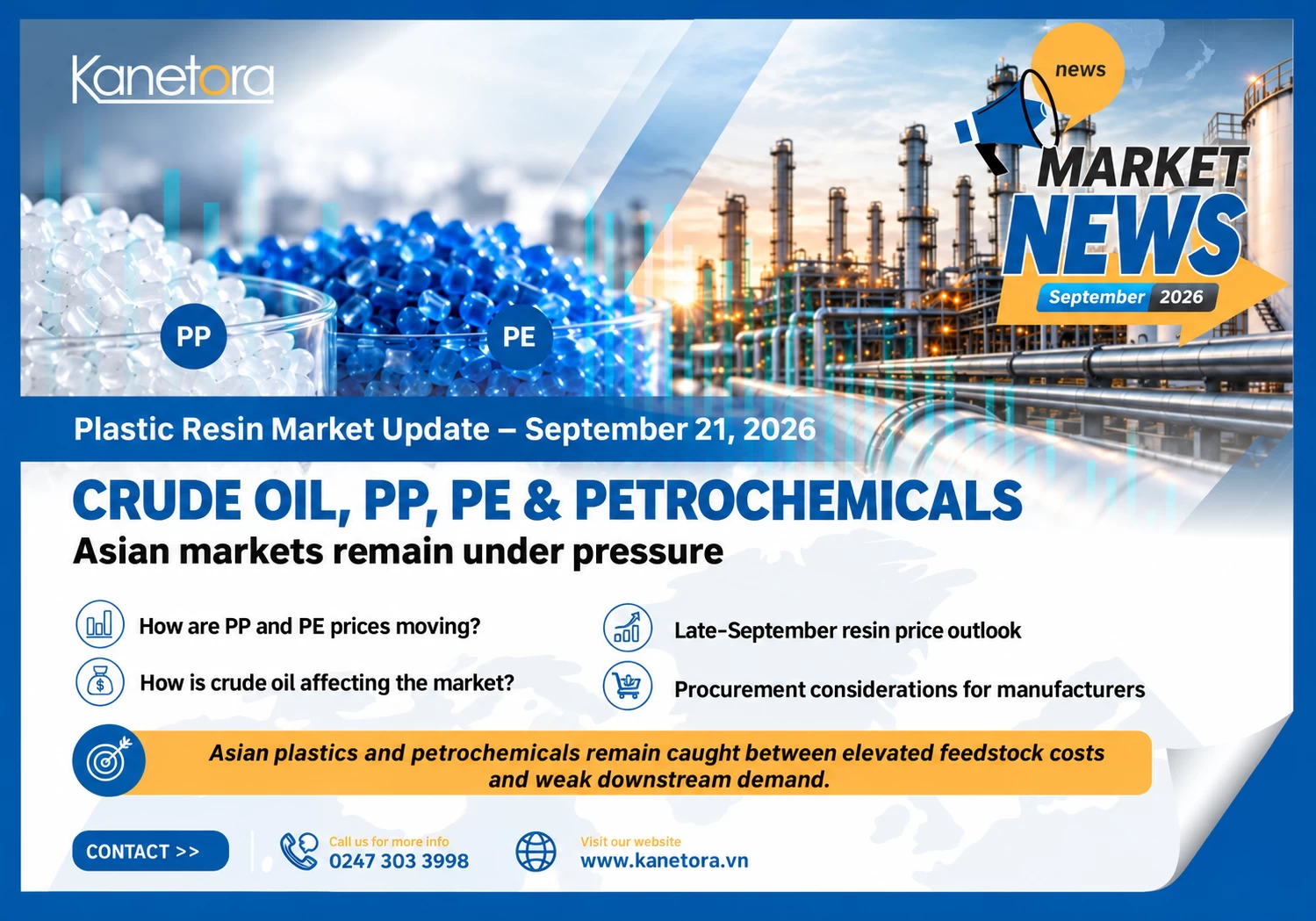
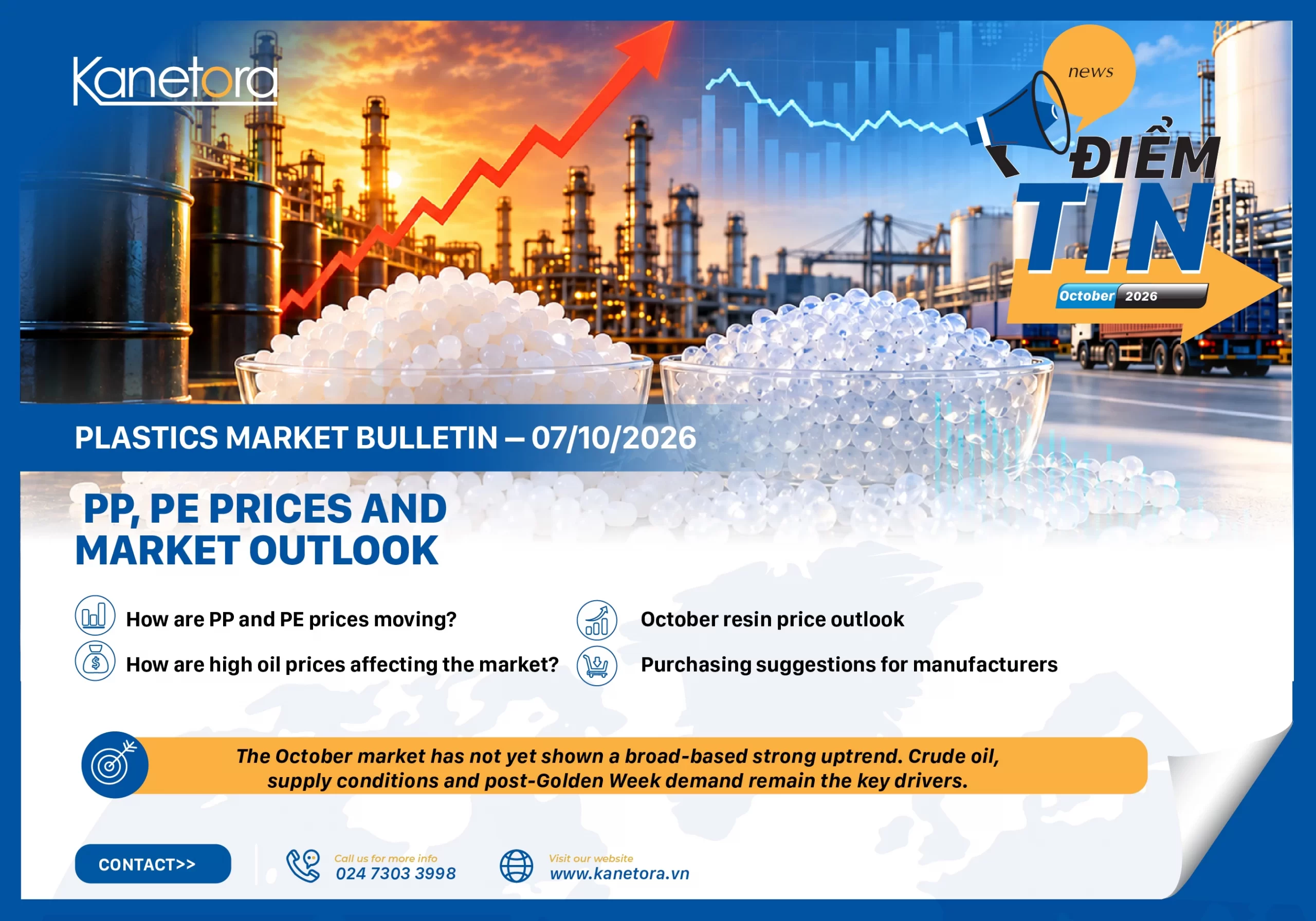
The Asian plastic resin and petrochemical market in the second half of September 2026 remains caught between elevated production costs and weak downstream demand.
Crude oil has retreated from its mid-September peak, but prices remain high. At the same time, naphtha, ethylene and propylene costs, selected supply constraints and logistics disruptions continue to support polymer production costs.
On the other side of the market, downstream consumption has yet to recover strongly. China continues to show stronger industrial production than domestic consumption, while expanding polymer capacity is reshaping regional PP and PE trade flows.
For manufacturers, the current market is therefore better understood through the following chain:
Crude Oil → Feedstocks → Polymer Supply → Downstream Demand → Logistics → Final Landed Cost
For a more application-specific procurement perspective, packaging manufacturers can also review Kanetora’s PP/PE Resin Sourcing Update for Packaging Manufacturers – September 2026.
1. Crude Oil Retreats from Its Peak, but Brent Remains Above $100/bbl
One of the most important changes since the mid-September update is the direction of crude oil.
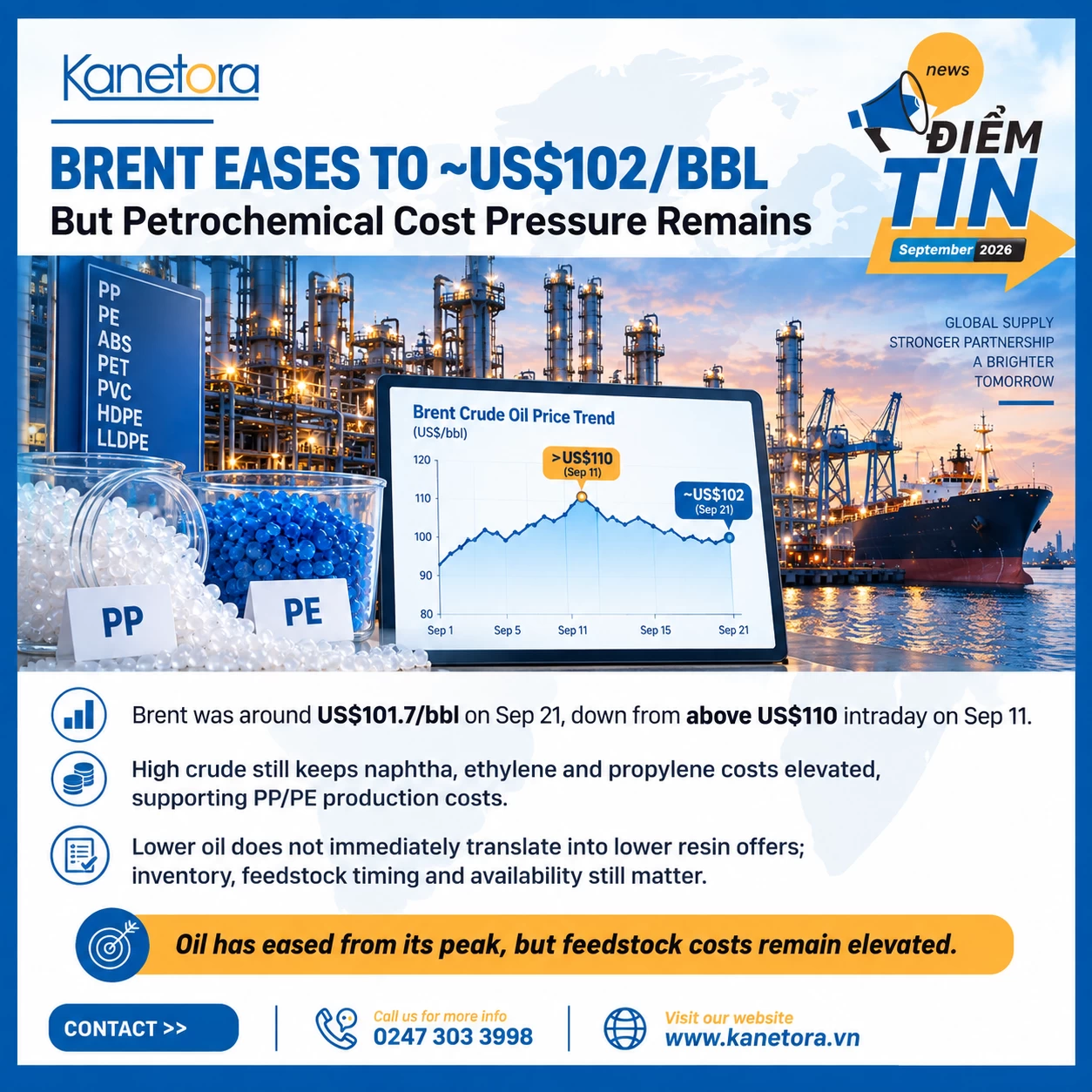
In Asian trading on September 21, Brent crude fell to approximately $101.71/bbl, while WTI declined to around $98.15/bbl, their lowest levels since September 10.
The decline reflected renewed expectations of diplomatic progress in the Middle East, alongside improving Saudi crude exports. However, the wider supply situation remains fragile and oil continues to carry a significant geopolitical risk premium.
Earlier in September, crude oil had surged above $110/bbl intraday, sharply raising feedstock costs across Asian petrochemical value chains.
The situation is therefore no longer simply:
“Crude oil continues to rise.”
A more accurate interpretation is:
Oil prices are easing from their recent peak, but remain elevated and highly sensitive to Middle East supply and shipping conditions.
This remains highly relevant to Asian petrochemicals, where naphtha is still an important feedstock for steam crackers.
The basic transmission mechanism is:
Crude Oil → Naphtha → Ethylene / Propylene → PE / PP
Kanetora has explained this relationship in more detail in How Do Crude Oil Prices Impact PE Resin Prices?.
2. Middle East Oil Flows Improve, but Hormuz Risk Has Not Disappeared
Saudi crude exports have started to recover.
Saudi Aramco is increasing Gulf exports through alternative logistics arrangements, including ship-to-ship transfers via Oman, helping offset disruption elsewhere in its export system. This additional supply has contributed to the recent easing in crude oil prices.
However, traffic through the Strait of Hormuz remains heavily disrupted.
Reuters reported that only around a dozen commodity vessels were observed crossing the strait during the latest weekend, compared with 35 the previous weekend. Before the current conflict, approximately 125 large commercial vessels typically crossed the waterway each day. Some energy shipments may not appear in public vessel-tracking data, so visible traffic does not represent the complete physical flow.
For polymer buyers, this means sourcing from the Middle East should still be evaluated through several variables:
Resin Price + Availability + Freight + Insurance + Transit Time
rather than headline resin price alone.
For additional background on how Middle East disruptions can affect polymers, see Kanetora’s Middle East Conflict 2026: Why Virgin Plastic Resin Prices Are Rising.
3. Asian Petrochemical Prices Rise Despite Weak End-User Demand
Higher crude oil prices have already moved through the Asian petrochemical chain.
According to ICIS, crude prices above $100/bbl pushed petrochemical prices higher across Asia during September despite generally weak demand.
Higher naphtha, propane and other feedstock costs have raised production expenses, while supply disruptions and lower operating rates have tightened availability in selected markets.
The market is therefore facing an unusual combination:
Feedstock Costs ↑ + Supply Risk ↑ + End-User Demand Remains Weak
This creates a particularly difficult operating environment for downstream producers.
Raw-material costs are increasing, but converters are often unable to pass the full increase on to customers because demand for finished products remains relatively soft.
For resin buyers, this also means supplier offers can increase due to replacement cost even when physical purchasing activity remains cautious.
4. PE: Naphtha and Ethylene Costs Continue to Provide Support
Polyethylene remains closely linked to developments in the C2 value chain.
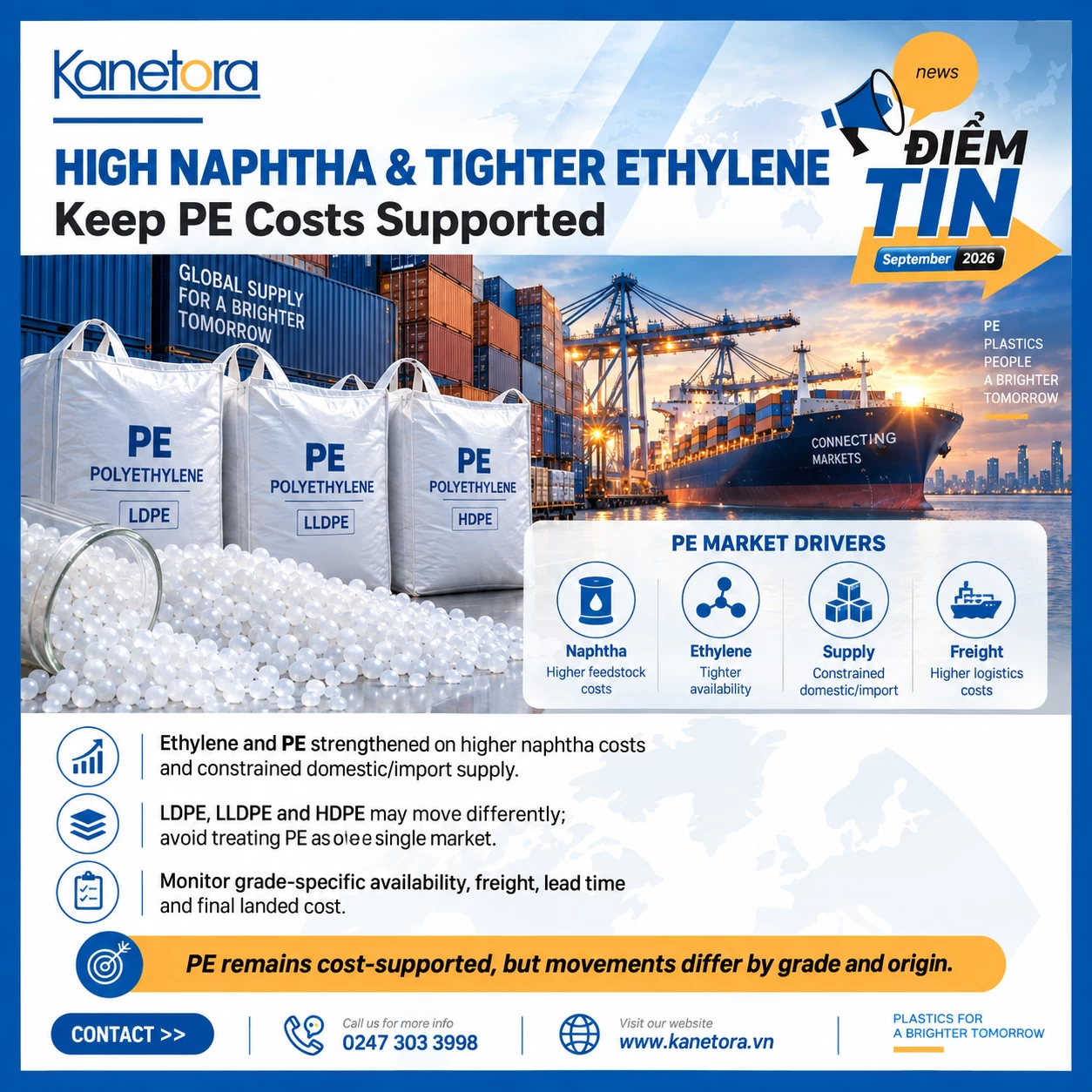
Higher crude and naphtha prices have increased ethylene production costs, while tighter regional availability has provided additional support to PE markets. ICIS has also reported stronger ethylene values amid reduced availability and increased regional enquiries.
The situation is relevant to several major PE grades:
- LDPE
- LLDPE Film
- HDPE Film
- HDPE Blow Molding
- PE liner materials
- Stretch film
- Flexible packaging film
However, PE should not be treated as one single market.
LDPE can move differently from LLDPE. HDPE Film can have a different supply-demand balance from HDPE Blow Molding or HDPE Injection.
For manufacturers, the more useful question is therefore not:
“Is PE going up?”
but:
Which PE grade is moving, from which origin, with what availability, lead time and final landed cost?
This grade-level approach is also covered in Kanetora’s September 2026 PP/PE Resin Sourcing Update.
5. PP: High Propylene Costs Push Producer Margins Into Negative Territory
The C3 value chain is facing even stronger margin pressure.
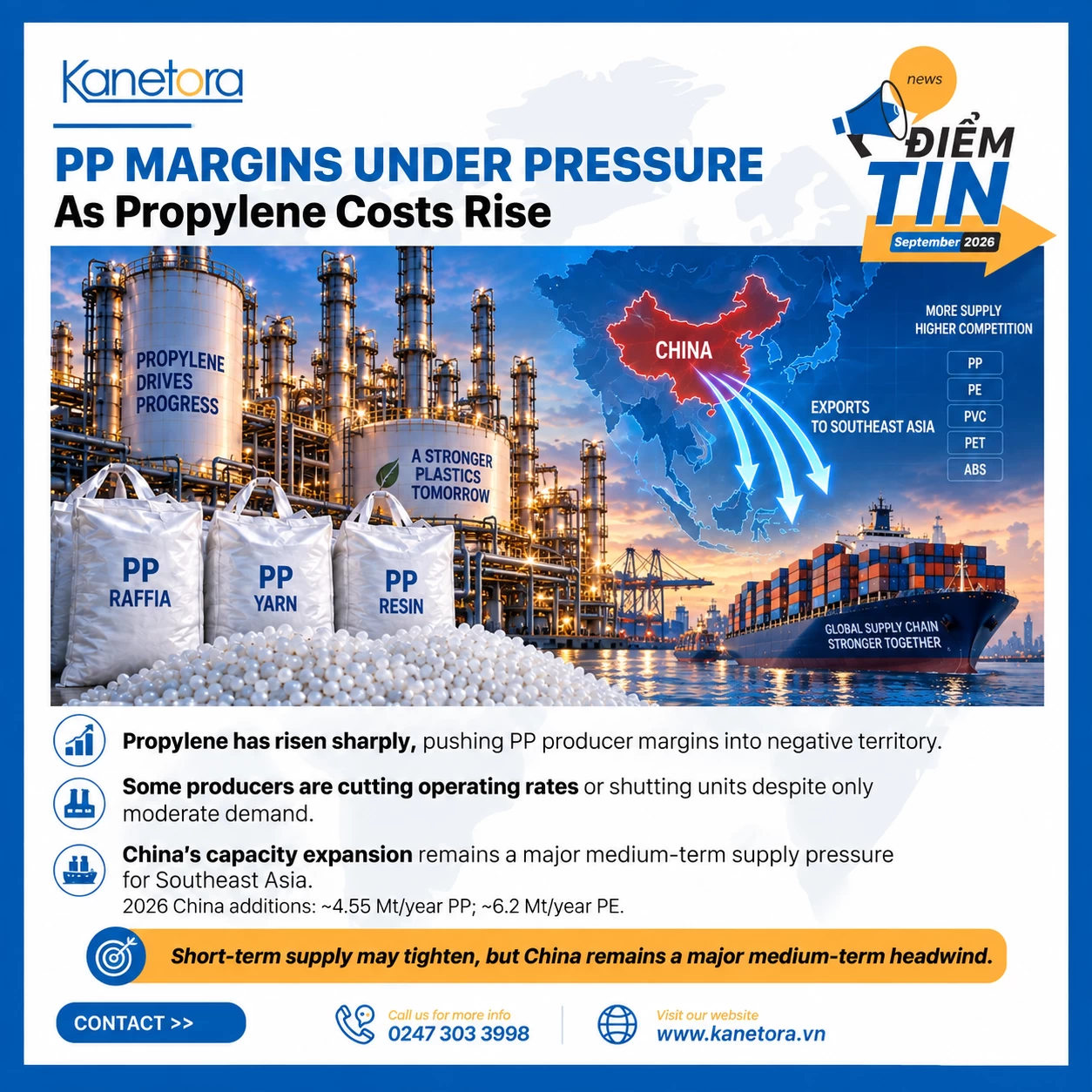
Asian propylene values have increased alongside crude oil, propane and methanol costs, while merchant supply has tightened in parts of the region.
Polypropylene prices, however, have not risen sufficiently to offset the increase in feedstock costs.
ICIS reported that PP margins have moved into negative territory, prompting production cuts and plant shutdowns even though underlying demand remains only moderate.
This is particularly important for:
PP Raffia / Yarn → Woven PP Fabric → Woven Bags → FIBC / Jumbo Bags
as well as:
PP Injection → Household Products → Components → Injection-Molded Products
The resulting market contains two opposing forces.
On one side:
Lower Operating Rates → Reduced Supply → Potential Price Support
On the other:
Weak Downstream Demand → Limited Ability to Raise PP Prices
PP may therefore remain volatile rather than entering a straightforward upward cycle.
6. China Approaches Golden Week, but Underlying Consumption Remains Weak
China’s Golden Week holiday from October 1–7 is approaching, and pre-holiday restocking is beginning to attract attention.
ICIS expects some petrochemical purchasing to strengthen as manufacturers and traders prepare inventories ahead of the week-long holiday.
However:
Restocking is not the same as a recovery in final consumption.
China’s August economic indicators illustrate this difference clearly.
Industrial output increased 5.2% year on year, accelerating from July. Retail sales, however, increased only 0.4%, while fixed-asset investment fell 7.2% during the first eight months of 2026.
This matters significantly for polymers.
China can maintain relatively strong industrial production while domestic consumption remains insufficient to absorb growing petrochemical capacity.
In simplified terms:
Industrial Production ↑ + Weak Domestic Consumption + Additional Capacity → Greater Export Pressure
This could continue to increase competition among Chinese, Middle Eastern, Northeast Asian and Southeast Asian resin suppliers.
For comparison with market conditions earlier in the quarter, manufacturers can review Kanetora’s Plastic Resin Market Update – July 2026.
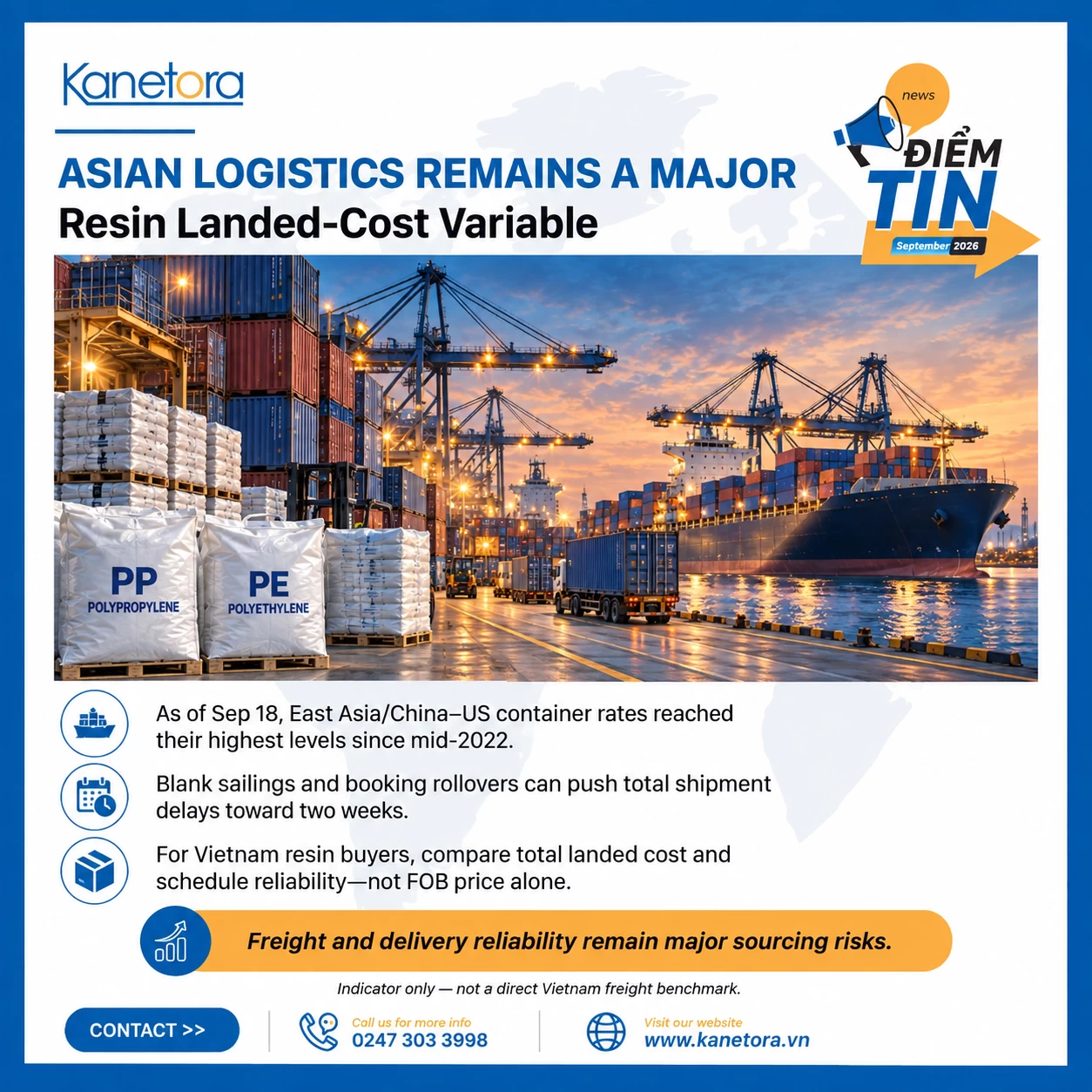
7. Container Freight and Shipping Reliability Are Becoming More Important to Resin Buyers
Logistics has become a much larger procurement variable since the beginning of September.
As of September 18, ICIS reported container rates from East Asia and China to the US at approximately:
US West Coast: $7,075–8,330/FEU
US East Coast: $9,165–12,000/FEU
Both were at their highest levels since mid-2022.
The Shanghai Containerized Freight Index also recorded its eighth consecutive weekly increase, rising by more than 20% over that period.
Schedule reliability may be even more important than the headline freight rate.
Industry participants cited by ICIS noted that cargo may secure vessel space but still experience delayed departures. When booking rollovers are combined with vessel delays, total delays can approach two weeks.
These Asia-US rates are not direct freight benchmarks for PP and PE imported into Vietnam.
However, they indicate broader pressure on:
Container Capacity + Port Congestion + Blank Sailings + Schedule Reliability
This matters because PP and PE pellets are commonly transported in containers.
For imported resin, the more meaningful procurement equation is:
FOB Resin Price + Freight + Insurance + Surcharges + FX + Lead Time + Inventory Cost = Effective Landed Cost
A cheaper FOB quotation does not necessarily result in a lower production cost.
8. Other Petrochemical Chains Remain Under Margin Pressure
The pressure is not limited to PP and PE.
Higher crude and aromatics costs have affected a broad range of petrochemical products, while weak downstream demand continues to limit margin recovery.
ICIS reported that ABS, PS and EPS producers have continued operating at reduced rates because of weak margins. PVC producers are also facing higher production and delivery costs due to stronger ethylene values, limited feedstock availability and longer container transit times.
The current environment therefore has implications across:
PET → Polyester → PVC → Engineering Plastics → Automotive Components → Electronics → Coatings → Adhesives → Industrial Chemicals
For Vietnam specifically, ICIS noted that relatively strong downstream manufacturing and infrastructure activity has continued to support PVC imports even as broader Asian demand remains uneven.
Impact on Key Downstream Industries
| Downstream Industry | Main Raw Materials | Key Variables to Monitor |
|---|---|---|
| Woven PP / FIBC | PP Raffia, PP Yarn | Propylene, PP operating rates |
| PE Film / Liners | LDPE, LLDPE, HDPE | Ethylene, supply availability |
| Flexible Packaging | PE, PP Film, PET | Feedstocks, FMCG demand |
| Injection Molding | PP Injection, HDPE | Resin costs, consumer demand |
| Engineering Plastics | ABS, PS, EPS | Aromatics, margins, plant rates |
| PVC / Pipes | PVC | Ethylene, construction activity |
| Polyester / PET | MEG, PET | Feedstock supply, textile demand |
| Coatings / Adhesives | Solvents, aromatics | Crude oil, regional availability |
| Polymer Logistics | PP and PE pellets | Freight, congestion, lead time |
For a practical example of how polypropylene performance connects directly with industrial packaging, see Kanetora’s FIBC Bags for Minerals and Construction Materials, where woven PP construction, mechanical strength and packaging design are directly linked to demanding bulk-material applications.
PP and PE Outlook for Late September 2026
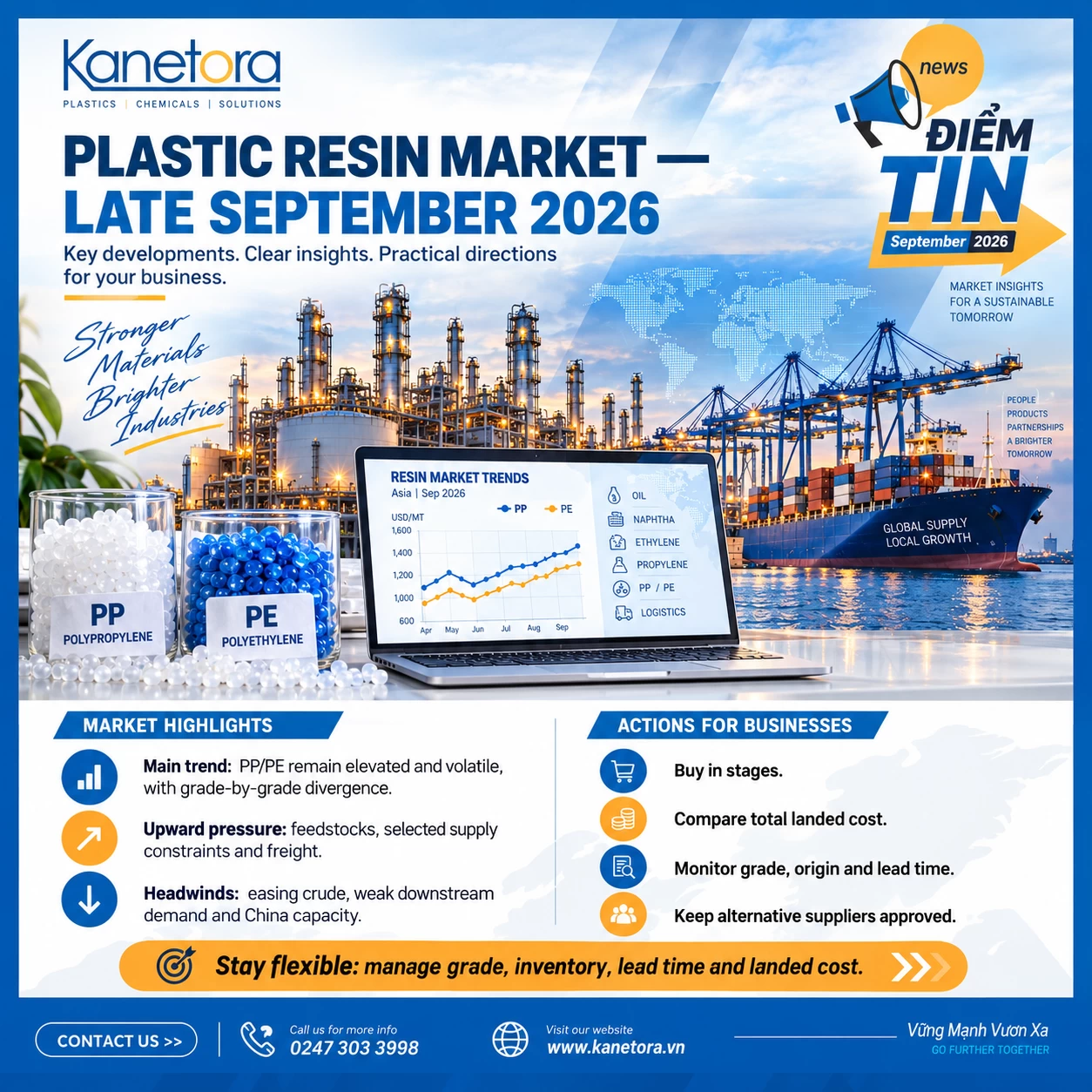
As of September 21, the market contains both upward and downward pressures.
Factors supporting resin prices include elevated crude oil prices, relatively high petrochemical feedstock costs, selected ethylene and propylene supply constraints, reduced PP operating rates, Middle East shipping risks and elevated container freight.
Factors limiting further price increases include crude oil’s retreat from recent peaks, improving Saudi oil exports, weak downstream demand, soft Chinese consumption and substantial Asian polymer production capacity.
The more realistic scenario for the remainder of September is therefore not necessarily:
“PP and PE prices will continue rising sharply.”
Instead:
PP and PE may remain at relatively elevated and volatile levels, while actual price movements continue to vary significantly by polymer family, grade, origin, availability and delivery schedule.
For manufacturers, purchasing decisions should increasingly be evaluated through:
Application → Grade → Approved Source → Landed Cost → Inventory → Lead Time → Purchasing Timing
rather than attempting to predict one exact market bottom or peak.
FAQ – Plastic Resin Market, September 21, 2026
Are PP and PE resin prices still under upward pressure?
Upstream costs continue to support both markets, but the situation differs significantly by grade and origin. Weak downstream demand and additional regional capacity continue to limit broad-based increases.
Will lower crude oil prices immediately reduce PP and PE prices?
Not necessarily.
Polymer pricing is also affected by previously purchased feedstocks, producer inventories, operating rates, cargo availability, freight and demand. A short-term decline in crude oil may therefore take time to influence physical resin offers.
What is currently the main risk for PE buyers?
For PE buyers, the key combination is ethylene cost, grade-specific availability, import lead time and freight. LDPE, LLDPE and HDPE should be evaluated separately.
What is currently the main issue in the PP market?
High propylene costs have significantly reduced PP production margins. Some producers have responded with operating-rate cuts or shutdowns, potentially reducing supply even while downstream demand remains relatively weak.
Could Golden Week push PP and PE prices higher?
Pre-holiday restocking may support short-term purchasing activity.
However, restocking alone does not confirm a sustained recovery in final consumption, particularly while Chinese retail and investment data remain weak.
What market indicators should Vietnamese resin buyers monitor?
Important indicators include:
- Brent and Dubai crude
- Naphtha
- Ethylene
- Propylene
- Chinese PP and LLDPE futures
- CIF Vietnam resin offers
- USD/VND
- Ocean freight
- Major producer operating rates
- Supplier lead times
Conclusion: Resin Purchasing Is Increasingly About Supply Resilience, Not Only Price
By September 21, 2026, the plastic resin market is no longer simply a story of higher crude oil pushing PP and PE prices upward.
Crude has started to retreat from its peak, but feedstock costs, production economics, supply availability, Middle East shipping risks and container logistics continue to keep polymer costs elevated.
At the same time, downstream consumption remains too weak to support unrestricted price increases.
For plastic converters and packaging manufacturers, a more resilient sourcing strategy is therefore built around:
Diversified Sources → Approved Alternative Grades → Appropriate Inventory → Staggered Purchasing → Landed-Cost Control → Continuous Market Monitoring
Rather than focusing exclusively on the lowest USD/tonne quotation, manufacturers should evaluate whether a resin source can provide the required technical performance, production stability, supply reliability and total cost.
About Kanetora Plastic & Chemical
Kanetora’s Plastic & Chemical business supplies PP, PE and other polymer materials for industrial manufacturing and packaging applications in Vietnam and international markets.
Within the Kanetora ecosystem, plastic and chemical distribution is positioned as one of the Group’s core business areas, supporting manufacturers through raw-material sourcing, commercial capabilities and an integrated logistics network.