

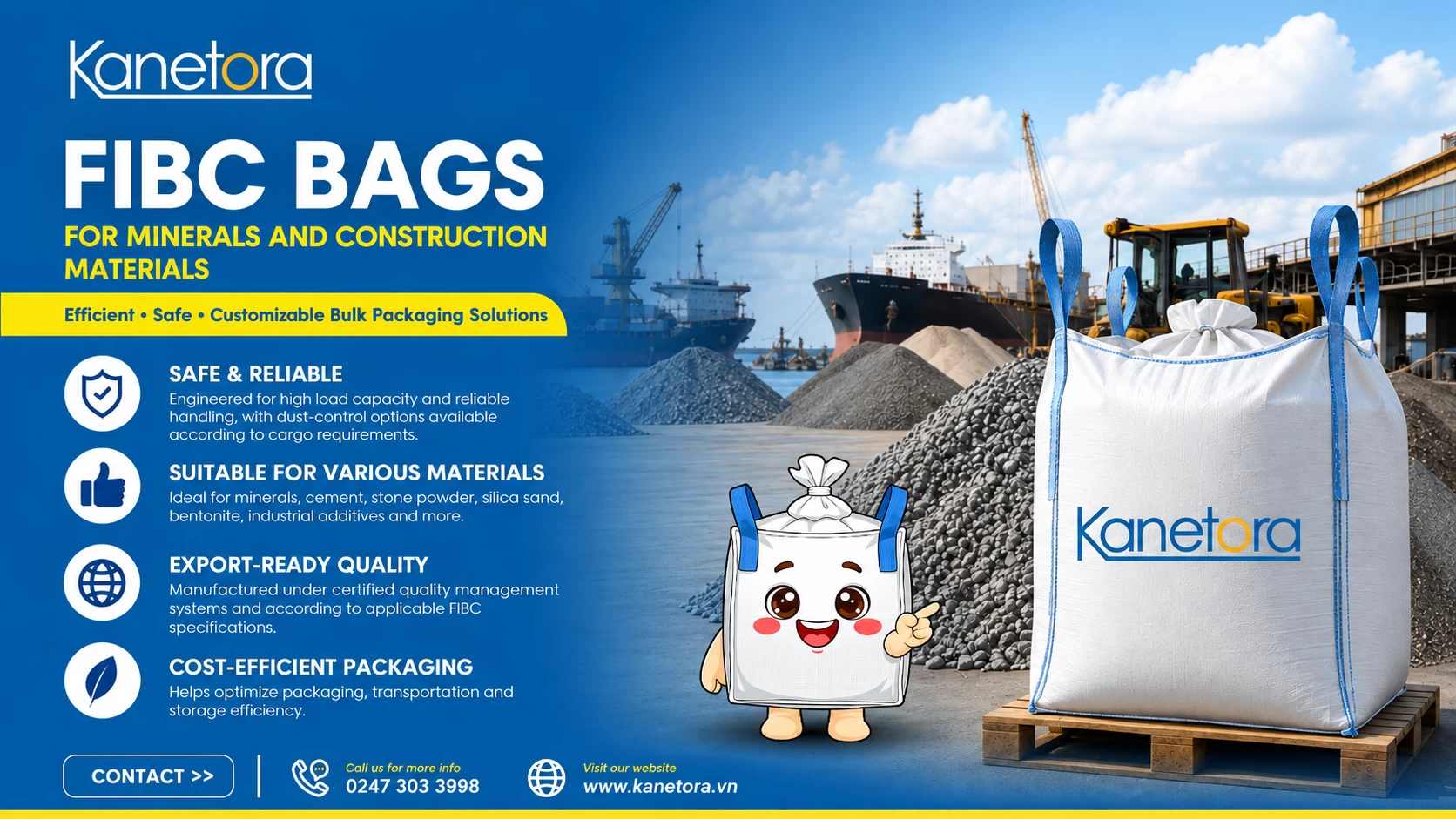
Minerals and construction materials are among the most demanding dry bulk applications for industrial packaging.
Calcium carbonate (CaCO3), silica, talc, bentonite, gypsum, fly ash, cement, dry sand and other mineral products can vary significantly in bulk density, particle size, flowability, moisture sensitivity and abrasiveness.
For this reason, selecting an FIBC should not begin with only:
“I need a 1,000 kg bulk bag.”
or:
“Please quote 180 GSM fabric.”
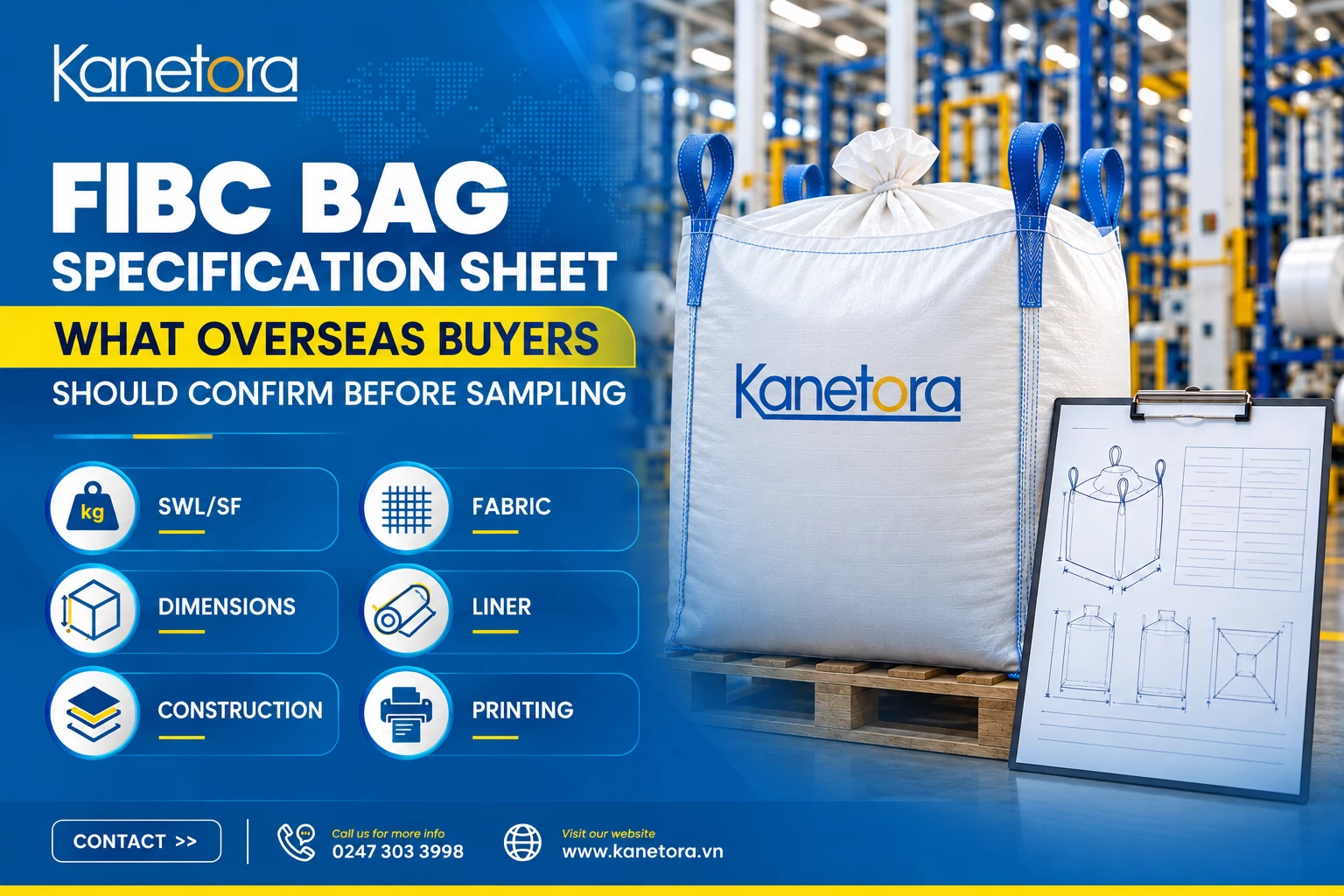
A suitable FIBC specification should consider the cargo itself, target filling weight, woven PP construction, seams, lifting loops, dust leakage, coating or inner liner, outdoor exposure, filling and discharge equipment, pallet configuration and the complete export logistics process.
Buyers who are new to bulk packaging can first review Kanetora’s FIBC and industrial packaging solutions. For a broader overview focused specifically on this industry, Kanetora also provides a guide to FIBC Bags for Cement & Construction Materials.
Quick Answer: Which FIBC Is Suitable for Different Mineral Products?
There is no single FIBC construction that works for every mineral.
| Cargo | Common Risk | FIBC Requirement to Consider |
|---|---|---|
| Calcium carbonate – CaCO3 | Fine powder, dust leakage, relatively high bulk density | Suitable SWL, seam control, coating or liner where required |
| Silica powder | Very fine dust | Dust containment, liner or suitable closed construction |
| Talc | Powder leakage, contamination | Coating, liner, controlled filling and discharge |
| Fly ash | Fine dust, flow characteristics, weight | Suitable fabric and seams, filling/discharge design |
| Gypsum | Moisture sensitivity | Coating, liner and moisture protection |
| Cement | Dust, moisture and load | Dust control, moisture protection, suitable filling spout |
| Dry sand | High weight and abrasion | Strong fabric, lifting loops and seams |
| Bentonite | Fine powder and moisture sensitivity | Dust and moisture control |
| Construction additives | Different formulations | Product-specific specification |
| Mineral granules | Abrasion and handling | Fabric strength, SWL and discharge design |
The key principle is simple:
Select the FIBC according to the actual material characteristics—not only the industry name.
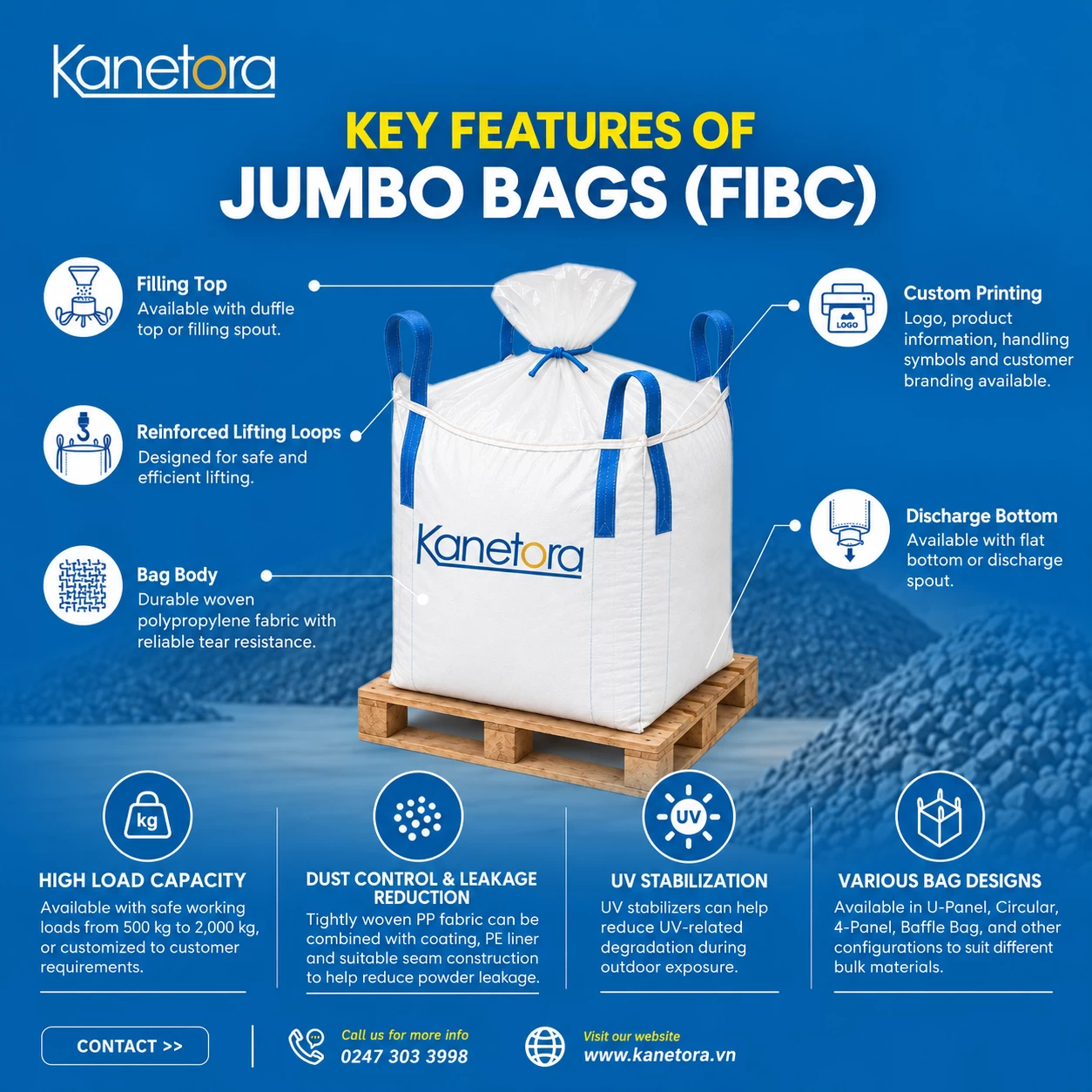
Why Are FIBC Bags Widely Used for Minerals and Construction Materials?
FIBC stands for Flexible Intermediate Bulk Container. Also known as a Jumbo Bag or Bulk Bag, it is designed for storing, lifting and transporting relatively large quantities of dry bulk material.
For mineral and construction applications, FIBCs can help manufacturers:
- Handle larger quantities in each packaging unit
- Reduce the number of individual sacks required
- Support forklift and lifting operations
- Integrate with industrial filling systems
- Use different controlled discharge options
- Add coating or inner liners
- Improve pallet and container handling
- Customize bag dimensions according to cargo density and logistics requirements
However, these benefits depend on correct FIBC design.
A bulk bag designed for plastic resin may not be suitable for fine silica or calcium carbonate powder even when both bags have the same rated SWL.
5 Cargo Properties to Define Before Selecting a Mineral FIBC
1. Bulk Density
Bulk density directly affects the volume required to pack a given cargo weight.
Two materials may both be packed at 1,000 kg per bag but require very different FIBC dimensions because their bulk densities are different.
Bulk density affects:
- Bag width
- Bag depth
- Bag height
- Filled dimensions
- Center of gravity
- Pallet footprint
- Container utilization
Buyers should therefore provide the actual bulk density—or at least the normal operating range—when requesting a quotation.
2. Particle Size
Mineral lumps, granules and micronized powders create very different packaging challenges.
Fine powder can potentially migrate through:
- Openings between woven yarns
- Needle holes in seams
- Construction joints
- Filling areas
- Discharge areas
For fine minerals, dust containment may be more important than simply increasing fabric GSM.
3. Flowability
Some minerals flow easily, while others can bridge, cake, stick to the bag or discharge slowly.
Flow behavior directly affects discharge design.
A poorly designed discharge outlet may cause slow unloading or require manual intervention at the customer’s facility.
4. Abrasiveness
Dry sand and certain mineral granules can create significant friction against the FIBC during filling, transport and discharge.
In such applications, the complete load-bearing system should be assessed:
Yarn → Fabric → Seams → Lifting loops → Handling method
rather than evaluating only bag weight or fabric GSM.
5. Moisture Sensitivity
Cement, gypsum, bentonite and various mineral powders can change their physical properties after absorbing moisture.
Depending on the application, the packaging system may therefore require coated fabric, a PE inner liner or another suitable barrier structure.
For products needing additional internal protection, buyers can review FIBC Bag with Liner: When and Why to Use.
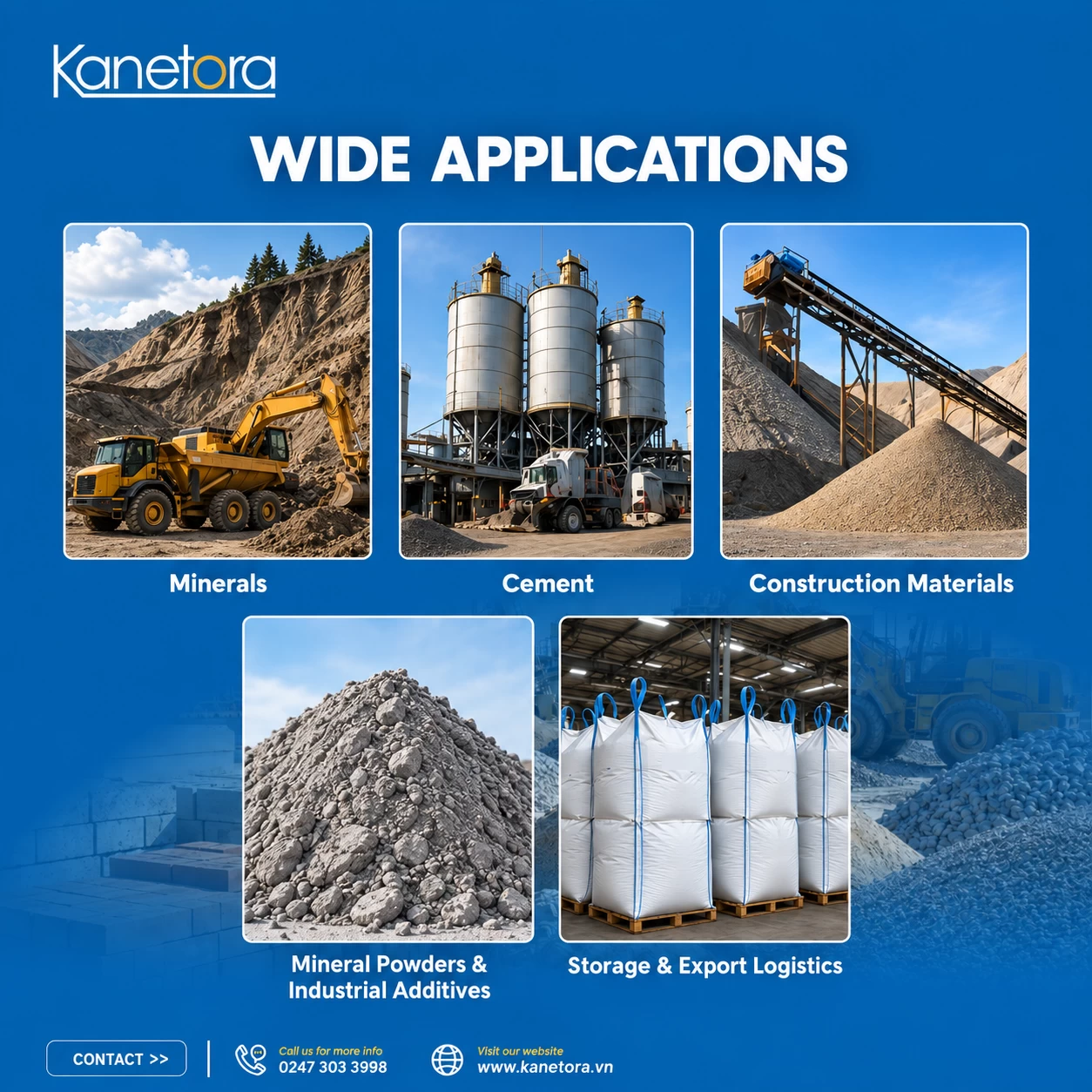
Heavy Cargo Risks: Why Mineral FIBCs Need More Than a High SWL
Minerals are commonly associated with high-load FIBC applications.
But heavy cargo risk is not determined by SWL alone.
During its operating cycle, a filled bag may experience loading and movement through:
Filling → Lifting → Forklift handling → Storage → Inland transport → Container loading → Ocean transit → Destination handling → Discharge
When an FIBC is lifted, the cargo load is transferred through several components:
Cargo → Fabric body → Seams → Lifting loops → Lifting equipment
An FIBC should therefore be treated as a complete load-bearing system.
Using heavier body fabric while ignoring webbing strength, seam construction or loop attachment does not create a properly engineered heavy-duty bag.
What Is SWL?
SWL means Safe Working Load.
It represents the maximum load for which the FIBC is designed to operate under its specified conditions of use.
If the target filling weight is 1,000 kg, the manufacturer still needs more information than simply:
“1,000 kg bag.”
The specification may also depend on:
- Cargo type
- Bulk density
- Filling process
- Lifting method
- Pallet use
- Stacking conditions
- Transport route
- FIBC construction
- Intended number of uses
A bag should never be deliberately loaded beyond its specified SWL simply because there appears to be unused volume.
Is Safety Factor the Same as SWL?
No.
SWL defines the working load.
Safety Factor relates to the design and performance requirements associated with the FIBC’s intended use.
They are connected but they are not interchangeable.
Buyers should also avoid assuming:
Higher GSM = higher Safety Factor.
The overall FIBC design and testing requirements must be considered together.
What Fabric GSM Is Suitable for Mineral FIBCs?
There is no universal GSM value for mineral and construction applications.
GSM means grams per square metre and describes the mass of the fabric per unit area.
It is an important specification parameter, but it does not define complete FIBC performance.
Two fabrics with the same GSM may differ in:
- Yarn denier
- Weaving construction
- Tensile strength
- Elongation
- PP formulation
- Coating
- UV stabilization
- Manufacturing consistency
Instead of beginning with:
“We need a 1,500 kg FIBC using 180 GSM fabric.”
a better engineering sequence is:
Cargo characteristics → Filling weight → Bulk density → Bag dimensions → SWL/Safety Factor → Fabric specification → Lifting loops and seams → Testing
GSM should be part of the resulting design rather than the only measure of quality.
Is Higher GSM Always Better?
Not necessarily.
An unnecessarily heavy construction may:
- Increase packaging weight
- Increase material consumption
- Increase unit cost
- Reduce material efficiency
- Fail to address the actual failure mode
At the same time, fabric that is too light for the application may reduce safety or reliability.
The goal is not maximum GSM.
The goal is appropriate performance for the application.
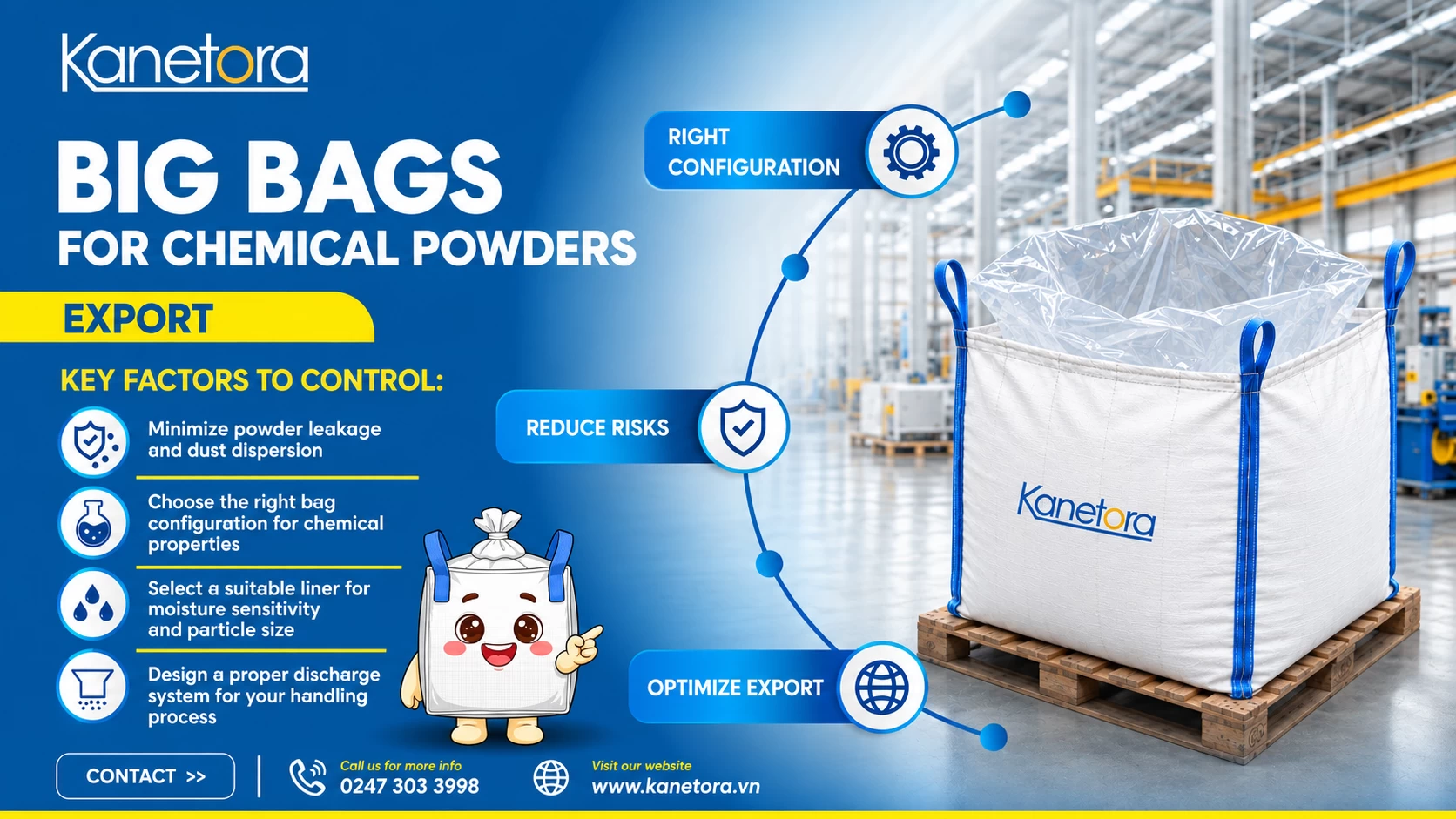
Why Is Dust Leakage a Major Issue for Mineral Powders?
Calcium carbonate, silica, cement and fly ash may contain very fine particles.
If powder escapes during filling, handling or transport, it can cause:
- Product loss
- Dust accumulation in warehouses
- Contaminated shipping containers
- Additional cleaning requirements
- Customer complaints
- Workplace hygiene concerns
- Cross-contamination between products
For export cargo, minor leakage at the filling plant may become more noticeable after multiple handling and transportation stages.
Dust control should therefore be considered during bag design rather than after mass production.
How Can Powder Leakage from an FIBC Be Reduced?
Dust control may involve several parts of the FIBC.
Fabric Construction
Weaving density and coating can influence leakage through the body fabric.
Seam Design
Fine powder may escape through needle holes or sewn joints.
The required seam solution depends on the product and the required level of containment.
Filling Spout
The filling inlet should match the filling equipment.
An unsuitable interface can generate substantial dust during the packing process.
Discharge Spout
The discharge system should also match the receiving process at the destination.
Inner Liner
A suitable liner can provide an additional internal containment layer for very fine powders or moisture-sensitive materials.
Kanetora’s guide to FIBC Bags with Inner Liners explains the role of different liner structures in powder, moisture and contamination control.
Coated FIBC vs FIBC with Inner Liner
These two packaging structures are not the same.
| Criteria | Coated FIBC | FIBC with Inner Liner |
|---|---|---|
| Structure | Coating applied to woven PP fabric | Separate film bag inside the FIBC |
| Dust control | Can help reduce leakage | Can provide stronger internal containment |
| Moisture protection | Limited depending on construction | Can provide greater protection depending on liner |
| High barrier performance | Not the main purpose | Specialized barrier liners are available |
| Complexity | Generally simpler | Depends on liner design |
| Filling/discharge | Air flow must be considered | Liner must also match filling and discharge |
A liner should not automatically be specified simply because the product is a powder.
For some products, coated fabric and suitable seam construction may be enough. Others require a PE liner or higher-barrier structure.
When Should a Mineral FIBC Use a PE Liner?
A liner should be evaluated when the product is:
- Very fine
- Sensitive to humidity
- Cleanliness-sensitive
- Prone to powder leakage
- Stored for extended periods
- Exported through humid environments
- Required to have increased internal protection
The liner must also be dimensioned correctly for the outer FIBC.
A liner that is too small can be subjected to unintended stress.
A liner that is too large may fold, wrinkle or interfere with discharge.
An FIBC liner is therefore not simply “a plastic bag inserted inside another bag.”
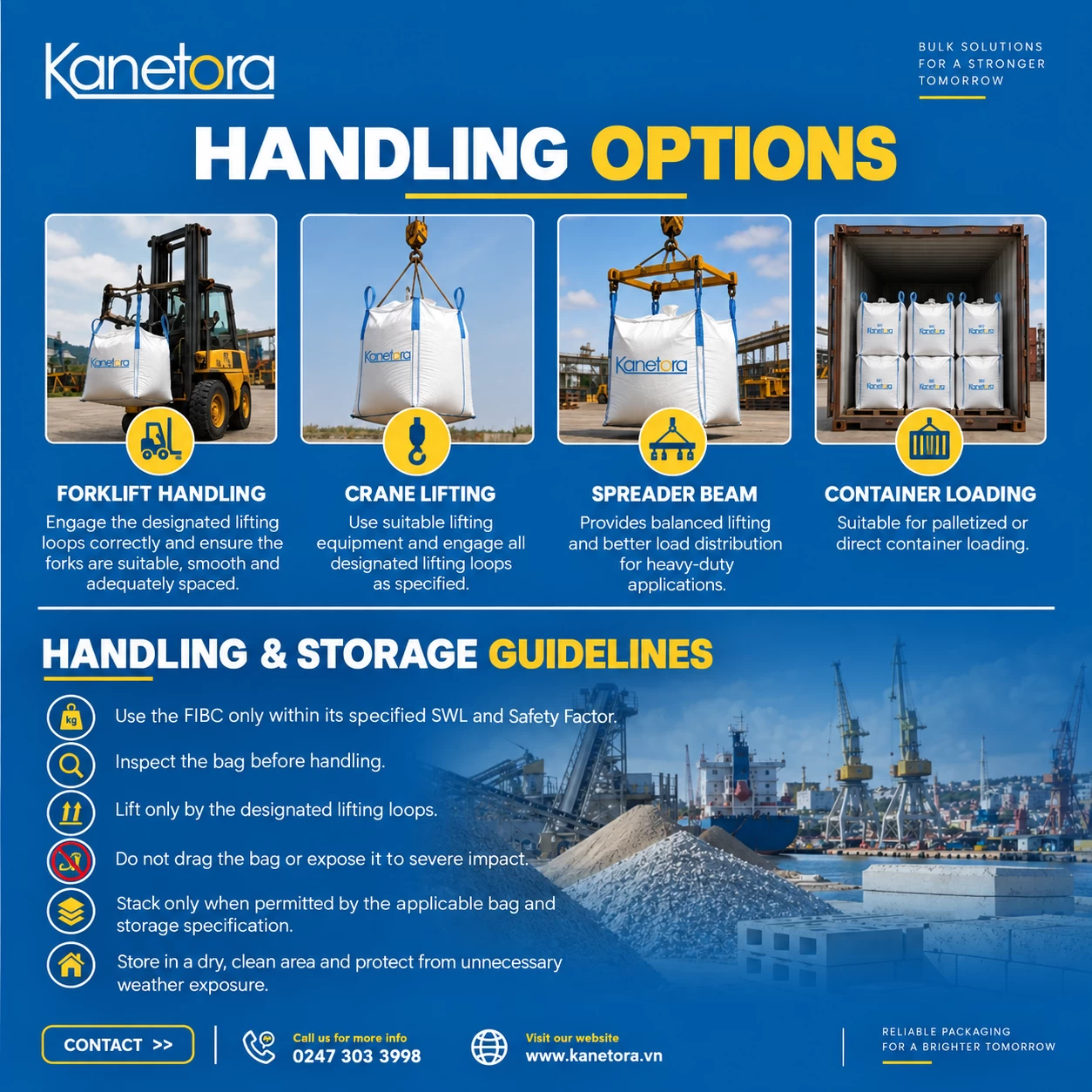
Do Mineral FIBCs Need UV Protection for Outdoor Storage?
UV stabilization should be evaluated whenever the bags may spend meaningful time in direct sunlight.
A typical export route may involve:
Factory filling → Outdoor yard → Inland transport → Port staging → Container → Destination yard
Even if the bags spend most of the ocean journey inside a closed container, they may still experience sunlight before containerization or after arrival.
UV radiation can gradually degrade polypropylene.
For outdoor applications, buyers should therefore define:
- Expected outdoor exposure
- Destination climate
- Fabric color
- Storage method
- UV stabilization requirement
- Applicable test specification
Read Kanetora’s detailed guide to Anti-UV FIBC Bags for Outdoor Storage and Export Transit.
Importantly:
UV resistance does not automatically mean moisture or rain protection.
These are separate packaging requirements.
Are Baffle FIBCs Suitable for Minerals?
They can be highly useful for certain mineral applications.
A conventional FIBC normally expands outward after filling.
A Baffle FIBC incorporates internal panels that help control side bulging and maintain a more compact square shape.
This can support:
- Better pallet stability
- More organized warehouse storage
- Improved container-space utilization
- More consistent unit dimensions
- Cleaner presentation
For high-volume mineral exports, logistics savings may sometimes justify the additional bag construction cost.
However, Baffle FIBCs are not automatically suitable for every powder.
Bulk density, flowability and discharge behavior still need to be evaluated.
See Baffle Bulk Bags: How to Optimize Container Loading Efficiency for additional guidance.
U-Panel, Circular or 4-Panel: Which Construction Is Best?
There is no single best construction.
U-Panel FIBC
A widely used industrial design suitable for many dry bulk products.
Circular FIBC
Uses tubular woven fabric for the main body and therefore reduces some vertical side seams.
4-Panel FIBC
Constructed from individual side panels and suitable for many customized bag designs.
Baffle FIBC
Uses internal baffles to help maintain a squarer shape after filling.
Final selection should be based on:
Cargo → Filling equipment → Discharge method → Logistics → Performance requirement → Cost target
rather than simply repeating the construction used for another product.
Which Filling Top Is Suitable for Mineral Powder?
A filling spout is commonly used for powders.
It can help interface the FIBC with industrial filling equipment and provide better control than a completely open top in many dusty applications.
Important dimensions include:
- Spout diameter
- Spout length
- Closure method
- Filling-machine outlet size
- Dust-extraction arrangement
- Target filling speed
If the filling spout is too small, throughput may be reduced.
If it is too large, creating a controlled connection to existing equipment may become more difficult.
Buyers should provide the dimensions of the filling outlet whenever possible.
Is an Open-Top FIBC Suitable for Minerals?
It may be suitable for some applications, especially when the product produces little dust and the filling method is simple.
For fine powders, however, an open-top design may provide less control over airborne dust than a properly matched filling spout.
The final choice should reflect the actual production process.
Which Discharge Bottom Should Be Used?
The discharge design strongly affects operations at the customer’s facility.
Flat Bottom
A simple construction, but the bag may need to be opened or cut according to a specific unloading procedure.
Discharge Spout
Provides more controlled material flow.
Important variables include:
- Outlet diameter
- Outlet length
- Closure system
- Product flowability
- Receiving-hopper dimensions
- Required discharge rate
Full Open Bottom
Can be suitable where rapid discharge of a large volume is required.
The unloading equipment and safety procedure must be assessed accordingly.
The bottom design should not be selected only for the filling plant.
The end user’s unloading process must also be considered.
When Should Block Bottom Valve Bags Be Used Instead of FIBCs?
For cement, dry mortar, gypsum, tile adhesive or mineral powders sold in smaller unit weights, a Block Bottom Valve Bag may be more appropriate.
A simple comparison is:
Smaller industrial packaging units → Block Bottom Valve Bags
Large-volume bulk handling → FIBC Bags
Kanetora provides a dedicated guide to Block Bottom Valve Bags for Powder Products.
How Does Container Loading Affect FIBC Design?
A bag may perform well at the production plant but still be inefficient for export if its filled dimensions do not match the container-loading plan.
Buyers should consider:
- Filled bag dimensions
- Pallet dimensions
- Internal container dimensions
- Bags per layer
- Stacking arrangement
- Container weight limits
- Forklift access
- Bag bulging
- Destination unloading
The objective is not simply:
“Fit as many bags as possible.”
The better objective is:
Optimize cargo weight per container + safe handling + bag stability + unloading efficiency
This is one reason FIBC dimensions should be developed around real logistics conditions rather than copied from an unrelated existing drawing.
For shipments that move as one complete bulk lot rather than individual bags, buyers may also compare FIBCs with Container Liner Bags for Bulk Cargo. Kanetora’s comparison notes that container liners are more suitable for certain direct bulk movements, while FIBCs are generally more flexible when individual handling, palletization or partial unloading is required.
Do Mineral FIBCs Need Pallets?
Not always.
FIBCs can be handled directly through their lifting loops or combined with pallets depending on the equipment and supply chain.
Pallets may support:
- Forklift handling
- Warehouse organization
- Separation from the floor
- Unit-load management
However, pallets also:
- Consume container volume
- Add shipment weight
- Affect loading patterns
- Introduce additional material requirements
Buyers should therefore decide early whether the export configuration will be:
Palletized or non-palletized.
Should Mineral FIBCs Be Custom Printed?
For many B2B applications, yes.
Printed information may include:
- Company logo
- Mineral name
- Product grade
- Net weight
- Item code
- SWL
- Handling instructions
- Country of origin
- Customer information
- Lot identification area
This is particularly useful for manufacturers exporting multiple grades of calcium carbonate, silica or industrial additives.
For artwork, colors, MOQ and production planning, see Custom Printed FIBC Bags: Logo, Specs, MOQ and Lead Time.
Do Minerals Require Anti-Static FIBCs?
Not all mineral products do.
Electrostatic control depends on:
- Cargo properties
- Dust explosibility
- Presence of flammable atmospheres
- Filling and discharge operations
- Grounding systems
- Plant safety requirements
Type C or Type D should not be selected simply because the product is a powder.
The decision should be based on a proper risk assessment of both the product and the surrounding operating environment.
Kanetora’s comparison of Type C vs Type D FIBC Bags explains why electrostatic FIBC selection must be based on actual process conditions.
Can Dangerous Minerals Use a Standard FIBC?
A standard FIBC should not automatically be used for dangerous goods.
If the material is regulated as dangerous cargo, buyers need to identify the relevant:
- Hazard classification
- Packing requirements
- Applicable packaging design
- Marking requirements
- Testing
- Certification
An FIBC designed for a non-dangerous mineral does not automatically become suitable for dangerous goods simply because the SWL is the same.
What Information Should Buyers Include in an RFQ?
For a more accurate mineral FIBC quotation, buyers should provide:
- Product name and grade
- Powder, granule or lump form
- Bulk density
- Particle size
- Moisture sensitivity
- Abrasiveness where relevant
- Target filling weight
- Required SWL and Safety Factor
- Current bag dimensions if available
- Preferred U-Panel, Circular, 4-Panel or Baffle construction
- Coated or uncoated fabric
- Liner requirement
- Filling system
- Discharge system
- Lifting-loop configuration
- Fabric color
- UV requirement
- Dust-containment requirement
- Printing and labeling
- Palletized or non-palletized loading
- Container type
- Destination market
- Storage conditions
- Annual purchasing volume
- Sample and testing requirements
- Target delivery schedule
If the FIBC design is not yet finalized, buyers can use Kanetora’s OEM/ODM Jumbo FIBC guide as a starting point for specification development.
8 Questions to Ask a Mineral FIBC Supplier
1. Does the Supplier Ask for Bulk Density?
If the quotation is based only on:
“1,000 kg Jumbo Bag”
without asking about bulk density, dimensions or cargo characteristics, the specification may not yet be sufficiently developed.
2. How Was the Fabric GSM Selected?
The answer should consider overall bag performance rather than treating GSM as the only indicator of strength.
3. How Is Powder Leakage Controlled?
The supplier should assess:
Fabric + coating + seams + filling inlet + discharge outlet + liner
as one containment system.
4. Is an Inner Liner Actually Necessary?
A good supplier should recommend a liner because the product requires it—not simply because the cargo is a powder.
5. Does the Filling Spout Match the Existing Equipment?
Providing the filling-machine outlet dimensions helps avoid assumptions.
6. Does the Discharge Design Work for the End User?
The bag must be easy to fill at the origin and practical to unload at the destination.
7. Does the UV Specification Reflect Real Storage Conditions?
For outdoor storage, actual exposure should be evaluated rather than relying only on a generic “UV treated” statement.
8. How Are Quality and Batch Traceability Controlled?
Consistency between production batches is especially important for large export programs.
Example FIBC Configurations for Mineral Applications
The following examples are starting points only and should not replace a technical review.
| Application | Configuration to Evaluate |
|---|---|
| CaCO3 powder | Coated FIBC or liner where required, controlled seams, filling and discharge spouts |
| Silica powder | Higher dust containment, liner where appropriate, controlled filling |
| Cement | Moisture and dust protection, suitable filling inlet and destination discharge |
| Fly ash | Powder containment, appropriate SWL and filling compatibility |
| Gypsum | Moisture assessment, coating or liner depending on logistics |
| Bentonite | Moisture protection combined with dust control |
| Dry sand | Mechanical strength and abrasion resistance |
| Mineral granules | Fabric strength and efficient discharge |
| Palletized mineral exports | Filled dimensions aligned with pallet and container |
| Outdoor mineral storage | UV stabilization and moisture protection assessed separately |
The final specification should always reflect the actual product and operating conditions.
Mineral FIBC Development at Kanetora Bach Dang
Kanetora Bach Dang in Ninh Binh, Vietnam manufactures industrial FIBC solutions for minerals, construction materials and other dry bulk applications.
A mineral FIBC project can be developed through the following sequence:
Cargo analysis → Filling weight and dimensions → Fabric construction → Filling and discharge design → Coating or liner → Printing → Sampling and testing → Commercial production
For mineral applications, the important point is to treat these decisions as one integrated packaging system.
For example:
“1,000 kg FIBC for CaCO3”
is not yet a complete specification.
The manufacturer should also understand:
Bulk density + particle size + powder leakage risk + filling equipment + discharge method + moisture protection + pallet/container configuration + printing requirements
before the commercial bag design is finalized.
Frequently Asked Questions About FIBC Bags for Minerals
Which FIBC is suitable for calcium carbonate powder?
The bag should be selected according to bulk density, particle size, target filling weight, dust-containment requirement, moisture protection and filling/discharge method. Fine CaCO3 powder may require coated fabric, controlled seams or an inner liner.
What SWL is commonly used for mineral FIBCs?
There is no single SWL for the entire industry. It must be selected according to packed weight, bulk density, bag design, handling method and logistics requirements.
Is higher GSM always better for mineral bulk bags?
No. GSM is only one fabric parameter. Performance also depends on yarn, weaving, tensile properties, lifting loops, seams and the overall FIBC design.
Can FIBC bags reduce calcium carbonate dust leakage?
Yes. A suitable combination of fabric construction, coating, seam control and inner liner can help reduce powder leakage.
Can coated FIBC replace a PE liner?
Not in every application. Coating can improve dust and moisture resistance, while a liner creates a separate internal film layer. The correct solution depends on the cargo and required protection level.
Does cement need moisture-resistant FIBC packaging?
If the cargo may be exposed to humidity during storage or transportation, moisture protection should be evaluated. Suitable solutions may include coating, a liner or additional outer protection.
Do minerals stored outdoors require UV-stabilized FIBCs?
UV stabilization should be considered when the bags may be exposed to direct sunlight. The requirement should be based on actual exposure conditions rather than a simple time claim.
Can Baffle FIBCs be used for stone or mineral powder?
Yes, where better shape retention and container utilization are required. Bulk density, flowability and discharge behavior must still be considered.
Can mineral grade and company logos be printed on FIBCs?
Yes. Product grade, logos, net weight, SWL and logistics information can be incorporated into an approved printing layout.
Does very fine silica powder need an inner liner?
A liner should be evaluated when stronger dust containment, moisture protection or cleanliness is required. It is not automatically mandatory for every powder.
Mineral FIBCs Should Be Engineered as a Complete System
When selecting FIBCs for minerals and construction materials, the most useful question is not simply:
“What GSM is this bag?”
A better question is:
“How is this FIBC designed to safely contain, lift, transport and discharge my specific mineral product?”
A complete specification should connect:
Cargo Properties → Bulk Density → Filling Weight → SWL/Safety Factor → Fabric and Seams → Dust Control → Moisture/UV Protection → Filling & Discharge → Logistics
If one part of that chain is ignored, simply increasing fabric GSM or adding a liner may not solve the actual packaging problem.
For export shipments, the FIBC should also be evaluated together with pallets, container dimensions, outdoor storage and handling practices at the destination.
Looking for FIBC Bags for CaCO3, Silica, Cement or Construction Materials?
Send Kanetora information about:
Product + bulk density + filling weight + particle size + bag dimensions + filling/discharge process + coating/liner requirements + storage conditions + destination market + expected purchasing volume
Our team can review the application and support the development of an FIBC structure suited to the cargo and actual export supply chain.
Kanetora Joint Stock Company
Hotline: +84 (0) 247 303 3998
Email: info@kanetora.vn
Website: www.kanetora.vn