

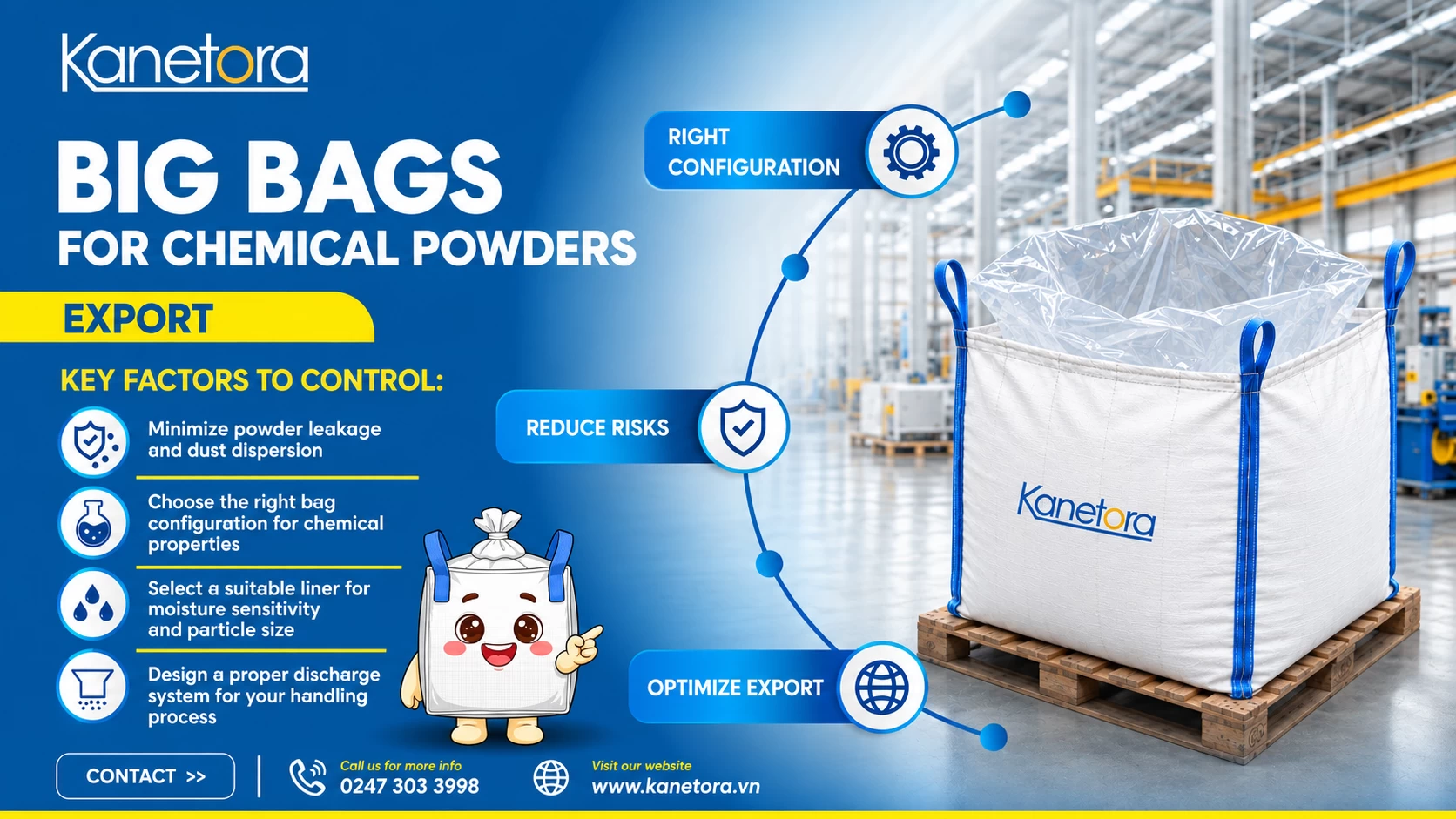
Chemical powders are among the industrial products that require the most careful FIBC specification.
Two products may both be described simply as “chemical powder” while behaving very differently during filling, storage, transportation and discharge.
Differences in particle size, bulk density, flowability, moisture sensitivity, electrostatic behavior, chemical properties and dangerous-goods classification can completely change the packaging requirements.
For this reason, a request such as:
“Please quote a 1,000 kg FIBC for chemical powder.”
does not provide enough information to develop a reliable bag specification.
The FIBC manufacturer should understand the product, filling equipment, discharge process, operating environment, transport conditions and applicable regulatory requirements before defining the woven fabric, coating, liner, filling top, discharge bottom or electrostatic-control system.
Buyers developing a new bag specification can first review Kanetora’s industrial FIBC and packaging solutions and its OEM/ODM Jumbo FIBC guide before moving into application-specific chemical requirements.
Quick Answer: Which FIBC Is Suitable for Chemical Powders?
There is no single FIBC construction suitable for every chemical powder.
The correct approach is to identify the cargo risks first, then engineer the packaging around them.
| Product characteristic | Main packaging concern | FIBC features to evaluate |
|---|---|---|
| Very fine powder | Dust leakage and product loss | Fabric construction, coating, seam control, liner |
| Moisture-sensitive powder | Caking or product degradation | PE liner or barrier liner |
| Poor-flowing powder | Difficult or incomplete discharge | Discharge-spout dimensions and bottom design |
| Static-sensitive process | Electrostatic discharge | Type B, C or D assessment and compatible liner |
| Combustible dust | Potential ignition risk | Electrostatic risk assessment and operating controls |
| Dangerous goods | Transport compliance | UN classification and approved packaging |
| Oxygen/odor-sensitive product | Product deterioration | Suitable barrier liner |
| Outdoor storage | UV degradation of polypropylene | UV stabilization based on exposure conditions |
The key point is simple:
“Chemical powder” describes an application category. It does not define an FIBC specification.
1. Not All Chemical Powders Present the Same Risk
The first packaging decision should be based on the product itself.
A non-hazardous inorganic additive may require only a coated FIBC with a PE inner liner.
A fine powder used in a process with significant electrostatic risk may require static-protective packaging.
A chemical classified as dangerous goods may require a tested and approved UN FIBC together with the correct marking and transport documentation.
The first question should therefore not be:
“Should I use Type C or Type D?”
A better starting point is:
“What can happen to this product and its surroundings during filling, handling, storage, transportation and discharge?”
Where available, the buyer should provide the product’s Safety Data Sheet (SDS) as part of the technical review.
2. Six Product Factors to Define Before Selecting the Bag
Particle Size and Dust Behavior
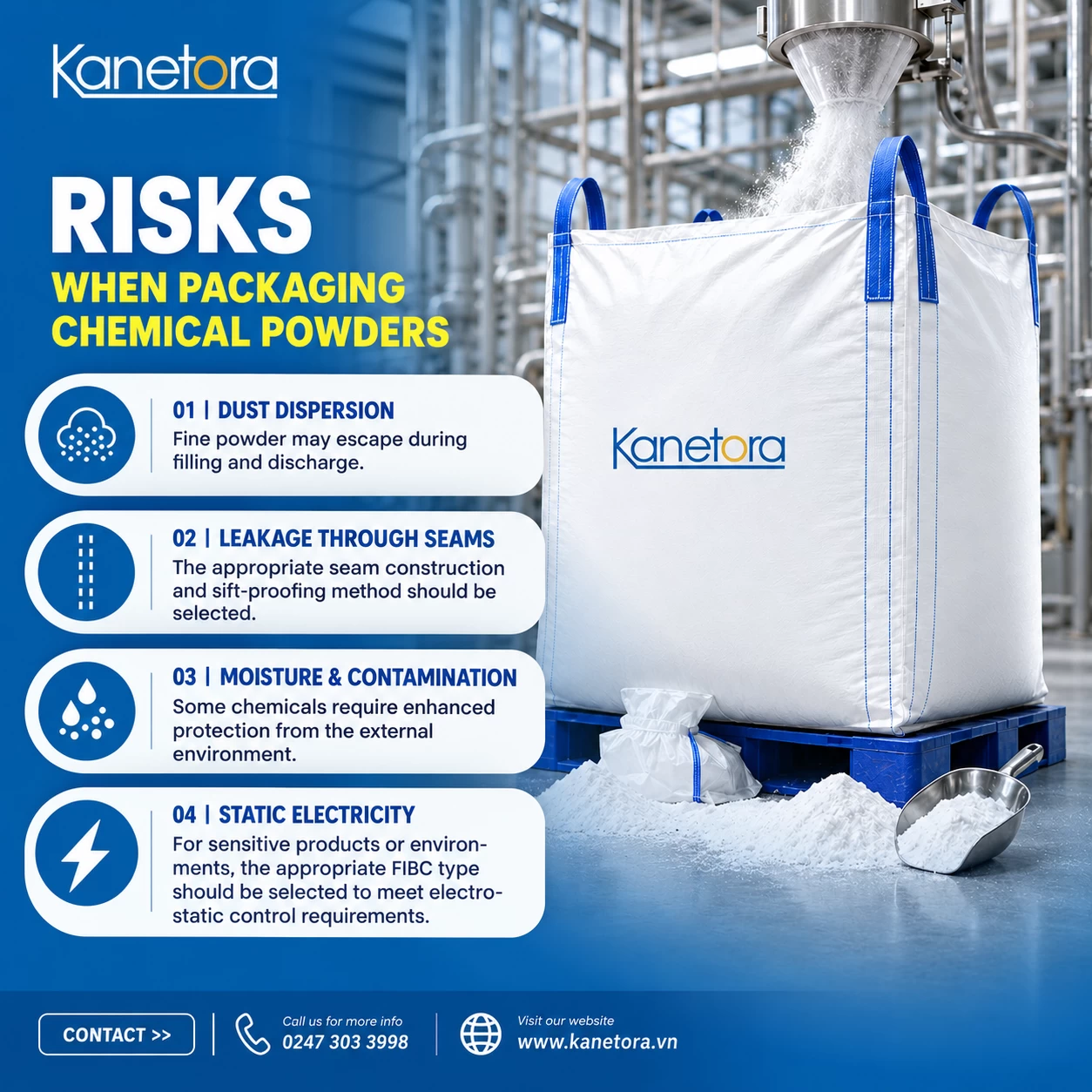
Fine powders can migrate through woven fabric openings, needle holes, seams, filling interfaces and discharge areas.
For these products, dust containment should be considered as a complete system involving:
Fabric → Coating → Seam Construction → Filling System → Discharge System → Inner Liner
Simply increasing fabric GSM does not necessarily solve powder leakage.
Bulk Density
Bulk density determines how much bag volume is needed for a target filling weight.
A 1,000 kg low-density powder may require a substantially larger FIBC than 1,000 kg of a dense inorganic chemical.
Bulk density therefore affects bag dimensions, filled shape, center of gravity, pallet configuration and container utilization.
Flowability
Some powders flow freely while others may cake, bridge or adhere to the liner.
These characteristics directly affect the discharge system.
A standard discharge spout that performs well with granules may work poorly with a cohesive powder.
Moisture Sensitivity
Hygroscopic chemicals can absorb moisture, cake or experience changes in physical properties.
Depending on the required level of protection, buyers may need coated fabric, a PE liner or a higher-barrier liner.
Kanetora explains these options in more detail in FIBC Bag with Liner: When and Why to Use.
Electrostatic Risk
Movement of powder during filling and emptying can generate electrostatic charge through friction.
Where combustible dust or flammable gases and vapors are present, an electrostatic discharge can become an ignition source.
IEC 61340-4-4:2018 covers the electrostatic classification of FIBCs and includes requirements relating to FIBC types, inner liners, testing, design and safe use in explosive atmospheres. IEC Webstore
Dangerous-Goods Classification
Electrostatic classification and dangerous-goods classification are different issues.
A product may require static control without being classified as dangerous goods for transport.
Conversely, dangerous goods may require specific UN-approved packaging even when electrostatic protection is not the primary hazard.
The UN Model Regulations cover classification, packaging, IBC construction and testing, marking, labeling and other transport requirements for dangerous goods. UNECE
 3. When Does a Chemical Powder Need an Inner Liner?
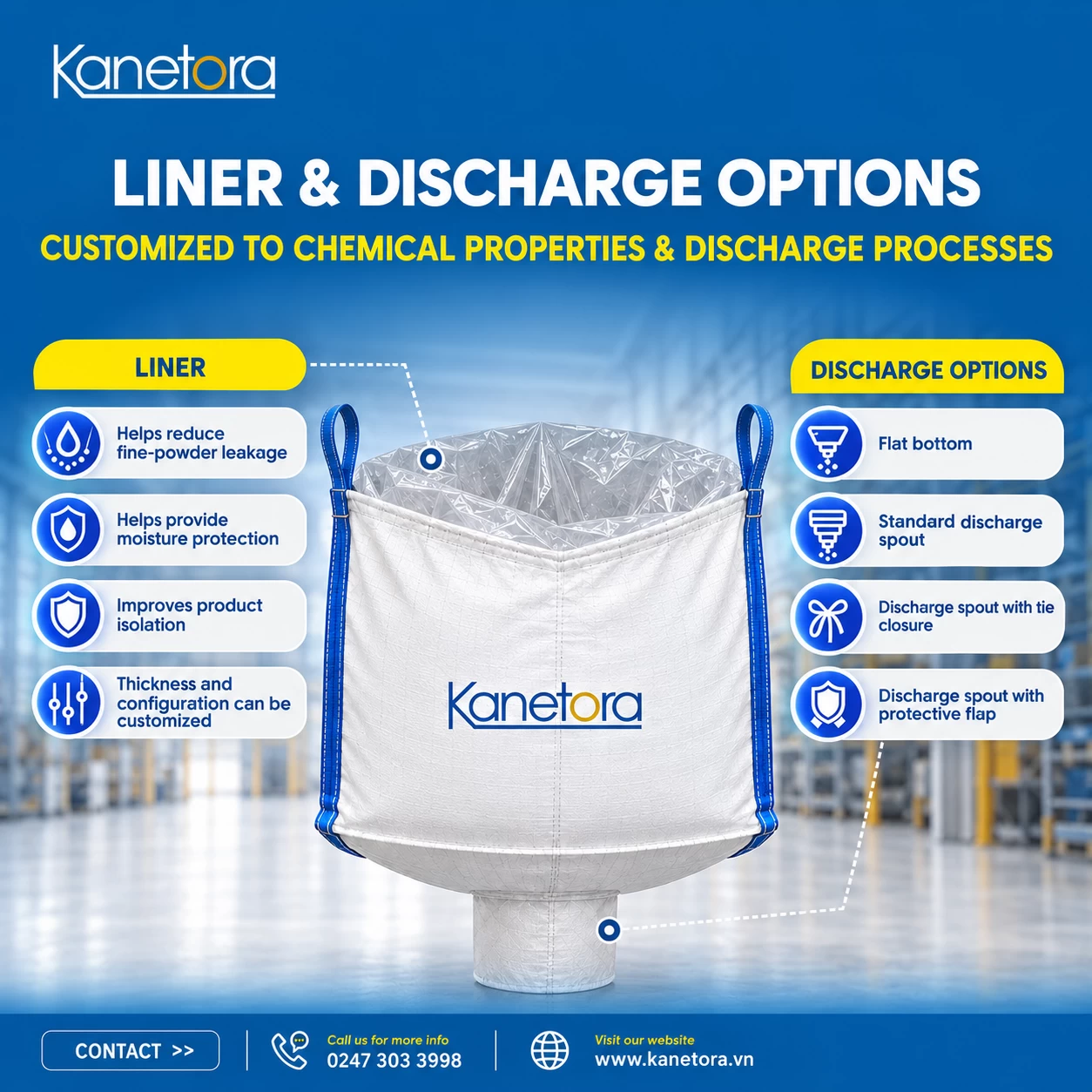
An FIBC liner is a separate film structure placed inside the woven polypropylene outer bag.
The outer FIBC provides load-bearing capability and lifting strength, while the liner provides an additional layer of product containment or environmental protection.
A liner should be evaluated where the powder is particularly fine, hygroscopic, contamination-sensitive, prone to leakage or sensitive to oxygen, odor or other external influences.
However, the presence of a liner should not automatically be interpreted as better packaging.
The liner material, dimensions, fixing method and compatibility with the filling and discharge process all matter.
For a detailed overview of liner structures, buyers can refer to Kanetora’s FIBC liner selection guide.
4. Which Liner Type Is Suitable for Chemical Powders?
Standard PE Liner
A standard polyethylene liner is widely used where additional dust containment and moisture protection are required.
It is a practical starting point for many dry chemical powders, but it does not automatically provide high-barrier or electrostatic performance.
Form-Fit Liner
A form-fit liner is designed to follow the internal shape of the FIBC more closely.
This may reduce liner twisting, folding or displacement during filling and discharge and can improve operational consistency.
Flanged Liner
A liner can also be configured with inlet or discharge flanges that align with the FIBC filling and emptying structures.
This can be useful where the packaging needs to connect more reliably with process equipment.
Barrier Liner
Where the product requires stronger protection from moisture, oxygen, odor or other environmental factors, a multilayer barrier structure may be more appropriate than a conventional PE film.
Conductive or Static-Protective Liner
This area requires particular care.
A standard liner should not simply be added to a Type C or Type D FIBC without technical evaluation.
IEC 61340-4-4 specifically includes classification, testing and safe-use requirements for inner liners because the liner can influence the electrostatic behavior of the complete FIBC system. IEC Webstore
5. Type A, B, C or D: Which FIBC Is Suitable?
The electrostatic classification of an FIBC should be based on the complete process rather than only the name of the product.
| FIBC Type | General principle | Key consideration |
|---|---|---|
| Type A | No specific electrostatic protection | Not suitable where static protection is required |
| Type B | Helps prevent certain high-energy propagating brush discharges | Limited static protection; no charge-dissipation system |
| Type C | Conductive structure transfers charge to earth | Must be properly grounded |
| Type D | Static-protective fabric dissipates charge without grounding | Must be used within qualified operating conditions |
Type C and Type D are particularly relevant when electrostatic ignition risk is a concern, but they operate differently.
A Type C FIBC uses interconnected conductive elements and depends on a reliable path to earth.
A Type D FIBC uses specially engineered static-protective fabric and does not require a physical grounding connection.
Kanetora provides a dedicated comparison in Type C vs Type D FIBC Bags for Export Cargo.
6. What Must Buyers Understand About Type C FIBCs?
Grounding is not an optional precaution for Type C.
It is part of the bag’s operating principle.
Before filling or discharge, the designated grounding point must be connected to a suitable earth connection and remain connected throughout product movement.
The overall system therefore involves:
FIBC conductive network → Grounding point → Cable/clamp → Verified earth connection
Selecting Type C makes the most sense where grounding can be controlled consistently at both the filling and receiving locations.
Kanetora’s current Type C/Type D guide also emphasizes that Type C must remain grounded throughout filling and discharge. Kanetora
7. Does Type D Mean “No Static-Safety Procedure Required”?
No.
The fact that Type D does not require a grounding cable does not make it universally suitable.
The performance of the complete system still depends on factors such as the qualified fabric, liner compatibility, surface contamination, bag condition and the operating environment.
For this reason:
“No grounding required” does not mean “no electrostatic controls required.”
Type D should be specified and used only within the conditions for which the system has been evaluated.
8. Is a UN Certified FIBC the Same as Type C or Type D?
No.
These classifications address different risks.
Type C and Type D relate to electrostatic behavior during handling and processing.
UN Certified FIBCs relate to packaging requirements for specified dangerous goods during transport.
A particular application may require one, the other, or both.
A UN FIBC is not automatically electrostatic-safe.
Likewise, a Type C or Type D FIBC is not automatically approved for the transport of dangerous goods.
Kanetora covers the transport side separately in UN Certified FIBC Bags for Hazardous Materials Export.
9. When Are UN Certified FIBCs Required for Chemical Powders?
Not every chemical requires UN packaging.
If the product is classified as dangerous goods for transportation, the packaging decision may depend on information such as:
| Information | Why it matters |
|---|---|
| UN Number | Identifies the dangerous good |
| Proper Shipping Name | Defines the regulated transport description |
| Class / Division | Identifies the hazard category |
| Packing Group | Indicates relative hazard where applicable |
| Transport mode | Sea, road, rail or air requirements may differ |
| Packing instruction | Defines permitted packaging options |
| Filled mass | Must remain within the approved packaging specification |
| Required markings | Must correspond to the approved packaging design |
The current UN Model Regulations cover dangerous-goods classification, packaging provisions, IBC requirements, testing and consignment procedures. UNECE
For this reason, buyers should never select a UN FIBC only by bag dimensions or SWL.
The packaging must match the actual dangerous-goods profile of the product.
10. Dust Containment Is More Than Adding a Liner
For fine chemical powders, product leakage can occur at several points in the packaging system.
The woven fabric and coating influence leakage through the bag body.
Seam construction affects leakage through needle holes and sewn joints.
The filling system determines how effectively the bag interfaces with the packing equipment.
The discharge system affects how the product is controlled at the receiving plant.
The liner provides an additional internal containment layer.
A better engineering approach is therefore:
Dust Containment = Fabric + Coating + Seams + Filling + Discharge + Liner
rather than:
Dust problem = thicker liner
This distinction can help buyers solve the actual source of leakage instead of increasing material unnecessarily.
11. How Should Buyers Select the Filling System?
Common FIBC filling configurations include open top, duffle top and filling spout designs.
For chemical powders, the filling system should be matched to the plant equipment.
Open Top
An open-top design is mechanically simple but may provide less containment when handling fine or dusty powders.
It is generally more suitable where dust generation is limited or where the filling process does not require a sealed interface.
Duffle Top
A duffle top allows a large filling opening while providing a closure after filling.
It can be useful where the product or filling process requires wider access.
Filling Spout
A filling spout is commonly used for powder applications that need a controlled connection to industrial filling equipment.
Important parameters include spout diameter, spout length, closure method and the dimensions of the filling-machine outlet.
A filling spout that is too small may reduce throughput.
A spout that is too large may make it difficult to achieve a controlled connection.
The filling equipment should therefore be considered before the final bag drawing is approved.
12. How Should the Discharge Bottom Be Selected?
The discharge system should be based on the receiving process, not only the filling plant.
Flat Bottom
A flat-bottom FIBC is relatively simple but usually requires the bag to be opened or cut according to the unloading procedure.
This may work well for one-time complete discharge where precise flow control is not required.
Discharge Spout
A discharge spout provides greater control over the material flow.
Its performance depends on the product and parameters such as outlet diameter, length, closure method and receiving-hopper dimensions.
Full-Open Bottom
A full-open bottom may be useful where a large quantity needs to be released quickly.
However, the receiving equipment, operator procedure and safety controls must be suitable for rapid discharge.
The best bottom design is therefore determined by:
Product flow behavior + Receiving equipment + Required discharge rate + Operator procedure
13. What About Powders That Bridge or Discharge Poorly?
Some chemical powders are cohesive rather than free-flowing.
They may cake, stick to the liner or form a bridge above the outlet.
Simply increasing the discharge-spout diameter may not solve the problem.
The supplier may need to review particle size, moisture level, angle of repose, bulk density, friction against the liner, bottom geometry and any discharge-assistance equipment.
For technically difficult materials, providing an actual product sample or detailed flow data during development can be valuable.
14. Coated FIBC or Inner Liner for Moisture-Sensitive Chemicals?
Coating and lining are different approaches.
| Factor | Coated FIBC | FIBC with Inner Liner |
|---|---|---|
| Structure | Polymer coating applied to woven PP | Separate film inside the outer bag |
| Dust control | Can reduce leakage through fabric | Adds a separate containment layer |
| Moisture protection | Limited by overall construction | Can provide higher protection |
| Seams | Still need separate consideration | Product is contained by liner |
| High barrier | Not normally the primary purpose | Multilayer barrier structures are possible |
| Electrostatics | Must still be evaluated | Liner can significantly affect electrostatic behavior |
A coated FIBC can be sufficient for some dry powders.
Other chemicals may require a PE liner or specialized barrier film.
The choice should depend on the actual moisture-protection target rather than simply specifying “waterproof FIBC.”
15. What If the Chemical FIBC Is Stored Outdoors?
UV resistance and moisture protection should be treated as separate functions.
UV stabilizers can help reduce polypropylene degradation caused by sunlight.
They do not automatically make the FIBC rainproof or moisture-tight.
If the cargo is both moisture-sensitive and exposed to sunlight during the supply chain, the specification may need to evaluate:
UV stabilization + Coating + Liner + Top closure + Pallet/container protection
Kanetora discusses outdoor exposure in more detail in Anti-UV FIBC Bags for Outdoor Storage and Export Transit. The article specifically notes that UV resistance does not itself solve moisture ingress, powder leakage, contamination or electrostatic risk. Kanetora
16. How Should the Bag Dimensions Be Determined?
The design process should begin with the product rather than an arbitrary bag size.
A practical sequence is:
Target Filling Weight → Bulk Density → Required Product Volume → Filling Level → FIBC Dimensions → Pallet and Container Plan
For example, a chemical powder with a bulk density of 0.6 t/m³ requires significantly more volume for 1,000 kg than a product with a bulk density of 1.2 t/m³.
Incorrect bag dimensions can lead to poor shape stability, unsuitable center of gravity, inefficient pallet use or wasted container space.
17. SWL and Safety Factor: Why GSM Alone Is Not Enough
Safe Working Load should match the intended filled weight and handling conditions.
The complete load-bearing structure includes the body fabric, lifting loops, seams and attachment areas.
For this reason, buyers should not define bag safety by fabric GSM alone.
A heavier fabric does not automatically compensate for an unsuitable loop design or seam construction.
The technical specification should connect:
Cargo → Filling Weight → Bag Dimensions → SWL/Safety Factor → Fabric → Lifting Loops → Seams → Testing
18. What Information Can Be Printed on Chemical FIBCs?
Depending on the project, printing may include the company logo, product name, grade, net weight, item code, SWL, handling instructions, warnings, importer information and logistics markings.
Particular care is required with:
UN markings, Safety Factor, hazard-related markings and certification claims.
Printed information must match the actual approved specification and applicable documentation.
Printing a certification-related mark on a bag does not itself make the bag certified.
For artwork preparation, buyers can review Custom Printed FIBC Bags: Logo, Specs, MOQ and Lead Time.
19. Chemical FIBC Supplier Checklist
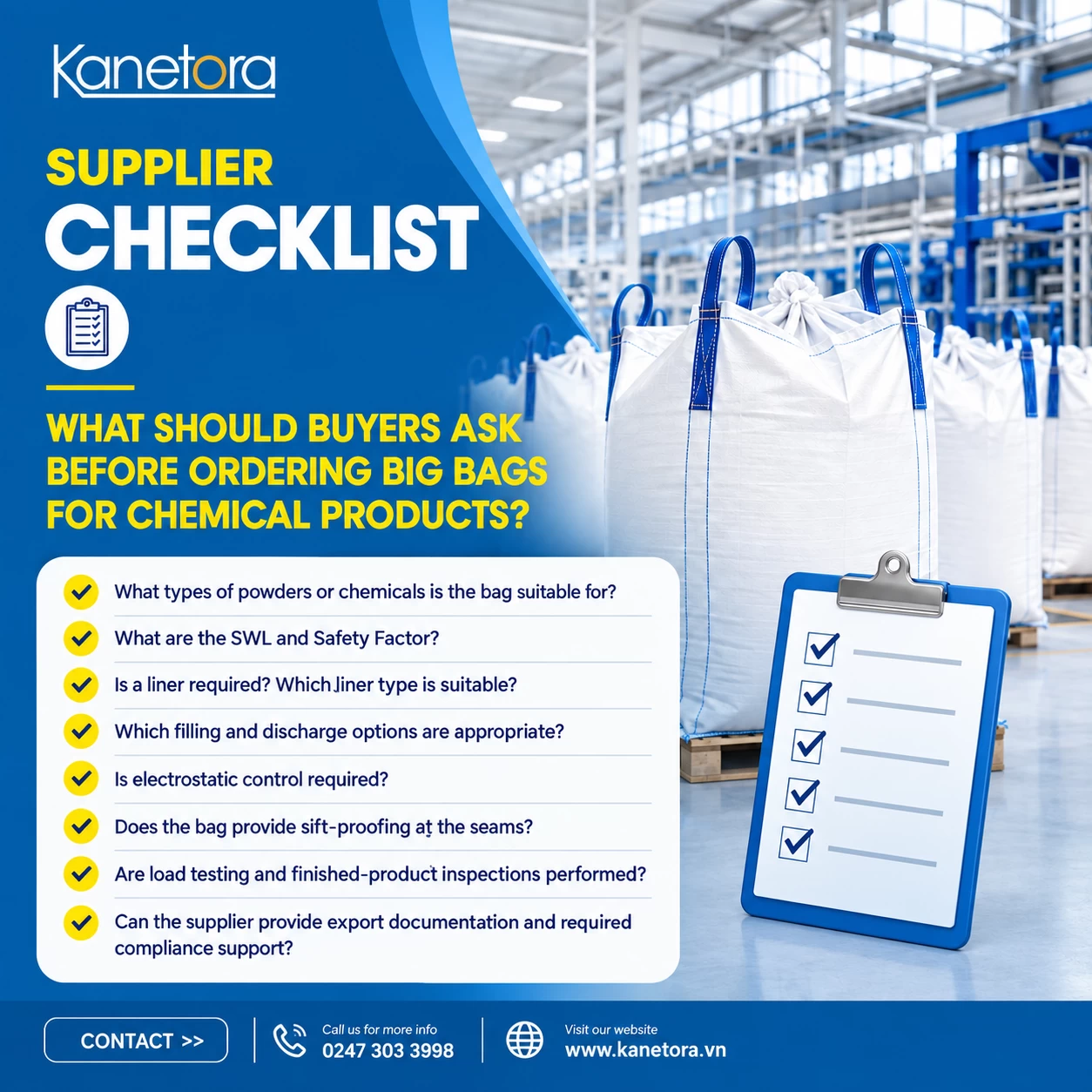
Chemical applications require more than checking factory capacity and unit price.
| Question | Evidence to Request | Warning Sign |
|---|---|---|
| Does the supplier ask for product/SDS information? | RFQ and technical review | Immediate quotation with no product questions |
| Is dangerous-goods status checked? | UN number, class and packing group where applicable | One generic bag proposed for all chemicals |
| Is electrostatic risk understood? | Type B/C/D assessment | Bag selected only by product name |
| Are Type C grounding requirements documented? | Specification and operating instructions | No clear grounding procedure |
| Is Type D qualification supported? | Relevant test documentation | Generic “anti-static” claims only |
| Is the liner compatible with the bag? | Liner specification | Arbitrary substitution of PE liner |
| Is powder leakage addressed as a system? | Fabric, seam, coating and liner details | Only higher GSM proposed |
| Are filling/discharge dimensions reviewed? | Technical drawing | Supplier does not ask about equipment |
| Is load performance tested? | Applicable test report | Report belongs to another bag design |
| Is production traceable? | Batch and lot records | No material or production traceability |
| Does a UN claim match the actual design? | Relevant certification/test documentation | One approval used for all constructions |
| Is final inspection defined? | QC/QA criteria | Visual inspection only |
A capable supplier should be able to discuss the application, not merely reproduce a bag drawing.
20. RFQ Checklist for Chemical Powder FIBCs
To receive a technically meaningful proposal, buyers should provide the following information whenever available:
- Product name and grade; Safety Data Sheet; powder, granule or other physical form; bulk density; particle size; flowability; moisture sensitivity; dust-containment requirement; target filling weight; required SWL and Safety Factor; bag construction if already defined; coated or uncoated fabric; liner requirement; electrostatic requirement; Type A/B/C/D classification if already determined; hazardous-area conditions; grounding capability; UN number, class and packing group where applicable; filling-top design; discharge-bottom design; filling and receiving-equipment dimensions; pallet configuration; outdoor-storage conditions; UV requirement; artwork and markings; destination country; transport mode; expected purchasing volume; sample requirements; and applicable test/document requirements.
A good RFQ changes the sourcing conversation from:
“How much is a 1-ton chemical FIBC?”
to:
“Which FIBC system is appropriate for this product and operating environment?”
21. Chemical FIBC Manufacturing Capability at Kanetora Bach Dang
Kanetora Bach Dang in Ninh Binh Province, Vietnam, has a published FIBC production capacity of approximately 300,000 bags per month. Kanetora’s current packaging profile lists BRC Grade A, ISO 9001:2015, ISO 14001:2015 and ISO 22000:2018 among the factory certifications. Kanetora
The manufacturing system covers the major FIBC production stages, including extrusion, webbing and fabric weaving, lamination, cutting and printing, sewing, inspection and packing. Kanetora
Depending on the project, FIBC structures can incorporate coated or uncoated woven PP fabric, different filling and discharge systems, liners, custom printing, static-control structures and other application-specific requirements.
For technically customized projects, buyers can use Kanetora’s OEM/ODM Jumbo FIBC guide to prepare the initial specification.
Frequently Asked Questions About FIBC Bags for Chemical Powders
Does every chemical powder require an inner liner?
No.
A liner should be evaluated according to powder fineness, moisture sensitivity, contamination requirements and leakage risk.
Some applications may be adequately served by coated fabric and suitable seam construction.
Does every chemical powder require Type C or Type D?
No.
Electrostatic classification depends on the product, combustible-dust risk, surrounding atmosphere and operating conditions.
The fact that a product is a chemical powder does not automatically make Type C or Type D necessary.
What is the main difference between Type C and Type D?
Type C uses conductive elements to transfer electrostatic charge to earth and therefore requires grounding.
Type D uses qualified static-protective fabric and does not require a physical grounding connection, but it must still be used according to its specified operating conditions. Kanetora
Can a standard PE liner be added to a Type C or Type D bag?
It should not be added or replaced without technical review.
The inner liner can affect the electrostatic behavior of the complete system, and IEC 61340-4-4 includes liner classification and testing requirements. IEC Webstore
Does every exported chemical require a UN Certified FIBC?
No.
UN packaging requirements depend on dangerous-goods classification and the applicable transport provisions.
The product’s UN number, hazard class, packing group where applicable and packing instruction should be established before the packaging is selected. UNECE
Is a UN Certified FIBC automatically anti-static?
No.
UN dangerous-goods packaging requirements and FIBC electrostatic classification address different hazards.
An application may require both, but one classification does not automatically satisfy the other.
Should moisture-sensitive chemicals use coating or an inner liner?
It depends on the required protection level.
Coating can help reduce permeability through the woven body, while a liner creates a separate internal film layer. More demanding products may require a multilayer barrier liner.
What discharge-spout diameter should be used?
There is no universal diameter.
It should be selected according to product flowability, discharge rate, receiving-hopper dimensions and the customer’s unloading equipment.
Do outdoor chemical FIBCs need UV stabilization?
UV stabilization should be evaluated where significant sunlight exposure is expected.
However, UV stabilization does not replace coating, liner or other moisture-protection measures.
Chemical Powder FIBCs Should Be Engineered as a Complete Packaging System
For chemical applications, the most useful sourcing question is not simply:
“Does this FIBC have a liner?”
or:
“Is this a Type C bag?”
The more important question is:
“Does the complete FIBC system match my product, equipment, operating environment and transport requirements?”
A robust specification should connect:
Product → SDS → Powder Characteristics → Filling Weight → FIBC Construction → Dust Containment → Liner → Electrostatic Control → Filling → Discharge → Logistics → Regulatory Requirements
Ignoring one of these elements can create problems that cannot be solved simply by increasing fabric GSM or adding a thicker liner.
For electrostatic or dangerous-goods applications in particular, buyers should evaluate the complete qualified configuration, rather than treating each component as an independent option.
Looking for FIBC Bags for Chemical Powder Export?
Provide Kanetora with information on the chemical product, SDS, bulk density, particle size, filling weight, dust and moisture requirements, electrostatic conditions, filling and discharge equipment, dangerous-goods classification where applicable, destination market and expected purchasing volume.
Kanetora can support the development of an FIBC, liner and filling/discharge configuration based on the actual product and operating conditions.
Kanetora Joint Stock Company
Hotline: +84 (0) 247 303 3998
Email: info@kanetora.vn
Website: kanetora.vn