

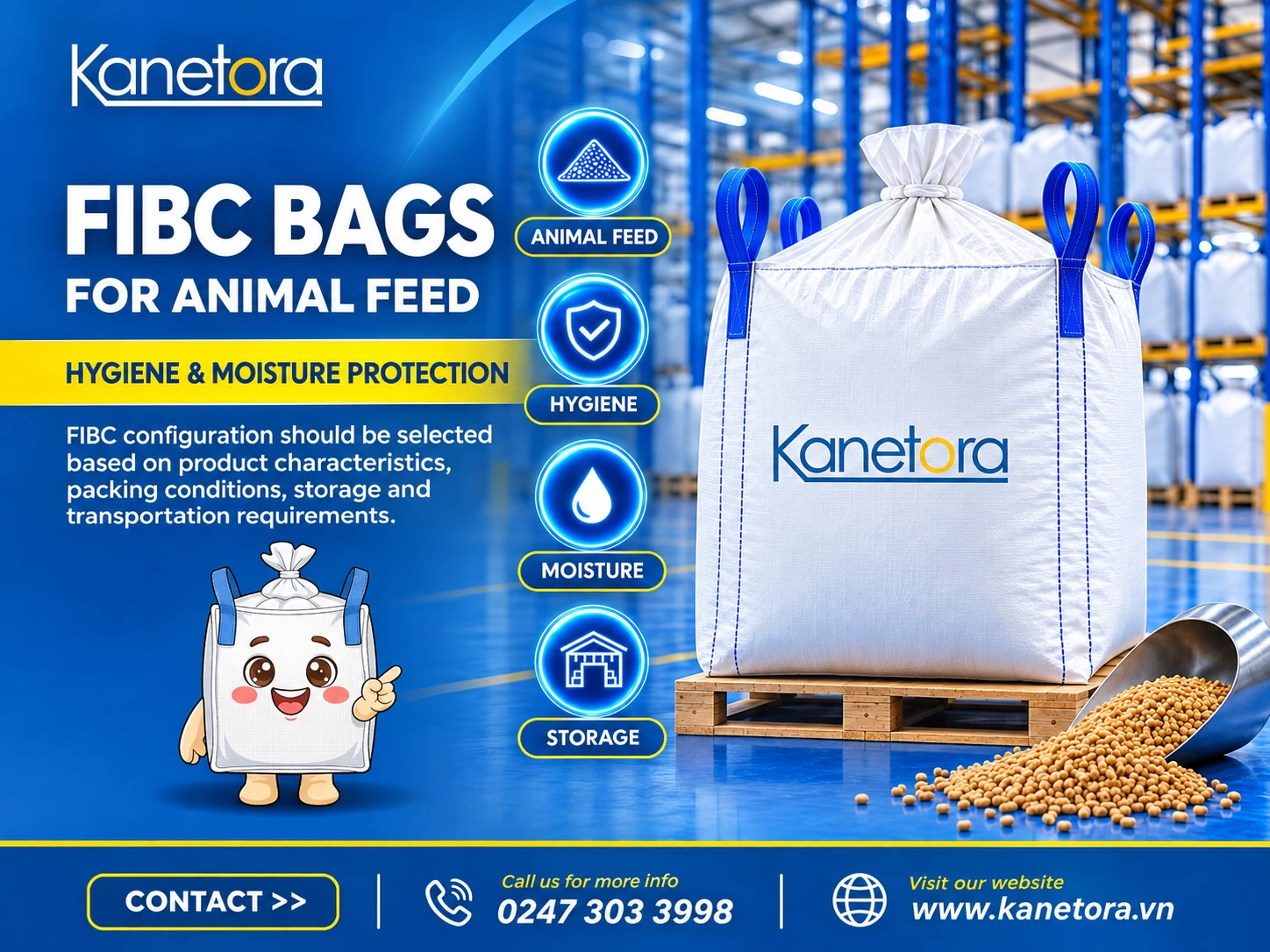
FIBC packaging for animal feed export requires careful consideration of hygiene, moisture protection, dust control and transportation conditions. Whether the cargo consists of finished feed pellets, feed premixes, soybean meal or powdered feed ingredients, the right bulk bag specification can help protect product quality throughout the international supply chain.
Flexible Intermediate Bulk Containers (FIBCs), commonly known as jumbo bags or bulk bags, are widely used to store and transport dry bulk materials. However, not all FIBC bags provide the same level of protection against contamination, moisture exposure or product leakage.
For animal feed manufacturers and international buyers, selecting an appropriate FIBC involves more than choosing a bag size or loading capacity. It requires an understanding of the cargo’s physical characteristics, hygiene requirements, packaging materials, inner liners and export logistics.
Quick Answer: What makes an FIBC suitable for animal feed exports?
An FIBC bag suitable for animal feed exports should offer:
- Appropriate polypropylene (PP) fabric and structural strength.
- Controlled production hygiene and protection against foreign materials.
- Suitable dust containment and moisture protection.
- An inner liner when required by the cargo’s moisture sensitivity.
- Secure filling and discharge systems.
- Verified Safe Working Load (SWL) and Safety Factor (SF).
- Product identification, traceability and relevant quality documentation.
The final specification should reflect the type of animal feed, storage duration, destination market and handling conditions.
1. Why Does Animal Feed Packaging Require Special Attention?
Animal feed products can be sensitive to environmental conditions during storage and international transportation.
Common products packed in FIBC bags include:
- Soybean meal and other oilseed meals.
- Corn-based feed ingredients.
- Rice bran and other grain-processing by-products.
- Feed pellets and compound feed.
- Mineral feed ingredients.
- Powdered feed additives and premixes.
- Other dry bulk ingredients used in animal nutrition.
These materials vary significantly in particle size, bulk density, moisture content and sensitivity to contamination.
For example, feed pellets may be relatively easy to handle but can generate fines through repeated movement. Fine feed premixes may require additional dust containment, while certain grain-derived ingredients can be particularly sensitive to humidity.
Improper packaging or storage conditions may contribute to:
- Moisture absorption and product caking.
- Mold growth under unfavorable moisture and temperature conditions.
- Contamination by dust, fibers or foreign particles.
- Product leakage during filling and discharge.
- Packaging deformation or damage during transportation.
- Reduced product quality and commercial disputes.
The objective of animal feed packaging is to maintain the required product condition from the filling facility to the final destination.
The packaging system should therefore be selected together with the product’s storage, handling and transportation requirements.
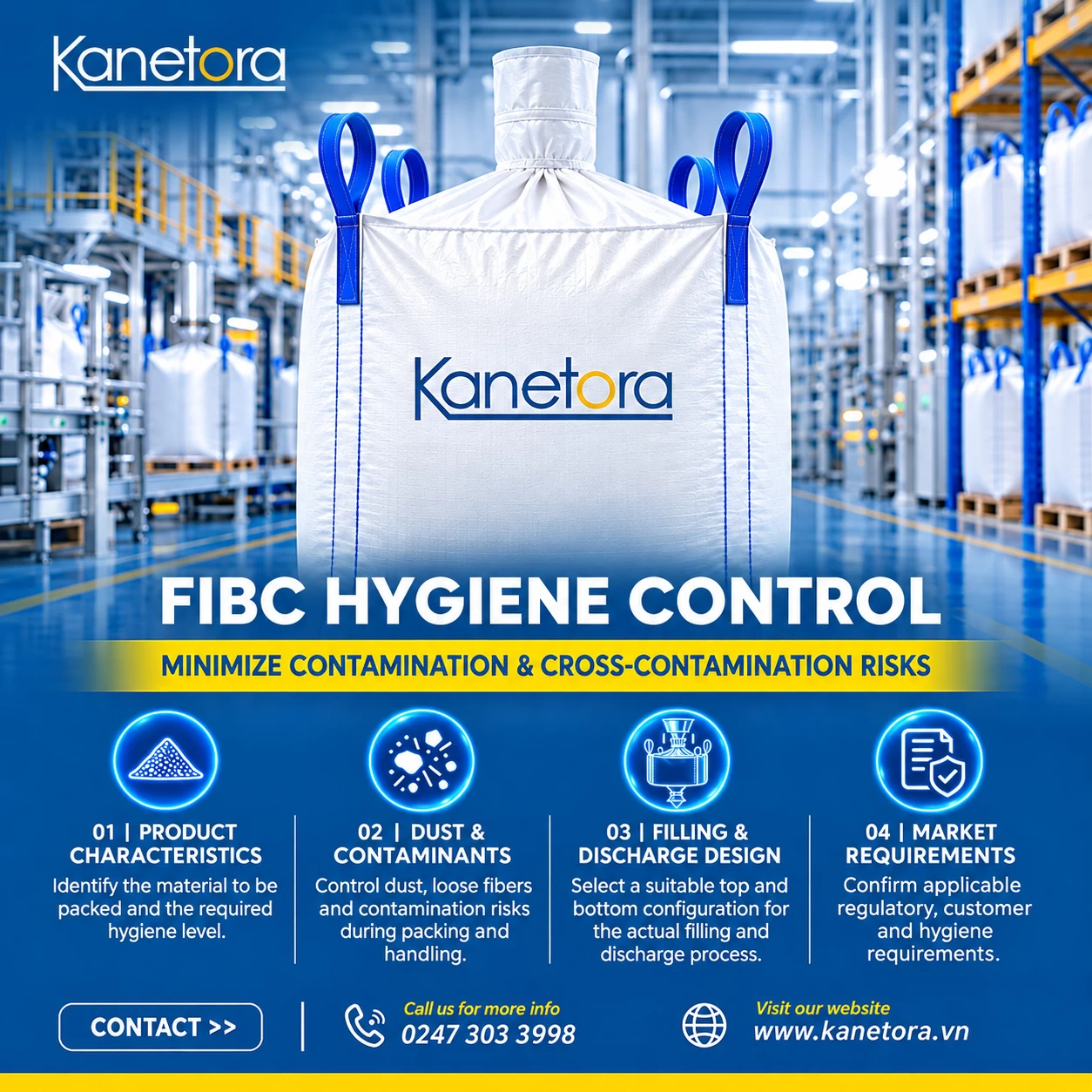
2. Hygiene Requirements for FIBC Bags Used in Animal Feed
2.1. Choosing Appropriate Packaging Materials
Polypropylene is commonly used for FIBC manufacturing because it offers strength, flexibility and relatively low weight.
For animal feed applications, buyers should evaluate the suitability of the fabric, coating, sewing materials and any components that may come into contact with the product.
Important considerations include:
- Raw material composition and specifications.
- Material consistency between production batches.
- Suitability for the intended animal feed application.
- Potential contamination from additives or processing aids.
- Compliance with applicable feed-safety and customer requirements.
Depending on the intended use, buyers may specify virgin polypropylene or other materials supported by appropriate documentation and risk assessment.
A white-colored FIBC bag should not automatically be considered hygienic or suitable for animal feed contact. Material specifications, manufacturing conditions and quality controls are more meaningful indicators than appearance alone.
For applications requiring a higher level of packaging hygiene, buyers can explore Food Grade FIBC Bags: Standards & Requirements.
2.2. Controlling Dust, Fibers and Foreign Materials
During manufacturing, FIBC bags pass through several operations, including extrusion, weaving, cutting, sewing and finishing.
Without adequate controls, these operations can introduce unwanted materials such as:
- Loose polypropylene fibers.
- Thread fragments from sewing.
- Dust and small particles.
- Packaging debris.
- Metallic foreign objects.
For animal feed applications, the risk associated with such materials should be assessed according to the product and buyer’s requirements.
A controlled cleaning and inspection process can include air blowing, micro-dust removal, visual inspection and metal detection where appropriate.
At Kanetora Bach Dang, the manufacturing system includes cleaning and inspection processes designed to reduce foreign-material risks, particularly for packaging with higher hygiene requirements.
2.3. Production Hygiene and Quality Management
Hygienic packaging requires more than selecting suitable raw materials. It also depends on the conditions under which the bags are manufactured, inspected and packed.
Important controls include:
- Housekeeping and cleaning procedures.
- Employee hygiene practices.
- Separation of clean and potentially contaminated materials.
- Protection of semi-finished products.
- Inspection of sewing and sealing areas.
- Controlled final packing.
- Identification and traceability of production batches.
For feed-related applications, buyers should confirm that the supplier’s production controls match the intended use and the requirements of the destination market.
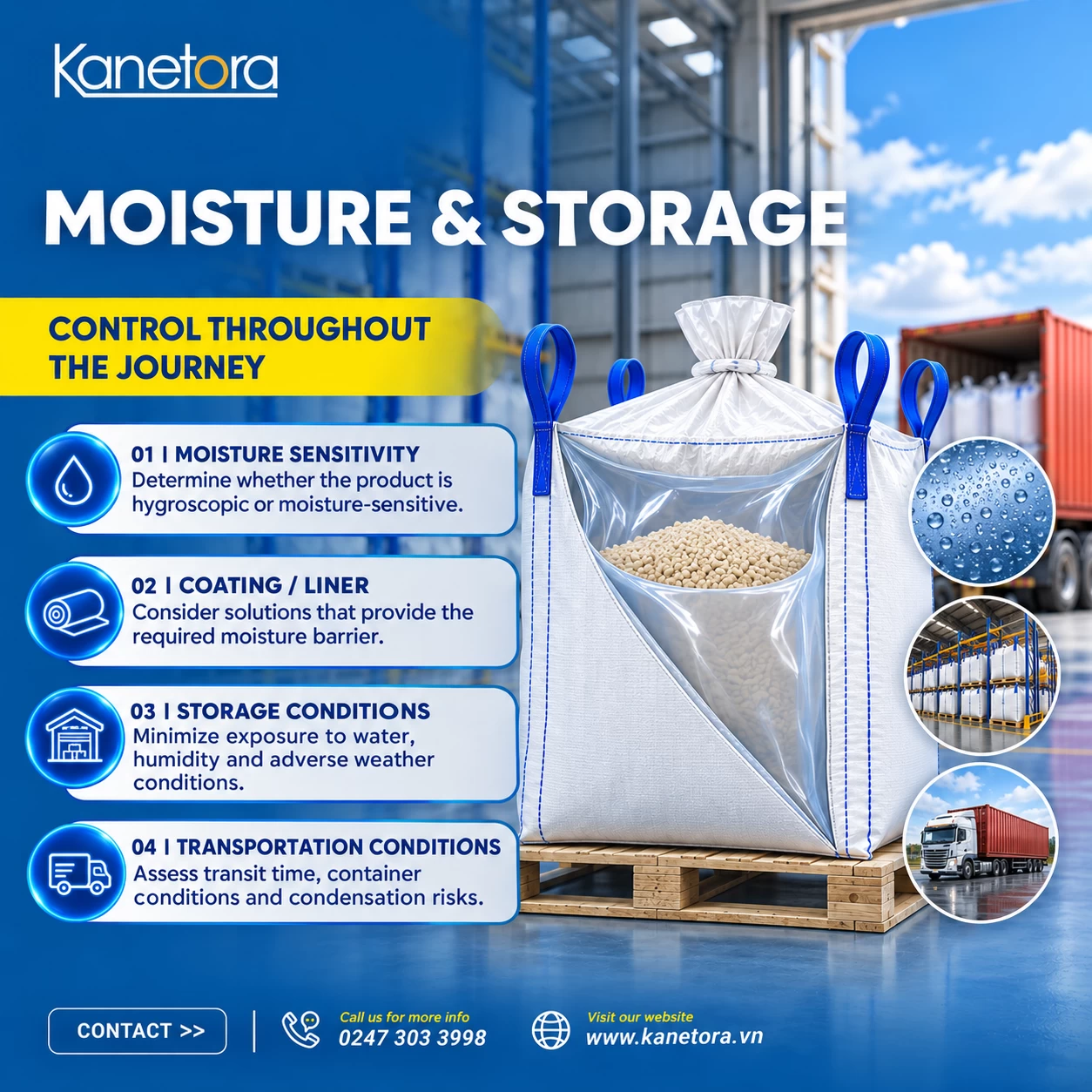
3. Moisture Protection: One of the Key Challenges in Animal Feed Exports
3.1. Why Is Moisture a Concern?
Moisture can affect the quality, handling characteristics and storage stability of animal feed ingredients.
Some dry products are hygroscopic, meaning they can absorb moisture from the surrounding environment. Others may experience condensation-related problems when exposed to changing temperatures during transportation.
For example:
- Soybean meal may deteriorate when stored under unfavorable moisture conditions.
- Powdered feed ingredients may form lumps or cakes.
- Certain feed additives may lose free-flowing characteristics.
- Feed pellets may soften or deteriorate when exposed to excessive moisture.
During international shipments, temperature fluctuations and humidity can create additional challenges.
These risks are especially relevant for sea freight, where products may remain inside shipping containers for extended periods.
3.2. Can a Standard Woven PP Bag Prevent Moisture?
A standard uncoated woven polypropylene FIBC provides mechanical containment but is not inherently waterproof or moisture-tight.
Its woven construction contains small openings between tapes, which can allow air, fine particles and moisture vapor to pass through.
A coated FIBC improves the fabric’s resistance to dust penetration and some forms of moisture exposure. However, the effectiveness depends on coating integrity, sewing construction, closure design and handling conditions.
An important distinction: Moisture resistance is not the same as a verified moisture barrier.
For moisture-sensitive animal feed ingredients, a dedicated inner liner may provide a more suitable protective layer.
3.3. How Does an FIBC Inner Liner Help?
An FIBC liner is an additional internal bag, typically made from polyethylene (PE), polypropylene (PP) or specialized multilayer films.
Depending on its design and sealing configuration, a liner can help:
- Reduce moisture vapor transmission.
- Limit contact with external dust and contaminants.
- Minimize leakage of fine powders.
- Support cleaner filling and discharge.
- Protect the product from direct contact with woven fabric.
Common liner options include standard PE liners, form-fit liners and specialized barrier liners.
For more information, see FIBC Bag with Liner: When and Why to Use.
3.4. Does a PE Liner Make an FIBC Waterproof?
Not necessarily.
A PE liner can improve protection against moisture exposure, but its effectiveness depends on several factors:
- Film thickness and material formulation.
- Moisture vapor transmission properties.
- Liner construction and seam integrity.
- Filling and discharge closure methods.
- Potential punctures during handling.
- Storage temperature and humidity.
For highly moisture-sensitive ingredients, buyers may need enhanced barrier films with documented barrier performance.
The required protection level should be determined by the product’s moisture tolerance and expected transportation conditions.
4. Selecting the Right FIBC Structure for Animal Feed Products
Different animal feed products require different packaging configurations.
The following table provides an initial selection guide.
| Animal Feed Product | Key Packaging Concern | Suggested FIBC Solution |
|---|---|---|
| Feed pellets | Handling strength, pellet damage, moisture | Standard or coated FIBC; PE liner if needed |
| Soybean meal | Moisture, dust, product flow | Coated FIBC with a suitable liner |
| Corn-based ingredients | Contamination, humidity | FIBC with controlled hygiene and optional liner |
| Powdered feed premixes | Fine dust, leakage, cross-contamination | Dust-controlled FIBC with a suitable liner and secure closures |
| Mineral feed ingredients | Weight, abrasion, dust | Reinforced FIBC with suitable dust containment |
| Hygroscopic feed additives | Moisture absorption, caking | FIBC with a specified moisture-barrier liner |
These are general selection guidelines. Final designs require evaluation of the actual product, filling system, handling equipment and destination requirements.
4.1. Bag Body Construction
Common FIBC constructions include:
U-Panel FIBC
A versatile design suitable for many dry bulk products. It offers structural strength and can be customized for different filling and discharge systems.
Circular FIBC
Made using tubular woven fabric, this design minimizes vertical body seams and is commonly used for agricultural and industrial bulk materials.
Four-Panel FIBC
Constructed from separate fabric panels, offering flexibility in bag dimensions and design.
Baffle FIBC
Includes internal baffles that help reduce bulging and maintain a more rectangular shape after filling.
Baffle bags can be particularly useful when buyers prioritize stacking geometry and container space utilization.
4.2. Filling and Discharge Options
For animal feed packaging, the filling and discharge configuration should match the handling system.
Common filling options include:
- Open top for suitable bulk materials.
- Duffle top for flexible filling and closing.
- Inlet spout for more controlled filling operations.
Common discharge options include:
- Flat bottom.
- Discharge spout.
- Conical discharge.
- Specialized discharge closure systems.
For powdered feed ingredients, inlet and discharge spouts combined with suitable closures may help reduce dust release and product loss.
5. Storage and Transportation: Protecting Animal Feed Beyond the Bag
Even a properly designed FIBC cannot compensate for unsuitable storage and transportation conditions.
5.1. Warehouse Conditions
Before export, animal feed products should be stored in a clean, dry and appropriately controlled environment.
Important practices include:
- Keeping bags away from standing water and moisture.
- Using suitable pallets or storage platforms.
- Avoiding contact with damaged or contaminated surfaces.
- Preventing exposure to pests and foreign materials.
- Monitoring relevant temperature and humidity conditions.
- Following safe stacking and handling procedures.
Warehouse personnel should also inspect packaging for visible damage before loading.
5.2. Container Loading for Sea Freight
Shipping containers can experience significant temperature changes during international transport.
These fluctuations may contribute to condensation, sometimes called container rain, when moisture condenses on cooler internal surfaces.
Before loading animal feed packed in FIBCs, exporters should consider:
- Inspecting the container for leaks, damage, odor and contamination.
- Confirming that the floor and internal surfaces are dry.
- Checking the condition of the bags and closures.
- Evaluating the need for desiccants or other humidity-control measures.
- Planning safe loading and cargo securing arrangements.
- Avoiding direct exposure to water during loading.
- Maintaining product identification and traceability records.
Desiccants may help manage certain condensation risks, but they do not replace adequate product drying, appropriate packaging or a sound container-loading plan.
5.3. Why Is the Entire Packaging System Important?
Moisture protection depends on the interaction between several components:
Product condition → FIBC fabric → Inner liner → Closures → Warehouse → Shipping container
A liner with good barrier properties may still fail to protect the cargo if it is punctured or inadequately closed.
Similarly, a clean FIBC may become contaminated if it is filled, stored or transported under unsuitable conditions.
For this reason, exporters should assess packaging performance across the entire logistics process rather than relying on one component alone.
6. Key Technical Specifications Buyers Should Confirm
Before ordering FIBC bags for animal feed exports, procurement teams should provide clear technical requirements.
| Specification | Information to Confirm |
|---|---|
| Product type | Pellets, meal, powder, premix or granules |
| Bulk density | Actual density of the material |
| Filling weight | Required net weight per FIBC |
| Bag dimensions | Length, width and height |
| Fabric | PP material, fabric weight, coating |
| Inner liner | Material, thickness, barrier properties, closure |
| Lifting design | Number and configuration of lifting loops |
| Safe Working Load | SWL based on the intended load |
| Safety Factor | Required SF, commonly 5:1 or 6:1 depending on use |
| Top and bottom | Filling and discharge configuration |
| Hygiene | Cleaning, inspection and contamination-control requirements |
| Quality documentation | Relevant certificates, test reports and specifications |
| Export conditions | Destination, transport method and storage duration |
These specifications help the manufacturer recommend a bag design suitable for the intended application.
A documented technical specification also reduces misunderstandings between manufacturers, exporters and end customers.
7. Animal Feed Packaging and International Compliance
Animal feed packaging requirements vary by destination market, product classification and intended use.
Buyers may need to consider:
- Applicable feed hygiene and safety requirements.
- Packaging material suitability.
- Customer-specific contamination limits.
- Traceability and batch identification.
- Relevant material testing.
- Supplier quality management systems.
- Transportation and storage requirements.
Food-contact documentation may be requested for some applications, but it should not automatically be treated as sufficient proof of animal feed packaging compliance.
Similarly, certifications such as ISO 9001, ISO 22000 or BRCGS Packaging Materials should be interpreted according to their specific scope.
Buyers should verify that the supplier’s certificates, material declarations and test reports are relevant to the actual packaging specification being purchased.
For related agricultural export packaging requirements, explore Food Grade FIBC Bags for Export Food & Agriculture Products.
8. Kanetora Bach Dang: FIBC Manufacturing Solutions for Animal Feed Exports
Kanetora Bach Dang is a packaging manufacturer in Vietnam, specializing in FIBC bags, block-bottom valve bags and multilayer plastic films.
As part of the Kanetora industrial ecosystem, the factory supplies packaging solutions for agricultural products, food ingredients, plastics, chemicals and other industrial applications.
8.1. Integrated FIBC Manufacturing
Located in Ninh Binh Province, Vietnam, Kanetora Bach Dang operates manufacturing facilities equipped for:
- Polypropylene tape extrusion.
- Woven fabric and lifting webbing production.
- Fabric coating and lamination.
- Cutting and printing.
- Industrial sewing.
- Inner liner production.
- Cleaning and quality inspection.
- Final packing and preparation for shipment.
Its integrated manufacturing approach enables greater control over essential packaging components.
The factory’s stated FIBC production capacity is approximately 300,000 bags per month, supporting customers with different order volumes and custom specifications.
8.2. Quality Control and Testing
Kanetora Bach Dang operates a quality management system covering multiple manufacturing stages.
Its production and inspection capabilities include equipment for evaluating:
- Fabric and webbing tensile strength.
- Seam and material performance.
- Top-lift strength.
- Ultraviolet resistance.
- Liner film tensile properties.
- Heat-seal strength.
- Puncture resistance.
- Coefficient of friction.
The factory also maintains cleaning and inspection processes for applications requiring higher levels of packaging hygiene.
These capabilities help support consistent product manufacturing and technical evaluation according to customer requirements.
8.3. Packaging Material and Liner Solutions
For animal feed manufacturers and exporters, Kanetora can evaluate customized FIBC configurations based on:
- Product particle size and bulk density.
- Required filling weight.
- Moisture sensitivity.
- Dust containment requirements.
- Inner liner selection.
- Filling and discharge systems.
- Handling and container-loading conditions.
Kanetora’s packaging portfolio includes PE inner liners and multilayer film solutions that can be incorporated into suitable FIBC designs.
Customers can explore the company’s FIBC Packaging Solutions for additional information about its manufacturing capabilities.
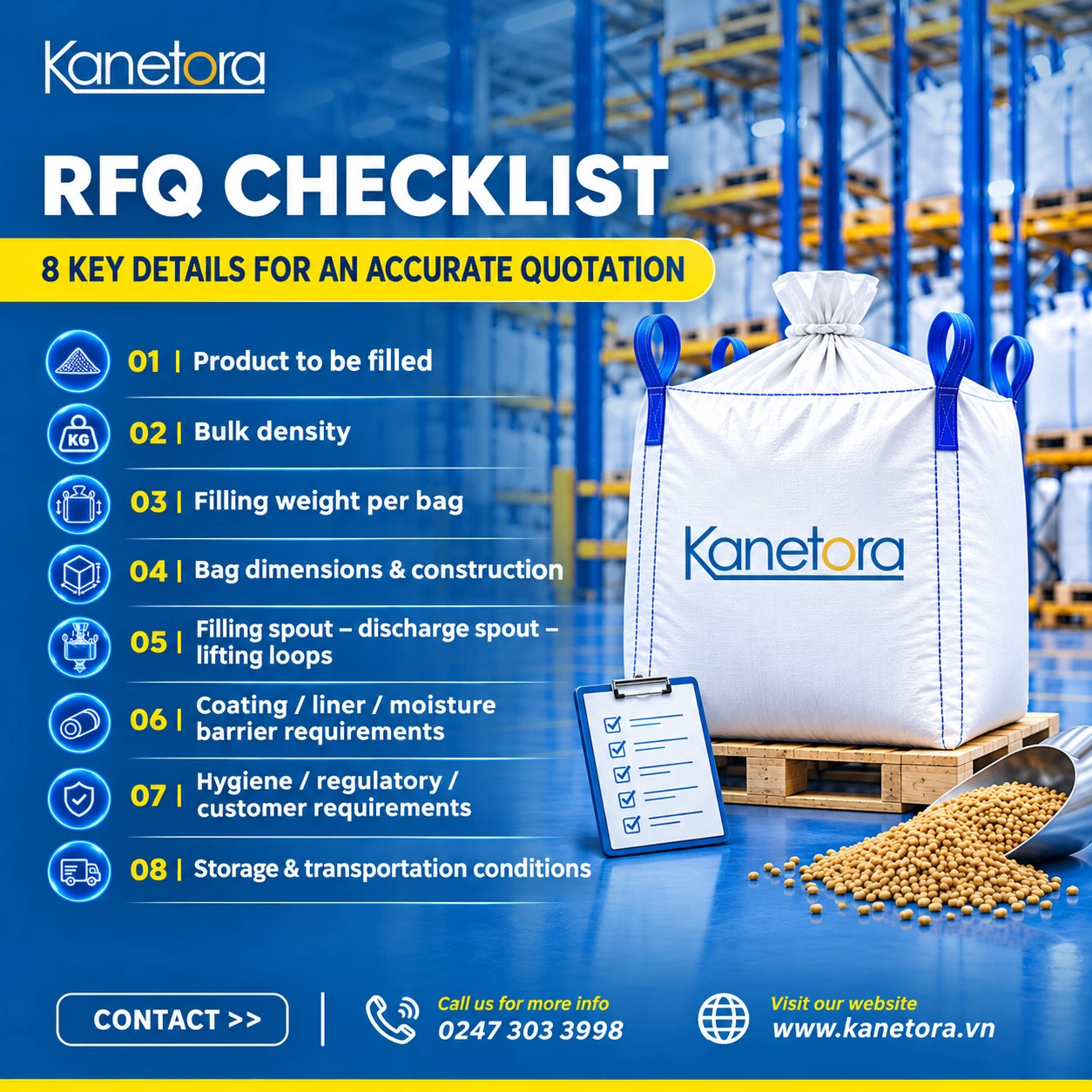
9. Buyer Checklist: Questions to Ask Before Ordering FIBC Bags for Animal Feed
When sourcing bulk packaging for animal feed exports, buyers should ask the manufacturer:
- Is the FIBC fabric suitable for the specific animal feed ingredient?
- What hygiene controls are applied during manufacturing?
- How are loose threads, dust and foreign materials controlled?
- Is an inner liner necessary for the product’s moisture sensitivity?
- What liner material, thickness and closure design are recommended?
- How is the bag’s Safe Working Load verified?
- Are the filling and discharge systems compatible with our equipment?
- Which certifications and test reports apply to the proposed specification?
- How are bags identified, packed and protected before shipment?
- Can the manufacturer provide samples or support packaging trials before mass production?
These questions allow buyers to compare suppliers based on technical suitability, quality assurance and export readiness rather than unit price alone.
10. Frequently Asked Questions About FIBC Packaging for Animal Feed
Are FIBC bags suitable for animal feed exports?
Yes. FIBC bags are widely used for dry animal feed ingredients such as soybean meal, grain-derived materials, feed pellets and powdered additives. The design must be suitable for the product’s characteristics, hygiene requirements and handling conditions.
Do animal feed FIBC bags need to be food grade?
Not always. Animal feed packaging requirements are not necessarily identical to those for food intended for human consumption. However, packaging materials and manufacturing processes must meet applicable feed-safety regulations and customer specifications. Higher hygiene controls may be appropriate for sensitive products.
Do FIBC bags protect animal feed from moisture?
Standard woven PP bags provide limited moisture protection. Coated fabric can improve resistance, while an appropriately selected inner liner may provide additional protection. The required barrier performance depends on the product and storage conditions.
What type of liner is best for animal feed?
A PE liner is a common option for dry bulk ingredients requiring additional protection against dust or moisture. More sensitive products may require specialized barrier liners. Selection should be based on the required moisture vapor transmission performance, liner strength and closure design.
Can FIBC bags be used for soybean meal?
Yes. Soybean meal can be packed in appropriately designed FIBC bags. Buyers should consider moisture control, packaging hygiene, safe load capacity and storage conditions, particularly for long-distance export shipments.
How much animal feed can an FIBC bag hold?
FIBC bags can be designed for different filling weights, commonly ranging from 500 kg to 2,000 kg in many industrial applications. Actual capacity depends on bulk density, bag dimensions, certified Safe Working Load and handling equipment.
Are coated FIBC bags better than uncoated bags for feed?
Coated FIBC bags can provide improved dust containment and resistance to some moisture exposure. However, coated fabric does not automatically replace an inner liner, particularly for fine powders or moisture-sensitive feed ingredients.
Can Kanetora manufacture custom FIBC bags for animal feed?
Yes. Kanetora Bach Dang provides customizable FIBC packaging solutions, including bag dimensions, lifting loops, fabric specifications, coating, inner liners, filling and discharge configurations, printing and packing options.
Conclusion: Choosing the Right FIBC for Safer Animal Feed Exports
Reliable animal feed packaging requires a balanced approach to hygiene, moisture protection, mechanical strength and export handling.
A well-designed FIBC should not only support the required loading weight but also help protect the product against contamination, moisture exposure and damage throughout storage and transportation.
For manufacturers and international buyers, the most effective approach is to evaluate the product characteristics, select suitable packaging materials, confirm liner requirements and establish clear technical specifications before production.
With integrated manufacturing capabilities and experience in industrial bulk packaging, Kanetora Bach Dang supports businesses seeking customized FIBC packaging solutions for animal feed ingredients and other dry bulk commodities.
Contact Kanetora for FIBC Packaging Consultation
KANETORA JOINT STOCK COMPANY
- Manufacturing location: Cau Mai, My Loc Ward, Ninh Binh Province, Vietnam
- Hotline: +84 (0) 247 303 3998
- Email: info@kanetora.vn
- Website: https://kanetora.vn
Share your product specifications, intended filling weight, moisture protection requirements and export destination with our team to discuss a suitable FIBC packaging solution.