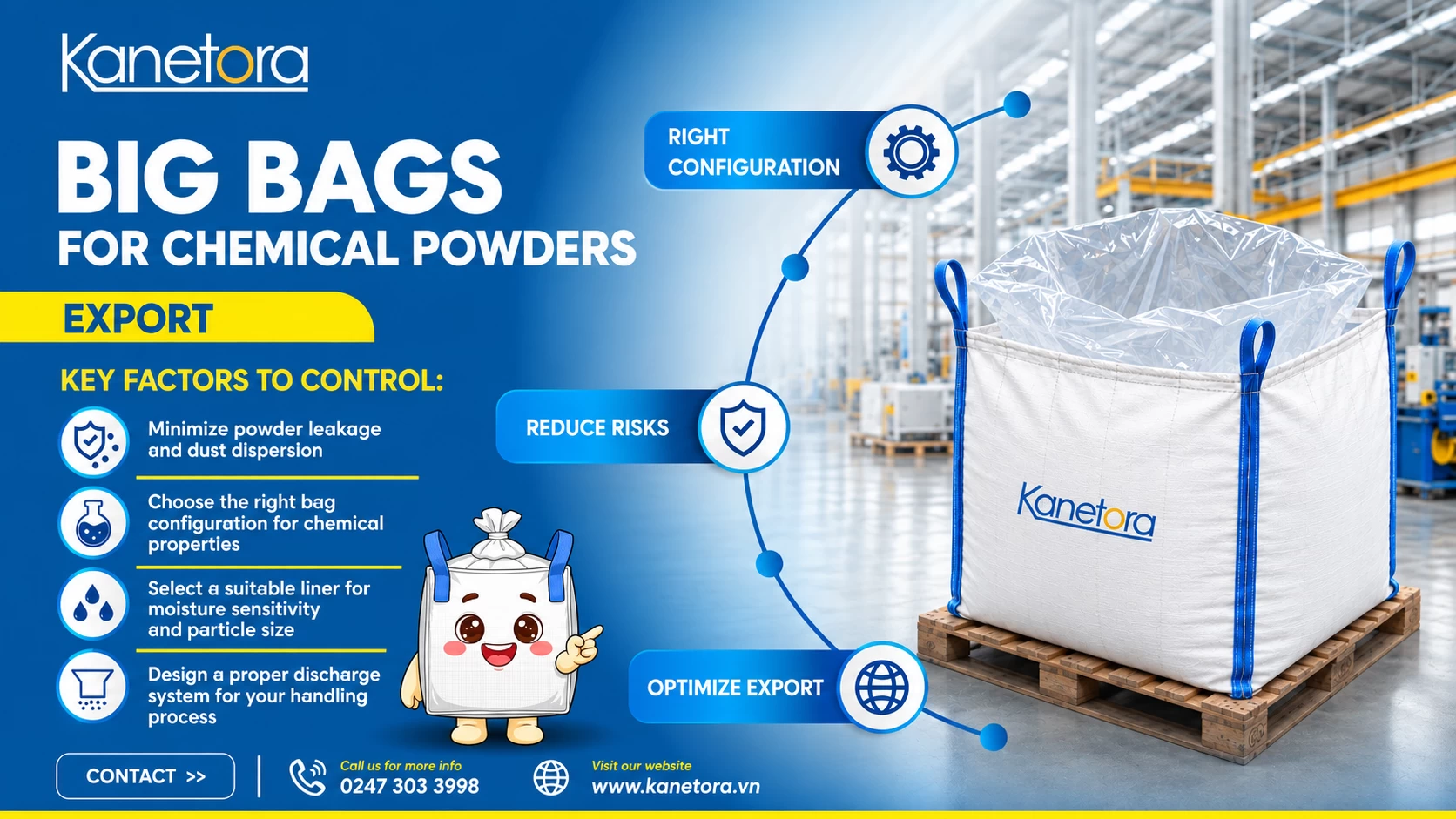


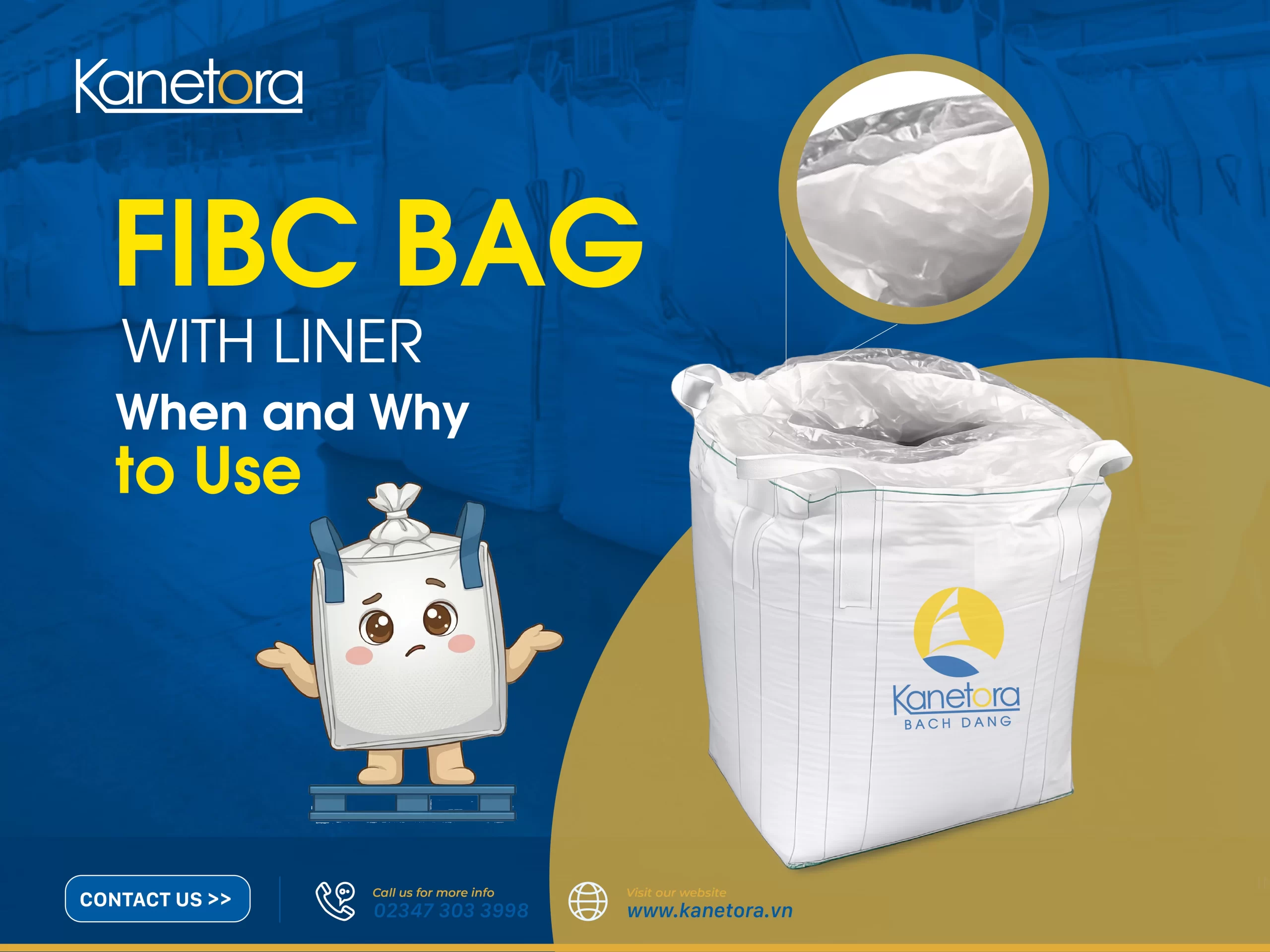
In bulk packaging, FIBC bags, also known as jumbo bags or bulk bags, are widely used for storing and transporting large volumes of dry goods. They are strong, cost-effective, easy to handle, and suitable for many industrial applications.
However, not every product can be safely packed in a standard woven polypropylene FIBC bag alone.
For moisture-sensitive, fine-powdered, food-grade, chemical, plastic, or high-cleanliness materials, businesses often need an additional layer of protection inside the bag. This is where an FIBC liner, also called an inner liner, becomes essential.
So, what is an FIBC bag with liner, when should it be used, and how can businesses choose the right liner type? This article explains the key points buyers should understand before ordering FIBC bags for domestic use or export.
Quick Answer: When Should You Use an FIBC Bag with Liner?
An FIBC bag with liner should be used when the packed product needs extra protection against moisture, dust, leakage, contamination, or external environmental factors.
It is especially suitable for products such as food powders, sugar, starch, mineral powder, plastic resin, fertilizer, additives, chemical powders, granular chemicals, and other dry bulk materials that require a cleaner and more protective packaging structure.
For rough construction materials such as sand, gravel, stones, or non-sensitive industrial products, a standard FIBC bag or a coated FIBC bag may be sufficient, depending on the storage and transportation conditions.
What Is an FIBC Bag with Liner?
An FIBC bag with liner is a bulk bag that contains an additional plastic film bag inside the outer woven polypropylene body. This liner is usually made from PE, PP, or multi-layer barrier film.
The outer FIBC bag provides strength and load-bearing capacity, while the inner liner protects the product from moisture, dust, leakage, and contamination.
A typical structure includes:
| Component | Function |
|---|---|
| Outer FIBC bag | Provides strength, shape, lifting support, and load-bearing performance |
| Inner liner | Protects the product from moisture, dust, leakage, and contamination |
| Filling/discharge system | Can be open top, duffle top, filling spout, flat bottom, or discharge spout |
| Liner fixing method | Helps keep the liner in position during filling, handling, and discharge |
In simple terms, the outer FIBC bag carries the load, while the inner liner protects the product quality.
Why Is a Standard FIBC Bag Not Always Enough?
A standard FIBC bag is made from woven polypropylene fabric. This fabric is strong and suitable for many industrial products, but the woven structure naturally contains small gaps between yarns. For some materials, these gaps may create risks during filling, storage, container loading, or long-distance transportation.
Common risks include:
Fine powders may leak through the fabric or seams.
Moisture-sensitive products may absorb humidity, clump, or lose quality.
Food ingredients may require a cleaner barrier between the product and the outer bag.
Products with odor or sensitivity to oxygen may need stronger protection.
Export cargo may face changes in temperature, humidity, and handling conditions during long transit.
In these cases, the liner is not just an optional accessory. It becomes an important part of the overall packaging solution.
What Is an FIBC Liner Used For?
1. Moisture Protection
Moisture protection is one of the most common reasons for using an FIBC liner.
Products such as food powders, starch, sugar, salt, fertilizer, additives, plastic resin, and chemical powders may be affected by humidity during storage or transportation. Moisture can cause clumping, quality changes, reduced flowability, or commercial loss.
An inner liner creates an additional protective film layer inside the bag, helping reduce direct exposure between the product and the surrounding environment.
2. Reducing Leakage of Fine Powders
Some products have very small particle sizes and may pass through the woven fabric or sewing seams of a standard FIBC bag.
Examples include mineral powder, calcium carbonate, plastic powder, food powder, chemical additives, and other fine dry bulk materials.
With a liner, the product is contained inside a more sealed inner layer, helping reduce product loss during filling, lifting, transportation, and unloading.
3. Supporting Food-Grade Packaging Requirements
For products such as rice, sugar, flour, starch, whey protein, grains, and food ingredients, packaging cleanliness is an important requirement.
An FIBC bag with liner helps reduce direct contact between the product and the outer woven fabric. When combined with appropriate production control, dust removal, metal detection, and clean packing processes, this solution can better support food-related or high-cleanliness applications.
4. Protecting Export Cargo During Long-Distance Transportation
Export cargo often goes through multiple stages: warehouse storage, inland trucking, container loading, sea freight, customs clearance, and destination warehousing.
During this process, humidity, dust, temperature changes, and repeated handling may affect product quality.
For long-distance shipping, an FIBC bag with liner provides an additional layer of security, especially when goods are packed in containers for international delivery.
5. Reducing Cross-Contamination Risks
In the food, pharmaceutical, chemical, additive, and specialty material industries, preventing contamination is a key packaging requirement.
The liner separates the product from the outer woven bag, helping reduce the risk of dust, fibers, foreign particles, or other unwanted elements coming into contact with the packed goods.
Products That Commonly Require FIBC Bags with Liners
FIBC bags with liners are commonly recommended for the following product groups:
| Product group | Why a liner is recommended |
|---|---|
| Food ingredients and agricultural products | Helps maintain cleanliness and reduce moisture exposure |
| Sugar, salt, and starch | Moisture-sensitive and prone to clumping |
| Flour and food powders | Fine particle size and higher hygiene requirements |
| Plastic resin and plastic additives | Helps keep products dry and clean |
| Chemical powders and granules | Helps reduce leakage and moisture-related risks |
| Fertilizer | Often moisture-sensitive and prone to hardening |
| Mineral powder and calcium carbonate | Fine powder that may leak through woven fabric |
| Odor-sensitive or high-value materials | Requires better separation from the environment |
When Is a Liner Not Always Necessary?
Not every FIBC order requires a liner. In some cases, adding a liner may increase cost without adding enough value.
A liner may not be necessary when:
The product is a rough material such as sand, gravel, stone, or construction waste.
The product is not sensitive to moisture.
The product has a large particle size and is unlikely to leak.
Storage and transportation time is short.
The storage environment is dry and well-controlled.
The packaging requirement is basic industrial-grade only.
For moderate dust or moisture protection, a coated FIBC bag may be considered instead of a liner. However, when the product needs stronger internal protection, a liner is usually the safer choice.
Coated FIBC Bag vs. FIBC Bag with Liner
Many buyers confuse coated FIBC bags with FIBC bags with liners. Both can improve protection, but they work differently.
| Criteria | Coated FIBC Bag | FIBC Bag with Liner |
|---|---|---|
| Structure | A coating layer is applied to the woven PP fabric | A separate film bag is inserted inside the FIBC |
| Protection level | Better than uncoated fabric, but still limited at seams | Better internal protection, especially for fine powders and moisture-sensitive goods |
| Leakage control | Moderate to good | Better for fine powder and granular products |
| Cost | Usually lower | Usually higher due to added material and production steps |
| Best for | Products needing basic dust or moisture resistance | Products needing moisture, leakage, and contamination protection |
In short, coating improves the outer fabric surface, while a liner creates a separate protective inner bag for the product.
Common Types of FIBC Liners
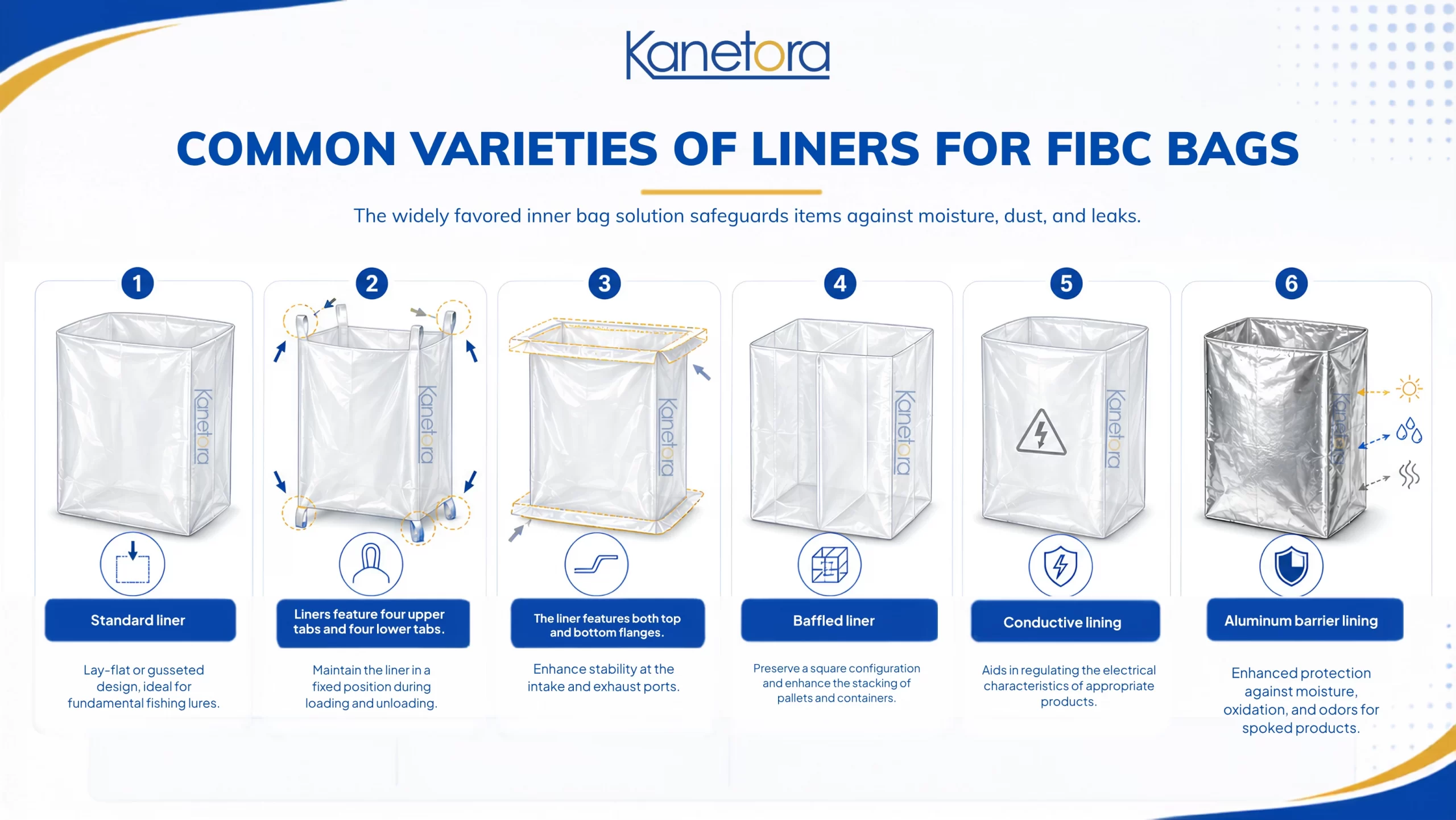
1. Standard Liner
A standard liner is usually supplied in lay-flat or gusseted form. It is inserted inside the FIBC bag to provide basic protection against moisture, dust, and leakage.
Best for: plastic resin, agricultural products, additives, dry powders, and general dry bulk goods.
2. Liner with Top and Bottom Tabs
This type of liner has fixing points at the top and/or bottom of the bag. These tabs help keep the liner in position during filling and discharge.
Best for: products requiring stable filling/discharging, FIBCs with spout systems, and export cargo that needs better handling stability.
3. Liner with Top and Bottom Flanges
Flanges help secure the liner around the filling or discharge area. This design reduces the risk of liner movement, folding, or blocking the product flow.
Best for: powder and granular products, automatic filling systems, and applications requiring smoother discharge.
4. Baffled Liner
A baffled liner includes internal panels that help the bag maintain a square shape when filled. It is often used together with a baffle FIBC bag to improve pallet and container space efficiency.
Best for: export cargo, container optimization, and products requiring a more stable bag shape.
5. Conductive Liner
A conductive liner is designed to help control static electricity during filling and discharging. This type may be required for certain powders, chemicals, or operating environments where electrostatic control is important.
Best for: selected industrial powders, chemical products, or applications with specific static-control requirements.
6. Aluminum Barrier Liner
An aluminum barrier liner is a multi-layer film structure designed to provide stronger protection against moisture, oxygen, UV light, odor transmission, and external environmental factors.
Best for: highly moisture-sensitive products, long-term storage, high-value materials, and goods that require a stronger barrier layer.
How to Choose the Right FIBC Liner
To select the right liner, buyers should clarify the following points:
| Key question | Why it matters |
|---|---|
| Is the product powder, granule, pellet, or flake? | Determines liner structure and leakage-control requirements |
| Is the product moisture-sensitive? | Determines film material, thickness, and barrier level |
| Is food-grade packaging required? | Affects material selection and production control |
| How will the product be filled and discharged? | Determines whether tabs, flanges, or special fixing methods are needed |
| How long will the product be stored or transported? | Determines the required level of protection |
| Is static-control or barrier protection required? | Determines whether a standard, conductive, or aluminum barrier liner is needed |
One common mistake is choosing a liner based only on thickness. In reality, liner design should also consider filling method, discharge method, product flowability, bag structure, and handling conditions.
A liner that is too thin may tear easily. A liner that is too thick or not properly fixed may create difficulties during filling or discharge. The right solution should balance protection, usability, and cost.
Information Buyers Should Provide Before Ordering FIBC Bags with Liners
To help the manufacturer recommend the most suitable bag and liner structure, buyers should prepare the following information:
Product name and material type.
Product form: powder, granule, pellet, flake, or mixed material.
Net weight per bag.
Required bag dimensions.
Moisture, dust, leakage, or contamination concerns.
Filling method: open top, duffle top, or filling spout.
Discharge method: flat bottom, discharge spout, or full open bottom.
Food-grade, anti-static, UV, or certification requirements.
Storage and transportation conditions.
Export market or customer-specific standards.
The clearer the input information, the more accurate the FIBC liner recommendation will be. This also helps reduce the risk of sample revisions, production adjustments, or packaging failure during actual use.
Kanetora Bach Dang Provides FIBC Bags with Inner Liner Solutions
Kanetora Bach Dang manufactures FIBC bags, jumbo bags, and inner liner solutions for multiple industries, including food, agriculture, plastics, chemicals, minerals, and industrial materials.
The factory’s product portfolio includes FIBC bags with inner liner, food-grade bags, baffle bags, dustproof bags, multi-layered PE film, and FIBC inner liner bags. Its listed production capacity includes 300,000 FIBC bags per month and 500 tons of multi-layered PE film per month.
Kanetora Bach Dang is also equipped with liner-related machinery, including a multi-layer extruder blowing machine, FIBC liner sealing machine, and FIBC liner insertion machine. The factory also lists testing equipment for FIBC inner liners, including tensile testing, light inspection, puncture resistance testing, coefficient of friction testing, and heat sealing strength testing.
With in-house production of semi-finished components such as liners, sling belts, webbings, labels, and document pouches, Kanetora Bach Dang can better control quality consistency and respond flexibly to customized packaging requirements.
Conclusion: Use an FIBC Liner When Product Protection Matters
An FIBC bag with liner is a suitable packaging solution when the product needs better protection against moisture, dust, leakage, contamination, or environmental exposure.
It is especially important for food ingredients, agricultural products, plastic resin, additives, chemical powders, fertilizer, mineral powders, and other fine or moisture-sensitive materials.
However, liner selection should not be based on guesswork. Businesses should consider product characteristics, filling and discharge methods, transport conditions, industry standards, and total packaging cost before choosing the right liner type.
With experience in FIBC manufacturing and the ability to customize bag structures based on customer requirements, Kanetora Bach Dang can support businesses in developing safer, cleaner, and more efficient bulk packaging solutions for both domestic and export markets.
FAQ
1. What is an FIBC bag with liner?
An FIBC bag with liner is a bulk bag that includes an additional inner film bag, usually made from PE, PP, or multi-layer barrier film. The liner helps protect the packed product from moisture, dust, leakage, and contamination during filling, storage, and transportation.
2. When should I use a bulk bag with liner?
A bulk bag with liner should be used when the product is moisture-sensitive, fine-powdered, leakage-prone, food-related, or requires a cleaner packaging environment. Common examples include food powders, starch, sugar, plastic resin, fertilizer, chemical powders, additives, and mineral powders.
3. Can a coated FIBC bag replace an inner liner?
A coated FIBC bag can provide moderate dust and moisture resistance, but it may not fully replace an inner liner for fine powders, moisture-sensitive goods, or high-cleanliness products. A liner offers a separate internal protective layer, making it more suitable for sensitive materials.
4. What is a PE liner used for in an FIBC bag?
A PE liner is used to create an internal protective layer inside the FIBC bag. It helps reduce moisture exposure, dust contamination, and product leakage. PE liners are commonly used for plastic resin, food powders, additives, chemicals, and other dry bulk products.
5. Are FIBC bags with liners suitable for food products?
Yes. FIBC bags with liners can be suitable for food products when the material, production process, and packing conditions meet the buyer’s food-grade requirements. Buyers should clearly specify food-contact or certification requirements before placing an order.
6. Does adding a liner increase the cost of an FIBC bag?
Yes. Adding a liner increases material and production costs. However, for moisture-sensitive, high-value, fine-powdered, or food-grade products, the cost of using a liner is often much lower than the risk of product damage, leakage, contamination, or customer claims.