

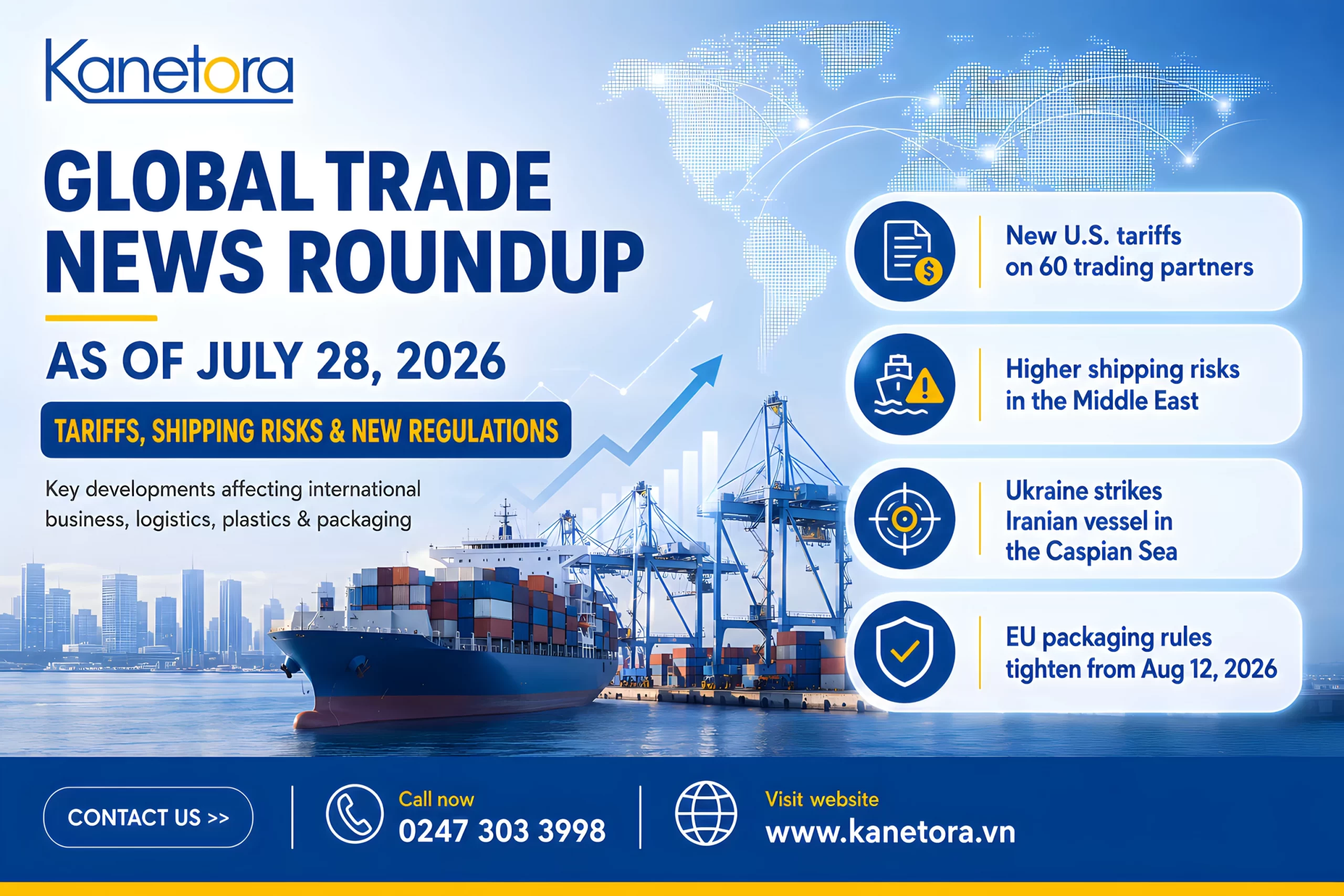
International trade faces a new wave of interconnected risks
By late July 2026, importers, exporters and manufacturers are facing three major groups of risks at the same time: new US tariff measures, expanding geopolitical tensions around key shipping corridors and increasingly strict environmental requirements for packaging products.
Although base container freight rates have softened on several major trade lanes, the total cost of international transportation may not fall accordingly. Higher oil prices, emergency fuel surcharges, war-risk insurance and longer vessel diversions continue to place pressure on supply chains.
For an integrated industrial ecosystem operating across PP and PE resin distribution, FIBC manufacturing, plastic films and multimodal logistics, these developments directly affect raw-material prices, delivery schedules, export quotations and market access. These areas closely match Kanetora’s core operations in industrial packaging, plastics distribution and international logistics.
1. The United States introduces new tariffs on imports from 60 trading partners
On July 24, the United States introduced new tariff rates ranging from 10% to 12.5% on imports from 60 trading partners.
The measures were implemented under Section 301 of the US Trade Act of 1974, with the US authorities citing insufficient action by the affected economies to prevent goods associated with forced labour from entering international supply chains.
Vietnam, China and several other trading partners were placed in the 12.5% tariff group. Goods already in transit were reportedly granted a temporary transition period until 12:01 a.m. Eastern Time on July 28.
The measures are understood to cover approximately 99.4% of US imports. However, exemptions remain available for selected categories, including oil and gas, fertilisers, certain food products, critical minerals and products already subject to separate tariff mechanisms.
This does not mean that every product exported from Vietnam will automatically face an additional 12.5% duty. Exporters of FIBC bags, woven polypropylene packaging, plastic films and other industrial goods should review:
- The specific HS code of each product
- Applicable exemption lists
- Existing import duties and trade remedies
- Vessel departure and US entry dates
- Transitional arrangements
- Raw-material origin and labour traceability documents
- Tax responsibilities under the agreed Incoterms
Brazil has also requested consultations at the World Trade Organization regarding separate US tariffs of 25% on several Brazilian products. This suggests that the current tariff disputes may expand and lead to further retaliatory measures.
Impact assessment: High for exporters serving the US market and moderate for companies importing materials for manufacturing and subsequent re-export to the United States.
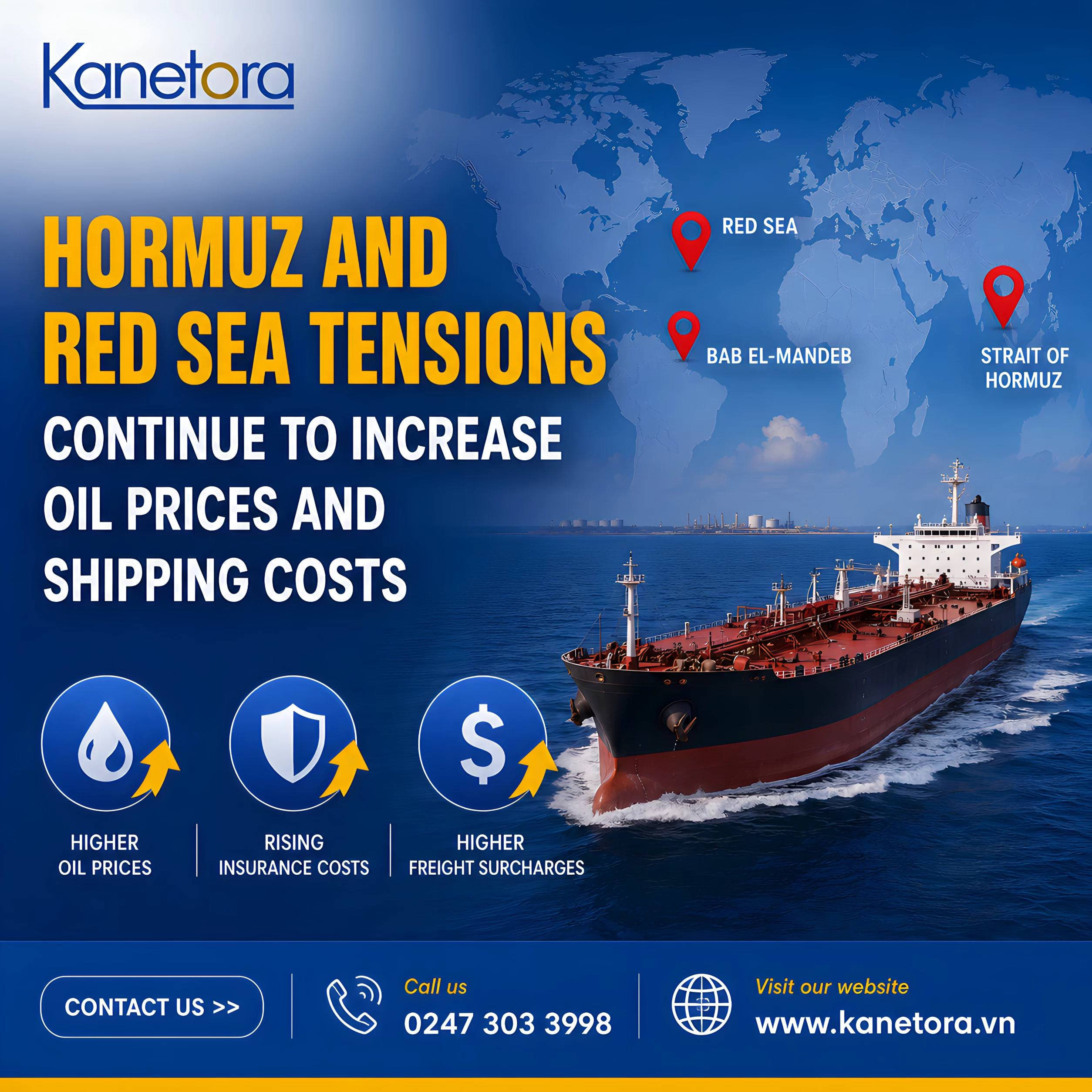
2. Hormuz and Red Sea tensions continue to increase oil prices and shipping costs
Conflict involving the United States and Iran has significantly disrupted shipping activity around the Strait of Hormuz. At the same time, Yemen’s Houthi forces have continued to threaten vessels associated with Saudi Arabia travelling through the Bab el-Mandeb Strait, the southern gateway to the Red Sea.
Several oil tankers loading cargo at Saudi Arabia’s Yanbu port reportedly changed direction towards the Suez Canal instead of continuing through Bab el-Mandeb.
Such diversions can add approximately 10,000 nautical miles to a voyage, extend transit time by more than one month and generate millions of US dollars in additional transportation costs per vessel, excluding fuel and insurance expenses.
Physical oil prices also moved sharply higher in late July, with some cargoes approaching USD 110 per barrel. Refineries in Japan, South Korea and other Asian economies have increasingly searched for alternative supplies from the Atlantic Basin, the North Sea and West Africa.
The impact extends beyond crude oil. Disruptions involving oil, naphtha and petrochemical feedstocks are tightening chemical and polymer supply. Major chemical producers have indicated that restricted access through the Strait of Hormuz has contributed to higher polyethylene and specialty polymer prices.
For PP, PE and plastic packaging manufacturers, the main cost pressures include:
- Crude oil and naphtha prices
- Monomer and polymer availability
- Bunker fuel prices
- Emergency carrier surcharges
- War-risk insurance
- Longer container turnaround times
- Reduced schedule reliability
Impact assessment: Very high for resin trading, ocean freight and shipments involving the Middle East, Europe and Africa.
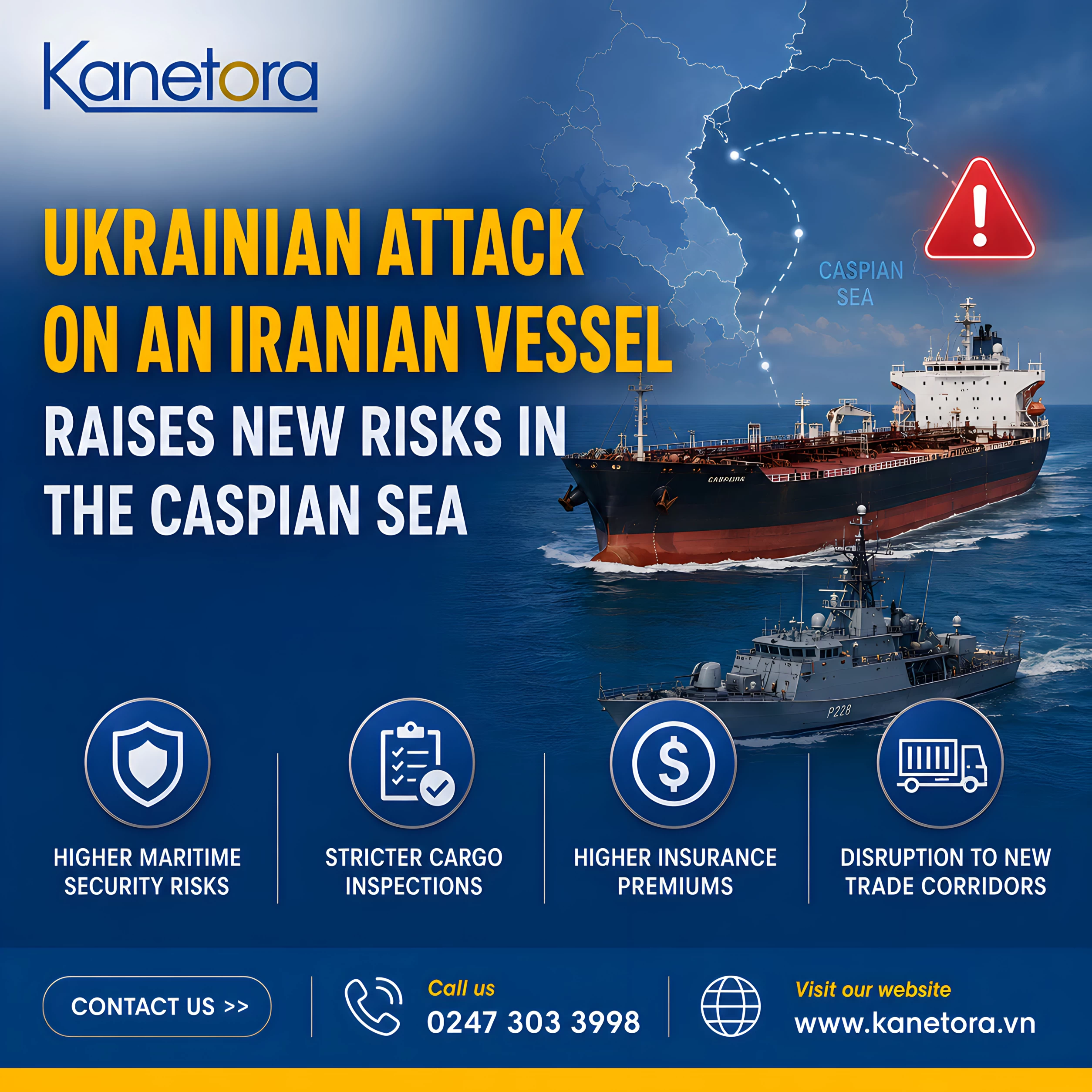
3. Ukrainian attack on an Iranian vessel raises new risks in the Caspian Sea
Iran stated that an Iranian commercial vessel was attacked by Ukraine in the Caspian Sea, killing one crew member and injuring another. Tehran summoned a Ukrainian diplomatic representative and warned that the incident would not go unanswered.
Ukraine, meanwhile, has said that its operations target Russian vessels involved in transporting military-related cargo associated with Iran. Because the accounts provided by the parties differ, the exact status of the vessel and the nature of its cargo should be treated cautiously.
The Caspian Sea is not a major container route between Vietnam and Europe. However, it is an important regional corridor connecting Russia, Iran, Kazakhstan, Azerbaijan and Central Asia.
Attacks involving commercial vessels could lead to:
- Higher war-risk insurance premiums
- Additional inspection requirements
- Tighter screening of cargo linked to Iran or Russia
- Secondary-sanctions exposure
- Payment and banking difficulties
- Delays along the Central Asia–Caspian–Caucasus corridor
- Greater demand for alternative rail and sea routes
The incident also shows that maritime risks are no longer concentrated only in the Strait of Hormuz, the Red Sea or the Black Sea. They are spreading into additional regional trade corridors.
Impact assessment: Moderate for Central Asian logistics and currently limited for conventional Vietnam–Europe container routes, although escalation risks should be monitored.
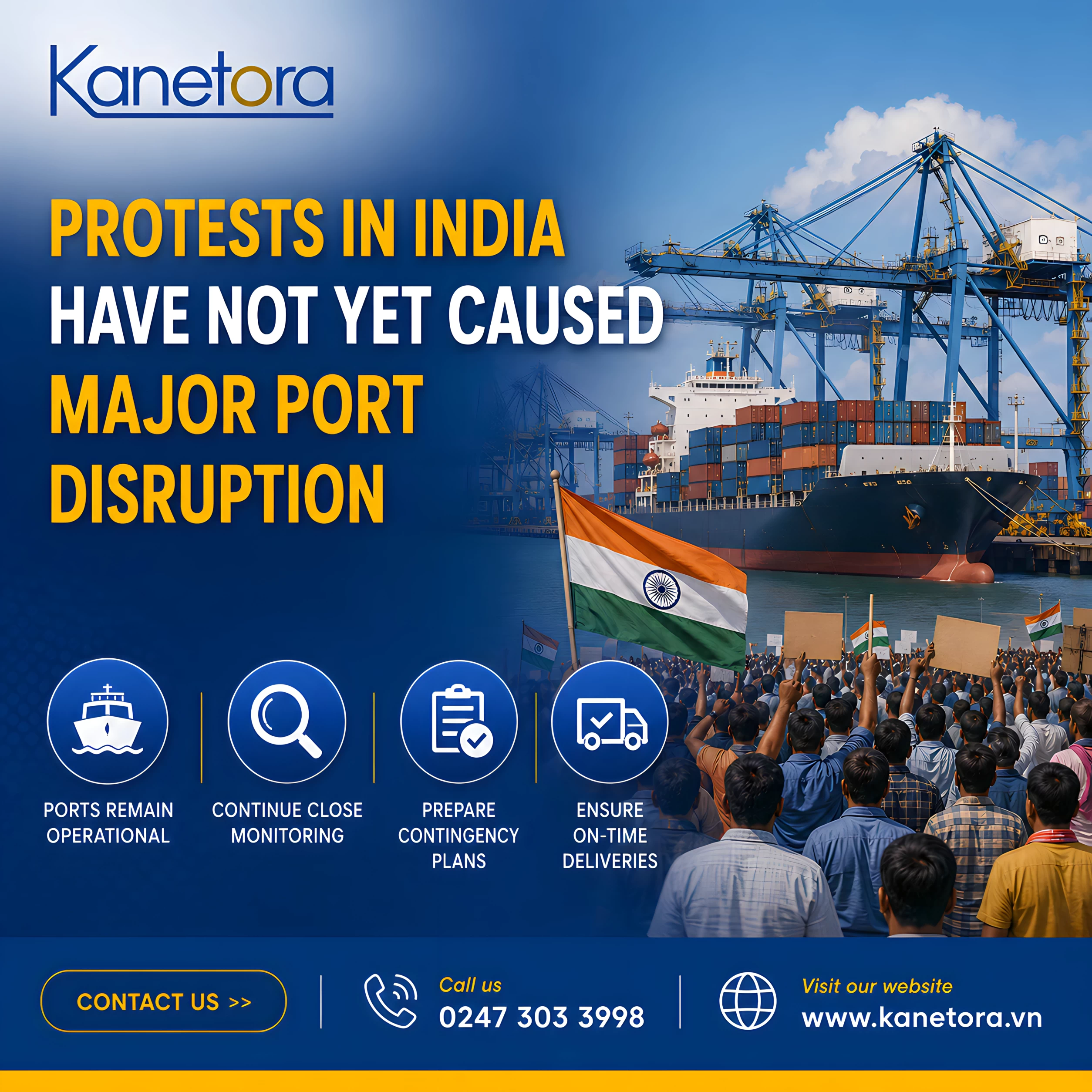
4. Protests in India have not yet caused major port disruption
Youth-led protests in New Delhi emerged following examination-paper leaks and demands for the resignation of India’s education minister.
Tens of thousands of protesters reportedly attempted to march towards parliament, resulting in clashes and police intervention.
As of the morning of July 28, there was no reliable evidence that the protests had developed into a nationwide strike or forced major ports such as Mundra, Nhava Sheva or Chennai to suspend operations.
The situation should therefore not yet be described as a nationwide logistics crisis.
However, companies with customers, employees or cargo-handling activities in New Delhi should prepare for possible:
- Delays in inland transportation
- Disruption to document delivery
- Restricted access to government offices
- Changes to business meetings and travel schedules
- Flight disruption
- Expansion of protests into broader employment or cost-of-living issues
India’s engineering exports nevertheless increased strongly in June, suggesting that the country’s manufacturing and international trade activities remain relatively resilient despite rising transportation costs through the Red Sea and Strait of Hormuz.
Impact assessment: Low for overall Indian import-export activity in the short term, but moderate for business operations based in New Delhi if protests continue.
5. The Panama Canal faces a growing El Niño risk
The Panama Canal Authority has reported a sharp increase in the probability of a severe El Niño weather pattern.
The likelihood reportedly rose from approximately 25% in April to 81% by July. The canal is currently handling an average of around 35 vessel transits per day during the 2026 fiscal year, and no major new restrictions have yet been announced.
The main risk is expected to emerge later in the year. If rainfall declines significantly, water levels in the lakes supporting the canal’s lock system may fall, potentially forcing authorities to restrict:
- Daily vessel transits
- Vessel draught
- Cargo capacity
- Booking-slot availability
- Container and bulk-cargo movements
Asian exporters shipping to the US East Coast, the Gulf of Mexico or Latin America should avoid relying on a single transport corridor.
Alternative arrangements may include:
- US West Coast ports combined with rail transport
- Routing through the Suez Canal
- Alternative destination ports
- Earlier booking of Panama Canal transit slots
- Flexible port-of-discharge clauses
Impact assessment: Currently moderate, but the risk could rise quickly during the fourth quarter of 2026.
6. Container freight rates decline, but emergency fuel surcharges are expected
Container freight rates declined for a second consecutive week on several major shipping lanes.
Reported rate movements included:
- Shanghai–Rotterdam down 1% to approximately USD 4,824 per 40-foot container
- Shanghai–Genoa down 5% to approximately USD 5,988
- Shanghai–Los Angeles down 6% to approximately USD 5,878
- Shanghai–New York down 4% to approximately USD 7,598
Intra-Asia freight rates also softened, continuing a multi-week downward trend. The Shanghai–Jawaharlal Nehru Port route reportedly fell to approximately USD 1,667 per 40-foot container.
However, lower base ocean freight does not necessarily mean lower total logistics costs.
Several carriers are preparing to introduce an Emergency Fuel Surcharge, or EFS, from August 2026 due to higher fuel prices and geopolitical risks associated with the US–Iran conflict and the Strait of Hormuz.
Exporters should clearly distinguish between:
- Ocean freight: The base sea-freight charge
- BAF: Bunker Adjustment Factor
- EFS: Emergency Fuel Surcharge
- War Risk Surcharge: Additional charge for conflict-related exposure
- PSS: Peak Season Surcharge
- Local charges: THC, CIC, documentation, handling and destination charges
A carrier may reduce the base freight rate while increasing fuel, war-risk or operational surcharges. The final landed transportation cost can therefore remain unchanged or even rise.
7. The EU Packaging and Packaging Waste Regulation applies from August 12, 2026
The European Union’s Packaging and Packaging Waste Regulation, known as PPWR – Regulation (EU) 2025/40, will generally apply from August 12, 2026.
The regulation covers packaging placed on the EU market regardless of material or country of origin.
PPWR introduces requirements concerning:
- Packaging design
- Material composition
- Waste prevention
- Reusability
- Recyclability
- Recycled content
- Labelling
- Extended producer responsibility
The long-term objective is for all packaging placed on the EU market to be recyclable in an economically viable manner by 2030.
For FIBC bags, inner liners and PE films exported to the EU, manufacturers should begin preparing a consistent technical documentation package covering:
- Polymer type and composition
- Packaging weight per unit
- Material structure
- Separation of liners, labels and accessories
- Reusability or recyclability
- Recycled-content information, where applicable
- Raw-material traceability
- Supporting test reports
- Statements of conformity
- Responsibilities of the EU importer
- Data required for extended producer responsibility obligations
Not every PPWR target becomes fully enforceable on August 12, 2026. Different obligations have separate implementation schedules.
Companies should therefore prepare an article-by-article compliance matrix rather than relying on a general statement that a product is “PPWR compliant.”
Impact assessment: Very high for packaging manufacturers and exporters serving the European market.
8. China’s export-driven recovery may intensify international competition
China’s industrial profits increased in June, although growth slowed compared with May. Manufacturing and exports remain key drivers of the economy, while domestic consumption and the property sector remain relatively weak.
This may encourage Chinese manufacturers to direct more products towards overseas markets to compensate for softer domestic demand.
As a result, international price competition could increase across:
- Industrial products
- Plastic packaging
- Machinery
- Intermediate materials
- Selected polymer grades
The resin market is therefore being influenced by two opposing forces.
On the one hand, higher oil, naphtha and transportation costs are creating upward price pressure.
On the other hand, weak domestic demand in China and increased export availability could limit price increases or generate competitive offers for certain PP and PE grades.
Companies should not forecast resin prices based solely on crude oil movements. They should also monitor:
- Plant operating rates
- Maintenance schedules
- Inventory levels
- Chinese domestic demand
- Export volumes
- Middle Eastern supply
- Northeast Asian producer quotations
- Freight and insurance costs
Overall implications for resin, packaging and logistics companies
PP and PE resin
The most immediate risk is rapid price movement combined with uneven regional supply.
Companies should shorten quotation-validity periods, maintain multiple sourcing options and consider price-adjustment clauses linked to raw materials or freight.
Supplier diversification across Northeast Asia, Southeast Asia and the Middle East can help reduce dependence on a single production region.
FIBC and plastic-film manufacturing
The two main priorities are US tariff exposure and EU PPWR compliance.
Technical documentation, raw-material origin, factory traceability and recyclability information are becoming commercial requirements rather than matters handled only by quality-assurance or legal departments.
Packaging companies with complete documentation will be better positioned during supplier assessments and international tendering.
Logistics
Freight quotations should clearly separate base ocean freight from adjustable surcharges.
For routes connected to the Middle East, Red Sea or Caspian region, logistics providers should confirm:
- War-risk insurance
- Actual vessel routing
- Transshipment ports
- Carrier diversion rights
- Emergency surcharges
- Alternative transport options
- Expected schedule reliability
International business development
Companies should review all open quotations for the US and EU markets, especially orders scheduled for delivery from August onwards.
Business with India does not currently need to be suspended. However, local political developments, port notices, airline schedules and customs operations should continue to be monitored.
Three scenarios for August 2026
Base-case scenario
Negotiations involving the United States and Iran continue without producing a durable settlement.
Base container freight rates decline slightly, but oil prices, emergency fuel surcharges and insurance costs remain elevated.
PP and PE prices fluctuate within a relatively wide range.
Downside scenario
The Strait of Hormuz or Bab el-Mandeb experiences serious disruption.
Oil, resin, bunker fuel and freight costs rise sharply. Asia–Europe vessel schedules become less reliable, and carriers introduce additional surcharges or blank sailings.
Manufacturers face pressure on both input costs and delivery commitments.
Positive scenario
Middle East tensions ease, vessels gradually return to normal routes and naphtha supply improves.
Polymer prices may stabilise, while freight surcharges could moderate.
However, US tariffs and EU packaging regulations would remain structural issues requiring long-term compliance and market planning.
Conclusion
The key challenge at the end of July 2026 is not any single event. It is the combined effect of multiple risks:
- New US tariff measures
- Conflict around strategic maritime corridors
- Rising oil and petrochemical feedstock costs
- Potential Panama Canal restrictions
- New EU packaging requirements
- Increasing price competition from China
Importers, exporters and manufacturers should move beyond managing only current freight and raw-material prices.
Effective international supply-chain management now requires coordinated control over shipping routes, surcharges, product compliance, origin documentation, insurance, supplier diversification and alternative logistics planning.
Companies with reliable product data, flexible quotations, diversified sourcing and multiple transport options will be in a stronger position to manage volatility during the second half of 2026.