

For packaging manufacturers, sourcing polypropylene (PP) and polyethylene (PE) should never be reduced to finding the lowest price per tonne.
A small raw-material price advantage may look attractive in the short term, but if the selected resin performs inconsistently in terms of melt flow, yarn stability, film strength or batch-to-batch consistency, the resulting production losses can easily exceed the initial savings.
This is particularly important for manufacturers of:
- PP woven bags
- FIBC / Jumbo Bags
- Woven PP fabric
- PP yarn and webbing
- PE films
- FIBC inner liners
- Flexible packaging
- Shrink and stretch films
- HDPE, LDPE and LLDPE film products
In September 2026, PP/PE sourcing should therefore be approached through three layers:
Market direction → Source flexibility → Actual production suitability
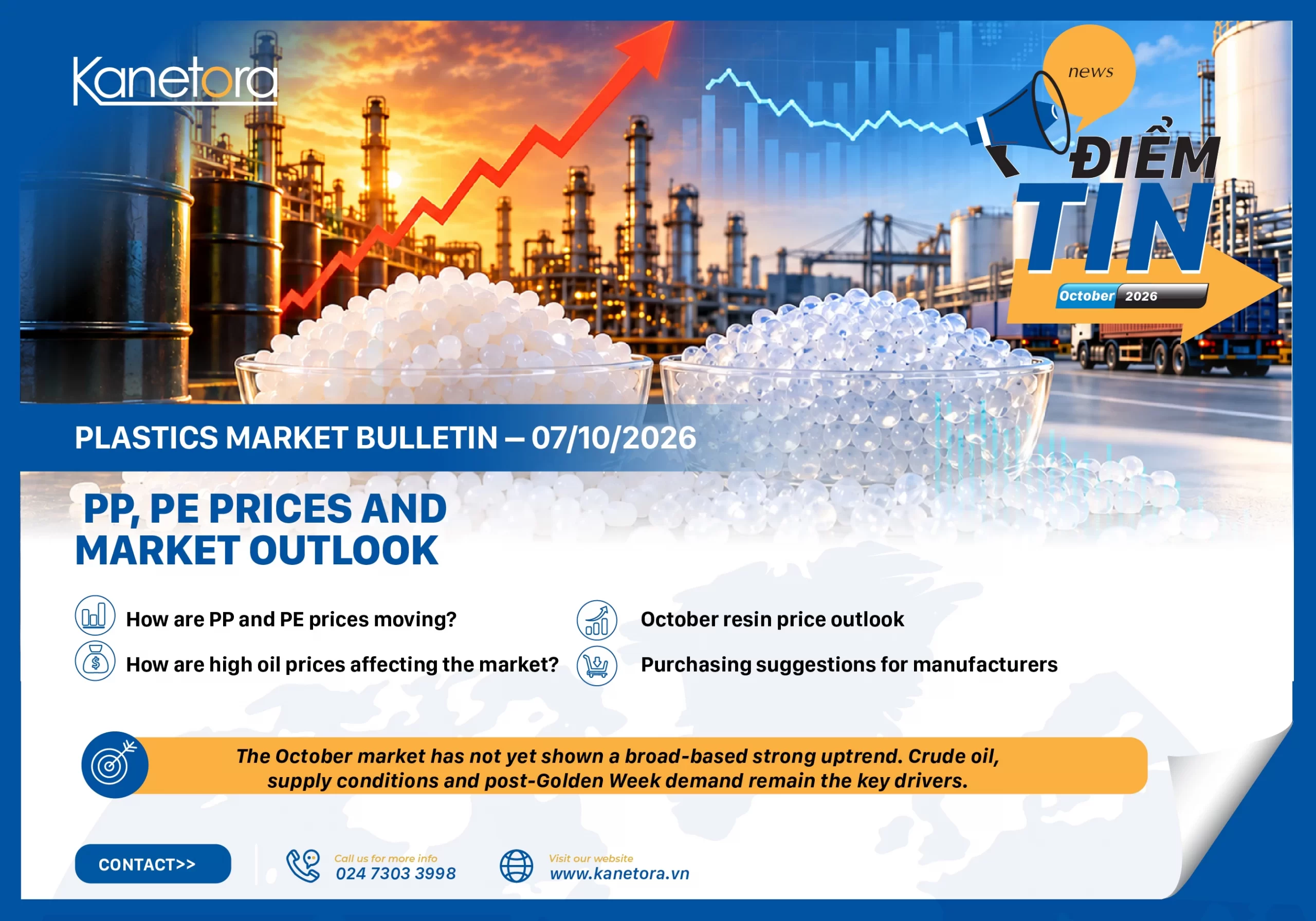
Quick Answer: What Is Happening in the PP/PE Market in September 2026?
At the beginning of September, several Asian PP and PE markets showed signs of price recovery after a period of softer conditions.
Supporting factors included:
- Higher upstream and energy costs
- Firmer propylene values
- Stronger PP and LLDPE futures in China
- Higher import offers from some suppliers
- Rising replacement costs for inventory
However, buying activity remains selective in several downstream markets.
This means the market should not yet be interpreted as a uniform upward cycle across every polymer, grade and origin.
For packaging manufacturers, the better questions are not simply:
“Is PP going up?”
or:
“Is PE getting cheaper?”
The more useful questions are:
Is the grade we actually use moving?
Can an alternative origin or producer replace it without affecting production?
How much inventory do we currently have?
How much of the next purchasing requirement should be fixed now versus left open?
PP and PE Should Not Be Treated as One Single Market
This is one of the most common mistakes in resin purchasing.
“PP prices are rising” does not mean every PP grade is rising at the same rate.
Likewise, “PE is weak” does not mean HDPE, LDPE and LLDPE are moving in exactly the same direction.
Each family serves different converting processes and end markets.
| Resin Group | Typical Packaging Applications |
|---|---|
| PP Raffia / Yarn | PP woven bags, FIBCs, woven fabric, webbing |
| PP Film | Film and selected flexible-packaging applications |
| PP Injection | Plastic components and injection-moulded products |
| LDPE | Flexible film, FIBC liners, packaging films |
| LLDPE Film | Packaging film, liners, stretch film |
| HDPE Film | Industrial bags and thin films |
| HDPE Blow | Bottles and blow-moulded packaging |
| HDPE Injection | Injection-moulded plastic products |
For this reason, purchasing decisions should be made at grade level, not merely at polymer-family level.
Kanetora supplies multiple PP, LDPE, LLDPE Film and HDPE Film grades for industrial plastics and packaging applications through its Plastic Resin portfolio.
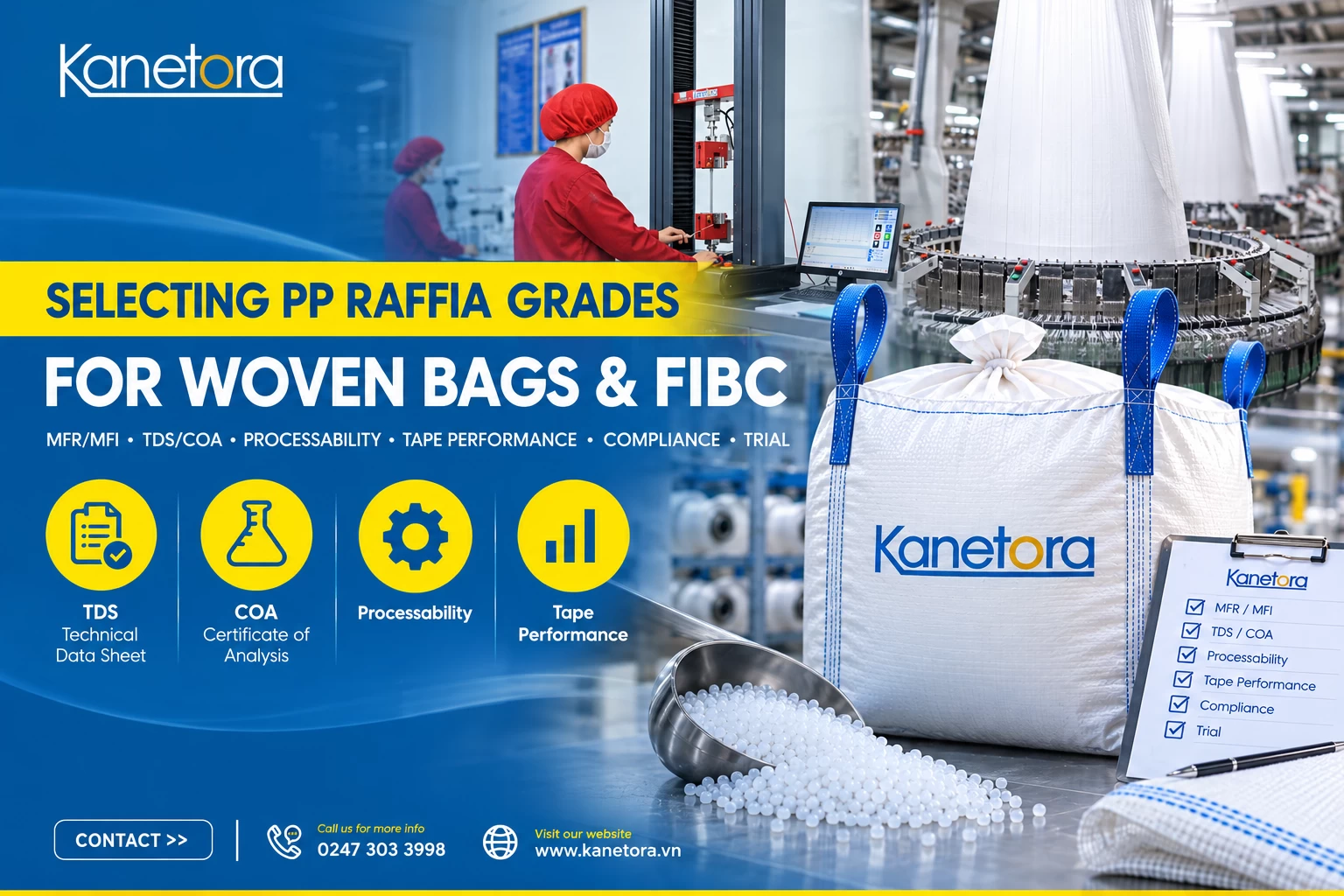
PP for Woven Bags and FIBC Production: Price Is Only Half the Decision
For PP woven bag and FIBC manufacturers, PP yarn or raffia grades are particularly important.
A suitable PP grade needs to perform consistently through:
Extrusion → Tape stretching → Orientation → Weaving → Lamination or downstream conversion
When evaluating a new PP source, manufacturers should review at least:
- Melt flow rate
- Batch-to-batch consistency
- Tape-drawing stability
- Tape-break frequency
- Tensile properties
- Elongation
- Base color
- Compatibility with masterbatch
- Processing conditions
- Actual scrap rate
A lower-priced grade that creates more tape breaks or unstable extrusion conditions may result in higher overall production cost.
The key principle is:
Not every PP homopolymer with a similar price or MFR is automatically suitable for woven packaging production.
Can One PP Grade Replace Another if the MFR Is Similar?
Not necessarily.
Two grades with similar melt flow rates can still differ in:
- Molecular-weight distribution
- Stiffness
- Toughness
- Additive package
- Thermal stability
- Ash or impurity content
- Base color
- Processing window
At high line speeds, even relatively small differences may appear as:
More tape breaks → More line stops → Lower output → Higher waste
Before switching a significant production volume to a new source, a controlled production trial is strongly recommended.
PE for Film Manufacturing: LDPE, LLDPE and HDPE Serve Different Functions
PE should not be treated as a single interchangeable raw material.
LDPE
LDPE is widely used where flexibility, processability and film softness are important.
In industrial packaging, typical applications include:
- FIBC inner liners
- PE bags
- Flexible films
- Packaging film
LLDPE
LLDPE is commonly selected where the converter requires:
- Toughness
- Puncture resistance
- Improved film strength
- Blending with LDPE
- Stretch and flexible packaging performance
HDPE Film
HDPE provides higher stiffness and density and is widely used for thin industrial films and bags requiring mechanical strength.
Before substituting one PE grade for another, converters need to evaluate both the resin specification and the final film structure.
The practical sourcing question should therefore be:
“Which PE grade is suitable for this film structure and line?”
not simply:
“What is today’s PE price?”
What Is Driving PP/PE Prices in September 2026?
1. Crude Oil and Petrochemical Feedstocks
PP and PE sit within a broader petrochemical chain.
For PE, ethylene is a key intermediate, while naphtha is an important feedstock in many Asian production routes.
For PP, propylene values and general energy costs can influence producer economics and market offers.
Kanetora has previously explained the relationship between crude oil prices and PE resin pricing and why movements in oil do not always translate immediately or proportionally into finished resin prices.
2. Import Offers
Vietnam uses both domestic and imported PP/PE.
As a result, offers from:
- The Middle East
- Northeast Asia
- Southeast Asia
- China
- The United States
can quickly influence local purchasing sentiment.
A change in international offer levels may affect the domestic market even before actual material arrives.
3. Chinese Futures
PP and LLDPE futures in China are often monitored as short-term sentiment indicators.
However:
Futures are not the same as physical resin prices delivered to Vietnam.
They should be used as one market signal among many—not as the sole basis for a purchasing decision.
4. Downstream Demand
If converters continue buying only against immediate production requirements, sellers may struggle to achieve significant price increases.
When multiple manufacturers begin rebuilding stocks simultaneously, resin values can react much faster.
5. Freight and Exchange Rates
A low FOB resin offer does not automatically mean a low landed production cost.
The converter should compare:
Resin price + freight + insurance + duties/fees + exchange rate + financing + warehousing + delivery time
For imported resin, the meaningful comparison is normally landed cost, not just the headline USD/tonne offer.
Domestic Supply or Imported Resin?
Neither option is always better.
Domestic or locally available supply may be attractive when:
- Fast delivery is required
- The converter wants to reduce safety-stock requirements
- Purchase lots are relatively small
- Production planning changes frequently
- The local grade has already been approved
- Landed cost is competitive
Imported resin may be attractive when:
- A specific grade is required
- Purchasing volume is large
- Longer production planning is possible
- International pricing or commercial terms are competitive
- The converter wants additional approved sources
- Lead time and exchange-rate exposure can be managed
A robust procurement strategy normally includes both primary sources and approved alternatives.
7 Criteria for Selecting a PP/PE Supplier for Packaging Production
1. Correct Grade Before Lowest Price
The grade must first be suitable for the production process.
A lower price has little value if the material causes higher scrap or poor machine stability.
2. Clear Technical Documentation
At minimum, buyers should be able to identify:
- Manufacturer
- Origin
- Grade
- TDS
- Melt flow rate
- Density where applicable
- Recommended application
- Relevant processing guidance
Depending on the application, COA, SDS or additional compliance documentation may also be required.
3. Batch-to-Batch Consistency
A grade that performs well once but varies significantly between shipments can create major production problems.
For high-volume converters, consistency is often as important as the nominal technical specification.
4. Continuity of Supply
A supplier should be able to answer:
- Is this source regularly available?
- What is the normal lead time?
- Is there an approved alternative?
- What happens if the producer enters maintenance?
5. Alternative-Grade Support
Strong resin sourcing is not dependent on a single grade.
Converters should ideally maintain a shortlist of pre-tested alternatives before the primary resin becomes unavailable.
6. Commercial and Payment Terms
A competitive price can be offset by unfavorable:
- Payment conditions
- Currency exposure
- Credit terms
- Delivery schedules
- Inventory requirements
Resin sourcing should be evaluated together with working-capital impact.
7. After-Sales Support
When a production problem appears, the ability to identify the lot, review COA data and coordinate with the producer can be extremely valuable.
Should Packaging Manufacturers Always Buy the Cheapest Resin?
No.
The better metric is often:
Raw-material cost per acceptable finished product
rather than:
USD per tonne of resin
For example, suppose Grade A is USD 10/tonne cheaper but creates:
- Higher tape-break rates
- More machine stoppages
- Increased scrap
- More line adjustment
- Higher energy consumption
- Greater risk of finished-product rejection
The lower resin price may actually create a higher total conversion cost.
A more complete assessment is:
Resin cost + waste + machine productivity + defect rate + conversion cost + quality risk
If Resin Prices Are Rising, Should Buyers Purchase More in Advance?
Not automatically.
A few stronger market sessions do not always indicate a sustained upcycle.
If prices are rising mainly because of futures or short-term upstream movements while downstream demand remains weak, part of the increase may later correct.
A more disciplined approach is to divide demand into:
Required purchases + Flexible purchases + Strategic buffer
For example:
- Secure enough material for confirmed production orders
- Maintain minimum inventory appropriate to the supply lead time
- Avoid excessive speculative inventory based only on a short-term rally
- Continue monitoring oil, propylene, ethylene, futures and import offers
If Prices Are Falling, Should Buyers Wait for the Bottom?
Trying to buy at the exact market bottom can be equally risky.
No buyer can consistently identify the bottom in real time.
If a plant waits for another USD 20–30/tonne reduction but then runs short of material and must purchase emergency supply at a premium, the expected saving disappears.
For a manufacturer, the first priority remains:
Keep production supplied.
Price optimization comes after supply continuity.
A Practical PP/PE Purchasing Strategy for September 2026
Under current conditions, packaging manufacturers may consider staggered purchasing rather than placing the entire requirement at one market point.
Requirements for the Next 0–2 Weeks
Prioritize supply security.
Material required for confirmed production should not depend entirely on a market-price forecast.
Requirements for the Next 2–6 Weeks
Purchases may be split into smaller tranches while monitoring market offers.
If prices are being supported mainly by upstream costs while downstream demand remains cautious, the market may continue to provide buying windows.
Longer-Term Requirements
Buyers may consider negotiating:
- Monthly volume agreements
- Contract pricing
- Price formulas
- Split delivery schedules
- Pre-approved alternative grades
The objective is to reduce the risk of purchasing an entire large requirement at an unfavorable market point.
What Should PP Woven Bag and FIBC Manufacturers Monitor Every Week?
A simple procurement dashboard can include:
| Area | Weekly Indicator |
|---|---|
| PP | PP Yarn/Raffia offers by origin |
| Upstream | Propylene, crude oil, naphtha |
| Market sentiment | China PP futures |
| Local availability | Resin stock and delivery lead times |
| Plant inventory | Current PP coverage |
| Consumption | Daily or weekly resin usage |
| Quality | Performance of current grades |
| Logistics | Freight and import lead time |
| FX | USD/VND movement |
| Orders | 30–60 day production forecast |
For an integrated packaging manufacturer producing FIBCs, woven PP packaging and related products, resin sourcing should be connected directly to finished-product production planning.
Buyers interested in the downstream use of PP and PE can also review Kanetora’s FIBC and industrial packaging solutions.
What Should PE Film Manufacturers Monitor?
In addition to resin price, film converters should monitor:
- LDPE/LLDPE blend ratio
- Film thickness
- Tensile strength
- Elongation
- Puncture resistance
- Optical properties where required
- Coefficient of friction where relevant
- Bubble stability
- Processing temperature
- Heat-sealing performance
A change in resin grade can alter the entire processing profile.
A lower-priced PE grade should therefore be evaluated through:
Technical review → Small production trial → Film-property testing → Productivity evaluation → Production approval
rather than being substituted at full scale immediately.
Virgin Resin or Recycled Resin?
These are two different sourcing strategies and should not be compared solely on price.
Recycled resin may be appropriate for selected products where:
- Product design allows it
- Customer specifications allow it
- Regulatory requirements permit it
- Performance remains acceptable
However, applications with stricter requirements for:
- Mechanical performance
- Color
- Odor
- Cleanliness
- Food-contact use
- Batch consistency
- Export specifications
may require more controlled raw-material selection.
The correct resin strategy should begin with the finished-product specification, not with the raw-material discount.
How Does Resin Sourcing Affect Export Packaging Quality?
Industrial packaging performance starts with the polymer.
For FIBCs and woven PP products, PP resin can influence:
- Tape quality
- Woven-fabric strength
- Elongation
- Weaving performance
- Base color
- Compatibility with UV masterbatch
- Production consistency
For PE inner liners, the PE grade can influence:
- Film strength
- Sealability
- Tear resistance
- Thickness consistency
- Barrier performance depending on structure
This is why resin sourcing and finished packaging performance should not be managed as completely separate functions.
For buyers interested in the opposite side of the value chain—packaging PP, PE and PET resin for export—see Bulk Bags for Plastic Resin Export: Safe Packaging for PP, PE & PET.
PP/PE Purchasing Checklist for Packaging Manufacturers
Before confirming a resin order, the purchasing team should verify:
- What is the exact grade?
- Who is the manufacturer?
- What is the origin?
- Does the TDS match the intended application?
- Is the MFR/MFI within the approved processing window?
- Has the grade been used on the production line before?
- If not, what is the trial plan?
- Are all supplier offers being compared under the same Incoterm?
- Has freight been included?
- Has exchange-rate exposure been included?
- Is material available immediately or subject to import lead time?
- What is the actual delivery time?
- What is the MOQ?
- Is COA available by lot?
- Is there an approved alternative grade?
- How many days of inventory are currently available?
- What is the 30–60 day production forecast?
- Is the current price movement driven by real demand, upstream costs or futures?
- What is the risk of production shortage if the purchase is delayed?
A good sourcing decision does not have to buy at the exact market bottom.
It should help the factory:
Avoid shortages + Avoid excessive inventory + Maintain product quality
Plastic Resin Supply at Kanetora
Kanetora Plastic Chemical supplies multiple virgin resin families for industrial manufacturing, including:
- PP
- LDPE
- LLDPE Film
- HDPE Film
These materials support applications ranging from PP tape and woven packaging to flexible film and industrial plastic processing.
For packaging manufacturers, the recommended sourcing sequence is:
Application → Technical requirement → Resin grade → Approved source → Price and commercial terms
rather than:
Lowest price → Purchase resin → Adjust the production line afterwards
FAQ – PP/PE Resin Sourcing for Packaging Manufacturers
Are PP prices rising in September 2026?
Several Asian PP markets showed stronger pricing at the beginning of September, supported by upstream costs, firmer futures and higher import offers. However, buying activity remains cautious and movements differ by grade and origin.
Is PE also increasing?
Some HDPE and LDPE markets have also shown firmer pricing. However, packaging manufacturers should evaluate the exact PE grade and landed cost rather than applying one market trend to all PE products.
Which PP grade is suitable for woven bags and FIBCs?
PP Yarn or Raffia grades are commonly used for tape extrusion and woven packaging. The exact grade should match the extrusion line, melt-flow requirement and finished-product performance.
Can one PP grade replace another if the MFI is the same?
Not automatically. MFI is only one parameter. Mechanical properties, additive package and actual processing behavior should also be evaluated.
Can LDPE and LLDPE fully replace each other?
No. They have different molecular structures and processing characteristics. They may be blended in many film applications, but the ratio needs to be validated.
Should manufacturers stockpile when resin prices rise?
Not solely because of a few stronger market sessions. Inventory decisions should reflect confirmed orders, current stock, supplier lead time and the specific grade being used.
Is domestic resin better than imported resin?
Neither is universally better. Buyers should compare quality, landed cost, availability, payment terms and delivery reliability.
When should a packaging manufacturer change resin suppliers?
A supplier change is worth considering when it creates a meaningful improvement in total cost or supply security while maintaining technical performance. A new grade should normally be tested and approved before large-scale use.
PP/PE Sourcing: Price Matters, but Production Stability Matters Too
September 2026 shows how quickly resin-market conditions can shift.
After a period in which supply was relatively comfortable and buyers were cautious about building inventory, parts of the Asian PP/PE market are now showing renewed upward pressure from feedstocks, energy and import offers.
That does not mean packaging manufacturers should chase every price increase.
The more resilient approach is to build a sourcing system around:
Multiple qualified sources → Approved alternative grades → Appropriate safety stock → Staggered purchasing → Lot-based quality control → Continuous market and logistics monitoring
With this structure, resin volatility becomes a manageable purchasing variable rather than a production emergency.
Looking for PP or PE Resin for Packaging Production?
Send Kanetora information about:
Application + Current resin grade + Manufacturer + MFR/MFI + Monthly consumption + Production requirements + Delivery schedule
Kanetora Plastic Chemical can support the evaluation of PP, LDPE, LLDPE and HDPE sources for packaging and industrial plastic applications.
Kanetora Joint Stock Company
Hotline: +84 (0) 247 303 3998
Email: info@kanetora.vn
Website: www.kanetora.vn