

When sourcing customized Flexible Intermediate Bulk Containers (FIBCs), also known as Jumbo Bags or Bulk Bags, achieving an accurate production sample depends on more than the manufacturer’s capabilities.
One of the most important factors is having a complete and clearly defined FIBC Bag Specification Sheet before sample development begins.
A small discrepancy in the filling spout diameter, lifting loop dimensions, inner liner configuration, Safe Working Load (SWL), or discharge mechanism can result in a sample that does not work properly with the buyer’s existing handling and filling equipment.
Before requesting a sample, overseas buyers and FIBC manufacturers should therefore agree on three fundamental questions:
-
What material will the FIBC contain?
-
How will the bag be filled, handled, transported, stored, and discharged?
-
Which technical specifications and performance requirements must be verified before production?
This guide explains the essential information buyers should confirm to minimize sample revisions, improve technical communication, and establish a reliable foundation for mass production.
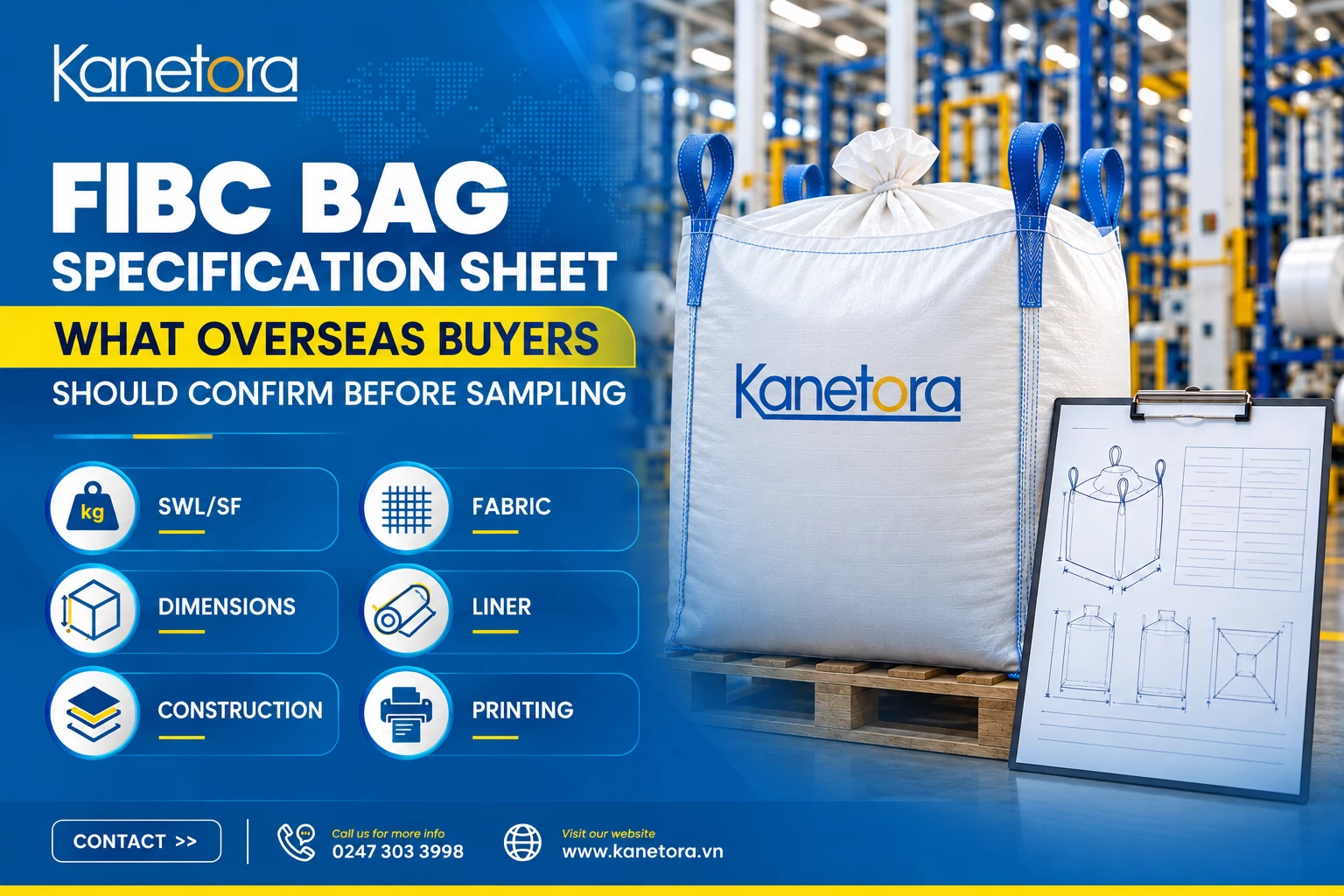
What Should an FIBC Bag Specification Sheet Include?
An effective FIBC specification sheet should cover the technical and operational requirements necessary for evaluating and developing a suitable bulk bag design.
The following 15 categories are particularly important:
-
Cargo characteristics and bulk density
-
Filling weight, Safe Working Load (SWL), and Safety Factor (SF)
-
Bag dimensions and dimensional tolerances
-
Bag construction: U-Panel, 4-Panel, Circular, or Baffle
-
Top filling construction
-
Bottom discharge construction
-
Lifting loop configuration
-
Polypropylene fabric specifications
-
Coating and UV resistance requirements
-
Inner liner type and construction
-
Dustproof, moisture protection, and electrostatic requirements
-
Printing, labels, and product markings
-
Food-contact, UN, or other application-specific requirements
-
Testing methods and acceptance criteria
-
Packing, palletization, and container loading requirements
Rather than simply requesting a price for a 1,000 kg bulk bag, buyers should first define the cargo characteristics and actual operating conditions.
A technically complete specification enables the manufacturer to recommend an appropriate construction and prepare a sample that closely matches the intended application.
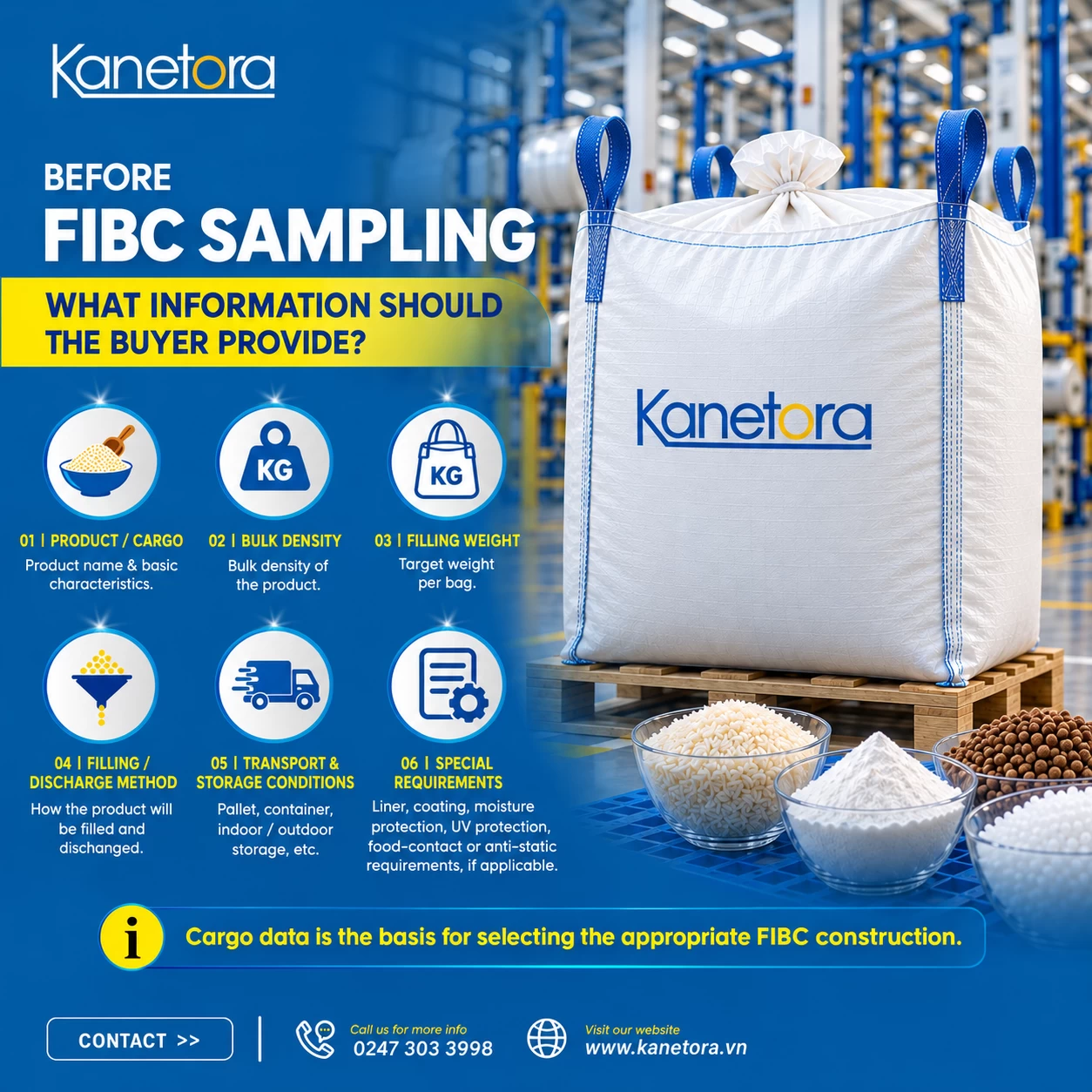
1. Cargo Data: What Material Will the FIBC Contain?
Cargo information is the starting point of every FIBC specification.
Two products with the same filling weight may require significantly different bulk bag designs depending on their bulk density, particle size, flow behavior, moisture sensitivity, and handling conditions.
For example, an FIBC designed for plastic resin pellets may not be suitable for fine mineral powder, even when both bags have a nominal filling weight of 1,000 kg.
Buyers should provide the following information:
| Specification | Required Information |
|---|---|
| Product name | Name of the material |
| Material form | Powder, granules, pellets, flakes, crystals, etc. |
| Bulk density | kg/m³ |
| Filling weight | kg per bag |
| Flowability | Free-flowing, cohesive, or difficult-flowing |
| Moisture sensitivity | Hygroscopic or non-hygroscopic |
| Dust generation | Low, medium, or high |
| Electrostatic risk | Applicable or not applicable |
| Food-contact requirements | Yes or no |
| Hazardous cargo classification | Applicable classification, if any |
Why Is Bulk Density Important?
Bulk density directly influences the required filling volume and overall bag dimensions.
For instance, two products weighing 1,000 kg may occupy very different volumes.
If the buyer only provides the filling weight without specifying bulk density, the manufacturer may not have sufficient information to optimize the bag’s dimensions and filling capacity.
Therefore, the technical evaluation should begin with:
Cargo type → Bulk density → Filling weight → Required volume → Bag dimensions
For additional guidance, buyers can refer to FIBC Bags for Minerals and Construction Materials, which discusses how cargo properties influence bulk bag selection.
2. Confirm Safe Working Load (SWL) and Safety Factor (SF)
What Is Safe Working Load?
Safe Working Load (SWL) is the maximum load an FIBC is designed to carry under its specified conditions of use.
Common SWL ratings include:
-
500 kg
-
1,000 kg
-
1,250 kg
-
1,500 kg
-
2,000 kg
However, the appropriate SWL should be selected based on the actual filling weight, lifting conditions, handling method, and intended application.
A higher SWL rating does not automatically mean that a bag is suitable for every operating environment.
What Is the Safety Factor?
The Safety Factor (SF) is associated with the required performance and testing criteria of an FIBC design.
Common specifications include SF 5:1 and SF 6:1, depending on the applicable design requirements and intended use.
For example:
SWL: 1,000 kg | Safety Factor: 5:1
This does not mean that the bag may be filled with 5,000 kg of cargo.
The rated SWL remains 1,000 kg, and the safety factor relates to the performance criteria used to evaluate the bag.
Buyers should also confirm whether the FIBC is intended for single-trip or multi-trip use.
For further information, read Can Jumbo Bags Be Reused? Understanding Single-Trip and Multi-Trip FIBCs.
3. Confirm FIBC Dimensions and Dimensional Tolerances
A typical FIBC specification records bag dimensions as:
Width × Depth × Height (W × D × H)
For tubular or circular designs, the dimensional convention should be agreed upon with the manufacturer.
In addition to nominal dimensions, buyers should specify:
-
Dimensional tolerances
-
Required dimensions after filling
-
Pallet dimensions
-
Maximum stacking height
-
Container loading requirements
-
Warehouse height limitations
-
Compatibility with existing filling and discharge equipment
Why Should Bag Dimensions Be Based on Logistics Requirements?
An FIBC may meet its stated dimensions when empty but behave differently once filled.
Depending on the fabric construction, cargo density, and bag design, the filled bag may expand or bulge.
This can affect pallet stability, warehouse space utilization, and container loading efficiency.
For applications requiring improved shape retention, buyers may consider a Baffle FIBC, which incorporates internal panels to reduce bulging and help maintain a more rectangular shape.
Learn more about Baffle Jumbo Bags for Optimized Warehouse and Container Loading.
4. Select the Appropriate FIBC Construction
The construction method affects the overall shape, seam arrangement, manufacturing process, and performance of the FIBC.
The most common options include:
U-Panel FIBC
A U-Panel bag is manufactured using one continuous U-shaped fabric panel combined with side panels.
This construction is widely used for different industrial applications and provides flexibility in customized bag design.
4-Panel FIBC
A 4-Panel FIBC consists of four separate side panels connected to a bottom panel.
This construction can support applications requiring a relatively well-defined bag shape.
Circular or Tubular FIBC
Circular FIBCs use tubular woven fabric to form the main bag body, reducing the number of vertical seams.
This design may be suitable for certain products where seam configuration is an important consideration.
Baffle FIBC
Baffle bags incorporate internal panels that help control bulging during filling.
They are commonly considered when storage efficiency, pallet utilization, or container loading optimization is important.
Kanetora’s FIBC product portfolio includes U-Panel, 4-Panel, Circular, and Baffle constructions, with final specifications developed according to the customer’s application.
5. Top Construction: Confirm the Filling Method
The top filling system should be designed around the buyer’s filling equipment and cargo characteristics.
A specification stating only “filling spout” is often insufficient.
For a spout-type design, buyers should specify:
Filling Spout Diameter × Filling Spout Length
Additional information may include the closure mechanism, tie cords, filling equipment dimensions, and dust containment requirements.
Open Top
A fully open top facilitates fast filling and may be suitable for applications where a fully enclosed filling system is not required.
Duffle Top
A wide skirt-style top can be gathered and secured after filling.
This construction offers greater flexibility in closing the bag.
Filling Spout
A filling spout allows the bag to be connected to a compatible filling system.
Its diameter and length should match the dimensions and operating requirements of the filling equipment.
For automated or semi-automated filling lines, buyers should provide the relevant equipment drawings or interface dimensions whenever possible.
6. Bottom Construction: How Will the Cargo Be Discharged?
Bottom construction should be confirmed before sampling, particularly when the FIBC will be used with controlled discharge equipment.
Common options include:
Flat Bottom
A closed bottom without a dedicated discharge mechanism.
This design is suitable where controlled bottom discharge is not required.
Discharge Spout
An outlet designed to release material in a controlled manner.
The specification should define:
Discharge Spout Diameter × Length × Closure Method
Conical Discharge
A conical outlet can help support material flow in certain applications.
Its suitability depends on the characteristics of the cargo and the discharge equipment.
Full Open Bottom
A construction allowing the bottom section to open for rapid discharge.
This may be useful for applications requiring fast emptying.
Buyers should also confirm whether the discharge system requires an iris closure, additional ties, or another securing mechanism.
An incomplete discharge specification may result in a sample that looks correct but cannot operate efficiently with the buyer’s equipment.
7. Lifting Loops: More Than Simply Specifying Four Loops
Lifting loops directly affect how the FIBC is handled by forklifts, cranes, and other lifting equipment.
A complete specification should include:
Loop Type + Width + Free Height + Position
For example:
Four Cross-Corner Loops | 70 mm Width | 300 mm Free Height
Common lifting configurations include:
-
Corner seam loops
-
Cross-corner loops
-
Stevedore loops
-
Sling lifting systems
Buyers should also provide any restrictions relating to forklift fork spacing, lifting height, or equipment configuration.
The lifting system must be evaluated as part of the overall bag design rather than as an independent accessory.
At Kanetora Bach Dang, several semi-finished components, including sling belts and webbings, are manufactured in-house to support quality consistency and production flexibility.
8. Fabric Specifications: Why GSM Alone Is Not Enough
One of the most common mistakes in bulk bag sourcing is assuming that fabric weight alone determines bag strength.
For example, a buyer may specify:
180 GSM PP Woven Fabric
However, GSM only describes fabric mass per unit area.
The actual performance of an FIBC also depends on:
-
Yarn specifications
-
Weaving structure
-
Tensile strength
-
Elongation
-
Fabric coating
-
Seam construction
-
Lifting loop design
-
UV stabilization
-
Overall bag construction
A more reliable technical approach is:
Cargo Characteristics → Filling Weight → Bag Dimensions → SWL/SF → Fabric Construction → Testing
Fabric GSM should be determined as part of the complete design rather than being treated as the sole indicator of load-bearing performance.
9. Coated or Uncoated FIBC?
Buyers should clearly indicate whether the bag requires coated or uncoated polypropylene fabric.
Coating may be considered for applications involving:
-
Fine powders
-
Dust containment
-
Reduced material leakage
-
Additional moisture protection requirements
-
Specific surface performance characteristics
However, coating does not automatically make an FIBC waterproof or provide the same protection as a dedicated inner liner.
For hygroscopic products or applications requiring stronger barrier properties, an appropriate liner should be evaluated.
10. Inner Liner Specifications
An FIBC liner should be included in the initial specification whenever required.
Adding a liner after the outer bag has already been developed may affect dimensions, filling compatibility, discharge behavior, and production costs.
The specification should confirm:
Liner Material + Thickness + Dimensions + Construction + Fixing Method
Common liner options include:
-
Lay-flat liners
-
Gusseted liners
-
Liners with fixing tabs
-
Top and bottom flange liners
-
Reinforced side-seal liners
-
Baffled liners
-
Conductive liners
-
Aluminum barrier liners
Different constructions provide different levels of moisture protection, dust containment, liner stability, and discharge performance.
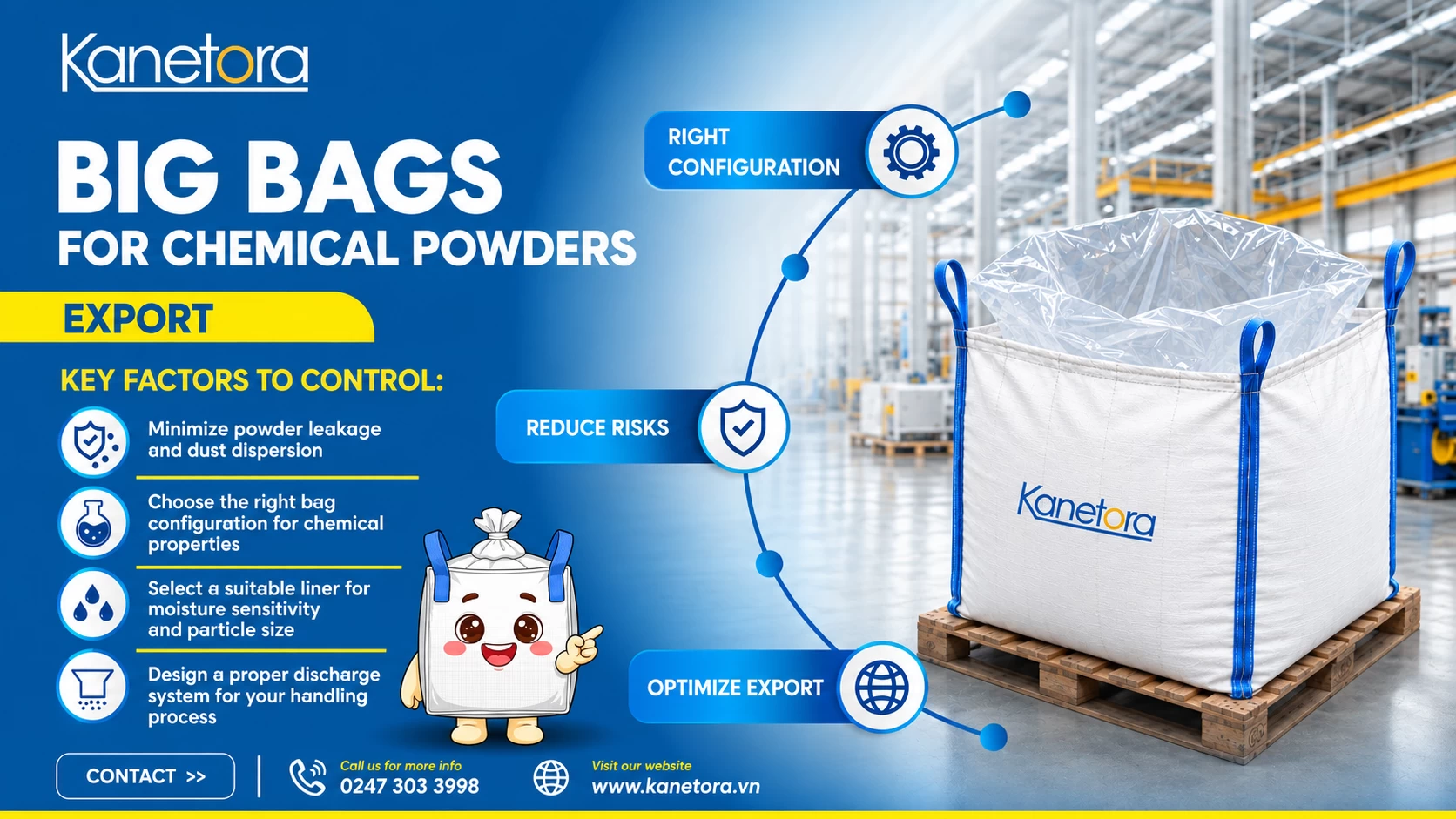
For further guidance, read FIBC Bags for Chemical Powders: Safety, Liners and Discharge Solutions.
11. Electrostatic Requirements: Does the Application Need Type C or Type D FIBC?
Electrostatic safety should be assessed based on cargo characteristics and the actual operating environment.
Buyers should communicate:
-
Whether the product generates combustible dust
-
Whether flammable gases or vapors may be present
-
Filling and discharging conditions
-
The electrical properties of the material
-
Grounding arrangements
-
Applicable site safety requirements
Depending on the risk assessment, different FIBC types may be considered, including Type A, Type B, Type C, and Type D.
Type C FIBCs are designed for use with appropriate grounding arrangements, while Type D FIBCs use specific static-protective designs that do not rely on conventional grounding of the bag.
The correct selection must be based on applicable safety requirements and the operating environment.
Read more: Type C vs Type D FIBC Bags for Export Cargo.
12. UV Resistance Requirements
If FIBCs may be stored, staged, or transported outdoors, UV exposure should be addressed in the specification.
Rather than simply stating “UV resistant,” buyers should provide details such as:
-
Expected outdoor exposure duration
-
Direct sunlight exposure
-
Storage environment
-
Destination market
-
Transportation conditions
-
Required UV test criteria, if applicable
UV resistance is an important consideration because prolonged exposure can affect polypropylene fabric performance.
Kanetora Bach Dang operates a UV accelerated weathering tester as part of its laboratory equipment for material and product evaluation.
13. Food-Grade and Food-Contact Requirements
FIBCs intended for products such as flour, sugar, starch, rice, or other food ingredients require additional attention to hygiene and contamination control.
Depending on the application, the specification may need to include:
-
Food-contact requirements
-
Material composition
-
Liner construction
-
Hygiene requirements
-
Foreign-body prevention
-
Traceability
-
Documentation
-
Applicable destination-market regulations
Kanetora Bach Dang applies a Quality Control and Quality Assurance system covering production and final inspection.
Its production processes include specific inspection and cleaning operations designed to reduce contamination risks.
Relevant material testing and certification documents can be reviewed according to the buyer’s product and market requirements.
For a more detailed explanation, see Food-Grade Jumbo Bags: Hygiene and Contamination Control.
14. Printing, Labels, and Markings
Printing and labeling requirements should be confirmed together with the technical specification.
The buyer should provide:
-
Company logo and approved artwork
-
Printing colors
-
Number of printed sides
-
Product identification
-
SWL and Safety Factor markings
-
Handling symbols
-
Batch or lot identification
-
Country-of-origin information
-
Warning statements, where applicable
-
Barcode or QR code requirements
-
Label dimensions and positioning
-
Document pouch requirements
The printed technical information must match the approved bag specification.
In particular, SWL and Safety Factor markings should be carefully reviewed before the artwork is released for production.
For customized printing projects, the buyer should approve both the technical specification and the final artwork before mass production.
15. Testing Requirements and Acceptance Criteria
Testing requirements should be discussed before sample production, not after the samples have been completed.
The specification should identify:
-
Required tests
-
Applicable testing standards
-
Sample quantity
-
Acceptance criteria
-
Test report requirements
-
Inspection responsibilities
-
Third-party inspection requirements
-
Production batch testing frequency
Depending on the bag design and customer requirements, evaluation may include tensile testing, top lift testing, seam performance checks, dimensional inspection, and liner testing.
Kanetora Bach Dang’s laboratory equipment includes tensile strength testing machines, a UV accelerated weathering tester, and a top lift test machine.
The factory also operates a two-stage QC/QA system, with in-process quality inspections and final quality assurance checks before shipment.
16. Packing and Container Loading Specifications
Technical approval should also cover how finished FIBCs will be packed and transported.
Buyers should confirm:
Pieces per Bale + Bale Dimensions + Pallet Requirements + Container Loading Plan
Additional considerations include:
-
Compression requirements
-
Palletized or non-palletized packing
-
Container type
-
Gross weight limitations
-
Export documentation
-
Shipping marks
-
Destination requirements
The final packing configuration should be approved according to the order quantity, bag dimensions, and logistics conditions.
At Kanetora Bach Dang, packing methods can be customized for different customer requirements.
Sample FIBC Bag Specification Sheet for Overseas Buyers
The following checklist can be used when preparing a request for quotation (RFQ) or sample development request.
| Specification Item | Buyer Confirmation |
|---|---|
| Product / Cargo | |
| Material Form | Powder / Granules / Pellets / Other |
| Bulk Density | kg/m³ |
| Filling Weight | kg/bag |
| Safe Working Load | kg |
| Safety Factor | |
| Bag Construction | U-Panel / 4-Panel / Circular / Baffle |
| Bag Dimensions | Width × Depth × Height |
| Fabric Material | PP Woven |
| Fabric Weight | GSM |
| Coating | Coated / Uncoated |
| UV Requirements | |
| Top Construction | |
| Filling Spout | Diameter × Length |
| Bottom Construction | |
| Discharge Spout | Diameter × Length |
| Lifting Loops | Type / Width / Free Height |
| Liner | Material / Thickness / Construction |
| Dustproof Requirements | |
| Electrostatic Requirements | |
| Food-Contact Requirements | |
| Printing | Number of Sides / Colors |
| Label | Type / Position |
| Document Pouch | Yes / No |
| Testing Requirements | |
| Packing | Pieces per Bale |
| Pallet Requirements | Yes / No |
| Destination Market | Country |
| Estimated Order Quantity | Pieces |
| Sample Requirements | |
| Reference Sample | Available / Not Available |
This checklist provides a starting point. The final specification should be reviewed and approved based on the actual application.
Common Mistakes That Lead to Multiple FIBC Sample Revisions
1. Providing Only a Reference Photo
A photograph may help the manufacturer identify the general bag construction, but it cannot reliably communicate exact dimensions, fabric specifications, lifting performance, or liner requirements.
Buyers should provide a technical drawing or specification sheet whenever possible.
2. Specifying Dimensions Without Cargo Information
Bag dimensions alone do not indicate the required filling capacity, bulk density, SWL, or handling conditions.
The manufacturer needs to understand the product and its application before finalizing the design.
3. Reusing Specifications from a Different Product
An FIBC designed for plastic pellets may not be appropriate for food powders, fertilizers, or minerals.
Each application should be evaluated individually.
4. Failing to Confirm Filling and Discharge Equipment Compatibility
Incorrect filling spout or discharge outlet dimensions can result in operational problems, even when the physical appearance of the sample matches the reference.
5. Approving Artwork Separately from Technical Specifications
Printed SWL ratings, Safety Factor information, product identification, and safety markings must correspond to the approved technical design.
6. Adding a Liner After Sample Approval
Introducing or changing the liner may affect filling performance, discharge efficiency, available filling volume, and production requirements.
Liner specifications should therefore be confirmed during the initial technical review.
From FIBC Specification to Approved Production Sample: The Recommended Process
A structured sampling process helps reduce unnecessary revisions and improves communication between overseas buyers and manufacturers.
Step 1: Submit Cargo Information
The buyer provides product characteristics, bulk density, filling weight, handling conditions, and operational requirements.
Step 2: Prepare the FIBC Specification Sheet
Both parties define the bag construction, dimensions, lifting loops, filling and discharge systems, fabric, liner, printing, and applicable performance requirements.
Step 3: Conduct a Technical Review
The manufacturer evaluates the proposed specification for manufacturability, compatibility, and performance requirements.
Where necessary, design modifications are recommended before sampling.
Step 4: Approve the Initial Specification
The buyer confirms the technical drawing, material requirements, and proposed sample configuration.
Step 5: Produce the FIBC Sample
The manufacturer prepares a sample according to the agreed specification.
Step 6: Evaluate the Sample
The sample is checked for dimensions, construction quality, equipment compatibility, and relevant performance requirements.
Additional testing may be conducted according to the agreed inspection plan.
Step 7: Approve the Golden Sample
Once the sample meets the agreed requirements, the buyer approves it as a reference for mass production.
The approved golden sample and final specification should be controlled together to avoid discrepancies.
Step 8: Begin Mass Production and Quality Control
Production follows the approved specification, supported by in-process inspections and final quality checks.
At Kanetora Bach Dang, FIBC manufacturing follows an eight-stage process:
Extrusion → Webbing Weaving → Fabric Weaving → Coating → Cutting & Printing → Sewing → Inspection → Packing
This integrated production approach supports specification consistency from sample development through commercial manufacturing.
How Kanetora Supports Overseas Buyers in FIBC Specification Development
Kanetora provides customized FIBC and Jumbo Bag manufacturing solutions for international buyers across industries including food, agriculture, plastics, chemicals, minerals, and construction materials.
Through its Kanetora Bach Dang manufacturing facility in Ninh Binh, Vietnam, the company offers an FIBC production capacity of approximately 300,000 bags per month, supported by integrated manufacturing equipment and quality control systems.


Integrated Manufacturing Capabilities
Kanetora Bach Dang manufactures several important FIBC components in-house, including:
-
Polypropylene woven fabrics and webbings
-
Lifting belts and sling components
-
FIBC inner liners
-
Labels and document pouches
-
Other customized semi-finished components
This manufacturing integration supports better control over product specifications, component consistency, and production scheduling.
Quality Control and Testing
The factory’s quality evaluation capabilities include tensile strength testing, top lift testing, UV accelerated weathering testing, and specialized liner inspection equipment.
Kanetora Bach Dang also maintains internationally recognized management system certifications, including ISO 9001:2015 and ISO 14001:2015, supporting its commitment to systematic quality management and environmental responsibility.
Technical Collaboration from Sampling to Shipment
Rather than selecting a bag based only on nominal capacity or fabric weight, Kanetora encourages buyers to consider the complete packaging application:
Cargo → Bulk Density → Filling Weight → Operating Conditions → Bag Design → Testing → Logistics
This approach helps buyers establish specifications that reflect their actual production, handling, and export requirements.
For companies seeking an FIBC manufacturer in Vietnam, technical collaboration during the specification and sampling stages can help improve product consistency and reduce the risk of costly design changes during mass production.
Frequently Asked Questions About FIBC Bag Specifications
What is an FIBC Bag Specification Sheet?
An FIBC Bag Specification Sheet is a technical document describing the agreed requirements for a Flexible Intermediate Bulk Container, including cargo characteristics, SWL, Safety Factor, dimensions, construction, fabric, lifting loops, liners, filling and discharge systems, printing, and testing criteria.
What information should buyers provide before requesting an FIBC sample?
Buyers should provide the cargo type, bulk density, filling weight, required SWL, proposed bag dimensions, filling and discharge methods, lifting requirements, liner or coating specifications, and applicable safety or regulatory requirements.
Can an FIBC manufacturer develop a sample from an existing bag?
Yes. An existing FIBC can serve as a reference sample. However, dimensions, materials, construction, and performance requirements should still be measured, reviewed, and confirmed before reproducing the bag.
What is the difference between SWL and Safety Factor?
SWL represents the maximum designed working load of the FIBC. Safety Factor relates to specified performance testing and the intended conditions of use. A 1,000 kg FIBC with an SF of 5:1 is not approved to carry 5,000 kg during normal operation.
Does a higher fabric GSM mean a stronger FIBC?
Not necessarily. Fabric GSM is only one design parameter. Overall FIBC strength also depends on yarn properties, woven fabric construction, seams, lifting loops, and the complete bag design.
Do all FIBC bags require an inner liner?
No. Inner liners are selected according to the packaged material and application. Products sensitive to moisture, contamination, or dust leakage may require a specially designed liner.
Can FIBC dimensions and spouts be customized to match filling equipment?
Yes. Manufacturers can develop customized bag dimensions, filling spouts, discharge spouts, lifting loops, and liners based on the customer’s equipment and operating requirements.
Should FIBC testing requirements be confirmed before sampling?
Yes. Applicable test methods, performance criteria, inspection responsibilities, and required reports should be agreed upon before sample development to ensure that the final design can be evaluated consistently.
Conclusion: The Right FIBC Sample Starts with the Right Specification
A reliable FIBC Bag Specification Sheet should be developed before the first sample is produced, not after it has been completed.
For overseas buyers, confirming cargo characteristics, bulk density, SWL, Safety Factor, dimensions, lifting loops, filling and discharge systems, liners, fabric construction, printing, testing, and packing requirements can significantly improve the sampling process.
More importantly, the specification must reflect how the FIBC will actually be used throughout the supply chain, from filling and lifting to storage, international transportation, and final discharge.
By combining technical evaluation with integrated manufacturing and quality control, Kanetora supports international customers in developing FIBC solutions tailored to their specific industrial applications.
Looking for a Customized FIBC Manufacturer in Vietnam?
Whether you already have a complete technical specification, an existing reference bag, or only basic cargo information, Kanetora can assist with specification review, customized sample development, and mass production planning.
Send us your FIBC specification sheet or cargo requirements to discuss a suitable packaging solution.
KANETORA JOINT STOCK COMPANY
-
Website: Kanetora official website
-
Manufacturing facility: Kanetora Bach Dang, Ninh Binh, Vietnam
-
Email: info@kanetora.vn
-
Hotline: +84 (0) 247 303 3998