

When powders, granules or plastic pellets move through filling and discharge systems, friction between the product, equipment and packaging can generate electrostatic charge. If that charge is not properly controlled, an electrostatic discharge may become an ignition source in environments containing combustible dust, flammable gas or vapor.
For this reason, businesses handling chemicals, plastic resins, fertilizers, pharmaceutical ingredients and other sensitive bulk materials may need static-protective FIBC bags rather than standard bulk bags.
Among the available options, Type C and Type D FIBC bags are commonly considered for operations where electrostatic safety is a critical requirement. However, the two bag types use different static-control mechanisms and involve different operational responsibilities.
Selecting the right option therefore requires more than simply comparing prices. Buyers must evaluate the packed product, hazardous-area classification, filling equipment, grounding capability, liner structure and operating procedures.
For a broader overview of material, load capacity, environment and bag construction, buyers can first review Kanetora’s guide on key factors to consider before choosing an FIBC bag.
Quick Answer: What Is the Difference Between Type C and Type D FIBC Bags?
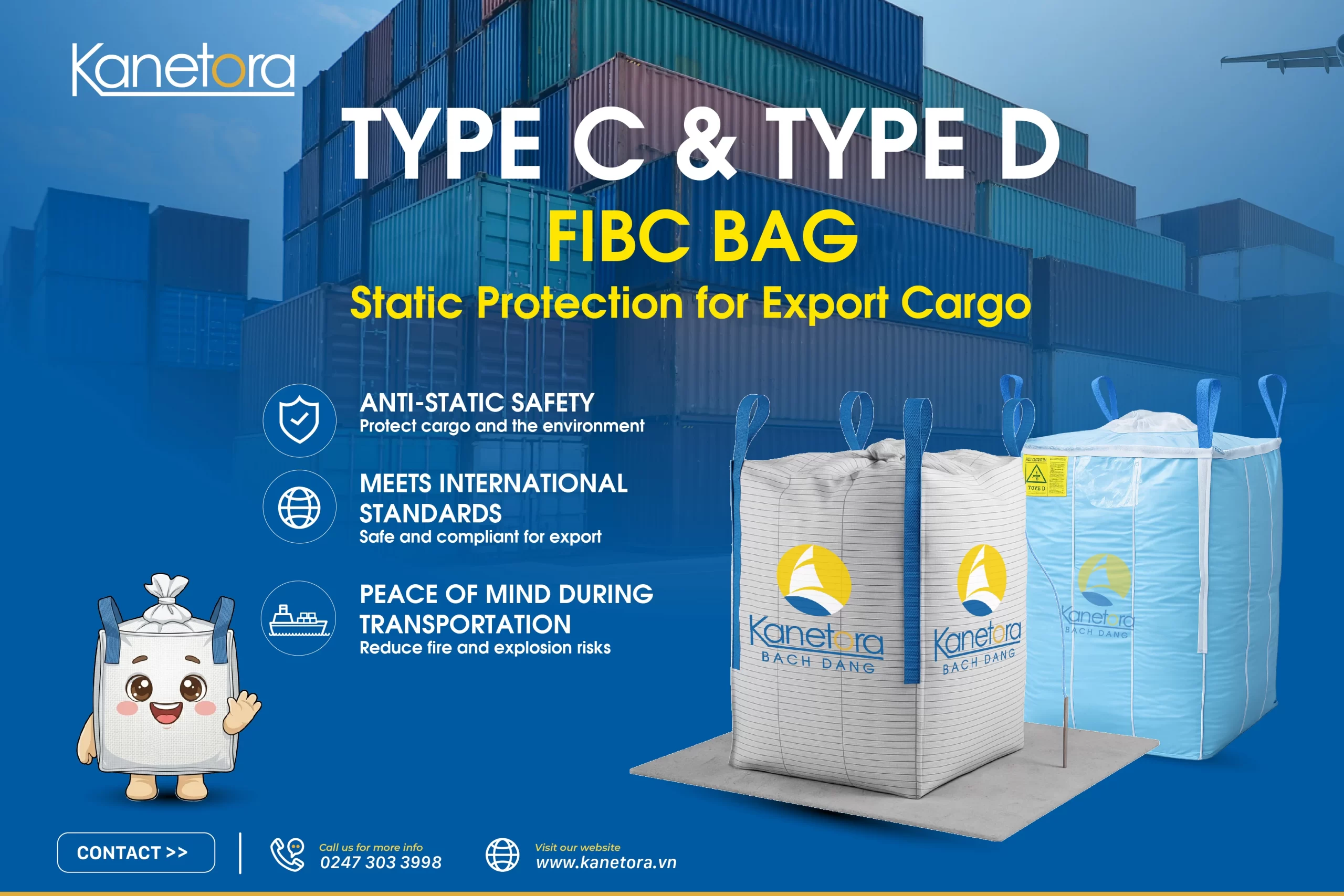
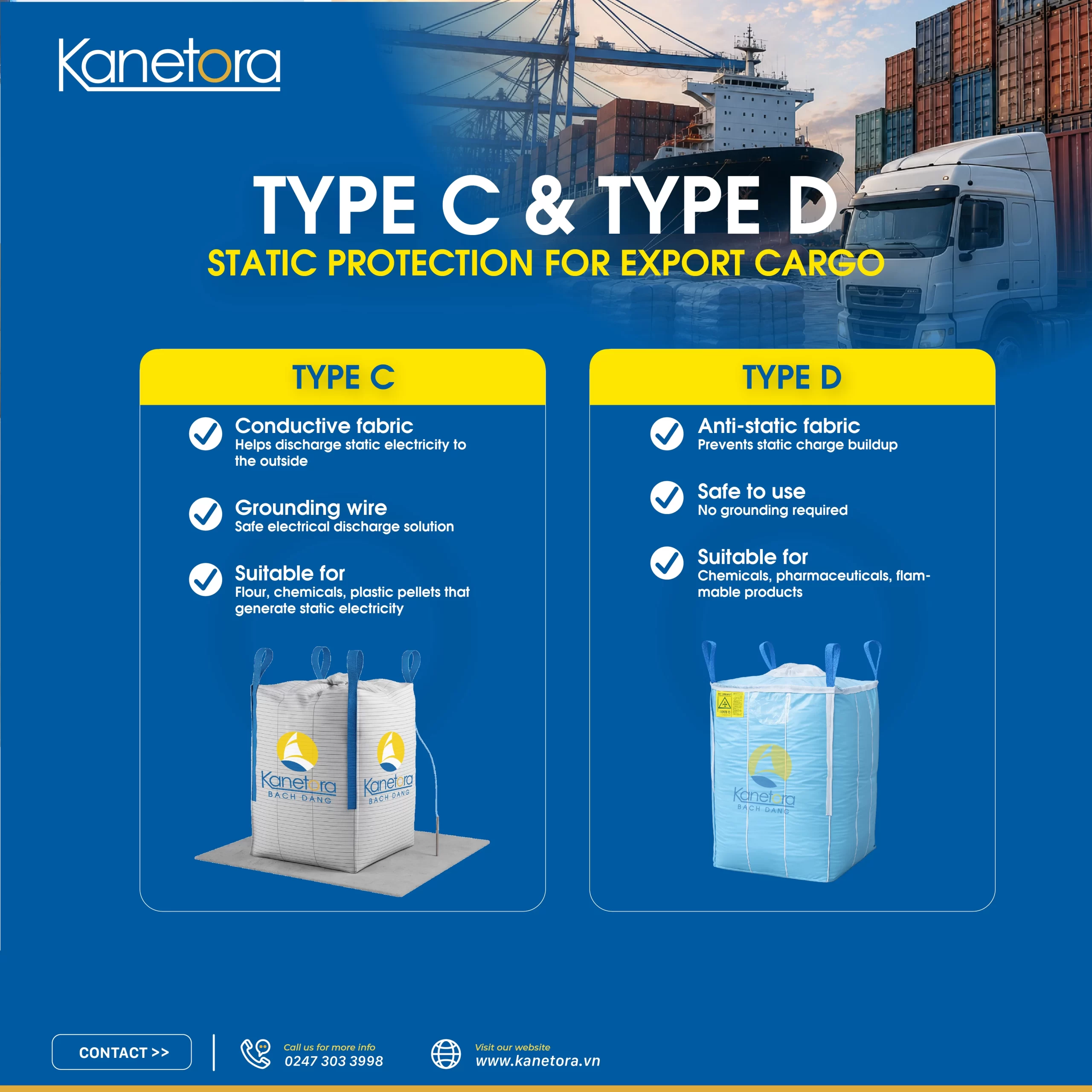
A Type C FIBC bag uses interconnected conductive threads or conductive fabric to transfer electrostatic charge to earth. It must be properly grounded before filling or discharging begins and must remain grounded throughout the operation.
A Type D FIBC bag uses specialized static-protective fabric that dissipates charge without requiring a physical grounding connection.
The key distinction is therefore:
Type C controls static electricity through grounding, while Type D controls static electricity through specially engineered static-dissipative fabric.
Neither type should be selected solely by cargo name. The decision must be based on a documented risk assessment covering both the material inside the bag and the environment surrounding it.
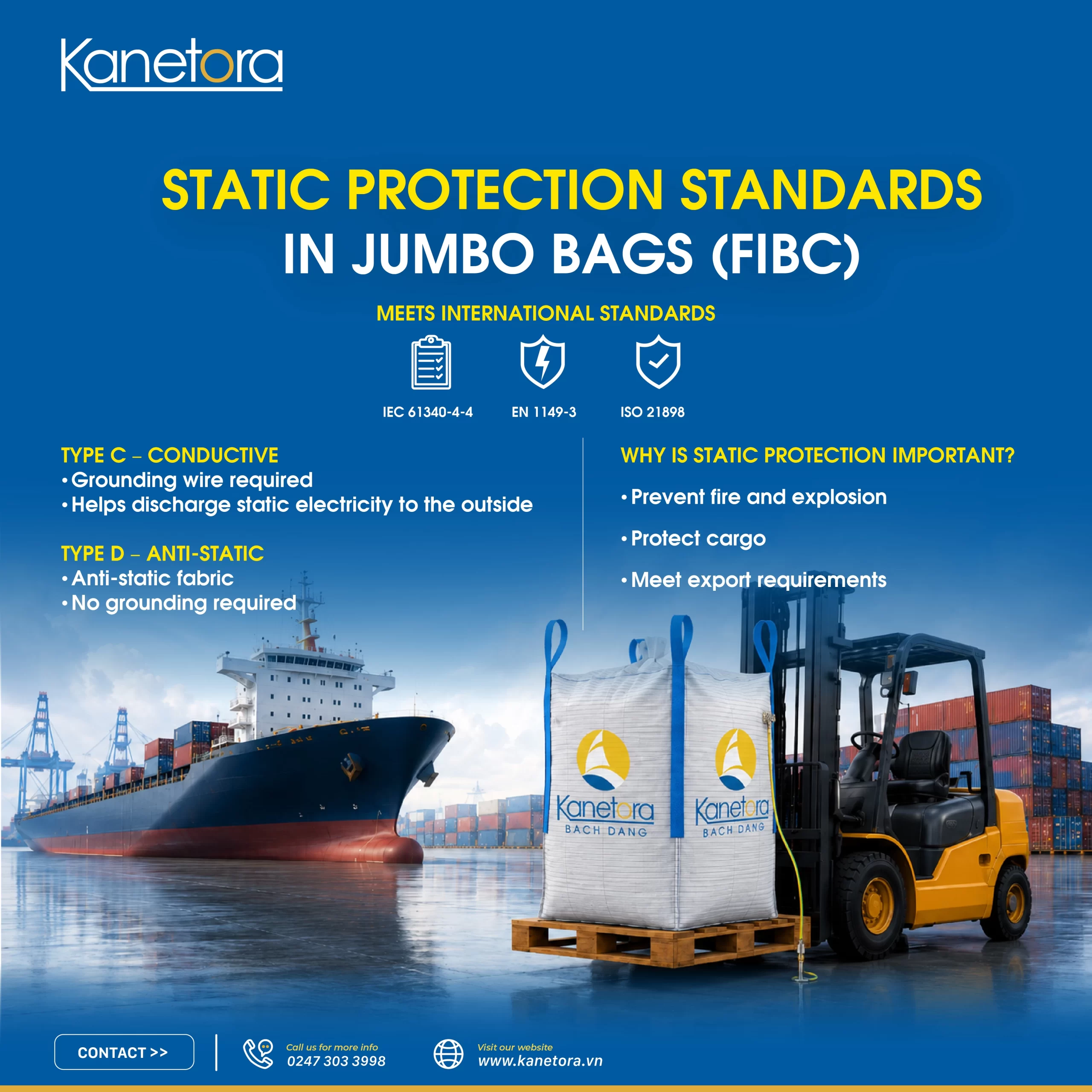
IEC 61340-4-4:2018 covers the electrostatic classification, labeling, inner liners and testing of FIBCs intended for use in potentially explosive atmospheres.
Why Does Static Electricity Occur During FIBC Handling?
Electrostatic charge can be generated during several stages of bulk-material handling:
- Pneumatic or gravity filling
- Rapid movement of powders or pellets
- Product friction against the liner and woven fabric
- Lifting and repositioning the FIBC
- Discharging through a bottom spout
- Contact between the bag and filling equipment
- Movement across dry production environments
Fine powders and lightweight particles can generate particularly high levels of charge because they have a large surface area and move rapidly through processing systems.
Static electricity does not automatically create an explosion. A serious incident normally requires several conditions to occur together: a flammable atmosphere, sufficient electrostatic energy and an effective discharge path.
However, in chemical, petrochemical, mineral, pharmaceutical and plastic-processing environments, those conditions may be present during routine operations. Static control should therefore be incorporated into the packaging specification, equipment design and operating procedure from the beginning.
IEC 61340-4-4 applies to FIBCs used where the contents or surrounding environment may create a hazardous explosive atmosphere and establishes requirements for their classification and testing.
What Is a Type C FIBC Bag?
A Type C FIBC is commonly described as a conductive or groundable bulk bag.
Its woven polypropylene body incorporates conductive threads or filaments. These conductive elements are interconnected and connected to one or more grounding points on the bag.
During filling and discharge, electrostatic charge is transferred through the conductive network and safely directed to earth.
How Does Type C Static Protection Work?
A typical Type C operating sequence includes:
- Inspecting the bag and grounding point.
- Connecting the designated grounding tab to a verified earth connection.
- Confirming that the connection is secure.
- Beginning the filling or discharge process.
- Keeping the bag continuously grounded throughout the operation.
- Disconnecting the grounding cable only after product movement has stopped.
Grounding is not an optional additional precaution for a Type C bag. It is a fundamental part of the bag’s static-control mechanism.
IEC guidance defines Type C FIBCs as bags made from conductive material or incorporating conductive threads and designed to be connected to earth before and during filling and emptying.
Advantages of Type C FIBC Bags
Type C bags provide a controlled and measurable route for charge dissipation. They can be a strong option for fixed industrial plants that already operate reliable grounding and bonding systems.
Their main operational advantages include:
- A defined conductive path to earth
- Compatibility with monitored grounding systems
- Easy integration into established plant safety procedures
- The possibility of checking grounding continuity before operation
- Strong suitability for facilities with disciplined operator training
Limitations of Type C FIBC Bags
The primary weakness of Type C is its dependence on correct grounding.
A Type C bag may not provide its intended protection if:
- The grounding cable is not connected
- The grounding point is damaged
- Conductive threads are broken
- The clamp is attached to the wrong part of the bag
- The earth connection is unreliable
- The bag is disconnected during filling or discharge
- Operators bypass the grounding procedure
For this reason, Type C is most appropriate where grounding can be consistently controlled, verified and documented.
What Is a Type D FIBC Bag?
A Type D FIBC is commonly described as an anti-static or static-dissipative bulk bag.
Instead of transferring charge through a grounding cable, Type D bags use specially engineered static-protective fabric. The fabric is designed to dissipate electrostatic charge through low-energy mechanisms that help prevent hazardous discharges.
The key operational distinction is that a Type D FIBC does not require connection to earth during filling or discharge.
Advantages of Type D FIBC Bags
Removing the grounding step can offer important practical advantages in operations where grounding is difficult to manage.
Type D may be considered for:
- Mobile filling stations
- Multi-location production systems
- Export operations involving different receiving facilities
- Sites where reliable grounding points are difficult to maintain
- Processes where grounding cables could restrict handling
- Operations seeking to reduce dependence on manual grounding procedures
A properly specified Type D bag may reduce the risk of an operator forgetting to attach a grounding cable. However, this does not mean the bag is automatically safe under every operating condition.
Limitations of Type D FIBC Bags
Type D bags require careful control of fabric quality, liner compatibility, contamination and intended-use conditions.
Their performance may be affected by:
- Use of an incompatible inner liner
- Conductive contamination on the bag surface
- Incorrect bag construction
- Damage during storage or handling
- Use outside the conditions for which the bag was tested
- Substitution with visually similar but unqualified fabric
- Inadequate product traceability
Type D should therefore be purchased with clear technical documentation and identification of the static-protective fabric system used.
Type C vs Type D FIBC Bags: Comparison Table
| Selection criterion | Type C FIBC | Type D FIBC |
|---|---|---|
| Static-control method | Conductive network transfers charge to earth | Static-protective fabric dissipates charge without grounding |
| Grounding requirement | Mandatory | Not required |
| Main operational dependency | Reliable connection to a verified earth point | Correct fabric, construction and intended-use conditions |
| Operator responsibility | Connect and maintain grounding throughout operation | Follow handling restrictions and protect bag integrity |
| Suitable operating model | Fixed plants with controlled grounding systems | Mobile or multi-site operations where grounding is difficult |
| Inspection priority | Grounding tabs, conductive continuity and earth connection | Fabric condition, contamination, labeling and traceability |
| Main misuse risk | Filling or discharging without effective grounding | Assuming “no grounding” means no operating restrictions |
| Inner liner selection | Must be compatible with the conductive system | Must be approved for the Type D construction |
| Procurement focus | Conductive continuity and grounding instructions | Qualified static-protective fabric and test documentation |
The table provides a general comparison only. Final selection must be made using the cargo’s electrostatic characteristics and the actual hazardous-area conditions at the filling and receiving facilities.
Type C or Type D: Which One Should Exporters Choose?
There is no universal answer that applies to every factory, cargo or destination market.
The correct bag depends on how the complete packaging and handling system operates.
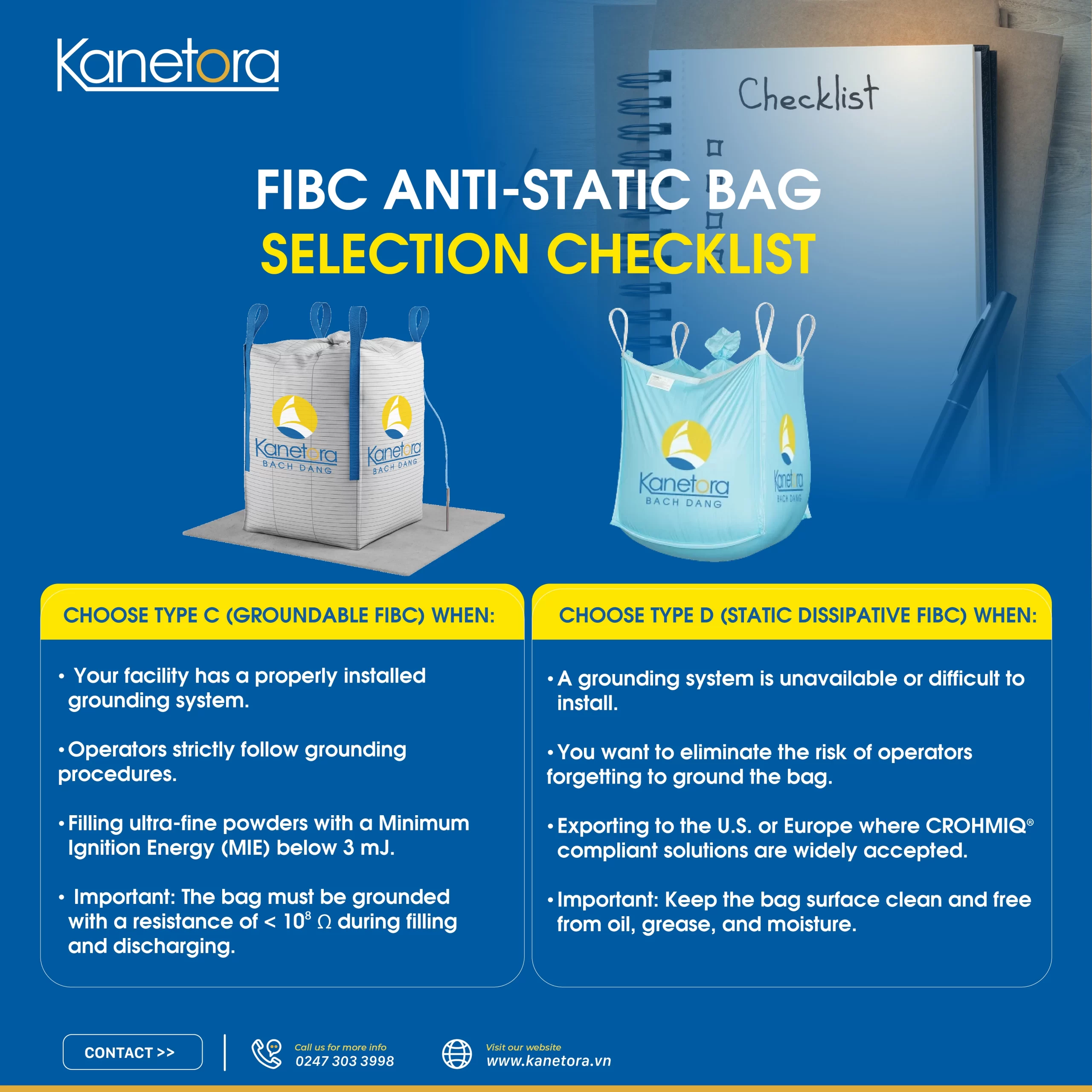
Choose Type C When Grounding Can Be Reliably Controlled
Type C may be the preferred direction when:
- The filling facility has permanent grounding points
- Operators receive formal grounding training
- Grounding continuity can be checked before operation
- The production process is fixed and repeatable
- The customer requires a groundable conductive FIBC
- Grounding records form part of the plant’s safety system
In these conditions, Type C provides a clear and auditable static-control process.
Consider Type D When Grounding Is Operationally Difficult
Type D may be considered when:
- Bags are filled or emptied at multiple locations
- Grounding quality cannot be guaranteed at every destination
- Mobile filling systems are used
- Frequent movement makes grounding cables impractical
- The buyer specifically requires a non-grounded static-protective FIBC
- The operation has been assessed for compatibility with Type D technology
The absence of grounding can simplify handling, but it does not remove the need for technical assessment, operating instructions or qualified packaging.
Evaluate Both the Cargo and Surrounding Environment
A common procurement mistake is evaluating only the material packed inside the FIBC.
The selection process must assess two separate risks:
- The ability of the packed product to generate combustible dust or electrostatic charge
- The presence of flammable gas, vapor or dust in the surrounding environment
For example, a plastic resin pellet may not be classified as dangerous goods for transport, but rapid pneumatic filling can still generate static charge. Additional precautions may also be needed if the operation takes place near solvents or flammable vapor.
Kanetora provides a more detailed discussion of these risks in its guide to FIBC bags for plastic resin.
The Importance of Inner Liner Compatibility
The electrostatic classification of an outer FIBC bag cannot be evaluated separately from its inner liner.
A standard PE liner may have different electrical properties from a conductive or static-dissipative liner. Installing an unsuitable liner inside a Type C or Type D bag can change how charge accumulates and dissipates.
When ordering a lined static-protective FIBC, buyers should confirm:
- Liner material
- Electrical classification
- Number of film layers
- Surface treatment
- Liner thickness
- Fixing method
- Filling-spout compatibility
- Discharge-spout compatibility
- Qualification of the complete bag-and-liner combination
The buyer should request confirmation that the complete FIBC system, rather than only the outer fabric, has been designed for the intended electrostatic environment.
IEC 61340-4-4:2018 includes requirements relating to the classification and testing of inner liners used with FIBCs.
For additional information on liner structures and their protective functions, see FIBC Bag with Liner: When and Why to Use.
Industries That May Require Type C or Type D FIBC Bags
Static-protective FIBCs are commonly considered in industries involving combustible powders, sensitive raw materials or hazardous production environments.
Chemical and Petrochemical Products
Chemical powders, additives, pigments and specialty compounds may produce dust clouds or be handled near flammable vapor.
The required bag specification should consider:
- Particle size
- Dust concentration
- Minimum ignition energy
- Filling speed
- Solvent or vapor exposure
- Classified production zones
- Discharge method
Plastic Resin and Compounds
PP, PE, PET, masterbatch, polymer powder and engineering-plastic compounds can generate electrostatic charge during pneumatic filling and high-speed transfer.
Depending on the process, the FIBC may also require:
- Anti-static or conductive protection
- PE inner liner
- Aluminum barrier liner
- Dustproof seams
- Controlled discharge spout
- Contamination-control procedures
For export resin applications, refer to Kanetora’s guide on bulk bags for PP, PE and PET export.
Pharmaceutical and Fine Industrial Powders
Fine powders may have high surface areas and can create both leakage and electrostatic risks.
The packaging specification may need to combine:
- Static protection
- Fine-powder containment
- Clean production controls
- Dustproof sewing
- Qualified inner liner
- Controlled filling and discharge
Fertilizers and Agricultural Chemicals
Some fertilizers, additives and agricultural chemical powders may require moisture control, contamination protection and electrostatic-risk assessment.
The correct solution depends on chemical composition and handling conditions rather than the general product category alone.
Export Buyer Checklist for Static-Protective FIBCs
Before approving a Type C or Type D FIBC specification, buyers should collect and review the following information.
1. Packed Product Data
Provide:
- Product name and composition
- Powder, pellet, granule or flake form
- Particle size
- Bulk density
- Moisture sensitivity
- Dust characteristics
- Electrostatic or ignition data
- Dangerous-goods classification, where applicable
2. Filling and Discharge Conditions
Confirm:
- Gravity or pneumatic filling
- Filling speed
- Product temperature
- Discharge method
- Equipment material
- Presence of grounded metal equipment
- Expected number of handling cycles
3. Hazardous-Area Information
Identify:
- Combustible dust presence
- Flammable gas or vapor
- Classified zones
- Potential hybrid mixtures
- Nearby ignition-sensitive processes
- Local safety regulations
4. Grounding Capability
For Type C, verify:
- Availability of a proper earth connection
- Grounding-clamp location
- Continuity monitoring
- Operator training
- Grounding inspection frequency
- Procedures at the destination facility
5. Complete Bag Construction
Specify:
- U-panel, four-panel, circular or baffle design
- Coated or uncoated fabric
- Top and bottom structure
- Safe Working Load
- Safety Factor
- Lifting-loop design
- Conductive or anti-static liner
- Dustproof sewing
- Label and document-pocket material
6. Test Reports and Traceability
Request:
- Applicable electrostatic test documentation
- Product specification sheet
- Batch identification
- Bag labeling
- Manufacturing traceability
- Safe-use instructions
- Grounding instructions for Type C
- Handling restrictions for Type D
Companies preparing a customized specification can also refer to Kanetora’s guide on OEM/ODM Jumbo FIBC bag requirements.
Common Mistakes When Buying Type C and Type D FIBCs
Mistake 1: Selecting by Bag Color
Type C and Type D classifications are based on construction and tested electrostatic performance, not simply fabric color.
A colored bag should never be assumed to be conductive or anti-static without supporting documentation.
Mistake 2: Treating Type D as Universally Safe
Type D does not require grounding, but it must still be used under its specified conditions. Wrong liners, contamination, unsuitable environments or product substitution can affect performance.
Mistake 3: Using Type C Without Grounding Verification
Connecting a clamp does not automatically confirm a safe earth path.
The grounding point, cable, clamp and conductive elements of the bag must form an effective system throughout filling and discharge.
Mistake 4: Adding a Standard Liner Without Technical Review
An inner liner can alter the electrostatic behavior of the complete packaging system.
Buyers should not replace, add or modify liners without confirmation from the FIBC manufacturer.
Mistake 5: Confusing UN Certification with Electrostatic Classification
UN-certified FIBCs are designed and tested for the transport of specified dangerous goods. IEC electrostatic classification addresses static behavior in potentially explosive atmospheres.
These requirements may overlap in a particular application, but one does not automatically replace the other.
Buyers shipping regulated hazardous materials should separately review the requirements for UN-certified FIBC bags for hazardous-material export.
Kanetora’s Static-Protective FIBC Solutions for Export Cargo
Kanetora supports customized FIBC solutions for plastic resins, chemicals, minerals, food ingredients, agriculture and other industrial export applications.
Depending on the buyer’s technical requirements, the packaging structure can be developed with:
- Type C conductive construction
- Type D static-protective construction
- Compatible inner liners
- Coated or uncoated woven PP fabric
- Dustproof sewing
- Customized filling and discharge systems
- U-panel, four-panel, circular or baffle designs
- Export labeling and traceability
- Application-specific testing requirements
Kanetora’s packaging profile includes Type C and Type D FIBCs within its product portfolio. The Kanetora Bach Dang factory has a stated FIBC production capacity of approximately 300,000 bags per month and operates quality-management systems supported by international certifications.
The factory applies a standardized production flow covering extrusion, webbing and fabric weaving, lamination, cutting and printing, sewing, inspection and packing. More information is available in FIBC Bags from Vietnam: Supplier Guide for Global Buyers.
For each project, the proposed Type C or Type D specification should be based on the buyer’s product data, filling process, discharge system, liner requirement, destination market and hazardous-area assessment.
Frequently Asked Questions
What is the main difference between Type C and Type D FIBC bags?
Type C FIBC bags transfer static charge to earth through interconnected conductive threads and therefore require grounding. Type D bags use static-protective fabric to dissipate charge without a grounding connection.
Does a Type C FIBC always need to be grounded?
Yes. A Type C bag must be connected to a verified grounding point before filling or discharge begins and must remain grounded throughout the operation.
Does a Type D FIBC require grounding?
No. Type D FIBCs are designed to provide static protection without being connected to earth. However, they must still be used according to the manufacturer’s specified conditions.
Can a standard PE liner be used in Type C or Type D bags?
Not automatically. The liner must be evaluated as part of the complete FIBC system. An unsuitable liner may change the bag’s electrostatic performance.
Are Type C and Type D bags suitable for plastic resin?
They may be appropriate where resin handling creates electrostatic hazards or where flammable dust, gas or vapor is present. Many ordinary resin applications may use another FIBC type, depending on the full risk assessment.
Is a UN-certified FIBC automatically anti-static?
No. UN certification and electrostatic classification address different safety requirements. A bag may need both types of compliance depending on the cargo and operating environment.
Which is better for export cargo: Type C or Type D?
Neither type is universally better. Type C may suit fixed plants with controlled grounding systems, while Type D may be more practical where reliable grounding cannot be guaranteed. The decision must be based on product and site-specific risk assessment.
Conclusion
Choosing between Type C and Type D FIBC bags is an important safety decision for businesses exporting chemicals, plastic resins, powders, fertilizers and other static-sensitive bulk materials.
Type C provides a controlled conductive route to earth but depends on continuous and verified grounding. Type D eliminates the grounding connection but requires qualified static-protective fabric, compatible components and strict compliance with its intended-use conditions.
Before placing an order, buyers should evaluate:
- Product electrostatic characteristics
- Combustible dust and vapor risks
- Hazardous-area classification
- Grounding capability
- Filling and discharge procedures
- Inner liner compatibility
- Test documentation and traceability
- Requirements at both origin and destination facilities
Kanetora can support international buyers in reviewing these requirements and developing customized FIBC structures for safer, more efficient export operations.
Contact Kanetora for consultation on Type C, Type D and customized static-protective FIBC solutions for your cargo and production environment.