

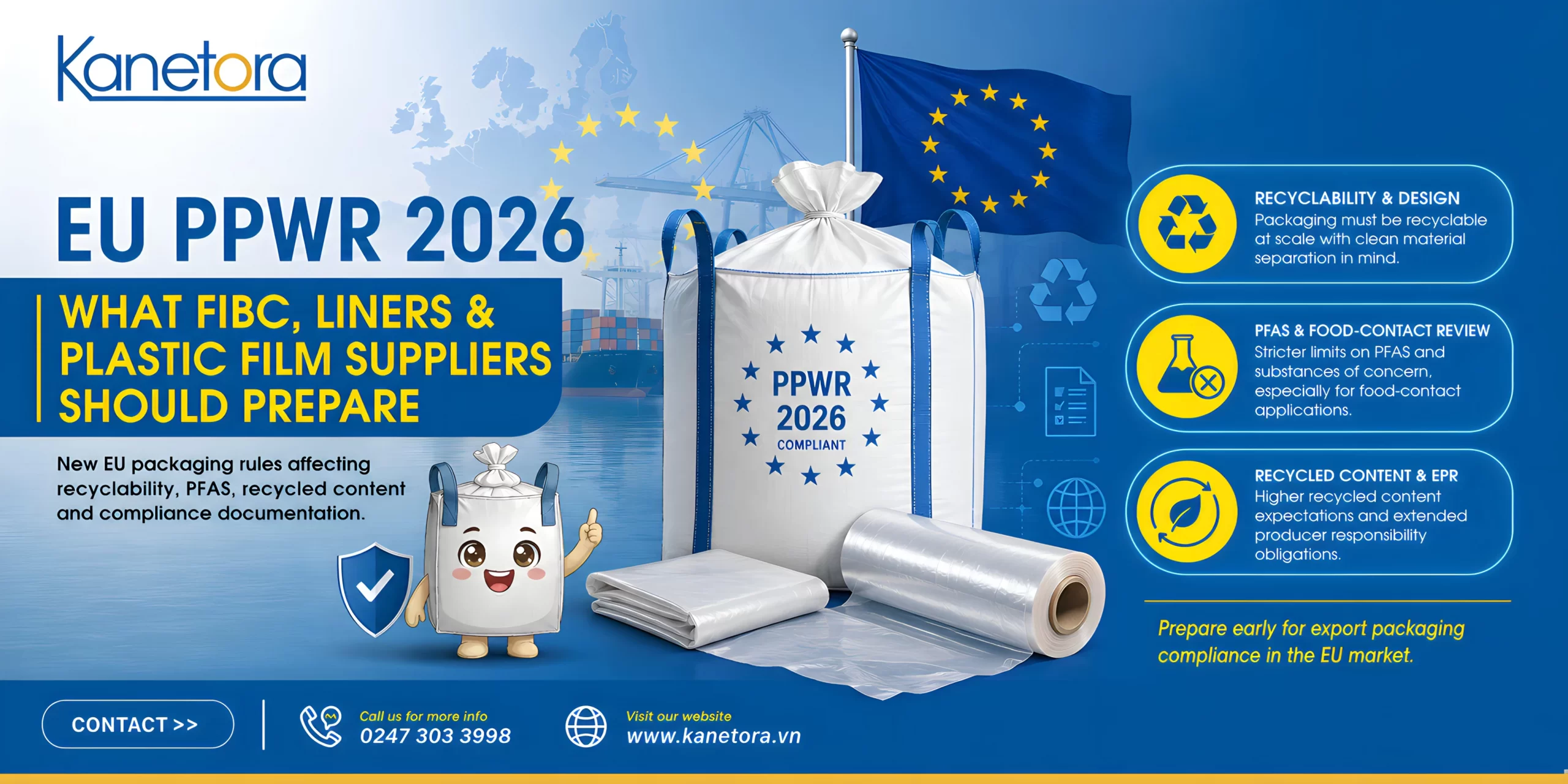
The European Union’s new Packaging and Packaging Waste Regulation, commonly known as the PPWR, will generally apply from 12 August 2026.
The regulation does not only concern consumer packaging such as bottles, boxes and shopping bags. It also covers industrial and transport packaging, including Flexible Intermediate Bulk Containers—FIBCs, jumbo bags, inner liners, plastic films, block-bottom valve bags, stretch hood films and container liners.
For manufacturers and exporters in Vietnam supplying packaging or packaged products to the European market, the PPWR marks a significant shift. Packaging compliance will no longer focus only on dimensions, load capacity, mechanical performance or traditional quality certificates.
Businesses will increasingly need to manage:
- Material composition;
- Substances used in packaging;
- Packaging minimisation;
- Recyclability;
- Post-consumer recycled content;
- Reuse systems;
- Technical documentation;
- Traceability;
- End-of-life responsibility.
These developments are also consistent with the broader sustainable industrial packaging trends in 2026, as international buyers increasingly evaluate packaging according to circularity, material efficiency, ESG performance and supply-chain transparency.
Quick Answer: Does the PPWR Affect FIBC Bags?
Yes.
FIBC bags, jumbo bags and other flexible industrial packaging formats may be affected by PPWR requirements relating to:
- Restricted substances;
- Technical documentation and conformity assessment;
- Design for recycling;
- Minimum recycled plastic content;
- Reusable transport packaging;
- Packaging labelling and traceability;
- Extended Producer Responsibility, or EPR.
However, the PPWR does not mean that all FIBC bags made from virgin polypropylene will be prohibited in August 2026.
The regulation establishes different implementation dates. Some requirements, such as restrictions on PFAS in food-contact packaging, become directly relevant from August 2026, while major requirements on recyclability, recycled content and reusable transport packaging generally follow later milestones, particularly from 2030.
What Is the PPWR?
PPWR stands for Packaging and Packaging Waste Regulation. Its official legal title is Regulation (EU) 2025/40.
The regulation entered into force on 11 February 2025 and will generally apply from 12 August 2026. It establishes a common regulatory framework for packaging and packaging waste across the European Union.
The PPWR covers packaging used in or originating from:
- Industrial production;
- Manufacturing;
- Distribution;
- Retail;
- Transport and logistics;
- Offices and services;
- Households.
This means that packaging manufactured in Vietnam may still fall within the scope of the PPWR when it is imported, supplied or used in the European Union.
The regulation aims to:
- Prevent and reduce packaging waste;
- Improve packaging recyclability;
- Increase recycled material use;
- Promote reuse and refill systems;
- Restrict substances of concern;
- Reduce unnecessary packaging;
- Strengthen producer responsibility;
- Improve packaging information and traceability.
The regulation covers the entire packaging lifecycle, from product design and manufacturing to use, collection and waste treatment.
Key PPWR Dates for Packaging Businesses
| Timeline | Key development |
|---|---|
| 11 February 2025 | Regulation (EU) 2025/40 entered into force |
| 12 August 2026 | The PPWR generally begins to apply; PFAS restrictions for food-contact packaging become particularly relevant |
| From 2030 | Major requirements on recyclability, recycled plastic content and reusable transport packaging begin to apply |
| From 2035 | Recyclability will also be assessed according to whether packaging is recycled at scale |
| From 2038 | Higher recyclability performance thresholds will apply |
Not every detailed technical calculation method has already been finalised.
The European Commission will continue issuing delegated acts, implementing rules, calculation methods and design-for-recycling criteria for different packaging categories.
Therefore, manufacturers should avoid making unsupported claims such as “fully PPWR compliant,” “recyclability grade A” or “EU-approved recyclable packaging” until the relevant assessment methods have been formally applied to the specific packaging format.
How Could the PPWR Affect Kanetora’s Packaging Products?
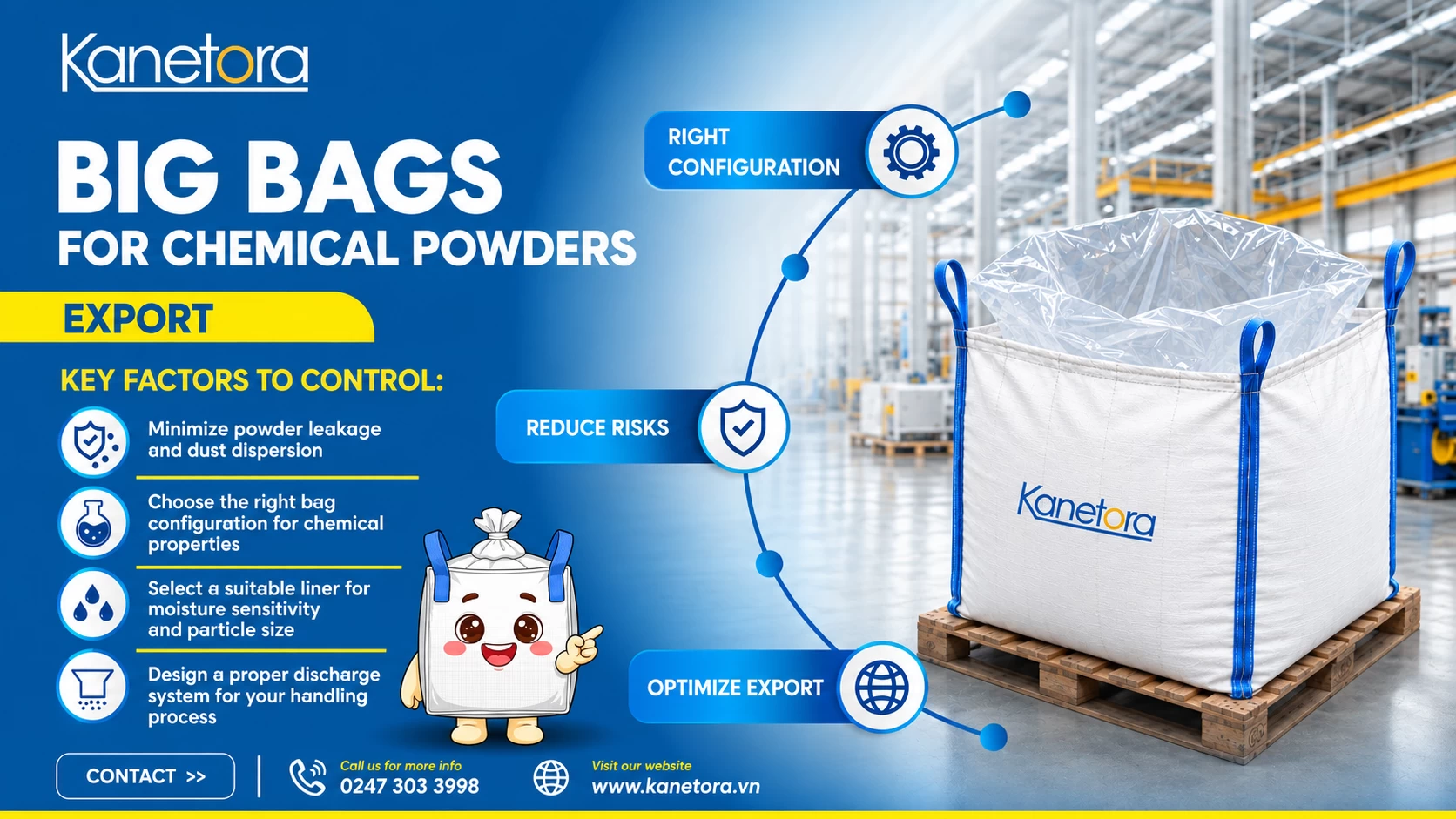
Kanetora’s industrial packaging portfolio includes FIBC bags, jumbo bags, sling bags, block-bottom valve bags, PE liners, multi-layer plastic films, stretch hood films and other flexible packaging solutions.
Kanetora Bach Dang has manufacturing capabilities for FIBC bags, liners and plastic films, together with production, QA/QC and testing systems supporting industrial and food-grade packaging applications. Its current company profile identifies a production capacity of approximately 300,000 FIBC bags per month, 10 million block-bottom valve bags per month and 500 tonnes of multi-layer film per month.
The actual level of PPWR impact will depend on the product’s:
- Material composition;
- Intended use;
- Contact with food or other sensitive products;
- Single-use or multi-trip design;
- Packaging components and accessories;
- Final destination;
- Import and distribution model.
1. Standard FIBC and Jumbo Bags
Standard FIBC bags are commonly manufactured from woven polypropylene fabric. Depending on customer requirements, the complete packaging may also include:
- PP lifting loops;
- Sewing thread;
- Lamination or coating;
- PE inner liners;
- Labels;
- Document pouches;
- Printing ink;
- Filling and discharge components.
Under the PPWR, recyclability will be evaluated based on the complete packaging unit, not only the main woven PP fabric.
For FIBC bags used for plastic resin, minerals, fertilisers, construction materials or industrial powders, manufacturers and buyers should begin examining:
- The percentage of PP and other materials;
- Whether the liner can be separated;
- Compatibility between the body, loops, thread and labels;
- Printing and coating systems;
- Additives and masterbatch;
- Product contamination after use;
- Collection and recycling options;
- Traceability of recycled raw materials.
Exporters of polymers can also review Kanetora’s guide to bulk bags for plastic resin export, including PP, PE and PET when selecting a bag structure, liner and contamination-control solution.
Recycled Content Requirements
The PPWR introduces minimum post-consumer recycled content targets for plastic packaging.
From 2030, the minimum target is generally:
- 10% for contact-sensitive plastic packaging made from materials other than PET, subject to applicable conditions and exemptions;
- 35% for plastic packaging that does not fall within the specified contact-sensitive and beverage-bottle categories.
For 2040, these targets generally increase to:
- 25% for contact-sensitive non-PET plastic packaging;
- 65% for other plastic packaging.
The calculation may be based on averages by manufacturing plant, year, packaging type and packaging format rather than requiring every individual item to contain exactly the same percentage.
For FIBC manufacturers, the technical challenge will be to integrate recycled PP while continuing to control:
- Fabric tensile strength;
- Lifting-loop performance;
- Seam strength;
- UV stability;
- Safe Working Load;
- Safety Factor;
- Material consistency;
- Colour and odour;
- Foreign-particle contamination.
2. Reusable FIBC Bags
The PPWR specifically addresses reusable transport packaging.
The relevant transport packaging formats include rigid and flexible intermediate bulk containers. Article 29 establishes an overall 40% reuse target from 2030 for economic operators using certain transport packaging formats, subject to the regulation’s scope, exemptions and calculation rules.
However, an FIBC bag should not automatically be treated as reusable packaging simply because it has a Safety Factor of 6:1 or has physically survived more than one filling cycle.
Under a structured reuse model, the packaging should be designed and managed for multiple rotations. This normally requires:
- A collection or return system;
- Inspection after each use;
- Assessment of the body, seams and lifting loops;
- Cleaning or reconditioning procedures;
- Recording the number of rotations;
- Removal of damaged packaging;
- End-of-life recycling arrangements.
The European Commission’s guidance has specifically recognised that reusable flexible intermediate bulk carrier bags may be feasible for certain bulk materials where the product does not significantly alter the bag’s interior or require intensive cleaning.
A detailed explanation is available in Kanetora’s article: Can FIBC Bags Be Reused? Understanding Single-Trip vs Multi-Trip Bulk Bags.
Reuse must always be managed together with lifting safety. An FIBC may still appear visually acceptable even when PP yarn, seams or lifting loops have lost mechanical strength due to UV exposure, chemical contact, abrasion, moisture, heat or improper storage.
3. Food-Grade FIBC Bags and Food-Contact Liners
Food-contact packaging is one of the product groups that requires particularly early attention.
From 12 August 2026, food-contact packaging placed on the EU market must not contain PFAS at or above the following thresholds, unless another Union legal act already prohibits the relevant concentration:
- 25 ppb for any individual PFAS measured through targeted analysis, excluding polymeric PFAS from quantification;
- 250 ppb for the sum of PFAS measured through targeted analysis;
- 50 ppm for total PFAS, including polymeric PFAS.
If total fluorine exceeds 50 mg/kg, additional evidence may be required to demonstrate whether the fluorine content originates from PFAS or non-PFAS substances.
For food-grade FIBC bags, PFAS and chemical control should not be limited to the main PP resin.
The review should also include:
- PE or multi-layer liners;
- Coating and lamination;
- Anti-slip additives;
- Antistatic additives;
- Colour masterbatch;
- Printing inks;
- Adhesives;
- Labels;
- Sealing and surface-treatment materials.
Businesses exporting rice, grains, flour, starch, sugar, animal feed or food ingredients can review Kanetora’s guide to food-grade FIBC bags for export food and agricultural products.
For more detailed information on hygiene systems, production controls and documentation, see Food Grade FIBC Bags: Standards and Requirements.
Kanetora’s current capability profile also states that its food-contact plastic materials have passed testing under Commission Regulation (EU) No 10/2011. This provides a useful food-contact compliance foundation, but it does not automatically replace a separate PFAS assessment under the PPWR.
4. PE Liners and Inner Liners for FIBC Bags
An FIBC liner is an inner plastic layer placed inside the outer woven bag. It is commonly used to protect products against:
- Moisture;
- Dust;
- Leakage;
- Oxygen;
- Odour transfer;
- Contamination;
- External environmental exposure.
Under the PPWR, the liner should be assessed as part of the overall packaging configuration.
Mono-PE or mono-PP liners may offer advantages for future recyclability when they:
- Contain a clearly identified polymer;
- Avoid incompatible material combinations;
- Use compatible additives;
- Can be separated from the outer FIBC;
- Can be collected and sorted;
- Do not contain coatings or barriers that disrupt recycling.
More information about liner selection is available in FIBC Bag with Liner: When and Why to Use.
For hygroscopic products or cargo exposed to long-distance sea transport, Kanetora’s guide to moisture-proof FIBC bags for export cargo explains how coated fabric, PE liners, barrier liners and pallet-level protection can be combined.
5. Multi-Layer Films and Aluminium Barrier Liners
Multi-layer films may combine different materials, including:
- LDPE;
- LLDPE;
- HDPE;
- PA;
- PET;
- EVOH;
- Aluminium foil.
These combinations can provide important technical performance such as:
- Moisture barrier;
- Oxygen barrier;
- Puncture resistance;
- Odour protection;
- UV protection;
- Longer product stability.
However, combining multiple polymers—or combining plastic and aluminium—can make the packaging more difficult to sort and recycle.
The PPWR does not immediately prohibit all multi-layer packaging. Its future market access will depend on:
- Design-for-recycling criteria;
- Material compatibility;
- Separation possibilities;
- Available recycling technologies;
- Actual recycling performance at scale;
- The packaging category assigned under implementing rules.
From 2030, packaging will generally need to meet the PPWR recyclability requirements and achieve at least recyclability performance grade C. From 2038, packaging will generally need to achieve grade A or B.
For flexible packaging manufacturers, potential R&D priorities include:
- Mono-material barrier structures;
- Lower quantities of incompatible polymers;
- Thinner functional barrier layers;
- Detachable liner designs;
- Recyclable sealing systems;
- Recycled content in non-contact layers;
- Improved material identification.
6. Block-Bottom Valve Bags
A block-bottom valve bag may be manufactured from PP or from a mixed structure containing paper, woven PP, PE film, adhesives, coating and barrier layers.
A predominantly mono-PP structure may be easier to assess for recycling than a complex paper–plastic laminate. However, the final result depends on the full design.
Important assessment points include:
- Material weight percentages;
- Adhesives;
- Printing inks;
- Coating;
- Internal valves;
- Liners;
- Layer separation;
- Sorting compatibility;
- Quality of the recycled output.
The fact that each individual material is technically recyclable does not automatically mean that the complete laminated package will satisfy the PPWR’s design-for-recycling criteria.
7. Stretch Hood Film and Pallet Protection
Stretch hood film is a flexible PE film used to stabilise and protect palletised goods during storage and transportation.
For PPWR preparation, businesses should assess:
- Film weight per pallet;
- Possibilities for downgauging;
- Polymer composition;
- Recycled PE content;
- Additive packages;
- Collection after use;
- Sorting and recycling conditions;
- Material declarations.
Kanetora has developed stretch hood film solutions for industrial packaging serving applications such as plastic resins, chemicals, construction materials and palletised export cargo.
8. Container Liners for Bulk Cargo
Container liners convert a standard shipping container into a bulk cargo transport system.
They may be used for:
- Plastic pellets;
- Agricultural products;
- Minerals;
- Chemical powders;
- Food ingredients;
- Dry bulk industrial materials.
Because a container liner may contain large film surfaces, reinforcement elements, filling ports, discharge ports, straps and accessories, recyclability should be assessed across the full structure.
Businesses comparing transport options can read Container Liner Bags for Bulk Cargo: When to Use Them Instead of FIBC.
Under the PPWR, future container-liner development may increasingly focus on:
- Mono-material structures;
- Reduced film weight;
- Recycled PE content;
- Detachable accessories;
- Improved collection after discharge;
- Clear material identification.
9. UN-Certified FIBC Bags
UN-certified FIBC bags are designed for transporting specified dangerous goods and must satisfy strict requirements relating to packaging design, testing, marking and safe transport.
The PPWR recognises the interaction between environmental packaging requirements and specialised dangerous-goods legislation.
Where relevant safety requirements conflict with PPWR provisions, dangerous-goods transport rules may take priority. Certain exemptions from recyclability, recycled-content and reuse obligations may also apply to packaging that is genuinely used for dangerous-goods transport under the relevant legislation.
However, displaying a UN mark does not automatically exempt a bag from every PPWR obligation.
The assessment should consider:
- The actual packed substance;
- Dangerous-goods classification;
- Packaging instruction;
- Transport mode;
- Destination;
- Applicable ADR, RID or IMDG requirements;
- The bag’s real use within the supply chain.
Additional information is available in Kanetora’s article on UN-Certified FIBC Bags for Hazardous Materials Export.
Will Packaging Suppliers Need Technical Documentation?
Yes. The PPWR introduces conformity-assessment and documentation obligations for packaging.
Manufacturers will need to prepare technical documentation demonstrating compliance with the applicable requirements under Articles 5 to 12 and issue an EU Declaration of Conformity.
Depending on the product and the company’s role in the supply chain, the documentation may include:
- Product description;
- Intended use;
- Technical drawings;
- Packaging specifications;
- Material composition by weight;
- Polymer and additive information;
- Coating, ink and adhesive information;
- PFAS and heavy-metal test reports;
- Mechanical performance results;
- Recycled-content evidence;
- Recyclability assessment;
- Supplier declarations;
- Batch traceability;
- Manufacturing control records;
- Applicable standards and test methods.
Manufacturers are generally required to retain technical documentation and the EU Declaration of Conformity for:
- Five years for single-use packaging;
- Ten years for reusable packaging.
For a non-EU packaging manufacturer, the European importer may request more extensive documentation than traditional COAs, ISO certificates or basic food-contact test reports.
Who Is Responsible for EPR?
EPR stands for Extended Producer Responsibility.
Under EPR systems, the entity classified as the “producer” may be required to finance or organise the collection, sorting and treatment of packaging waste in the EU Member State where the packaging is first made available.
A Vietnamese packaging manufacturer will not automatically be responsible for paying EPR fees in every transaction.
The responsible party may depend on:
- Who imports the packaging or packed product;
- Who first makes it available in an EU Member State;
- Whether the packaging is sold empty or with goods inside;
- Incoterms;
- Whether the sale is B2B or direct to end users;
- Whether the non-EU supplier uses distance selling;
- National implementation and registration rules;
- Contractual allocation of responsibility.
In a conventional B2B transaction, the EU importer or the company first placing the packaging on the national market may carry the main EPR obligation.
However, where a non-EU business sells directly to EU end users or retains responsibility for placing the packaging on the market, producer registration or the appointment of an authorised representative may need to be considered.
Is the PPWR Only a Challenge?
Not necessarily.
The PPWR will increase requirements for testing, data management, product development and supply-chain transparency. At the same time, it creates opportunities for packaging manufacturers that can offer:
- Integrated manufacturing;
- Clear material control;
- In-house production of components;
- Customised packaging design;
- Traceability;
- Mono-material solutions;
- Recycled-content development;
- Multi-trip FIBC systems;
- Reliable technical documentation;
- Packaging lifecycle optimisation.
The market may gradually move away from evaluating packaging only by unit price.
Buyers may place greater value on a supplier’s ability to deliver a complete packaging solution covering:
- Product protection;
- Safe handling;
- Export compliance;
- Material documentation;
- Recyclability;
- Logistics efficiency;
- Reuse or recovery planning.
What Should Kanetora Prepare from 2026?
Review the Product Portfolio
Each product family should be classified according to:
- Food-contact or non-food use;
- Contact-sensitive or non-sensitive application;
- Single-use or reusable design;
- Standard cargo or dangerous goods;
- Mono-material or multi-material structure;
- Polymer type;
- Destination market;
- End-of-life scenario.
Strengthen Testing and Documentation
Priority actions may include:
- PFAS screening for food-contact packaging;
- Heavy-metal verification;
- Supplier declarations for resin, additives, coatings and inks;
- Material composition records;
- Technical files by product family;
- EU Declaration of Conformity templates;
- Improved raw-material and production-batch traceability;
- Documentation for recycled-content claims.
Develop Products for the 2030 Roadmap
Potential R&D directions include:
- Mono-PP FIBC bags;
- PP-compatible lifting loops and sewing thread;
- Easier-to-remove labels and document pouches;
- Mono-PE liners;
- Recyclable barrier structures;
- PCR PP and PCR PE trials;
- Multi-trip FIBC identification systems;
- Inspection and reconditioning protocols;
- Packaging take-back and reuse partnerships.
Conclusion
The PPWR will gradually change how industrial packaging for the European market is designed, manufactured, documented and managed after use.
From August 2026, packaging compliance will no longer be evaluated only through load capacity, dimensions, quality certificates or visual inspection.
Manufacturers and exporters will increasingly need to consider:
- Chemical composition;
- PFAS restrictions;
- Technical documentation;
- Recyclability;
- Recycled content;
- Reuse systems;
- Traceability;
- EPR responsibility.
Virgin-plastic FIBC bags will not be universally prohibited in August 2026. Nevertheless, packaging manufacturers and exporters should begin preparing now to reduce technical, commercial and compliance risks as the 2030 milestones approach.
With industrial packaging production capabilities, in-house component manufacturing and established QA/QC systems in Vietnam, Kanetora will continue researching packaging solutions aligned with the evolving requirements of European and international supply chains.
Frequently Asked Questions About the PPWR and FIBC Bags
When Does the PPWR Apply?
Regulation (EU) 2025/40 entered into force on 11 February 2025 and will generally apply from 12 August 2026. Some major requirements relating to recyclability, recycled content and reuse will apply under later implementation milestones.
Will Virgin-PP FIBC Bags Be Banned in August 2026?
No. The PPWR does not introduce a universal ban on virgin-PP FIBC bags in August 2026.
However, manufacturers should prepare for recycled-content and recyclability requirements that will become increasingly important from 2030.
Are FIBC Bags Covered by Reuse Targets?
Flexible intermediate bulk containers are included among transport packaging formats relevant to the PPWR reuse framework. Actual obligations depend on the economic operator, use case, exemptions and calculation rules.
Do Food-Grade FIBC Bags Need PFAS Testing?
Food-contact packaging placed on the EU market from 12 August 2026 must meet the PPWR PFAS limits.
The review should consider the bag body, liner, coating, additives, printing inks, adhesives and other relevant components.
Does EU Regulation No 10/2011 Replace the PPWR Requirements?
No.
Commission Regulation (EU) No 10/2011 mainly concerns plastic materials and articles intended to come into contact with food.
The PPWR introduces additional requirements covering restricted substances, recyclability, recycled content, packaging design, documentation, reuse and end-of-life responsibility.
What Information Should Buyers Request from an FIBC Supplier?
Buyers should consider requesting:
- Complete material composition;
- Liner and coating specifications;
- PFAS and heavy-metal information;
- Recycled-content evidence;
- Recyclability information;
- Mechanical test reports;
- Food-contact documentation where applicable;
- Production-batch traceability;
- Supplier declarations;
- Technical documentation for the EU market.
Compliance note: This article provides a general market and regulatory update. The obligations applicable to a specific product should be assessed according to its material structure, intended use, supply chain, destination country and the latest EU implementing measures.