

Following the market uncertainty discussed in the Plastic Resin Market Update for July 2026, the resin market entered early August with clearer divergence across product categories.
Crude oil prices remain elevated as geopolitical risks surrounding the Strait of Hormuz and the Red Sea continue to influence energy supply, shipping routes, insurance costs and market sentiment. However, demand for plastic resin in China and several Asian markets has not recovered strongly enough to support a broad-based price increase.
In Vietnam, domestic PP supply is showing signs of stabilizing after Nghi Son Refinery and Petrochemical, or NSRP, reportedly resolved a recent production issue. LLDPE prices have softened slightly, while new PET offers have encountered resistance from buyers.
In China, PP and PVC recorded periods of recovery, while PE continued to move differently across grades and applications. This suggests that the market has not yet formed a consistent upward trend.
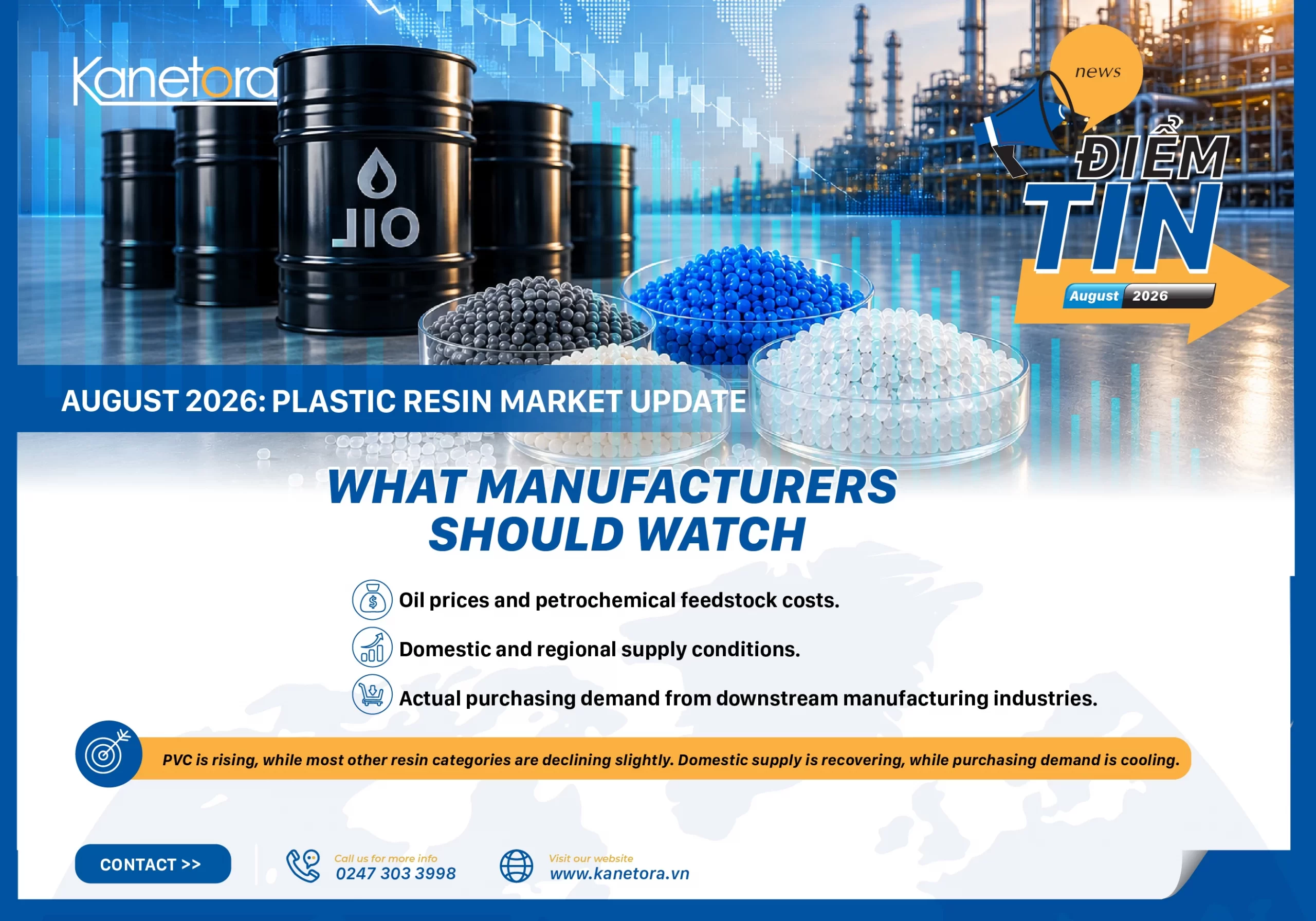
Manufacturers of industrial packaging, plastic film, injection-moulded products, PET bottles, pipes and consumer products should closely monitor three major variables:
- Crude oil and petrochemical feedstock prices;
- Domestic and regional supply conditions;
- Actual demand from downstream manufacturing industries.
Quick Answer: Will Plastic Resin Prices Increase in August 2026?
Plastic resin prices in the first half of August 2026 are more likely to remain sideways, soften slightly or recover selectively by grade, rather than increase across the entire market.
Brent crude trading above USD 84 per barrel creates a relatively high feedstock cost environment. However, China’s manufacturing PMI fell to 49.2 in July, while the new order index declined to 48.5, indicating weaker manufacturing activity and raw material demand.
As a result, crude oil currently acts more as a factor preventing resin prices from falling sharply than as a sufficient driver for a broad PP, PE, PVC or PET price rally.
Plastic Resin Market Overview as of August 4, 2026
| Product | Early-August movement | Main influencing factors | Short-term outlook |
|---|---|---|---|
| PP | Domestic offers eased as NSRP supply stabilized | Local production, propylene, buyer demand | Sideways to slightly softer |
| PE | LLDPE softened; northern spot supply remains limited | Incoming cargoes, film demand, crude oil | Mixed, narrow-range movement |
| PVC | China futures and spot prices showed signs of recovery | Construction demand, energy costs, Dalian futures | Possible selective rebound |
| PET | New offers faced buyer resistance | PTA, MEG, bottle and packaging demand | Sideways to softer |
| ABS | Several grades continued to decline | Styrene, acrylonitrile and appliance demand | Downward pressure remains |
| Brent crude | Rebounded after a sharp decline | Hormuz, U.S.–Iran developments, supply outlook | High news-driven volatility |
Based on the market dashboard supplied for August 4, PVC futures in Dalian increased by approximately 0.65%, while LLDPE 218W declined by 0.51% and ABS PA757 fell by around 1.84%. Brent crude increased by approximately 0.56% at the observed point in time.
These mixed movements reinforce the view that the market is being driven by individual product fundamentals rather than a single unified trend.
The percentages above represent market movements at a particular time and should not be treated as final transaction prices. Actual offers will vary depending on resin grade, producer, origin, quantity, payment terms and delivery schedule.
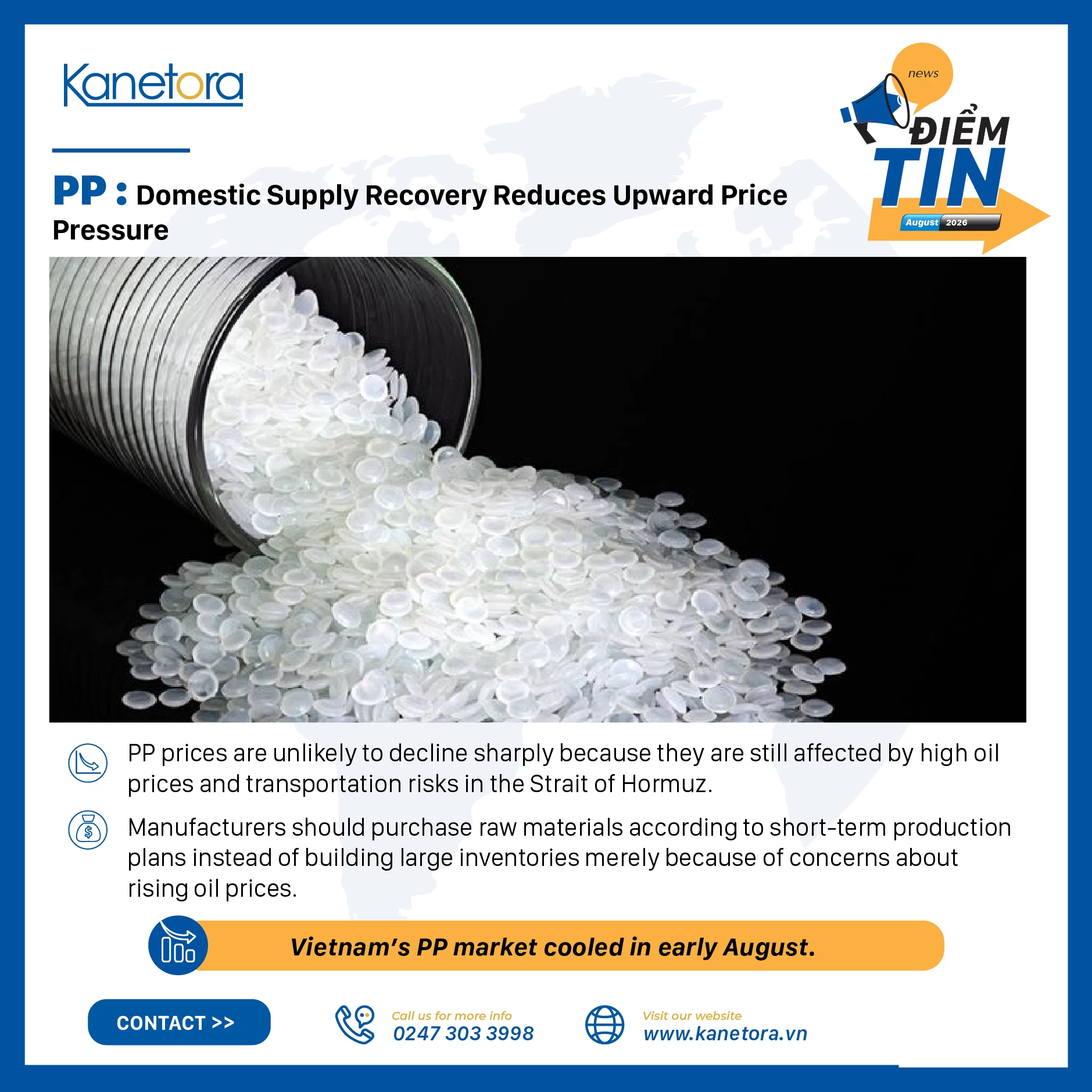
1. PP Market: Domestic Supply Recovery Reduces Upward Price Pressure
Vietnam’s PP market recorded an important change in early August when NSRP reportedly completed repairs following a recent operational issue.
After this development, offers for PP 114G softened quickly, suggesting that part of the previous price increase had been driven by concerns over a temporary domestic shortage.
When NSRP production becomes more stable, buyers have greater flexibility to postpone non-urgent purchases, especially for commonly used PP homopolymer grades applied in:
- PP woven sacks;
- FIBC and jumbo bags;
- Injection-moulded household products;
- General industrial components;
- Packaging applications.
Distributors may also find it more difficult to maintain elevated prices when domestic cargo availability improves.
However, a sharp PP price decline is not guaranteed. Crude oil remains relatively high, while shipping risks surrounding Hormuz and the Red Sea have not been fully resolved.
Disruption in these areas could raise the cost of propylene, imported cargoes, marine insurance and freight. The broader impact of these risks on resin, packaging and logistics was analysed in Kanetora’s Global Trade News Roundup as of July 28, 2026.
Businesses can also review Kanetora’s Plastic Resin portfolio for PP, LDPE, LLDPE, HDPE and other industrial material options.
PP Outlook for August
Common domestic PP homopolymer grades are likely to remain stable or soften slightly as NSRP supply normalizes.
PP copolymer, random copolymer and specialised grades may maintain firmer prices because they have fewer interchangeable supply sources and more specific technical requirements.
For manufacturers of woven bags, FIBC products or injection-moulded goods, a practical strategy is to secure enough PP for confirmed short-term production instead of accumulating excessive inventory solely because crude oil prices are high.
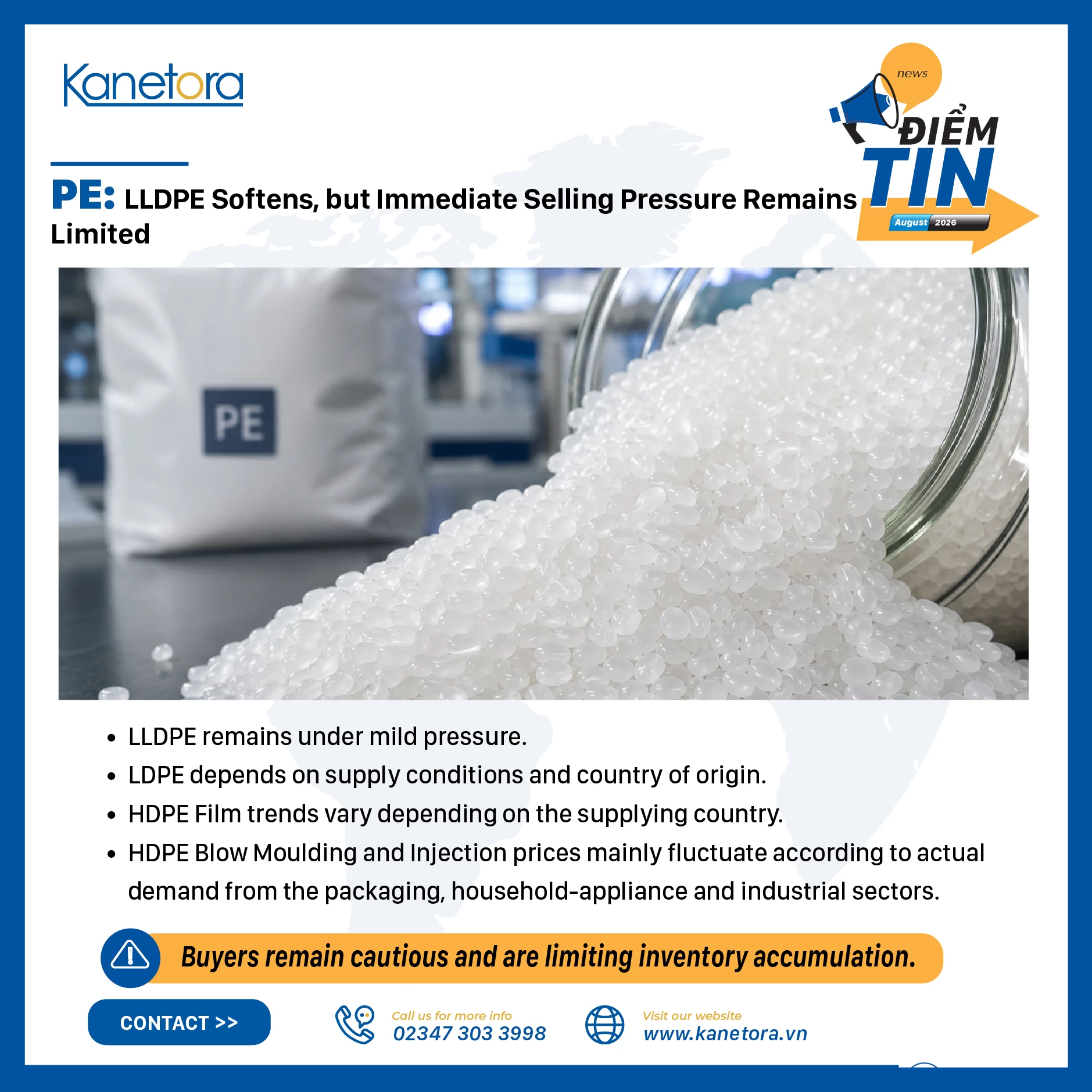
2. PE Market: LLDPE Softens, but Immediate Selling Pressure Remains Limited
Vietnam’s domestic PE market recorded a slight decline in LLDPE prices in early August.
Spot inventory in northern Vietnam was reportedly not excessive, although supply is expected to improve when additional imported cargoes arrive later in the month.
This creates two opposing market forces.
In the immediate term, limited spot availability may prevent LLDPE from falling significantly. However, expectations of additional cargo arrivals may discourage inventory accumulation and encourage converters to wait for more competitive offers.
China’s PE spot market also remains divided by grade rather than moving in one direction. This reflects different supply-and-demand conditions across:
- LLDPE film;
- LDPE film;
- HDPE film;
- HDPE blow moulding;
- HDPE injection;
- HDPE yarn.
Outlook by PE Category
LLDPE
LLDPE may remain under mild pressure due to cautious film demand and expectations of greater cargo availability later in August.
LDPE
LDPE prices will depend heavily on spot availability and product origin. Selected grades may remain firm when immediate supply is limited.
HDPE Film
HDPE film offers are likely to differ between Middle Eastern, Thai, South Korean and Chinese producers. Buyers should compare not only price, but also:
- Technical specifications;
- Melt flow rate;
- Film strength;
- Processing stability;
- Lead time;
- Cargo availability.
HDPE Blow Moulding and Injection
These grades will be more dependent on actual orders from bottle, container, household appliance, industrial component and consumer product manufacturers.
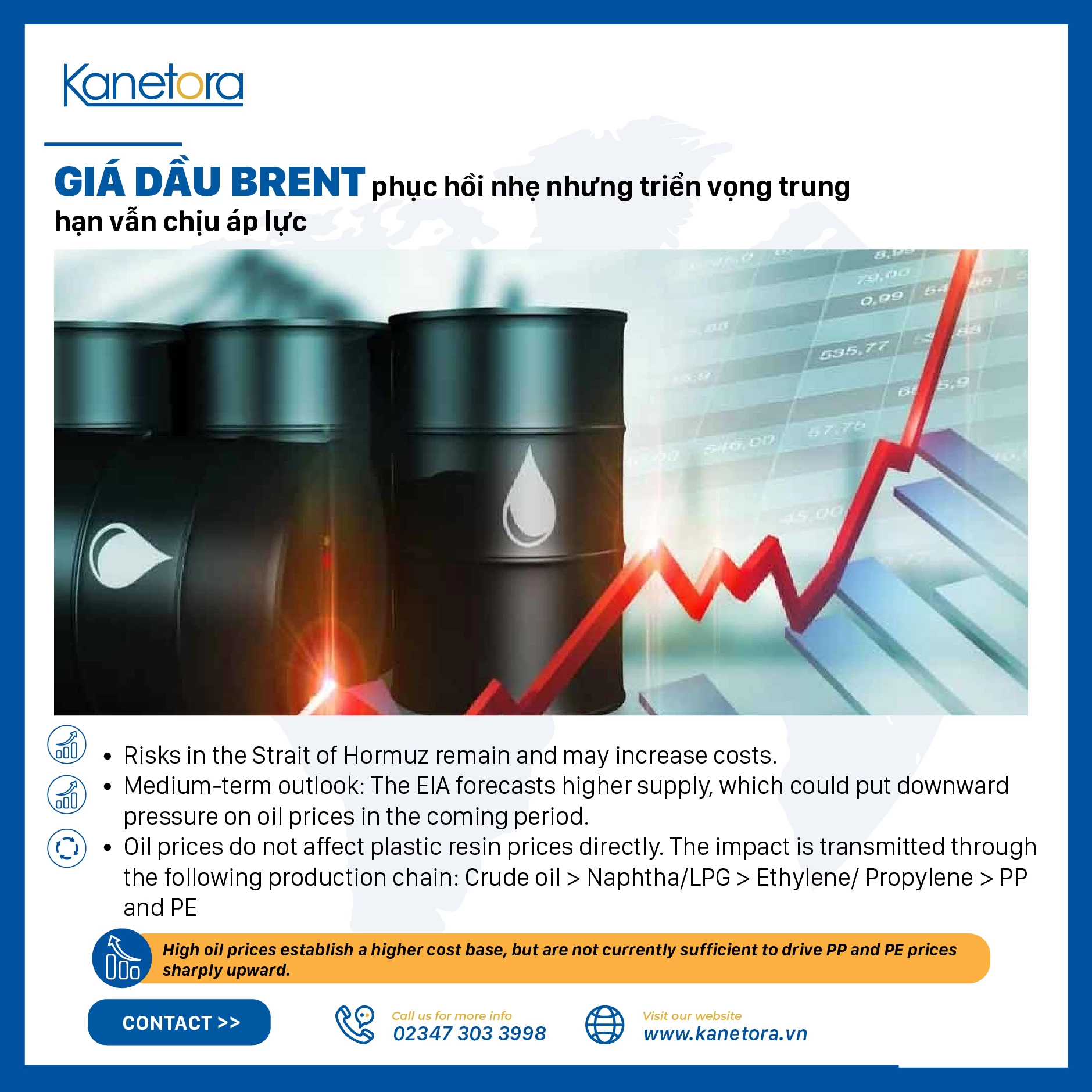
3. Brent Crude Rebounds, but the Medium-Term Outlook Remains Under Pressure
On August 4, front-month Brent crude increased by approximately 0.7% to USD 84.39 per barrel, while U.S. WTI rose to USD 80.95 per barrel.
The rebound followed a sharp decline in the previous session, when markets reacted to possible de-escalation and renewed diplomatic discussions involving the United States and Iran. However, Iran denied that negotiations were taking place, leaving the market exposed to further geopolitical volatility.
The Strait of Hormuz remains one of the most important energy transit routes in the world. Reuters reported that energy exports equivalent to approximately 20% of global consumption passed through the waterway before the conflict.
Shipping traffic in both Hormuz and the Red Sea has also been affected by security incidents, diversions, higher insurance expenses and longer voyages.
These conditions mean that oil prices can move sharply in response to diplomatic announcements, military activity or attacks on commercial vessels.
However, the medium-term oil outlook is less supportive.
The U.S. Energy Information Administration forecasts Brent crude to average approximately USD 74 per barrel during the third quarter of 2026. The agency expects higher production and more moderate inventory withdrawals to place downward pressure on oil prices.
How Do Crude Oil Prices Affect Plastic Resin?
Crude oil does not affect PP, PE, PVC or PET prices immediately or at a fixed one-to-one ratio.
The typical production chain is:
Crude oil → Naphtha or LPG → Ethylene and propylene → PE and PP resin → Finished plastic products
For a more detailed explanation, businesses can read How Do Crude Oil Prices Impact PE Resin Prices?.
In addition to crude oil, resin prices are influenced by:
- Naphtha and LPG costs;
- Ethylene and propylene prices;
- Cracker margins;
- Petrochemical plant operating rates;
- Maintenance schedules;
- Regional inventory;
- Freight and insurance;
- Currency movements;
- Actual downstream purchasing activity.
Therefore, Brent above USD 84 per barrel may create a cost floor, but it does not guarantee higher PP or PE prices when regional supply improves and manufacturing demand remains weak.
4. Weak Chinese Manufacturing Demand Remains a Major Constraint
China’s manufacturing PMI declined from 50.3 in June to 49.2 in July 2026, moving back below the 50-point expansion threshold.
The production index fell to 49.9, while the new order index declined to 48.5. Raw material inventory remained in contraction at 48.3.
Additional indicators also showed cautious purchasing conditions:
- Purchase quantity index: 49.4;
- Producer price index: 47.8;
- New export orders: 49.6;
- Import index: 47.5.
The data suggests that Chinese manufacturers remain reluctant to rebuild inventory aggressively and may have limited ability to pass higher feedstock costs on to finished-product buyers.
This is particularly important for polymer markets because China is both a major resin producer and one of the world’s largest consumers of PP, PE, PVC, PET and engineering plastics.
When production orders weaken, converters tend to reduce raw material purchases even when crude oil or petrochemical costs increase.
This creates a market in which supply costs may support prices, while weak demand limits the size and duration of any recovery.
5. PVC: Selective Recovery, but Downstream Demand Is Still Weak
PVC spot prices in China showed signs of recovery on August 3, while PVC futures in Dalian also increased during early trading on August 4.
However, this is not yet sufficient evidence that PVC has entered a sustained upward cycle.
PVC demand remains highly dependent on:
- Real estate and construction;
- Infrastructure projects;
- Plastic pipes;
- Window and door profiles;
- Flooring;
- Plastic panels;
- Building materials.
China’s construction business activity index fell to 47.0 in July, while the construction new order index declined to 40.1. Both indicators remain well below the expansion threshold.
The weakness of these downstream indicators suggests that the current PVC rebound may be driven by technical futures movements, energy costs or short-term trading sentiment rather than a strong recovery in physical demand.
A sustainable PVC uptrend would require improvement in construction orders, infrastructure activity and converter purchasing.
6. PET: New Offers Face Resistance from Buyers
Vietnam’s PET market recorded new offers from a Chinese supplier in early August, but the revised prices reportedly received limited acceptance from buyers.
This suggests that converters do not yet see sufficient urgency to accept higher price levels.
PET is commonly supported by demand from:
- Beverage bottles;
- Water bottles;
- Preforms;
- Food packaging;
- Polyester fibre;
- Consumer packaging.
However, if downstream manufacturers already hold sufficient inventory and PTA or MEG prices do not rise substantially, buyers are likely to continue purchasing only for immediate requirements.
PET prices in August may therefore remain differentiated between Chinese, Vietnamese and Southeast Asian supply sources.
Bottle, preform and packaging manufacturers should monitor:
- PET chip offers;
- PTA prices;
- MEG prices;
- Freight;
- Beverage demand;
- Post-summer consumption;
- Local inventory.
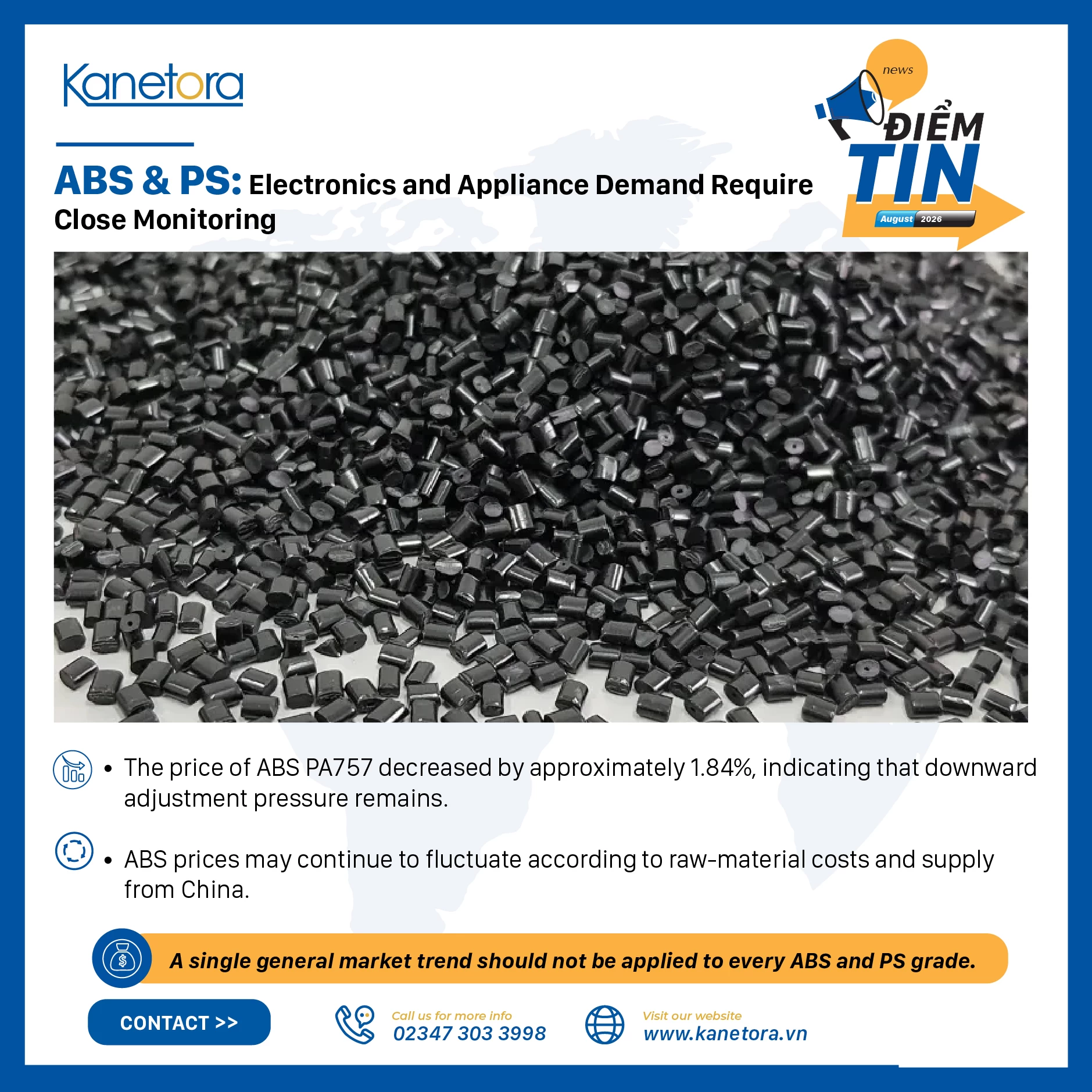
7. ABS and PS: Electronics and Appliance Demand Require Close Monitoring
According to the supplied August 4 market dashboard, ABS PA757 declined by approximately 1.84%, indicating that downward pressure remains present in selected engineering plastic grades.
ABS and PS prices are influenced by:
- Styrene;
- Acrylonitrile;
- Butadiene;
- Electronics production;
- Household appliances;
- Automotive components;
- Toys;
- Consumer products.
When export orders or industrial production weaken, manufacturers usually reduce raw material replenishment. This places pressure on spot prices even when individual feedstock costs rise.
In the short term, ABS and PS may continue to fluctuate according to Chinese cargo availability, upstream monomer prices and converter demand.
Buyers should not apply a single market direction to all grades because significant price and performance differences may exist between:
- General-purpose products;
- Prime resin;
- Off-grade material;
- High-impact grades;
- Flame-retardant grades;
- Specialised engineering formulations.
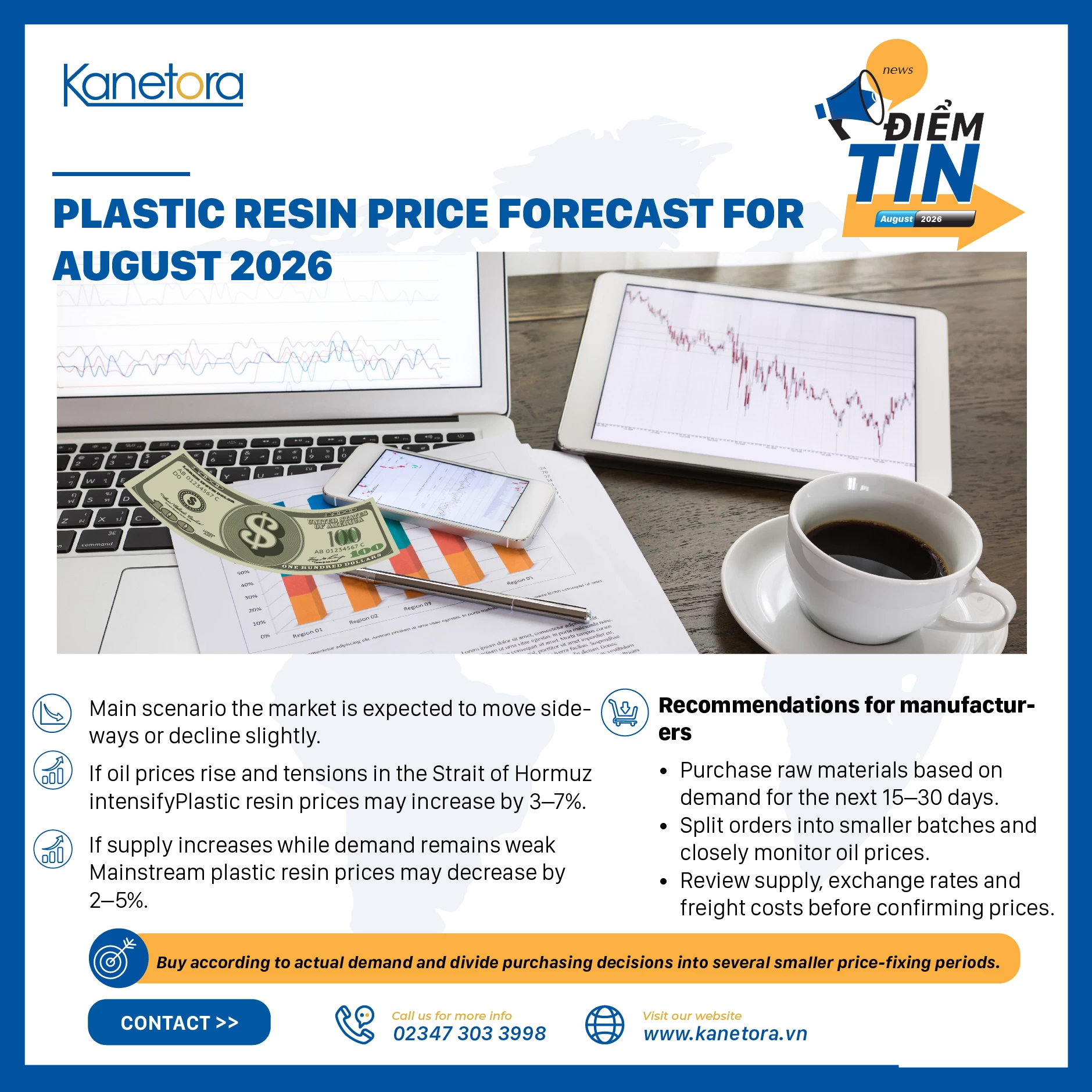
Plastic Resin Price Forecast for August 2026
Base Scenario: Sideways to Slightly Softer
This is currently the most likely scenario for the first half of August.
The return of stable domestic PP supply, expected PE cargo arrivals and weaker Chinese manufacturing demand may limit the potential for a broad price increase.
At the same time, elevated crude oil prices and continuing Hormuz risks may prevent a sharp market decline.
Depending on origin, grade, inventory and delivery schedule, indicative movements may remain within a range of approximately -2% to +2%.
Possible market direction:
- PP: Stable to slightly softer, especially for common homopolymer grades;
- PE: Mild pressure on LLDPE, with LDPE and HDPE varying by origin;
- PVC: Selective recovery possible, but sustained increases remain difficult;
- PET: Sideways to slightly softer if buyer resistance continues;
- ABS and PS: Mixed movement depending on feedstock and Chinese supply.
These ranges represent analytical scenarios rather than guaranteed market price changes.
Upside Scenario: Hormuz Tensions Escalate Again
If diplomatic efforts fail, shipping through the Strait of Hormuz is disrupted again or Brent crude returns above USD 90 per barrel, the cost of naphtha, olefins, freight and marine insurance could rise rapidly.
Under this scenario, imported plastic resin prices could potentially increase by approximately 3–7%, depending on product, origin and cargo availability.
PP and PE grades linked to Middle Eastern supply or Asian naphtha-based production would likely react more strongly.
However, the final increase in Vietnam would still depend on whether converters can accept higher offers and whether domestic supply remains available.
Downside Scenario: Oil Declines, Supply Improves and Demand Remains Weak
If Brent crude moves closer to the EIA’s projected quarterly average, NSRP operates steadily, imported PE cargoes arrive on schedule and China’s PMI remains below 50, the resin market may face additional downward pressure.
Under this scenario, common commodity grades could decline by approximately 2–5%, particularly products with:
- Multiple alternative supply sources;
- High commercial inventory;
- Weak downstream orders;
- Limited technical differentiation.
How Should Manufacturers Purchase Resin in August?
The objective should not be to identify the exact market bottom. A more practical approach is to divide purchasing according to production urgency and supply risk.
1. Secure Materials for 15–30 Days of Production
Manufacturers should maintain enough material for confirmed orders and reliable short-term production plans.
Inventory should not be reduced excessively while crude oil, marine insurance and shipping conditions remain vulnerable to sudden changes.
2. Divide Purchase Timing
Instead of purchasing the entire monthly requirement in one transaction, buyers can divide the volume into two or three lots.
This approach helps reduce the risk of:
- Buying during a temporary price spike;
- Missing a market correction;
- Facing an unexpected cargo shortage;
- Becoming overexposed to one supplier or origin.
3. Separate Spot Cargo from Forward Cargo
A lower offer for cargo arriving later in the month may involve additional risks:
- Vessel delay;
- Port congestion;
- Shipping schedule changes;
- Container availability;
- Additional surcharges;
- Longer financing periods.
Buyers should compare total landed cost and supply reliability rather than evaluating resin only by the quoted price per tonne.
4. Do Not Change Resin Grade Based Only on Price
Before replacing a resin grade or supplier, manufacturers should evaluate:
- Melt flow index;
- Tensile strength;
- Elongation;
- Density;
- Colour consistency;
- Processing stability;
- Machine settings;
- Scrap rate;
- Odour and contamination;
- Food-contact requirements;
- Export standards;
- Batch traceability.
A lower-priced grade can increase total production cost if it causes more defects, unstable extrusion, lower machine speed or inconsistent finished-product quality.
5. Include Packaging and Logistics in the Procurement Decision
For resin distributors and exporters, packaging affects moisture protection, contamination risk, loading speed, discharge efficiency and container utilisation.
Businesses can review Bulk Bags for Plastic Resin Export: Safe Packaging for PP, PE & PET for guidance on:
- Bag loading capacity;
- Liner selection;
- Coated or uncoated fabric;
- Filling and discharge systems;
- Container loading;
- PP, PE and PET packaging requirements.
For moisture-sensitive or high-cleanliness products, an FIBC Bag with Liner may offer additional protection against moisture, dust, leakage and contamination.
6. Monitor Oil, Futures and Physical Offers Together
Purchasing decisions should not be based on Brent crude alone.
Manufacturers should monitor:
- Brent and WTI crude;
- Naphtha;
- Ethylene;
- Propylene;
- PTA and MEG;
- PP, LLDPE and PVC futures in China;
- USD/VND exchange rate;
- Freight and insurance;
- Plant operating rates;
- Maintenance schedules;
- Actual Vietnam spot offers.
A genuine market reversal usually requires confirmation from several indicators, not just a single increase in crude oil.
August 2026 Plastic Resin Procurement Checklist
Before confirming a resin purchase, procurement teams should review:
- Current inventory and cargo already in transit.
- Production requirements for the next 30–45 days.
- Spot prices versus forward cargo offers.
- Price differences between origins and producers.
- Technical substitution options.
- Brent, naphtha, ethylene and propylene trends.
- PP, LLDPE and PVC futures in China.
- Producer operating rates and maintenance schedules.
- Delivery lead time and delay risks.
- Exchange rate, payment terms and financing cost.
- COA, specifications and traceability documents.
- Finished-product selling prices and the ability to pass on cost increases.
- Packaging requirements for storage and export.
- Supplier stability and claim-handling capability.
Conclusion
The plastic resin market in early August 2026 is being shaped by two opposing forces.
Brent crude prices and continuing risks around the Strait of Hormuz and the Red Sea are supporting feedstock, freight and insurance costs. At the same time, domestic PP supply is stabilizing, additional PE cargoes are expected and Chinese manufacturing demand has weakened.
As a result:
- PP and PE are likely to remain stable or slightly softer;
- PVC may recover selectively but lacks strong downstream support;
- PET continues to face buyer resistance;
- ABS and PS remain dependent on feedstock costs and electronics, appliance and automotive demand.
For manufacturers, the most suitable August strategy is to:
- Purchase according to actual production requirements;
- Divide buying into several stages;
- Maintain safe inventory;
- Confirm resin quality before substitution;
- Prioritize reliable suppliers;
- Include logistics and financing costs in purchasing decisions.
In a news-driven and volatile market, competitive advantage does not come only from obtaining the lowest price. It also comes from maintaining uninterrupted production, consistent quality and a reliable supply chain.
FAQ – Plastic Resin Market August 2026
Will Plastic Resin Prices Rise Sharply in August 2026?
A broad and sharp increase is currently unlikely.
Crude oil supports production costs, but improving supply and weaker Chinese demand are limiting upward pressure on PP, PE, PVC and PET.
What Was the Brent Crude Price on August 4, 2026?
Front-month Brent crude traded at approximately USD 84.39 per barrel in early August 4 trading, while WTI was around USD 80.95 per barrel. Both benchmarks recovered slightly after a significant decline in the previous session.
Should Manufacturers Buy PP Now or Wait?
Manufacturers should secure PP for approximately 15–30 days of confirmed production.
Non-urgent volume can be divided into smaller purchasing lots while buyers monitor NSRP production, propylene costs and distributor inventory.
Could LLDPE Continue to Decline?
LLDPE may remain under pressure because film demand is cautious and more imported cargoes are expected later in the month.
However, immediate spot supply in northern Vietnam is not excessive, which may limit the size of any short-term decline.
Why Can Resin Prices Fall When Crude Oil Rises?
Crude oil is only one of several pricing factors.
PP or PE prices can decline even when crude oil increases if:
- Resin supply is abundant;
- Producer inventory is high;
- Import offers are competitive;
- Downstream demand is weak;
- Buyers delay restocking.
Which Resin Categories Require the Closest Monitoring?
PP and PE require close monitoring because they are widely used across Vietnamese manufacturing.
PVC depends heavily on construction, PET on beverage and packaging demand, while ABS and PS are more closely linked to electronics, appliances, automotive products and consumer goods.
Does Kanetora Supply Plastic Resin to Manufacturers?
Yes. Kanetora operates in plastic resin and chemical distribution, with a portfolio focused on PP, PE and other industrial polymer materials.
According to Kanetora’s 2026 company profile, its plastic resin business has distribution capacity of up to approximately 100,000 tonnes per year.
Businesses can review Kanetora’s Plastic Resin solutions or contact Kanetora to discuss grade specifications, purchasing volume, technical requirements and delivery planning.
References
- Reuters, Oil Ticks Up After Selloff as Talks to End U.S.–Iran War Remain Uncertain, August 4, 2026.
- National Bureau of Statistics of China, Purchasing Managers’ Index for July 2026.
- U.S. Energy Information Administration, Short-Term Energy Outlook, July 2026.
- Thị Trường Hạt Nhựa – Vietnamese resin market updates for PP, PE, PVC, PET and China spot markets.
- Kanetora, Plastic Resin Market Update July 2026.
- Kanetora, How Do Crude Oil Prices Impact PE Resin Prices?.