

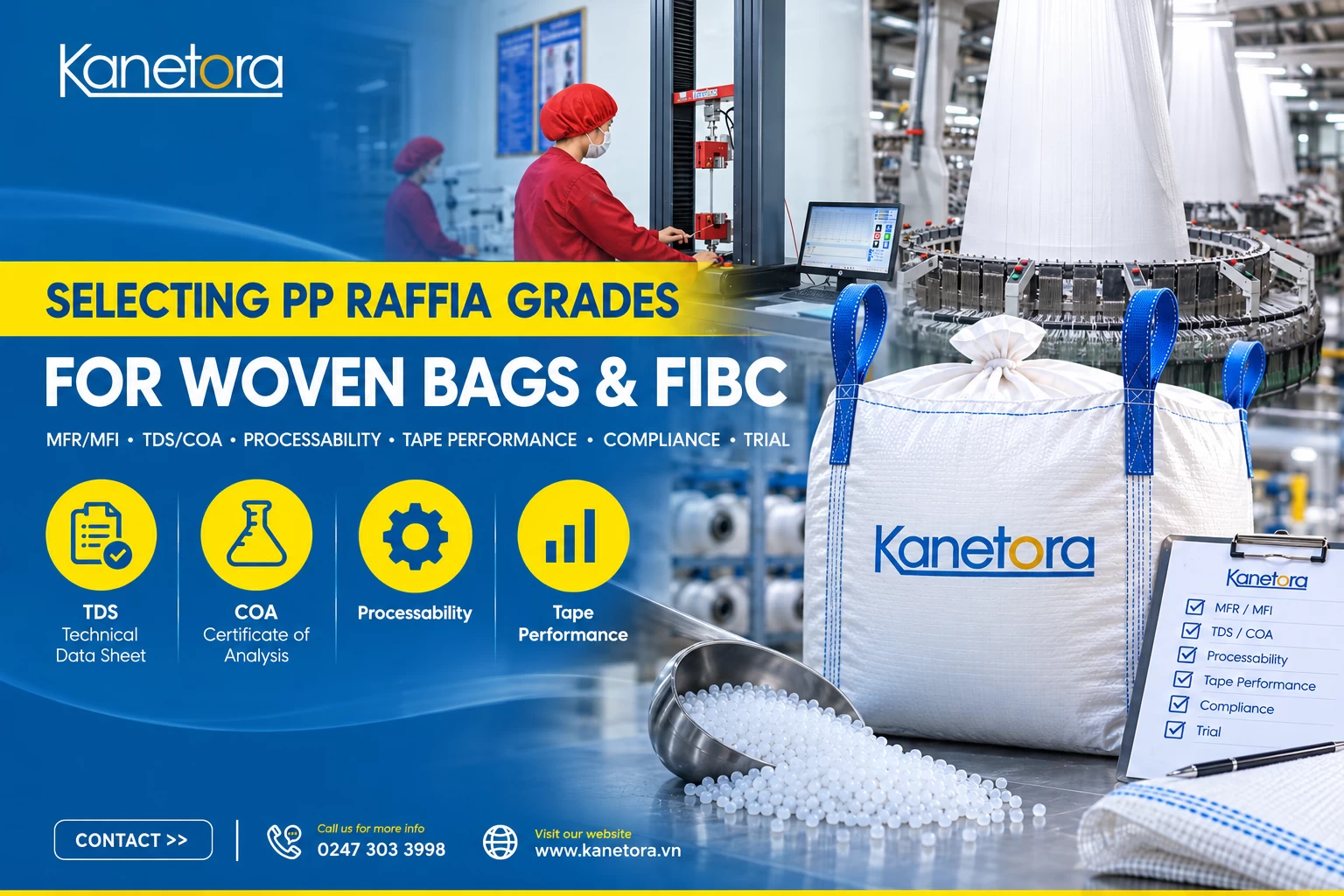
Selecting the right polypropylene (PP) raffia grade is a critical decision for manufacturers of woven bags, FIBC bulk bags, and industrial packaging materials.
While price and melt flow index (MFI) are often the first specifications buyers compare, these factors alone cannot determine whether a PP grade will perform consistently on a particular extrusion and weaving line.
A suitable resin must support stable tape extrusion, adequate stretching performance, consistent mechanical properties, and reliable conversion into finished woven fabric.
For procurement teams, the objective is not simply to purchase polypropylene at the lowest price. It is to select a grade that delivers consistent quality, efficient production, and a competitive total manufacturing cost.
This guide explains the technical factors buyers should evaluate before selecting, substituting, or approving PP raffia grades for woven packaging applications.
What Is PP Raffia Grade and Why Is It Used for Woven Bags and FIBC?
PP raffia grade is a category of polypropylene resin designed for producing stretched tapes, flat yarns, and woven polypropylene fabrics.
These materials are widely used in industrial packaging applications, including:
- PP woven sacks for agricultural and industrial products
- Flexible Intermediate Bulk Containers (FIBC / Jumbo Bags)
- Woven polypropylene fabric
- Industrial packaging tapes and selected strapping applications
- Selected woven packaging components
In a typical manufacturing process, polypropylene pellets are melted and extruded into a thin film. The film is subsequently slit into narrow tapes, stretched under controlled conditions, and wound onto bobbins for weaving.
The resulting woven fabric can then be cut, sewn, coated, or converted into various packaging formats.
Although PP woven bags and FIBC bulk bags share similar base materials, their structural and performance requirements can differ significantly.
Smaller woven sacks are commonly used for packaging products such as rice, fertilizer, animal feed, and industrial powders. FIBCs are designed for larger bulk loads and require appropriate fabric strength, seam construction, lifting systems, and validated safety performance.
For a detailed comparison, see PP Woven Bags vs FIBC Bulk Bags: Which Packaging Fits Your Cargo?.
This distinction is important because the suitability of a PP raffia grade must be evaluated against the finished packaging requirements, not merely its general application category.
1. Melt Flow Index (MFI): Important, but Not the Only Selection Criterion
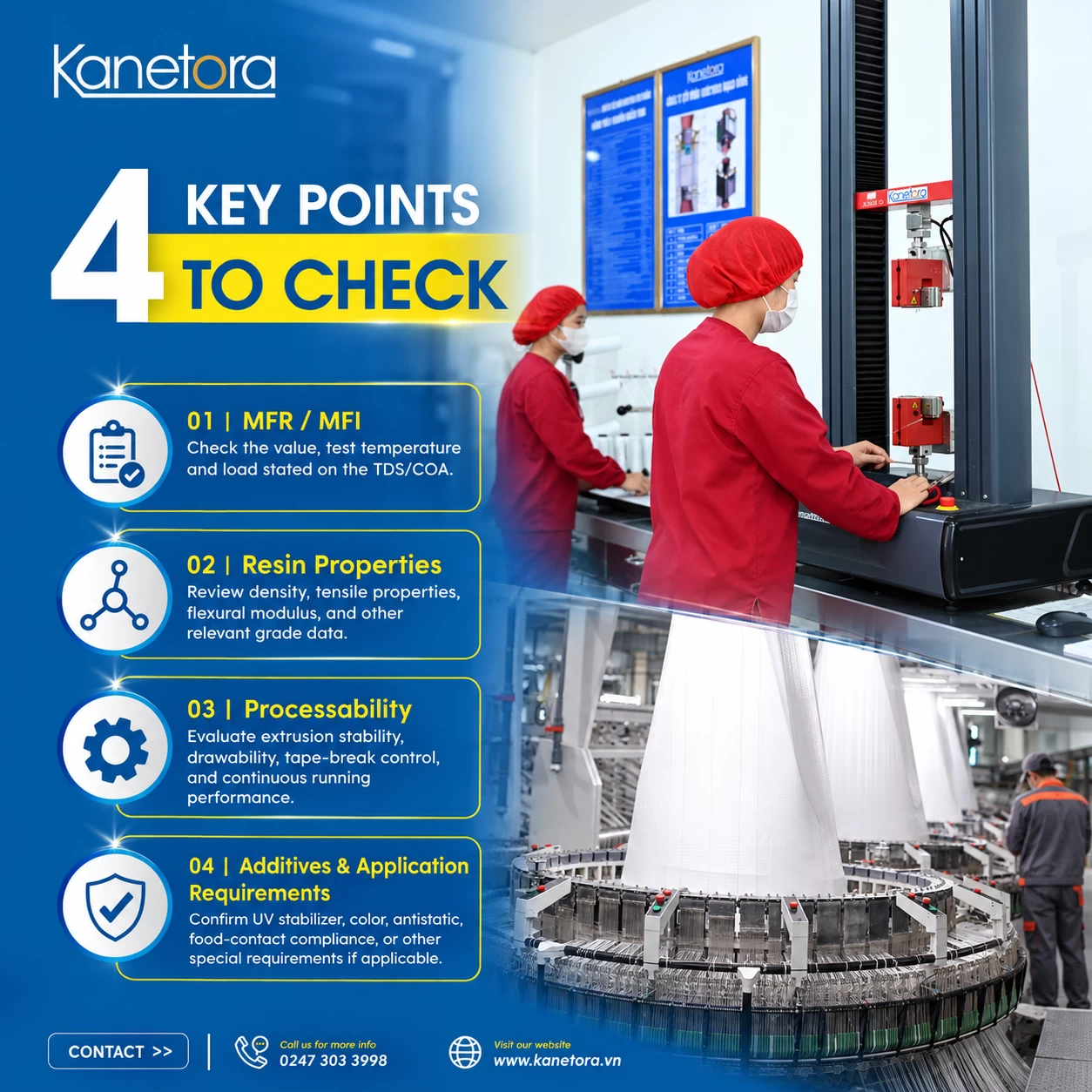
Melt Flow Index (MFI), also called Melt Flow Rate (MFR), is one of the most frequently reviewed properties when purchasing PP raffia resin.
MFI describes the mass of molten polymer flowing through a standardized test apparatus under specified temperature and load conditions.
For polypropylene, it is commonly reported at 230°C under a 2.16 kg load, using methods such as ASTM D1238 or ISO 1133.
MFI helps buyers evaluate the processing characteristics of a resin and compare grades under equivalent test conditions.
However, two polypropylene grades with similar MFI values do not necessarily deliver identical production performance.
Their behavior may differ because of:
- Molecular weight distribution
- Polymer structure and formulation
- Additive packages
- Thermal stability
- Stretching characteristics
- Raw material consistency
For example, a grade that operates successfully on one tape extrusion line may require processing adjustments when introduced into another production environment.
Therefore, buyers should treat MFI as an initial screening parameter rather than a complete grade-approval criterion.
Buyer checklist:
- Confirm the MFI/MFR value and its test conditions.
- Compare the proposed grade with the currently approved resin.
- Review processing recommendations provided by the manufacturer.
- Assess whether adjustments to extrusion and stretching conditions may be necessary.
- Avoid assuming that matching MFI values guarantee equivalent performance.
2. Tensile Strength and Elongation: Evaluating Mechanical Performance
Mechanical properties are particularly important for polypropylene used in woven packaging.
During production, extruded PP tapes are stretched to develop the strength and characteristics required for weaving.
The resulting tape must withstand processing tension, weaving operations, and the mechanical demands of the finished packaging application.
Two important performance indicators are tensile strength and elongation.
Tensile Strength
Tensile strength describes a material’s resistance to failure under pulling force.
For woven packaging manufacturers, inadequate tape strength may contribute to yarn breakage, weaving interruptions, and inconsistent fabric performance.
However, tensile strength values reported in a resin Technical Data Sheet typically refer to standardized test specimens and should not be treated as direct measurements of stretched tape or finished woven fabric strength.
Actual tape performance must be measured under the intended processing conditions.
Elongation
Elongation describes how much a material stretches under tensile loading.
In raffia processing, an appropriate balance between tensile strength and elongation is important for stable tape production and subsequent weaving.
An unsuitable balance can affect tape breakage behavior and manufacturing efficiency.
Buyers should therefore assess mechanical performance at two levels:
- Resin properties: Manufacturer-reported tensile and elongation data under standardized test methods.
- Converted tape properties: Actual strength and elongation measured after extrusion and stretching.
The second level is essential because manufacturing conditions significantly influence the final tape characteristics.
For FIBC applications, additional validation of woven fabric, seams, lifting loops, and complete bag performance is necessary.
3. Processability: How Does PP Raffia Perform on the Production Line?
A PP grade may have acceptable laboratory specifications but still create challenges during production.
Processability describes how reliably a resin performs throughout the manufacturing process.
For PP raffia applications, this includes:
Extrusion stability: The resin should support stable melt processing and consistent film formation within the operating window of the equipment.
Tape stretching: The material should allow the required stretching conditions without excessive tape breakage or unstable operation.
Water carry-over behavior: Where a water-quench process is used, the formulation and processing conditions should support effective water removal before subsequent operations.
Winding performance: Consistent tape dimensions and tension are important for efficient winding and downstream weaving.
Weaving efficiency: Tape quality should support stable loom operation and minimize unnecessary stoppages.
Production teams should record performance indicators such as tape-break frequency, line speed, output consistency, and material waste during trials.
These indicators often provide more practical information than laboratory specifications alone.
A resin that appears less expensive per tonne may result in higher manufacturing costs if it causes frequent line interruptions or excessive scrap.
4. Batch-to-Batch Consistency: A Key Requirement for Industrial Procurement
Consistency is one of the most important considerations when sourcing polypropylene for continuous manufacturing.
A resin may perform well during initial qualification but create difficulties if subsequent deliveries show significant variation.
Potential sources of concern include changes in:
- Melt flow behavior
- Mechanical characteristics
- Additive formulation
- Contamination levels
- Processing performance
For manufacturers operating multiple extrusion and weaving lines, these variations can affect productivity and finished-product consistency.
A reliable sourcing strategy should therefore consider both the technical suitability of a grade and the supplier’s ability to provide stable material over time.
Buyers should establish clearly defined acceptance criteria for incoming resin and maintain traceability between resin batches and production results.
Kanetora discusses this broader purchasing approach in its PP/PE Resin Sourcing Update for Packaging Manufacturers, emphasizing grade-level suitability, source flexibility, and production consistency.
5. TDS and COA: What Documentation Should Buyers Request?
Technical documentation plays an essential role in resin qualification and incoming quality control.
Two commonly used documents are the Technical Data Sheet (TDS) and Certificate of Analysis (COA).
Technical Data Sheet (TDS)
A TDS provides information about a resin grade’s typical technical characteristics.
Depending on the manufacturer and product, it may include:
- Polymer type and grade designation
- Recommended applications
- Melt Flow Rate
- Density
- Tensile properties
- Flexural properties
- Thermal characteristics
- Processing recommendations
- Relevant test standards
TDS values are often typical values rather than guaranteed batch specifications. Buyers should review the manufacturer’s stated tolerances and specifications separately.
Certificate of Analysis (COA)
A COA provides reported test results for a particular production batch or lot.
Depending on the producer and supply agreement, a COA may include melt flow results and other defined quality parameters.
Not every property listed in a TDS will necessarily appear in the COA.
The buyer should therefore confirm which parameters are routinely tested, which limits apply, and whether the documents correspond to the delivered material.
| Document | Main Purpose | Buyer Verification |
|---|---|---|
| TDS | Understand typical grade properties and applications | Grade suitability and processing guidance |
| COA | Review reported batch-specific test results | Lot identity and agreed acceptance limits |
| SDS | Communicate material safety and handling information | Storage and handling requirements |
| Regulatory declarations | Support specific compliance requirements | Applicable regulations and declared scope |
| Trial report | Evaluate manufacturing performance | Actual production suitability |
For food-contact or other regulated packaging applications, additional documentation may be required based on the final product, intended use, and destination market.
A general PP raffia classification does not automatically establish food-contact compliance.
6. Additives and Masterbatch Compatibility
Industrial woven packaging often requires performance characteristics beyond those of the base polypropylene resin.
Depending on the application, manufacturers may introduce additives or masterbatches for:
- Color control
- UV stabilization
- Processing performance
- Thermal stabilization
- Other application-specific requirements
The suitability of these materials should be evaluated as part of the complete formulation.
For example, adding a color masterbatch can influence tape extrusion and stretching behavior if its carrier resin, formulation, or dosage is incompatible with the processing system.
Similarly, UV protection should be assessed through the performance of the final formulation and packaging design rather than assumed solely from the base resin grade.
For outdoor storage and export applications, manufacturers should also consider UV exposure, storage duration, and the finished packaging requirements.
Learn more about these downstream considerations in Anti-UV FIBC Bags for Outdoor Storage and Export Transit.
7. Why Production Trials Are Essential Before Approving a New PP Grade
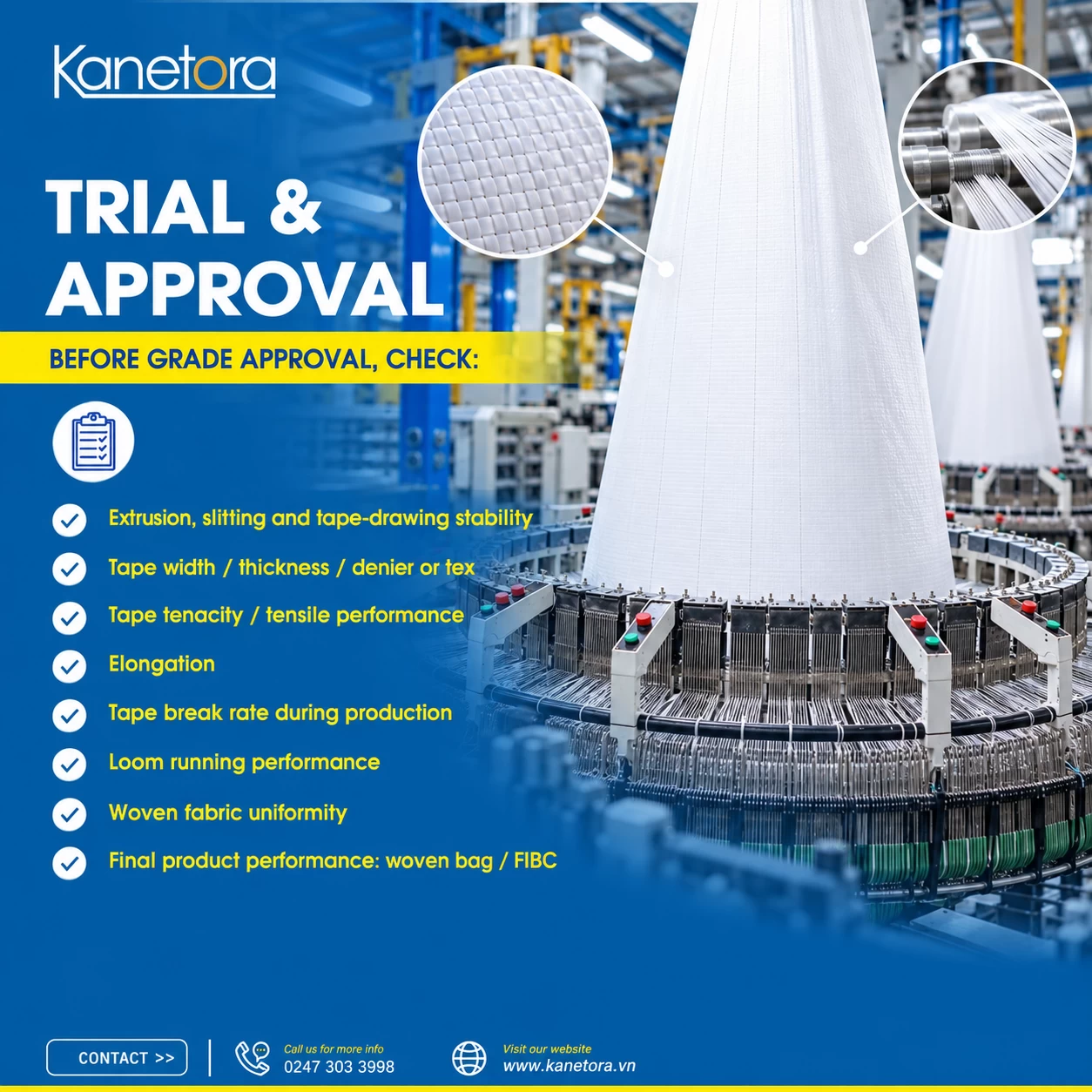
A production trial is one of the most reliable ways to determine whether a proposed PP raffia grade is suitable for an existing manufacturing process.
Even when two grades have similar technical data, their performance may differ under actual operating conditions.
An effective trial should compare the candidate resin with an approved reference grade whenever possible.
Step 1: Define the Reference Conditions
Record the current grade, operating conditions, product specifications, and baseline production performance.
Step 2: Review the Candidate Grade
Confirm its manufacturer, origin, TDS, COA, MFI, formulation information, and applicable technical documentation.
Step 3: Conduct a Controlled Extrusion Trial
Evaluate melt stability, film formation, tape stretching, breakage behavior, and winding performance under documented operating conditions.
Step 4: Test the Converted Tape and Fabric
Measure relevant performance characteristics using suitable testing procedures.
These may include tape tensile properties, elongation, fabric strength, and other application-specific requirements.
Step 5: Evaluate Finished Packaging Performance
For FIBC applications, the assessment may include fabric properties, seam performance, lifting-loop construction, and finished-bag tests appropriate to the intended design and Safe Working Load.
Step 6: Complete Grade Approval
Document the results, identify any necessary operating adjustments, and establish approved purchasing and quality-control criteria.
A successful trial should demonstrate that the material can deliver acceptable product quality and stable production under defined conditions.
Important: A successful resin trial does not automatically qualify a finished FIBC design. Final packaging validation must follow the applicable product specification and testing requirements.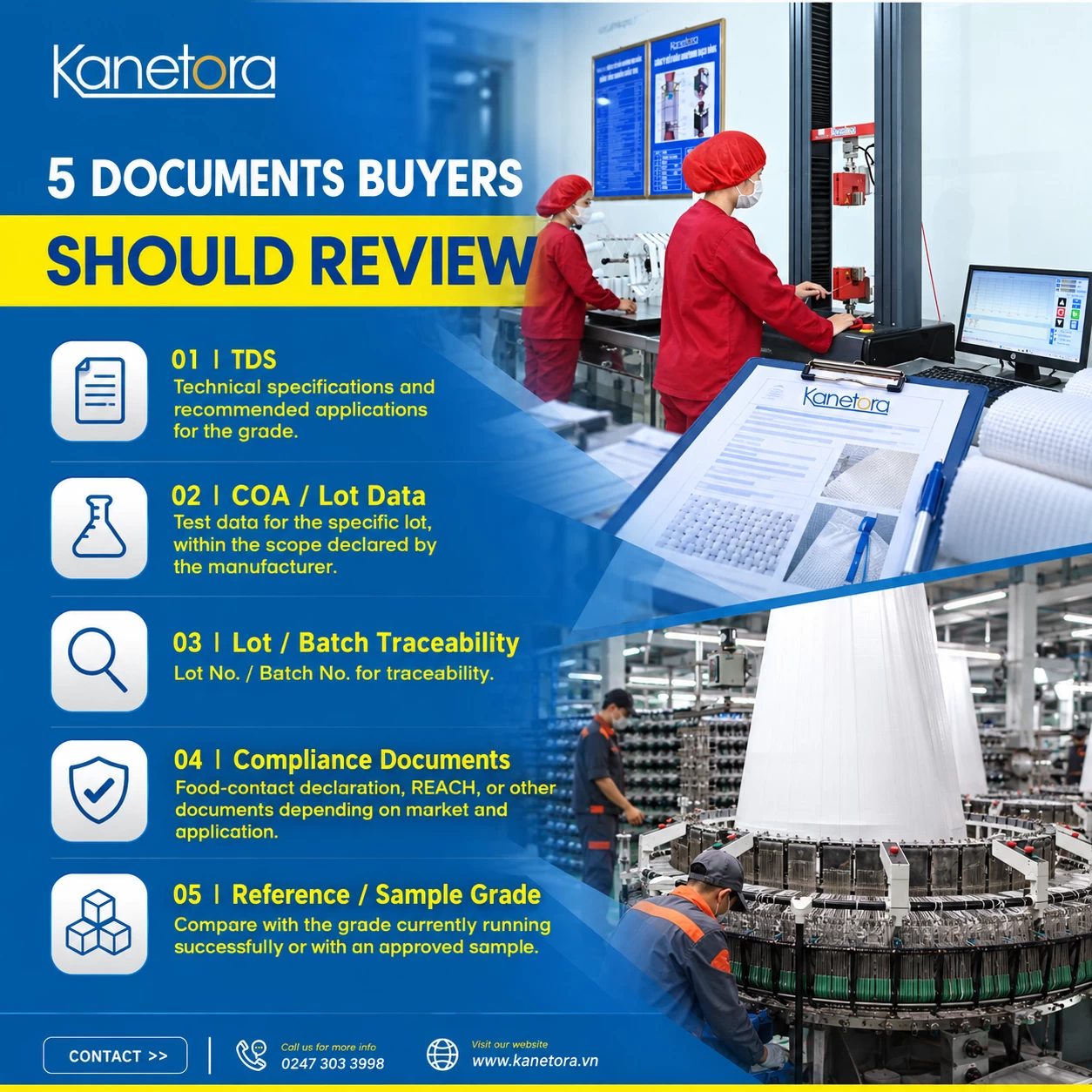
8. PP Raffia Buyer Checklist: 12 Questions Before Purchase Approval
The following checklist can help purchasing, quality-control, and production teams evaluate a candidate resin.
| No. | Buyer Question | What to Verify |
|---|---|---|
| 1 | Is the resin intended for raffia/tape extrusion? | Polymer type and recommended applications |
| 2 | What is the MFI/MFR? | Value, temperature, load, test method |
| 3 | Does it match the current processing requirements? | Equipment compatibility and operating window |
| 4 | Are mechanical properties suitable? | TDS and converted tape test results |
| 5 | How stable is the extrusion process? | Trial observations and process records |
| 6 | Does the resin support the target draw ratio? | Tape stretching trial |
| 7 | Is yarn breakage within acceptable limits? | Production trial data |
| 8 | Are additives and masterbatches compatible? | Formulation review and trials |
| 9 | Is batch quality sufficiently consistent? | COA history and incoming QC |
| 10 | Are technical and compliance documents available? | TDS, COA, SDS and relevant declarations |
| 11 | Is the supply arrangement reliable? | Availability, lead time and origin |
| 12 | Has the grade passed production approval? | Signed trial and quality records |
Procurement recommendation: Establish acceptance criteria jointly with production and quality teams before issuing purchase approval for a new or substitute grade.
This reduces the risk of selecting a resin based solely on commercial specifications.
9. Can One PP Raffia Grade Replace Another?
Substituting one PP raffia grade for another may be possible, but the decision should not be based on MFI similarity alone.
A proposed alternative should be assessed in terms of polymer characteristics, processability, mechanical performance, additives, supply consistency, and downstream product requirements.
A structured substitution process should include:
Technical screening: Compare TDS values, manufacturer recommendations, and defined quality requirements.
Document verification: Review batch traceability, COA information, and relevant declarations.
Production evaluation: Conduct controlled trials to identify changes in operating conditions and material performance.
Commercial evaluation: Compare purchase cost alongside production losses, conversion efficiency, and supply reliability.
Formal approval: Update approved material lists and purchasing specifications after successful qualification.
For manufacturers seeking alternative resin sources, a qualified substitute should maintain both production stability and finished-product performance.
10. From PP Resin to Finished FIBC: Why Downstream Manufacturing Knowledge Matters
Resin selection is closely connected to the way woven packaging is manufactured.
At Kanetora, our industrial ecosystem combines plastic resin distribution with packaging manufacturing capabilities.
Through our Plastic Resin portfolio, we supply polypropylene and other polymer materials for a wide range of industrial applications.
Our packaging operations at Kanetora Bach Dang also provide practical insight into the conversion process, including tape extrusion, weaving, coating, cutting, sewing, inspection, and packaging.
This connection between raw materials and downstream manufacturing helps shape a more application-oriented approach to resin sourcing.
Understanding the Complete Manufacturing Process
For woven bags and FIBC production, material quality must be considered across multiple processing stages:
PP resin → Tape extrusion → Tape stretching → Weaving → Fabric conversion → Finished packaging testing
A resin that performs well in the extrusion process must still deliver suitable converted tape and fabric properties.
At Kanetora Bach Dang, production quality is supported by QC and QA activities as well as testing equipment used to evaluate materials and finished FIBC performance.
The facility’s testing capabilities include tensile testing, UV resistance testing, and top-lift testing for FIBC applications.
This manufacturing perspective reinforces an important purchasing principle:
The right PP raffia grade is the one that performs consistently throughout the intended production process and supports the required final product specifications.
PP Raffia Grades Available Through Kanetora
Kanetora’s polypropylene portfolio includes grades for various processing methods and industrial applications.
One example is PP F501N, a polypropylene homopolymer from Hyosung associated with raffia, ropes, and flat yarn applications.
According to the published product information, F501N is designed for extrusion applications including tapes and woven packaging materials.
However, the suitability of any individual grade depends on the buyer’s application, processing conditions, and performance requirements.
Customers seeking PP raffia materials or alternative sourcing options are encouraged to provide their existing resin grade, target specifications, production requirements, and expected order volume for technical and commercial evaluation.
Frequently Asked Questions About PP Raffia Grades
What is the difference between PP raffia grade and injection-molding grade?
PP raffia grades are developed for processes such as tape extrusion and stretching, while injection-molding grades are designed for molding applications. They may differ in melt flow behavior, molecular characteristics, additives, and processing requirements. A grade intended for injection molding should not automatically be considered suitable for woven tape production.
What MFI is suitable for PP woven bags and FIBC?
Many commercial PP raffia grades have relatively low melt flow rates, and grades in the approximate 2–4 g/10 min range are commonly encountered for tape extrusion. However, this is not a universal specification. The appropriate MFI depends on the equipment, processing conditions, required tape properties, and the manufacturer’s grade recommendations.
Is the same PP raffia grade suitable for woven bags and FIBC?
A PP raffia grade may be used in both applications if it meets the relevant processing and performance requirements. However, finished FIBC bags have additional structural and safety requirements that must be verified independently.
Why is a COA important when purchasing polypropylene?
A COA provides reported test information for a specific material batch. It helps buyers verify lot identity and applicable quality parameters against agreed purchasing specifications.
Can a lower-priced PP grade increase manufacturing costs?
Yes. A lower purchase price may be offset by higher scrap rates, increased tape breakage, reduced production efficiency, or additional processing adjustments. Buyers should compare total conversion cost rather than resin price alone.
Should manufacturers conduct trials before changing PP raffia suppliers?
Yes. Controlled trials are recommended when introducing a new resin grade or supplier, particularly for continuous production and applications requiring consistent mechanical performance.
Conclusion: Select PP Raffia Based on Total Production Performance
Selecting the right polypropylene raffia grade requires more than comparing prices or melt flow values.
For woven bag and FIBC manufacturers, an effective purchasing decision should consider:
- Resin grade and intended application
- Melt Flow Rate and technical characteristics
- Tape tensile strength and elongation
- Extrusion, stretching, and weaving performance
- Batch-to-batch consistency
- TDS, COA, and supporting documentation
- Production trials and finished-product requirements
- Supply reliability and total manufacturing cost
By combining these factors, buyers can reduce sourcing risks, improve production consistency, and establish more reliable material approval procedures.
Looking for PP raffia grades for woven bags or FIBC manufacturing?
Kanetora supports industrial customers with polypropylene sourcing and access to technical product information through its international supply network.
Explore our Plastic Resin solutions or contact our team to discuss suitable PP grades and procurement requirements.
KANETORA JOINT STOCK COMPANY
Website: https://kanetora.vn/
Email: info@kanetora.vn
Hotline: +84 (0) 247 303 3998
Technical note: Resin data and application recommendations are grade-specific. Buyers should refer to current manufacturer documentation and verify suitability through controlled trials before production approval.