

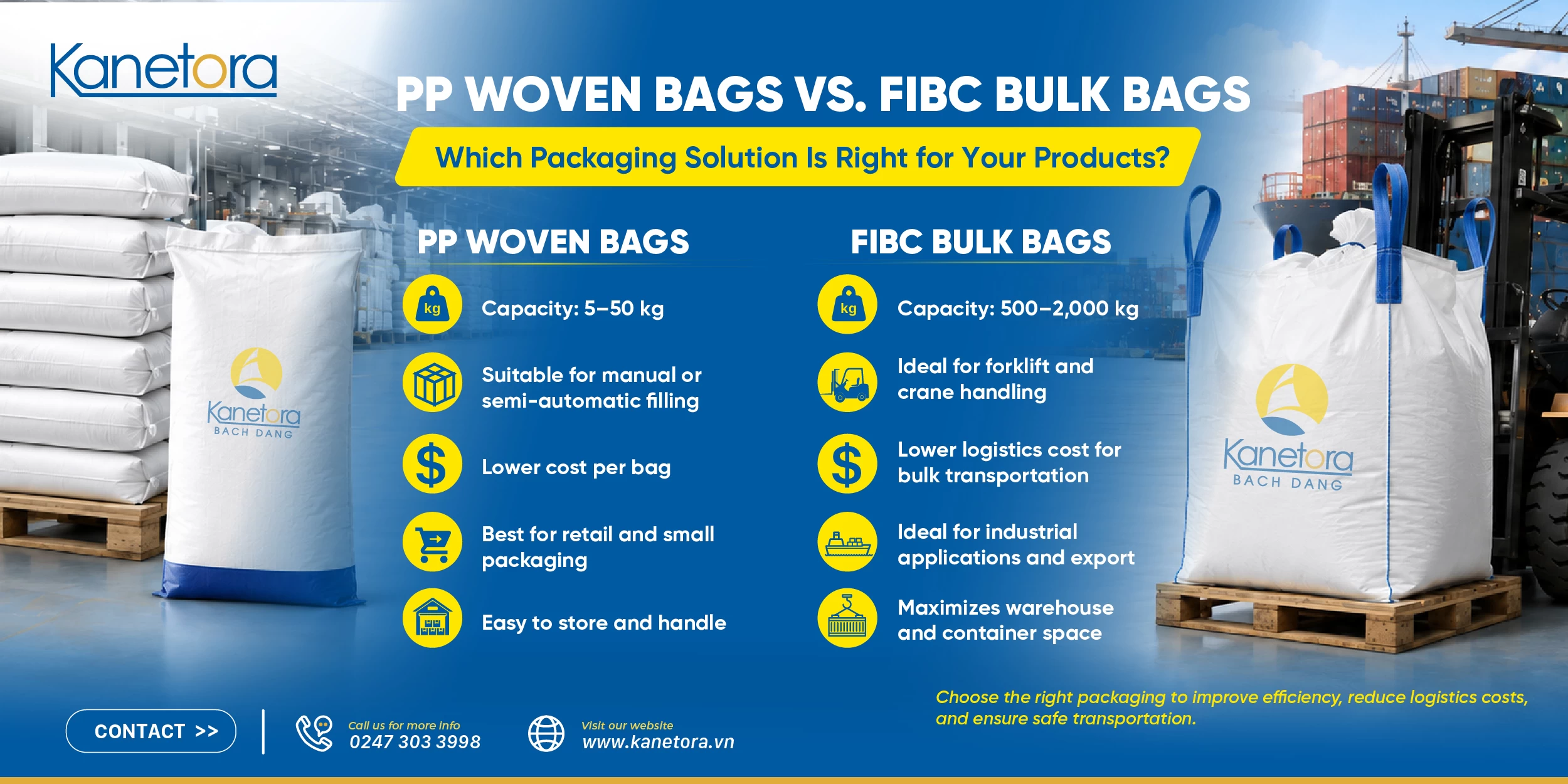
When sourcing industrial packaging for powders, granules, agricultural products, plastic resins, minerals or other dry bulk materials, buyers often compare two common options: PP woven bags and FIBC bulk bags.
Both are typically based on woven polypropylene, but they serve very different logistics and handling models.
PP woven bags are generally used for smaller packaging units that can be handled individually, stacked on pallets and distributed bag by bag. FIBC bulk bags, also known as Jumbo Bags or Big Bags, are designed to consolidate much larger quantities of material into a single lifting unit.
The key question is therefore not simply:
“Which bag is cheaper?”
A more useful question is:
“Which packaging system gives the lowest total cost and the most efficient handling for my product and supply chain?”
This guide compares PP Woven Bags vs FIBC Bulk Bags across capacity, handling, packaging cost, product protection, export applications and operational requirements to help buyers select the right solution.
Quick Answer: PP Woven Bags or FIBC Bulk Bags?
Choose PP Woven Bags when your product needs to be packed into smaller commercial units, manually handled, palletized or distributed to multiple customers.
Choose FIBC Bulk Bags when you are handling larger volumes of dry bulk material, have forklift or lifting equipment available and want to reduce the number of individual packaging units.
Within Kanetora’s packaging portfolio, conventional PP woven bags are typically designed for smaller unit loads, while FIBC structures can commonly be developed for Safe Working Loads of approximately 500–2,000 kg, depending on bag construction, material, safety factor and application.
| Comparison Factor | PP Woven Bags | FIBC Bulk Bags |
|---|---|---|
| Packaging unit | Small | Large |
| Typical load range | Often 5–50 kg | Commonly 500–2,000 kg |
| Manual handling | Practical | Generally not suitable |
| Forklift handling | Usually pallet-based | Direct lifting through loops |
| Number of packages per tonne | High | Low |
| Unit-by-unit distribution | Excellent | Less flexible |
| Bulk handling efficiency | More individual operations | Fewer handling units |
| Customization | Coating, liner, printing, closure | Very extensive |
| Best suited for | Smaller distributed loads | Industrial bulk cargo |
What Are PP Woven Bags?
PP Woven Bags are made from polypropylene tapes woven together to form a strong and lightweight packaging fabric.
Depending on the product requirements, the fabric can be uncoated, laminated or combined with an inner PE liner. The bag can also be printed, sewn, heat sealed or equipped with different filling and closing structures.
Their main advantage is the manageable package size.
A 20 kg, 25 kg or 50 kg bag can be:
- handled individually;
- stacked onto pallets;
- sold as a commercial unit;
- distributed to different customers;
- fed into manufacturing processes in smaller batches.
For this reason, PP woven bags remain widely used for products such as rice, grains, animal feed, fertilizers, minerals, plastic pellets and industrial powders.
For fine powders and high-speed filling operations, companies may also evaluate Block Bottom Valve Bags for Powder Products as an alternative to conventional sewn PP woven sacks. Kanetora currently lists block bottom valve bags among its industrial packaging solutions alongside FIBCs and multilayer films.
What Are FIBC Bulk Bags?
FIBC stands for Flexible Intermediate Bulk Container.
Also known as a Bulk Bag, Big Bag or Jumbo Bag, an FIBC is a flexible industrial container primarily designed for storing, lifting and transporting large quantities of dry bulk material.
Unlike smaller PP sacks, an FIBC normally incorporates lifting loops so that the complete loaded unit can be handled by forklift or suitable lifting equipment.
FIBCs can be customized with different constructions including:
- U-Panel;
- Circular;
- Four-Panel;
- Baffle;
- coated or uncoated fabric;
- filling spouts;
- duffle tops;
- discharge spouts;
- PE inner liners;
- dustproof sewing;
- static-control structures;
- food-grade configurations;
- UN-certified configurations.
Kanetora’s current packaging profile includes Type A, Type B, Type C and UN FIBCs as well as food-grade, liner-equipped, Baffle and dust-control solutions. Buyers can also review Kanetora’s FIBC Bags from Vietnam: Supplier Guide for Global Buyers for a broader overview of sourcing and manufacturing options.
1. Capacity: The Biggest Difference Between PP Woven Bags and FIBCs
Capacity is usually the first major distinction in a PP Woven Bags vs FIBC Bulk Bags comparison.
Imagine that a company needs to package 1,000 kg of raw material.
Using 25 kg PP woven bags would require approximately:
1,000 kg ÷ 25 kg = 40 individual bags
If the product and operating conditions allow the use of a 1,000 kg FIBC, the same quantity could potentially be managed as one packaging unit.
That difference affects much more than packaging material.
Forty individual bags may require forty filling operations, closures, labels and handling actions before the goods even leave the warehouse.
A single FIBC consolidates the material into a larger unit that can be lifted and moved mechanically.
However, bigger is not automatically better.
If the customer consumes only 25 kg of material per production batch, receiving one 1,000 kg FIBC may create additional downstream handling requirements.
The correct packaging capacity therefore needs to match not only the shipping volume, but also how the customer receives, stores and consumes the product.
2. Handling: Manual Operations vs Mechanical Bulk Handling
Another major difference is the handling system.
Handling PP Woven Bags
Smaller woven bags are easier to manage individually.
They can be manually moved, counted, sorted and stacked. Multiple bags can then be palletized for warehouse storage and international shipping.
This gives distributors significant flexibility, especially when:
- several customers share one shipment;
- different product grades need to be separated;
- goods are sold bag by bag;
- the receiving facility has limited bulk-handling equipment.
The disadvantage is the number of handling operations.
As shipment volume increases, so do the number of individual packages that must be filled, closed, labeled, palletized and moved.
Handling FIBC Bulk Bags
FIBCs consolidate material into larger units and use lifting loops for mechanical handling.
This can significantly reduce the number of packaging units moving through the warehouse.
However, FIBCs also require compatible infrastructure.
The shipper and receiver may need to consider:
- forklift availability;
- lifting clearance;
- filling stations;
- bag support frames;
- discharge systems;
- lifting-loop configuration;
- warehouse height;
- operator procedures.
The better packaging option is therefore not simply the one that is easier to lift.
It is the one that best matches the handling infrastructure at both origin and destination.
3. Cost: Compare Cost per Tonne, Not Cost per Bag
One of the most common sourcing mistakes is comparing only the purchase price of an individual bag.
Naturally, one small PP woven sack will normally cost less than one large customized FIBC.
But that does not tell you which solution is more economical.
A more useful calculation is:
Total Packaging Cost = Packaging + Filling + Closing + Labor + Pallet + Wrapping + Handling + Storage + Freight + Product Loss/Risk
For example, a smaller bag system may require:
- more individual bags;
- more labels;
- more sewing or sealing operations;
- more workers;
- pallets;
- pallet wrapping;
- more forklift movements.
An FIBC may reduce the number of packaging units but may require more specialized lifting, filling or discharge equipment.
Therefore, buyers should calculate the total packaging and logistics cost per tonne of product delivered, not simply the unit price of each bag.
The same principle applies when comparing FIBCs with even larger bulk systems. Kanetora’s guide to Container Liner Bags for Bulk Cargo explains why the complete loading, transport and unloading model should be evaluated instead of packaging purchase price alone.
4. Product Protection: The Specification Matters More Than Bag Size
Neither PP woven bags nor FIBCs should automatically be considered more moisture-resistant or cleaner simply because of their size.
The actual protection level depends on the specification.
For relatively coarse and non-sensitive products, standard woven polypropylene may be sufficient.
For fine powders, leakage control may require:
- coated fabric;
- improved seam construction;
- dustproof stitching;
- suitable closures.
For moisture-sensitive or contamination-sensitive cargo, an internal liner can provide an additional protective layer.
Kanetora currently produces FIBC liners and multilayer flexible films as part of its packaging manufacturing portfolio. Its 2026 factory profile lists dedicated liner production and testing equipment alongside FIBC manufacturing capabilities.
Buyers handling moisture-sensitive materials can read:
FIBC Bag with Liner: When and Why to Use
and
Moisture-Proof FIBC Bags: Protecting Export Cargo from Humidity
5. When Should You Choose PP Woven Bags?
PP woven bags are generally a strong option when the supply chain requires relatively small packaging units.
They are particularly practical when:
- the product is sold in 10–50 kg units;
- workers need to handle individual packages;
- customers do not operate bulk unloading systems;
- different grades or batches must remain separated;
- products are distributed to several destinations;
- the customer consumes material in relatively small batches;
- individual bag branding is important.
Typical applications may include:
- rice and grains;
- animal feed;
- fertilizers;
- plastic resin;
- minerals;
- construction materials;
- chemicals;
- industrial powders.
For export shipments, these smaller bags are often palletized.
When pallet stability and external transport protection are important, manufacturers can also consider Stretch Hood Film for Industrial Pallet Packaging. Stretch hood creates a containment layer around the pallet and can be used with bags, cartons and selected FIBC pallet configurations.
6. When Should You Choose FIBC Bulk Bags?
FIBCs become particularly attractive when a company regularly handles large quantities of dry bulk material.
Common applications include:
- PP, PE and PET resin;
- plastic compounds;
- fertilizers;
- minerals;
- calcium carbonate;
- chemicals;
- agricultural commodities;
- food ingredients;
- starch;
- flour;
- sugar;
- animal-feed ingredients;
- construction materials.
The key advantage is consolidation.
Instead of managing dozens of individual sacks, the company can handle one larger packaging unit.
However, there is no single “standard FIBC” suitable for every cargo.
A 1,000 kg bag for plastic pellets may require a completely different specification from a 1,000 kg bag used for fine food powder or a bag operating in an environment with electrostatic ignition risks.
This is why buyers should define the complete FIBC specification rather than simply sending an RFQ for “1 ton jumbo bags.”
7. Food and Agricultural Products: Distribution Format Matters
Food and agricultural products provide a good example of why packaging selection should begin with the supply chain.
Take rice as an example.
Rice distributed to wholesalers or smaller processors may be packed in PP woven bags of 25 kg or 50 kg.
The same product moving between large industrial facilities may instead be shipped in FIBCs.
For food-contact applications, the packaging decision should also consider:
- raw materials;
- manufacturing hygiene;
- foreign-material control;
- dust removal;
- liner requirements;
- metal detection where applicable;
- traceability;
- quality documentation.
Kanetora Bach Dang’s current manufacturing profile describes a controlled inspection process for food-grade FIBCs including loose-thread treatment, air blowing, micro-dust removal and metal detection, with packing under controlled clean-room conditions.
For more detail, see Food Grade FIBC Bags for Export Food & Agriculture Products.
8. Plastic Resin: 25 kg Bags or 1-Ton FIBCs?
Plastic resin is another product category where both packaging formats are widely relevant.
A manufacturing plant consuming several tonnes of PP or PE continuously may prefer FIBCs because they reduce the number of packaging units and can integrate more efficiently with industrial material-handling systems.
By contrast, a resin distributor handling many grades or supplying customers in smaller quantities may prefer 25 kg PP woven bags.
The correct choice depends on factors including:
- polymer type;
- pellet, powder or flake form;
- bulk density;
- contamination sensitivity;
- moisture sensitivity;
- customer batch size;
- silo availability;
- filling equipment;
- discharge equipment;
- warehouse handling.
Kanetora also provides a dedicated guide on Bulk Bags for Plastic Resin Export: Safe Packaging for PP, PE & PET, which discusses liners, contamination control and leakage risks for resin packaging.
9. When Is a Baffle FIBC Worth Considering?
Traditional FIBCs may bulge outward after filling, especially when packed with free-flowing materials.
This can reduce space efficiency in:
- warehouses;
- pallets;
- trucks;
- shipping containers.
A Baffle FIBC, sometimes called a Q-Bag, incorporates internal baffles that help control side bulging and retain a more rectangular shape.
This can be useful when a buyer wants the handling advantages of FIBCs while improving container-space utilization and load geometry.
For more information, see Baffle Bulk Bags: How to Optimize Container Loading Efficiency.
10. Electrostatic Risk: Capacity Is Not the Only Safety Factor
For certain powders, chemicals, resins and other dry products, friction during filling and discharge can generate electrostatic charge.
Where combustible dust, flammable vapor or other hazardous conditions exist, FIBC selection may require additional electrostatic controls.
For example, Type C and Type D FIBCs use fundamentally different static-control mechanisms.
A Type C FIBC uses conductive components and must be connected to a suitable earth point during operation.
A Type D FIBC uses specialized static-protective fabric designed to dissipate charge without a physical grounding connection.
Neither should be selected based only on cargo weight or bag price.
Buyers should evaluate the material, operating environment, filling and discharge system, liner compatibility and site-specific safety requirements. Kanetora discusses these considerations in Type C vs Type D FIBC Bags for Export Cargo.
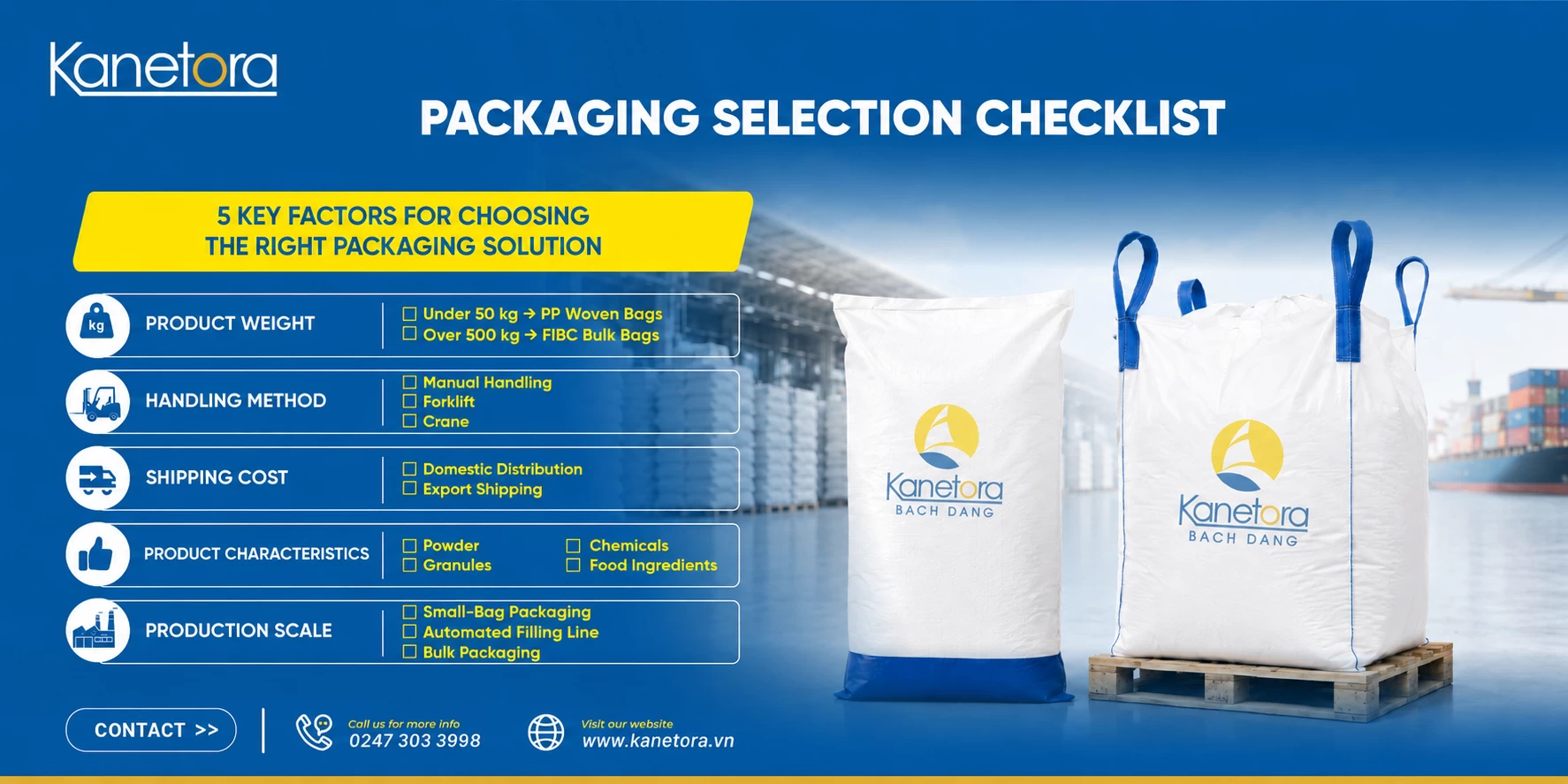
PP Woven Bags vs FIBC Bulk Bags: Selection Checklist
Before requesting a quotation, buyers should answer the following questions:
- What is the required net weight per package?
- Is the product a powder, pellet, granule, flake or abrasive material?
- What is the product’s bulk density?
- Will the bags be manually handled or mechanically lifted?
- Does the receiving customer have forklift and bulk discharge equipment?
- Does the product require moisture, dust or contamination protection?
- Is a PE liner, coated fabric or barrier liner required?
- Are there food-grade, electrostatic or dangerous-goods requirements?
- Will the customer consume the material bag by bag or in large batches?
- Is the priority packaging price, labor reduction, container utilization or total logistics cost?
These questions give the packaging manufacturer enough information to recommend a practical specification instead of simply supplying a generic bag.
PP Woven Bags vs FIBC Bulk Bags: Which Is Better?
There is no universal winner.
PP woven bags are generally better when the supply chain requires smaller, individually distributed packaging units.
FIBC bulk bags are generally better when companies handle larger quantities of dry bulk material and have the infrastructure for mechanical lifting and discharge.
And for certain high-volume full-container shipments, neither may be the optimum solution.
If one homogeneous dry product fills most or all of a shipping container and both facilities have bulk loading and discharge equipment, a Container Liner Bag may also be worth evaluating.
The most useful procurement question is therefore not:
“Which bag has the lowest unit price?”
It is:
“Which packaging system delivers my product safely at the lowest total cost per tonne?”
Industrial Packaging Solutions from Kanetora, Vietnam
Kanetora develops industrial packaging solutions including FIBC/Jumbo Bags, Block Bottom Valve Bags, inner liners and multilayer flexible films for applications across food, agriculture, plastics, chemicals, minerals and construction materials.
At the Kanetora Bach Dang manufacturing facility in Ninh Binh, Vietnam, the current stated production capacity includes approximately:
- 300,000 FIBC bags/month
- 10,000,000 Block Bottom Valve Bags/month
- 500 tonnes of multilayer plastic film/month
The facility also operates production and quality-control systems covering extrusion, weaving, lamination, cutting, printing, sewing, inspection and packing. Its current profile lists ISO 9001:2015, ISO 14001:2015, ISO 22000:2018 and BRC Grade A among its certifications.
Rather than selecting packaging only by dimensions and price, international buyers can work with Kanetora to evaluate:
- product characteristics;
- bulk density;
- target filling weight;
- bag construction;
- liner and coating requirements;
- filling and discharge method;
- lifting method;
- pallet configuration;
- container loading;
- destination-market requirements.
This allows the packaging specification to be developed around the actual cargo and logistics process.
Request a Packaging Recommendation
If you are deciding between PP Woven Bags and FIBC Bulk Bags, provide the following information when requesting a quotation:
- Product name
- Product form: powder, pellet, granule or flake
- Bulk density
- Required net weight per bag
- Filling method
- Discharge method
- Moisture or contamination requirements
- Pallet requirement
- Destination country
- Estimated order volume
Kanetora can then recommend the appropriate packaging structure for your cargo and export operation.
Frequently Asked Questions About PP Woven Bags vs FIBC Bulk Bags
Are PP Woven Bags and FIBC Bags Made from the Same Material?
Both commonly use woven polypropylene as the primary structural material.
However, their dimensions, fabric specifications, sewing construction, lifting systems and intended loads are significantly different.
How Much Weight Can an FIBC Hold?
FIBCs are produced in different Safe Working Load configurations.
Kanetora’s current product portfolio includes common structures designed around approximately 500–2,000 kg SWL, depending on design and application. The final SWL and Safety Factor must be defined for the specific FIBC specification.
Can PP Woven Bags Use an Inner Liner?
Yes.
A PE liner may be added when the packed product requires additional protection against moisture, leakage, dust or contamination.
The liner material, thickness and structure should be matched to the actual cargo and filling process.
Are FIBCs Always Cheaper Than 25 kg Bags?
No.
FIBCs may reduce the number of individual packaging units and handling operations, but the overall economics depend on filling equipment, discharge equipment, forklift handling, warehousing and customer requirements.
The most appropriate comparison is total cost per tonne, not cost per bag.
Can FIBC Bags Be Used for Food Products?
Yes, provided the complete packaging system and manufacturing conditions are suitable for the intended food-contact application.
Raw materials, hygiene controls, contamination prevention, liners, traceability and applicable documentation should all be reviewed before the final specification is approved. Kanetora currently manufactures food-grade FIBC solutions for food and agricultural applications.
When Should I Use a Baffle FIBC?
Baffle FIBCs are worth considering when side bulging reduces pallet or container efficiency.
Internal baffles help the filled bag retain a more rectangular profile and can improve space utilization compared with conventional FIBC designs.
When Should I Use a Container Liner Instead of FIBCs?
Container liners are most relevant when one homogeneous dry bulk material is transported in full-container quantities and both the shipper and consignee have compatible bulk loading and unloading systems.
FIBCs remain more flexible when individual units, forklift handling, batch separation or staged distribution are required.
What Information Should I Send to an FIBC Manufacturer?
At minimum, provide the product, bulk density, required weight per bag, filling method, discharge method, lifting requirements, liner or coating requirements, destination market and estimated order volume.
For sensitive cargo, additional information on moisture, contamination, electrostatic hazards and regulatory requirements should also be provided.