

Transporting dry bulk cargo is not only a question of choosing a bag or booking a container. The packaging system must match the product, shipment volume, loading equipment, unloading method, destination infrastructure and required level of cargo protection.
For many export shipments, FIBC bags remain one of the most practical solutions because they divide cargo into manageable units that can be lifted, stored and unloaded separately.
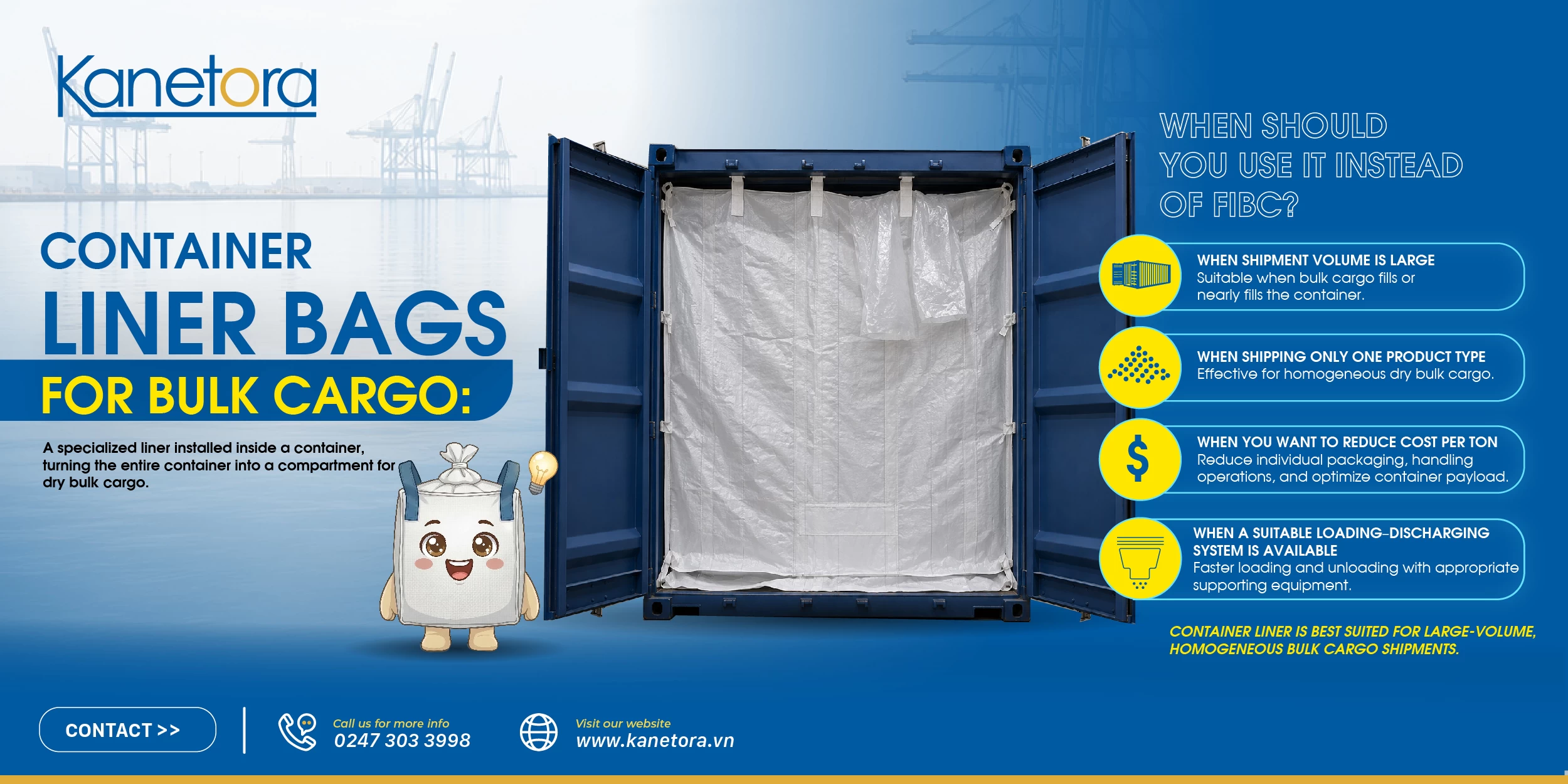
However, when a company ships one homogeneous dry material in full-container volumes, container liner bags for bulk cargo may provide a more efficient alternative.
A container liner can transform the interior of a standard dry freight container into a protected space for transporting loose powders, granules, flakes or pellets without dividing the cargo into individual FIBCs.
The result may be lower packaging consumption, less manual handling and faster bulk loading—but only when the complete logistics system is prepared for it.
Quick Answer: When Should You Use a Container Liner Instead of FIBC?
A container liner is usually suitable when:
- One dry, flowable product fills most or all of the container.
- The cargo is shipped as a homogeneous bulk lot.
- The shipper has suitable bulk-loading equipment.
- The consignee can receive and discharge loose bulk cargo.
- Individual bags, pallets and forklift handling are not required.
- Reducing packaging units and manual handling is a priority.
FIBC bags are generally more suitable when:
- Cargo must be divided into individual units.
- Several product grades or batches share one shipment.
- The customer requires palletized or forklift-compatible handling.
- Only part of the cargo will be unloaded at each destination.
- Individual batch identification and traceability are important.
- The receiving facility does not have bulk-discharge equipment.
In practical terms, container liners optimize full-container bulk movement, while FIBCs provide greater flexibility in handling, warehousing and distribution.
What Is a Container Liner Bag?
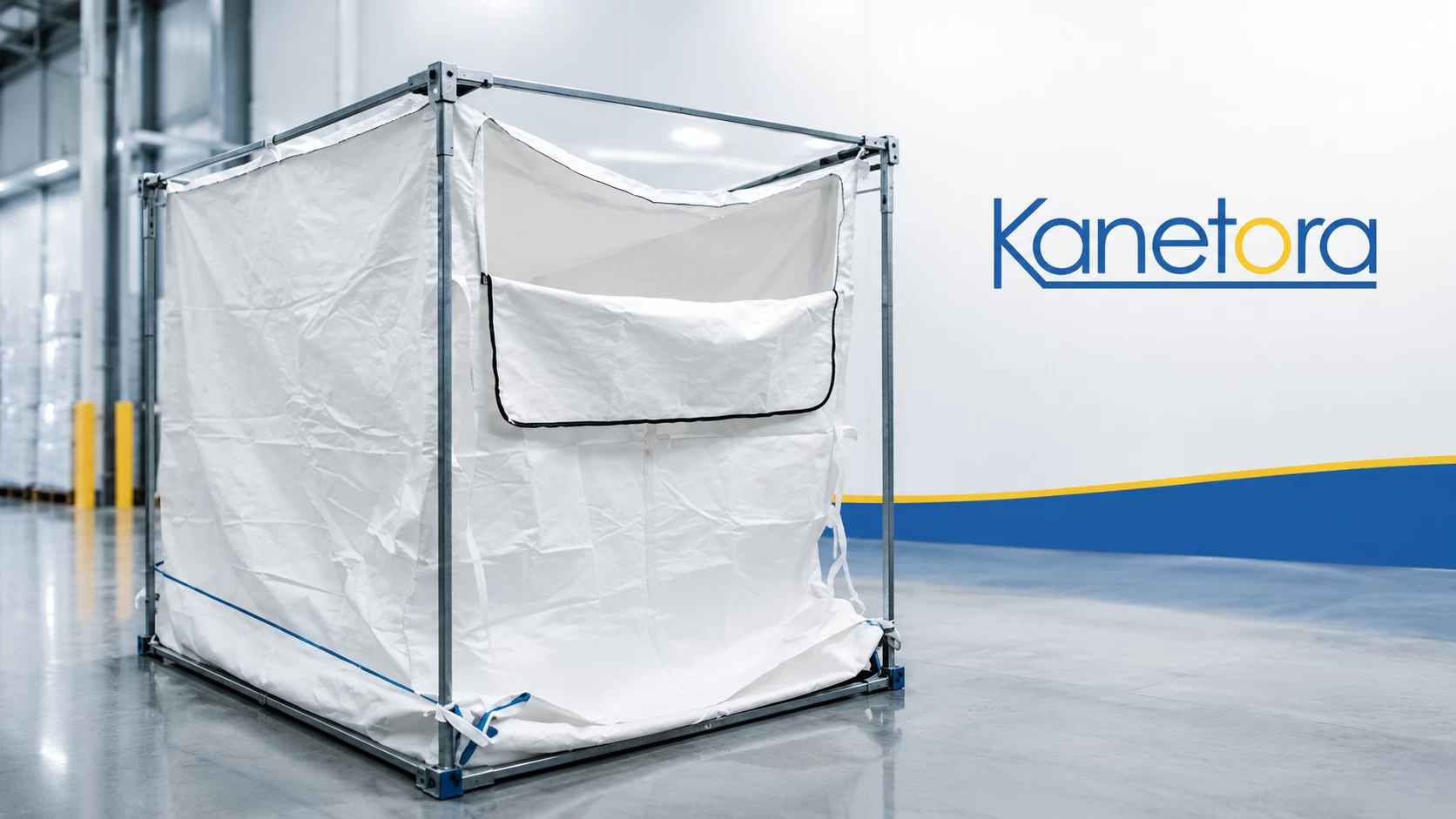
A container liner bag—also called a dry bulk container liner, bulk liner or sea bulk liner—is a flexible film structure installed inside a standard shipping container.
Once installed, the liner separates the cargo from the container walls, floor, ceiling and doors. The dry material is loaded directly into the liner rather than being packed into individual sacks or bulk bags.
The IMO/ILO/UNECE Code of Practice for Packing of Cargo Transport Units recognizes the use of cargo-specific liner bags for bulk commodities and emphasizes the importance of suitable container preparation and door protection.
A typical container liner system may include:
| Component | Main function |
|---|---|
| Main liner body | Separates the cargo from the container interior |
| Filling inlet | Connects to a conveyor, blower, chute or loading pipe |
| Discharge outlet | Supports controlled unloading at destination |
| Attachment points | Hold the liner in the correct position |
| Door barrier | Prevents bulk cargo pressure from acting directly on the container doors |
| Ventilation ports | Allow displaced air to escape during loading |
| Closure system | Helps seal the liner after filling |
The exact construction depends on the cargo, container size, loading method and unloading equipment.
Is a Container Liner the Same as an FIBC Inner Liner?
No. Although both may be made from flexible plastic film, they serve different packaging systems.
An FIBC inner liner is installed inside an individual bulk bag. The woven polypropylene outer bag provides lifting strength, while the inner liner helps protect the cargo from moisture, dust, leakage and contamination.
You can explore this structure in more detail in our guide to FIBC bags with inner liners.
A container liner, by contrast, lines most or all of the inside of the shipping container and holds the cargo as one large bulk shipment.
| Packaging system | Outer load-bearing structure | Cargo arrangement |
|---|---|---|
| FIBC with liner | Woven PP bulk bag | Cargo divided into individual bags |
| Container liner | Shipping container | Cargo transported as one loose bulk lot |
This difference affects loading, handling, unloading, storage, traceability and risk control throughout the supply chain.
What Types of Cargo Are Suitable for Container Liner Bags?
Container liners are mainly designed for dry, flowable bulk materials that can be loaded and discharged through gravity, pneumatic conveying, belts, augers or similar systems.
Plastic Resins and Polymer Materials
Container liners may be considered for:
- PP pellets
- PE pellets
- PET resin
- PVC compounds
- Masterbatch
- Recycled plastic flakes
- Polymer regrind
- Selected plastic powders
Plastic resin is a strong candidate when one grade is shipped in large volume directly from a production facility to another facility equipped with silos or bulk material handling systems.
However, moisture sensitivity, static risk, contamination control and discharge compatibility must be evaluated before selecting the liner structure.
For shipments that still require individual packaging units, read our guide to bulk bags for plastic resin export.
Agricultural Commodities
Potential applications may include:
- Rice
- Corn
- Wheat
- Coffee beans
- Animal-feed ingredients
- Seeds
- Granular agricultural materials
The packaging material and production environment must be appropriate for the required hygiene and food-contact standards.
The IMO CTU Code specifically illustrates the use of a liner bag for sensitive bulk commodities such as grain and coffee beans.
For products that require individual handling, controlled clean packing or smaller delivery units, food-grade FIBC bags may remain a more practical solution.
Minerals and Construction Materials
Container liners can also be evaluated for dry, free-flowing materials such as:
- Mineral granules
- Calcium carbonate
- Silica
- Dry sand
- Selected cementitious materials
- Construction additives
- Industrial fillers
Fine powders may create dust, pressure and flow-control challenges. The liner, filling inlet, ventilation system and discharge design must therefore be selected according to particle size, bulk density and material behavior.
Chemicals and Industrial Powders
Selected non-hazardous chemicals and additives may be transported using container liners when the film is chemically compatible and the logistics process has been properly assessed.
Key considerations include:
- Chemical compatibility
- Moisture sensitivity
- Dust generation
- Electrostatic behavior
- Product purity
- Contamination risk
- Temperature during loading
- Regulatory classification
A standard container liner should not automatically be assumed suitable for dangerous goods. Hazardous materials require specialized packaging selection, testing, marking and regulatory review.
Businesses shipping regulated materials should also review UN Certified FIBC bags for hazardous material export.
Which Cargo Is Not Ideal for a Container Liner?
Container liners are not appropriate for every bulk shipment.
They may be unsuitable when the cargo is:
- Wet, liquid or highly moist
- Very hot during filling
- Sharp enough to puncture the film
- Highly abrasive without adequate liner protection
- Prone to severe bridging or poor flow
- Chemically incompatible with the liner material
- Classified as dangerous without an approved transport system
- Required in multiple separated batches
- Delivered to facilities without bulk unloading equipment
Products that require individual identification, staged delivery, pallet handling or direct sale in packaged units are usually better suited to FIBCs.
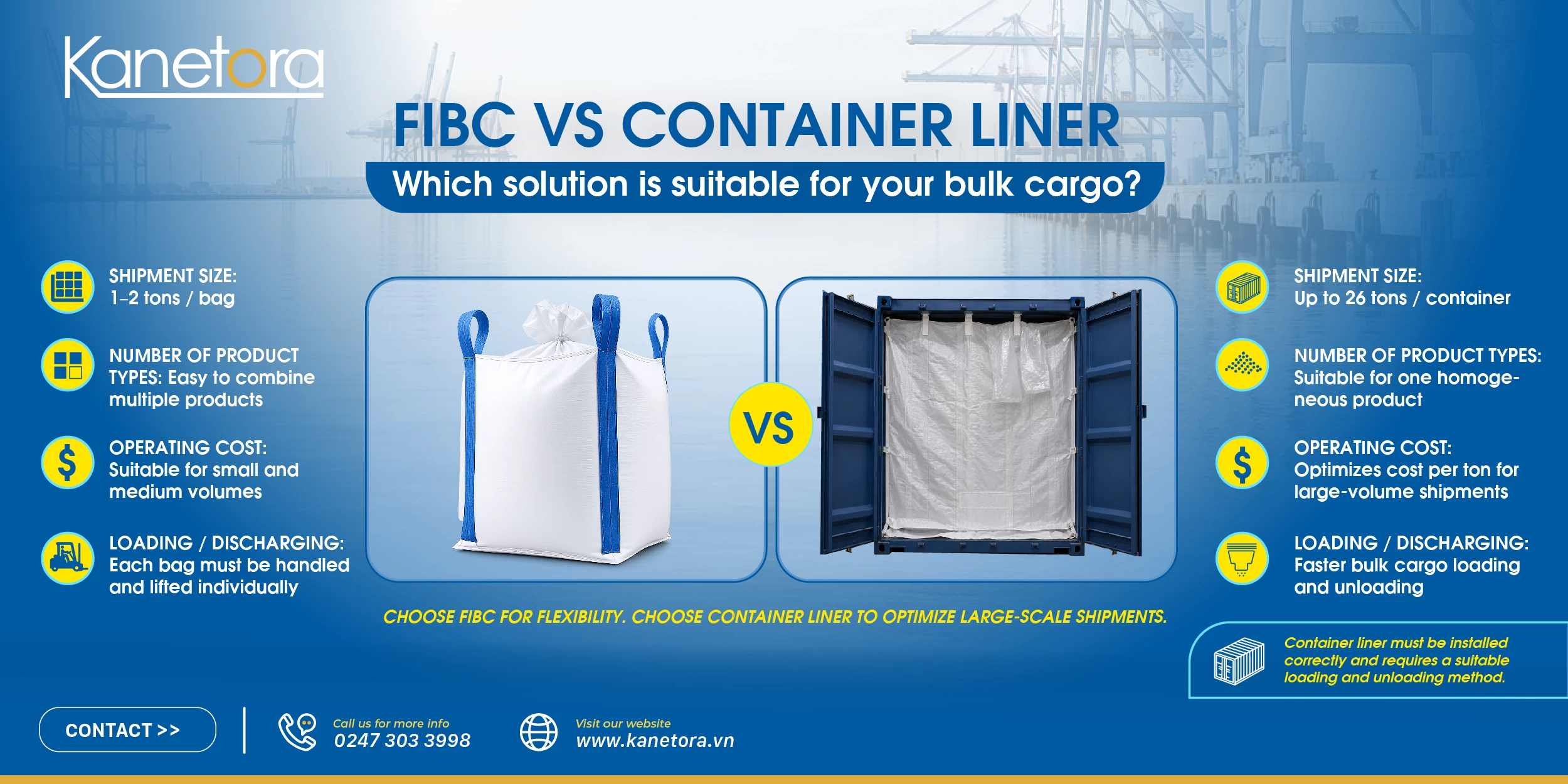
Container Liner vs FIBC: What Is the Difference?
The right option depends on the complete supply chain—not only the packaging price.
| Comparison factor | Container liner | FIBC bag |
|---|---|---|
| Cargo arrangement | One bulk lot per container | Individual packaging units |
| Typical shipment | Full-container homogeneous cargo | Flexible shipment quantities |
| Loading | Conveyor, gravity or pneumatic system | Individual bag filling |
| Unloading | Bulk discharge equipment required | Forklift, crane or hoist handling |
| Pallet compatibility | Generally not applicable | Available when required |
| Batch separation | Limited | Strong |
| Traceability | Container or shipment level | Individual bag or batch level |
| Partial unloading | Difficult | Practical |
| Warehouse flexibility | Requires bulk receiving system | Easier to store and move |
| Packaging units | Fewer | More individual packages |
| Destination infrastructure | Specialized | Widely compatible |
| Return or reverse logistics | Container-based | Depends on bag design |
| Risk concentration | Entire cargo in one liner | Cargo divided among bags |
This comparison is a practical decision framework: container liners prioritize bulk-flow efficiency, while FIBCs prioritize handling flexibility and unit-level control.
Cost Advantages of Container Liner Bags
A container liner may reduce total logistics cost in the right operating environment.
Fewer Individual Packaging Units
Instead of manufacturing, filling, closing, moving and recording multiple individual FIBCs, the cargo is loaded into one container liner.
This may reduce:
- Packaging units per shipment
- Filling operations
- Labeling requirements
- Individual bag handling
- Pallet use
- Forklift movements
- Packaging disposal at destination
However, the liner should not be compared with FIBCs only by purchase price.
Faster Bulk Loading
When the factory already has silos, conveyors or pneumatic loading systems, cargo may be transferred directly into the lined container.
This can reduce the time required for individual bag filling and handling.
The actual result depends on:
- Material flow rate
- Filling-system capacity
- Liner inlet design
- Ventilation performance
- Container positioning
- Worker experience
- Safety procedures
Better Use of Internal Container Volume
Individual FIBCs may leave unused space between bags, around rounded corners or above the filled units.
A container liner can allow loose material to occupy more of the usable internal space, subject to cargo bulk density, weight limits and safe load distribution.
For exporters that still need individual bulk bags, baffle FIBCs can reduce side bulging and improve container-space utilization.
Reduced Packaging Weight per Shipment
Using one large liner instead of multiple woven bags, liners, labels and closures may reduce the amount of packaging material associated with each shipment.
Nevertheless, environmental performance should be assessed through the entire logistics cycle, including:
- Product loss
- Packaging recyclability
- Loading efficiency
- Cleaning requirements
- Cargo damage
- Freight utilization
- Disposal infrastructure
The Hidden Costs Buyers Should Calculate
Container liner economics depend on more than liner price.
A better calculation is:
Total packaging and logistics cost = liner cost + installation + loading + unloading + equipment + labor + cargo loss + cleaning + handling risk
Before replacing FIBCs, buyers should evaluate the following factors.
Installation Labor
The liner must be installed correctly inside a clean and suitable container. Attachment points, inlet positions, ventilation ports and door protection must be checked before loading.
Incorrect installation can cause:
- Liner sagging
- Twisting
- Blocked filling ports
- Uneven cargo distribution
- Film tearing
- Difficult discharge
Loading Equipment
The exporter may require:
- Conveyor systems
- Loading chutes
- Pneumatic blowers
- Augers
- Mobile loading frames
- Dust-collection equipment
A liner is not automatically cost-effective when the factory must make a significant equipment investment for only occasional shipments.
Unloading Equipment at Destination
The consignee may need:
- Container tilting equipment
- Pneumatic suction
- Vacuum conveying
- Rotary valves
- Discharge hoppers
- Conveyor systems
- Dust-management systems
The receiving facility must confirm compatibility before the shipment leaves the origin country.
Risk of Complete-Lot Contamination
With FIBCs, a local packaging defect may affect one unit.
With a container liner, damage or contamination may affect a much larger portion of the shipment because the cargo is transported as one bulk lot.
This makes container inspection, liner quality and installation procedures especially important.
When Is FIBC Still the Better Choice?
Despite the potential efficiency of container liners, FIBCs remain more practical in many supply chains.
When Customers Need Individual Units
FIBCs allow cargo to be sold, stored or processed bag by bag.
This is useful when:
- Customers consume material gradually.
- Different production lines receive separate bags.
- Inventory must be divided by batch.
- The cargo is delivered to multiple locations.
- The container is not unloaded all at once.
When Forklift Handling Is Required
FIBCs are designed with lifting loops, allowing them to be handled by forklifts, cranes or hoisting equipment.
Container liners do not create independent lifting units. Once the container is opened, the receiving facility needs a controlled bulk-discharge method.
When Traceability Is Critical
Each FIBC can carry:
- Product identification
- Batch number
- Production date
- Net weight
- Handling instructions
- QR code
- Customer-specific label
This provides stronger unit-level traceability than a single bulk shipment.
When Cargo Needs Additional Protection
An FIBC can combine:
- Coated woven fabric
- PE inner liner
- Aluminum barrier liner
- Dust-proof seams
- Filling and discharge spouts
- UV protection
- Electrostatic protection
For moisture-sensitive products, businesses should review moisture-proof FIBC structures for export cargo.
When Container Space Must Be Optimized Without Losing Unit Handling
Baffle bags can help retain a more rectangular shape after filling while preserving the individual handling advantages of FIBCs.
They may provide a useful middle option between standard jumbo bags and loose bulk container loading.
Learn more about using baffle bulk bags to improve container loading efficiency.
Important Loading Notes for Container Liners
The performance of a container liner depends heavily on installation and loading practices.
1. Inspect the Shipping Container
Before installation, confirm that the container is:
- Clean
- Dry
- Odor-free
- Structurally suitable
- Free from sharp edges
- Free from protruding nails or screws
- Free from holes and water leakage
- Free from residue from previous cargo
- Suitable for the required liner attachment system
The CTU Code recommends confirming that both the transport unit and cargo are free from visible contamination and that a proper packing plan is prepared.
2. Confirm Cargo Compatibility
The supplier should receive information about:
- Product name
- Particle size
- Bulk density
- Flowability
- Moisture sensitivity
- Filling temperature
- Abrasiveness
- Chemical properties
- Food-contact requirements
- Electrostatic behavior
- Hazard classification
The liner material and thickness should be selected according to these conditions.
3. Install Effective Door Protection
Dry bulk cargo can exert significant pressure toward the rear doors during loading and transportation.
A properly engineered door barrier helps prevent the cargo from pressing directly against the container doors when they are opened.
The barrier must be compatible with:
- Cargo weight
- Flow behavior
- Discharge system
- Container structure
- Liner design
The IMO CTU Code specifically highlights the need for appropriate door protection when liners are used for bulk cargo.
4. Secure the Liner Correctly
All straps, loops and suspension points should be attached according to the liner supplier’s instructions.
The liner should be positioned so that:
- The filling inlet aligns with the loading system.
- The discharge outlet remains accessible.
- The film is not excessively stretched.
- Folds do not block material flow.
- The liner does not contact sharp surfaces.
5. Allow Air to Escape During Filling
As material enters the container, the displaced air must exit safely.
Poor ventilation can cause:
- Excessive internal pressure
- Slow loading
- Dust release
- Liner inflation
- Uneven filling
- Stress on seams and attachment points
The vent design should also prevent unnecessary product loss or contamination.
6. Control Load Distribution
Cargo should be distributed as evenly as possible inside the container.
Uneven loading may affect:
- Container stability
- Axle loads
- Road-transport compliance
- Handling safety
- Discharge performance
- Structural stress
The packed container must remain within its permitted gross weight and relevant transport limits.
7. Confirm the Unloading Plan Before Shipping
The loading team should never assume that the consignee can discharge the liner.
Before shipment, confirm:
- Available unloading equipment
- Discharge height
- Container tilting capability
- Outlet size and position
- Receiving silo connection
- Dust-control system
- Emergency procedures
- Expected discharge rate
8. Conduct a Trial Shipment
For a new product, route, liner design or receiving facility, a controlled trial shipment can help verify:
- Installation time
- Loading speed
- Cargo behavior
- Container utilization
- Liner integrity
- Unloading performance
- Product loss
- Contamination control
- Actual logistics cost
A trial is especially valuable before replacing an established FIBC packaging system across large export volumes.
How to Choose the Right Container Liner
The best liner cannot be selected from container dimensions alone.
Buyers should define the following information.
Cargo Information
- Product name
- Powder, pellet, granule or flake
- Bulk density
- Particle size
- Flowability
- Abrasion level
- Moisture sensitivity
- Loading temperature
- Food-contact requirement
- Static or ignition risk
Shipment Information
- Container type
- Export route
- Expected transit time
- Destination climate
- Target cargo weight
- Loading method
- Unloading method
- Storage conditions
- Number of shipments per year
Liner Requirements
- Film material
- Film thickness
- Number of layers
- Barrier properties
- Filling inlet
- Air vents
- Discharge outlet
- Attachment design
- Door-barrier configuration
- Food-contact documentation
- Printing or traceability requirements
Operational Requirements
- Installation instructions
- Worker training
- Loading supervision
- Container inspection checklist
- Emergency procedures
- Disposal or recycling plan
Container Liner, FIBC or Integrated Packaging?
The final packaging choice does not always need to be one system for every shipment.
A company may use:
- Container liners for direct factory-to-factory bulk deliveries.
- Standard FIBCs for flexible domestic distribution.
- FIBCs with liners for moisture-sensitive products.
- Baffle FIBCs for container-space optimization.
- Food-grade FIBCs for controlled hygiene applications.
- Stretch hood film for pallet-level protection.
Kanetora’s industrial packaging portfolio covers FIBC bags, liner-based structures and flexible-film solutions for different product and logistics requirements.
For palletized exports, Stretch Hood Film can provide an additional layer of protection around the complete loading unit.
The best solution should be selected according to total supply-chain performance—not simply the lowest packaging price.
A Practical Decision Checklist
Choose a container liner when most answers below are “yes”:
- Is the cargo dry and sufficiently flowable?
- Is only one product or grade being loaded?
- Will the shipment fill most of the container?
- Does the origin have bulk-loading equipment?
- Does the destination have bulk-discharge equipment?
- Can the full shipment be unloaded at one location?
- Is individual bag handling unnecessary?
- Has cargo compatibility been confirmed?
- Has the container liner system been trialed?
Choose an FIBC system when several answers are “no,” especially when the customer needs individual units, forklift handling, partial unloading, palletization or batch-level traceability.
Conclusion
Container liner bags can be an efficient bulk packaging option when one dry, homogeneous and flowable material is shipped in full-container volumes between facilities equipped for bulk loading and discharge.
Their main potential advantages include fewer packaging units, reduced manual handling, faster loading and improved use of container space.
However, these benefits depend on proper cargo assessment, container inspection, liner installation, door protection, ventilation, weight distribution and unloading preparation.
FIBCs remain the stronger option when cargo needs individual handling, pallet compatibility, staged distribution, multiple batches, easier warehousing or unit-level traceability.
Therefore, the choice should not be framed as simply container liner versus FIBC. It should be based on which system creates the lowest total risk and the best logistics performance across the entire route.
For advice on FIBC bags, inner liners, flexible films and customized industrial bulk packaging, contact Kanetora Packaging.
Frequently Asked Questions
What is a container liner bag?
A container liner bag is a flexible film structure installed inside a shipping container to hold dry bulk cargo. It separates the product from the container interior and allows the cargo to be transported as one loose bulk lot.
When should a container liner be used instead of an FIBC?
A container liner is generally suitable when one homogeneous dry product is transported as a full-container load and both the exporter and consignee have compatible bulk loading and unloading equipment.
Are container liners waterproof?
Container liners can provide a protective barrier against contamination and environmental exposure, but performance depends on film material, seams, closures and handling conditions. They should not automatically be considered completely waterproof.
Can container liners be used for food products?
They may be used for suitable food or agricultural commodities when the liner material, manufacturing environment, documentation and handling process meet the applicable hygiene and food-contact requirements.
Can dangerous goods be shipped in container liners?
A standard container liner should not automatically be used for dangerous goods. The cargo classification, transport regulations, packaging system, container requirements and approvals must be reviewed by qualified parties.
Can a container liner be installed in both 20-foot and 40-foot containers?
Liners can be designed for different container formats, but the final design must match the container dimensions, cargo weight, loading system and legal gross-weight limits.
Does a container liner always reduce shipping costs?
No. It may reduce packaging and handling costs for suitable full-container bulk shipments, but businesses must also calculate installation, loading equipment, unloading infrastructure, labor, product loss and operational risk.
What information is needed to design a container liner?
The supplier normally needs the cargo type, particle form, bulk density, filling temperature, moisture sensitivity, flow behavior, target weight, container size, loading method, unloading method, destination requirements and applicable regulatory standards.