

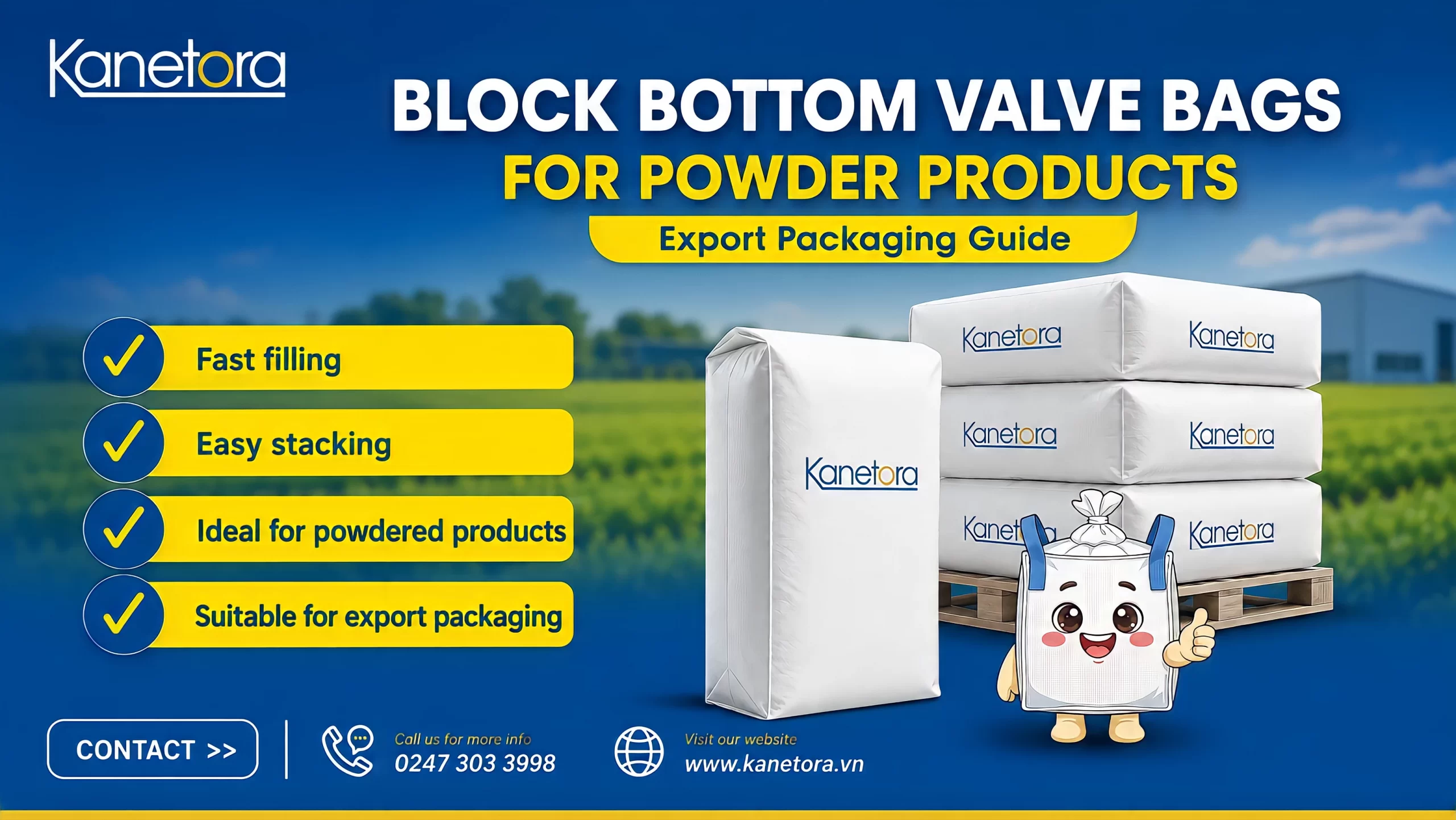
Powder products create specific packaging challenges. Fine particles may escape through small openings, trapped air can slow down filling, moisture may cause clumping, and unstable bags can reduce pallet and container efficiency.
Block bottom valve bags are designed to address these challenges by combining a woven polypropylene body, a stable rectangular bottom and an integrated filling valve. They are widely considered for cement, dry mortar, mineral powder, fertilizer, chemicals, food ingredients and other free-flowing dry products.
For manufacturers and international buyers, however, selecting the right bag involves more than choosing a bag size. The material structure, valve design, perforation, coating, moisture resistance, printing and filling-line compatibility must all match the packed product and export conditions.
Quick Answer: What Is a Block Bottom Valve Bag?
A block bottom valve bag is an industrial sack manufactured from coated or laminated polypropylene woven fabric. It has a rectangular block-shaped bottom and a valve opening through which powder or granulated material is filled.
Once filled, the bag develops a compact, brick-like shape that can support more stable palletizing and warehouse handling. Depending on the valve design and packed material, the valve may close under product pressure or require an additional sealing method.
The well-known AD*STAR® product is a registered Starlinger bag concept made from coated polypropylene woven fabric. “Block bottom valve bag” is the broader generic product category used by packaging manufacturers and buyers.
Businesses evaluating different industrial packaging formats can also review Kanetora’s complete industrial packaging portfolio, which includes FIBC bags, block bottom valve bags and multilayer plastic films.
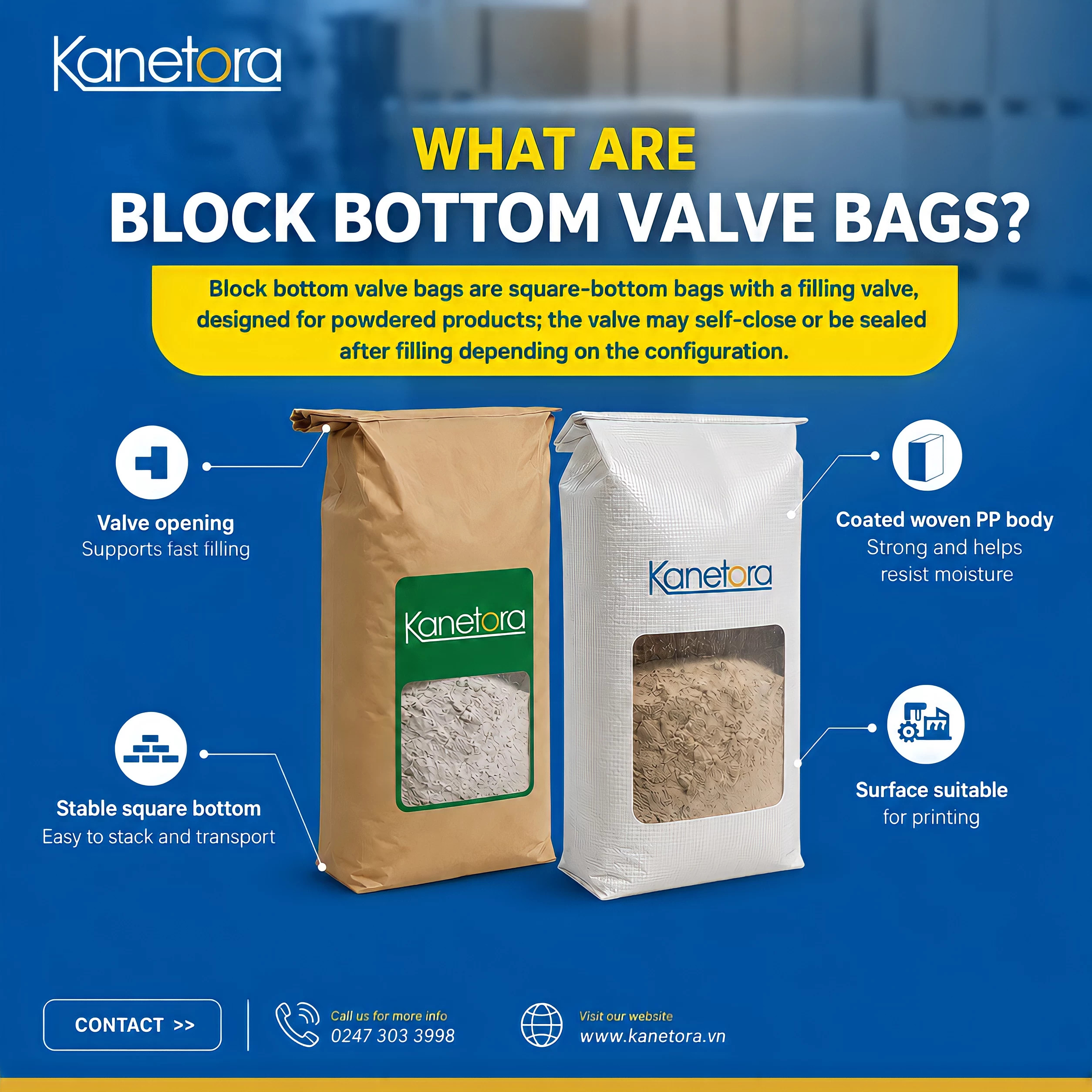
Main Components of a Block Bottom Valve Bag
A typical block bottom valve bag contains several functional elements.
| Component | Main function |
|---|---|
| PP woven fabric | Provides tensile strength and resistance during handling |
| Coating or lamination | Helps control dust, moisture penetration and print quality |
| Block-shaped bottom | Creates a rectangular shape after filling |
| Filling valve | Connects the bag to a filling nozzle |
| Perforation system | Allows displaced air to escape during powder filling |
| Anti-slip treatment | Helps improve pallet stability |
| Printed surface | Displays branding, product information and handling instructions |
Each component should be specified based on the powder’s particle size, bulk density, moisture sensitivity and filling behaviour.
How Block Bottom Valve Bags Work on Powder Filling Lines
During filling, the valve is positioned over or connected to the filling nozzle. Powder enters the bag while air displaced by the product escapes through the woven structure or controlled perforations.
The filling process normally follows four stages:
- The empty bag is placed on the filling spout.
- Powder is introduced through the valve.
- Air escapes through the selected ventilation or perforation structure.
- The filled bag is discharged for weighing, conveying, palletizing or secondary packaging.
Effective de-aeration is especially important for fine powders. If the bag cannot release air quickly enough, filling speed may fall, the bag may inflate excessively, and the final package may not reach the intended dimensions.
Starlinger describes block bottom valve sacks as suitable for free-flowing bulk goods and powdered products, with configurations ranging from nearly airtight to highly air-permeable. Its micro-perforation technology is designed to increase air permeability while limiting product escape.
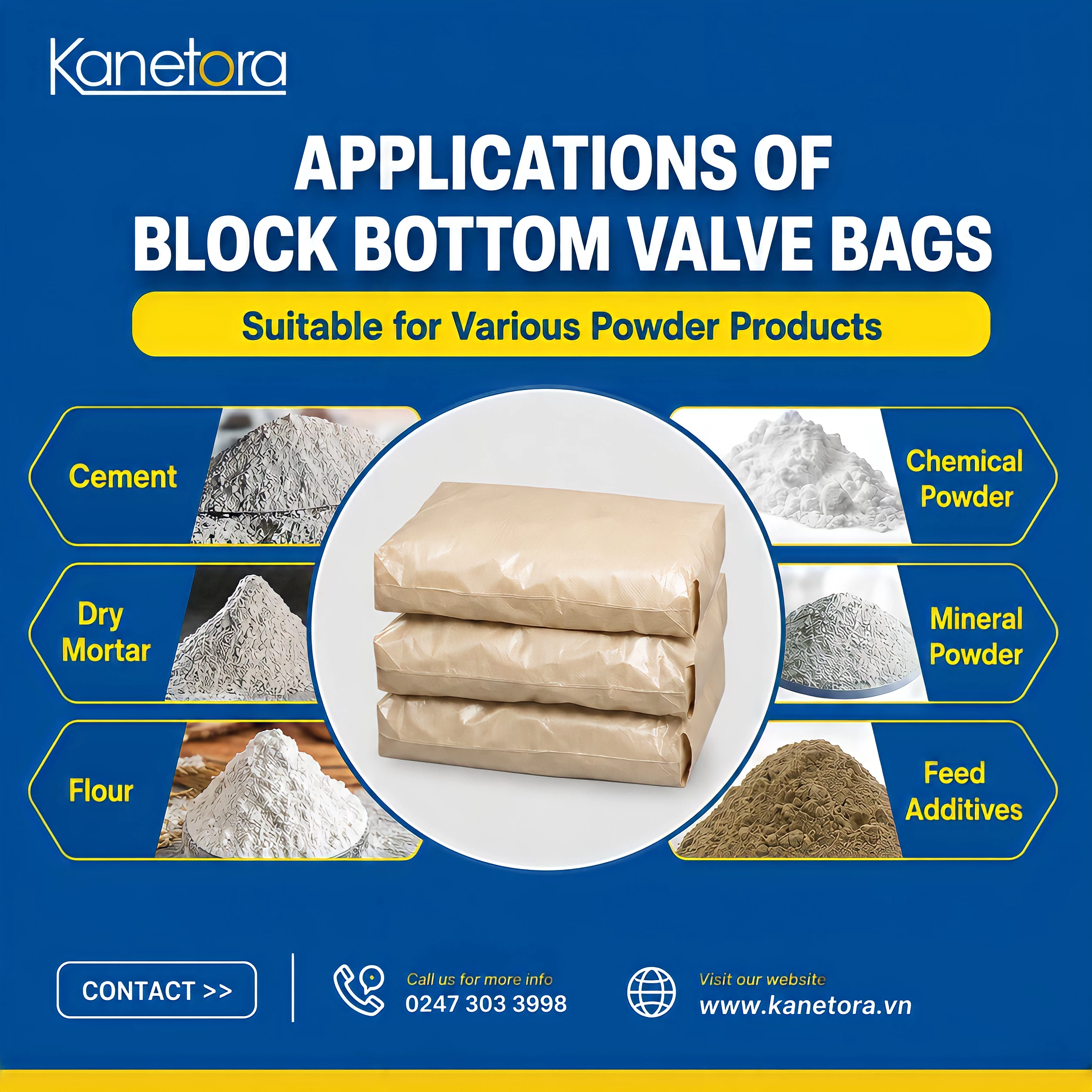
Why Are Block Bottom Valve Bags Suitable for Powder Products?
1. Efficient Filling Through an Integrated Valve
The integrated valve allows the bag to be connected directly to compatible filling equipment.
Compared with an open-mouth bag that may require sewing or another closing process after filling, a valve bag can simplify the packaging flow when the product, valve and filling machine are correctly matched.
This can support:
- Faster filling cycles
- More consistent fill weights
- Reduced manual handling
- Cleaner filling areas
- Easier integration with conveyors and palletizers
The actual filling performance depends on powder flowability, air content, valve dimensions, filling pressure and ventilation design.
2. Controlled De-Aeration for Fine Powder
Products such as cement, calcium carbonate, gypsum, starch and dry chemical powder may carry significant air during filling.
Controlled perforation helps release this air without creating excessively large openings that could allow product leakage.
Available approaches may include:
- Standard perforation
- Micro-perforation
- Nano-perforation
- Perforated valve zones
- Permeable fabric structures
- Customized combinations based on filling tests
More perforation is not automatically better. Excessive ventilation may increase dust leakage or reduce moisture protection. Insufficient ventilation may slow filling or produce poorly shaped bags.
3. Stable Shape for Palletizing and Container Loading
The block bottom forms a flatter, more rectangular package after filling. This shape can improve alignment between bags and reduce unused space on a pallet.
A more regular package may support:
- Neater pallet formation
- Better load distribution
- Easier stretch wrapping or stretch hood application
- Reduced movement during warehouse handling
- More consistent container loading
- Improved retail or warehouse presentation
For additional pallet protection, manufacturers can combine valve bags with stretch hood film for industrial pallet packaging.
4. Strong Woven Polypropylene Construction
Polypropylene woven fabric provides a favourable strength-to-weight ratio for industrial packaging.
Depending on the specification, the structure can be designed to resist:
- Filling pressure
- Conveyor handling
- Compression during stacking
- Pallet movement
- Vibration during road transport
- Container loading and unloading
- Normal impacts throughout distribution
Performance should still be validated through agreed tests and actual filling trials. Bag strength alone does not guarantee successful packaging if the valve, perforation, dimensions or pallet configuration are unsuitable.
5. Moisture and Dust Management
Coated PP woven fabric can improve resistance to external moisture and help reduce powder leakage. However, a coated block bottom bag should not automatically be treated as fully waterproof or hermetically sealed.
The required structure depends on:
- Particle size
- Hygroscopic behaviour
- Storage duration
- Warehouse humidity
- Exposure to rain or condensation
- Sea-freight duration
- Required shelf life
- Buyer specifications
For highly moisture-sensitive products, businesses may need additional protective measures such as pallet covers, stretch hood film, container desiccants or a different internal barrier structure.
Companies handling moisture-sensitive bulk materials can review Kanetora’s guide to FIBC bags with inner liners for a broader comparison of barrier options.
6. High-Impact Printing and Product Identification
The relatively smooth coated surface of a block bottom valve bag can support clear printing for both industrial identification and commercial branding.
Printing may include:
- Company logo
- Product name
- Net weight
- Batch number area
- Handling instructions
- Storage warnings
- Country of origin
- Recycling symbols
- Barcode or QR code
- Importer information
- Multilingual export labelling
For consumer-facing or premium products, laminated BOPP structures may provide more detailed graphics. For industrial powder, flexographic printing is often selected for clear and economical product identification.
Common Applications
Block bottom valve bags are suitable for many free-flowing dry products.
| Industry | Typical products | Main packaging priorities |
|---|---|---|
| Cement and construction | Cement, dry mortar, gypsum, tile adhesive | Strength, ventilation, filling speed |
| Minerals | Calcium carbonate, silica, talc, mineral powder | Dust control, abrasion resistance |
| Chemicals | Powder additives, compounds, pigments | Leakage control, product compatibility |
| Fertilizer | Powder or granular fertilizer | Moisture resistance, print identification |
| Food ingredients | Flour, starch, sugar, salt | Hygiene, food-contact compliance |
| Animal nutrition | Feed additives, premixes | Dust control, traceability |
| Plastic materials | Compounds, masterbatch, selected granules | Moisture control, contamination prevention |
Block bottom valve sacks are used internationally for cement, construction materials, fertilizer, chemicals, granules, flour, sugar and animal feed.
For products requiring much larger packaging weights, buyers should compare this format with FIBC bags for cement and construction materials.
How to Select the Right Block Bottom Valve Bag
Product Characteristics
The supplier should first understand the packed material.
Important information includes:
- Powder, fine powder, granule or mixed particle form
- Bulk density
- Particle size distribution
- Flowability
- Abrasiveness
- Moisture sensitivity
- Product temperature during filling
- Dust generation
- Food-contact or chemical requirements
A fine, low-density powder may require a different perforation and valve design from a dense mineral product, even when both bags have the same target net weight.
Target Filling Weight and Bag Volume
Bag dimensions should be calculated using product bulk density rather than copying the dimensions of another product.
Buyers commonly request packaging weights such as 20 kg, 25 kg, 40 kg or 50 kg, but the final bag dimensions must reflect the actual volume occupied by the material.
An oversized bag may result in poor pallet formation. An undersized bag may create excessive filling pressure or prevent the valve from closing correctly.
Valve Design
The filling valve must match the filling nozzle and production line.
RFQ information should include:
- Valve length
- Valve width
- Internal or external valve structure
- Valve material
- Required sealing method
- Filling-spout dimensions
- Filling pressure
- Whether ultrasonic or heat sealing is required
A technically strong bag may still perform poorly when its valve does not fit the customer’s equipment.
Perforation and Air Permeability
Perforation should be designed around the actual air that must escape during filling.
The manufacturer may recommend:
- Standard perforation for moderately aerated materials
- Micro-perforation for fine powders
- Localized perforation around specific bag areas
- Lower-perforation structures for moisture-sensitive products
- Filling tests to balance speed and dust control
Pilot filling is strongly recommended when changing bag suppliers, powder formulation or filling equipment.
Coating and Moisture Protection
The supplier should clarify whether the buyer needs:
- Standard coated PP fabric
- Increased coating weight
- Moisture-resistant valve construction
- Reduced perforation
- Pallet cover
- Stretch hood film
- Container moisture-control measures
- Alternative packaging with a higher barrier
Export packaging should be evaluated as a complete system rather than as an individual empty bag.
Anti-Slip Performance
A smooth bag surface can create pallet instability. Anti-slip coating, surface treatment or optimized pallet patterns may therefore be necessary.
The required coefficient of friction depends on:
- Bag surface
- Pallet material
- Number of layers
- Stacking pattern
- Transport distance
- Forklift movements
- Use of stretch film or stretch hood
- Warehouse temperature and humidity
Printing Requirements
Printing artwork should be confirmed before production.
The buyer should specify:
- Number of colours
- Printing sides
- Pantone references
- Artwork dimensions
- Regulatory text
- Language versions
- Barcode requirements
- Registration tolerance
- Reserved area for batch or production coding
Block Bottom Valve Bag vs Other Industrial Packaging
| Packaging type | Typical packing range | Main advantage | Suitable applications |
|---|---|---|---|
| Block bottom valve bag | Small and medium industrial sacks | Automated valve filling and stable shape | Cement, minerals, powders, fertilizer |
| Sewn PP woven bag | Small and medium sacks | Simple, flexible and economical | Grain, feed, fertilizer, granules |
| Multiwall paper valve sack | Small and medium sacks | Good print surface and familiar filling format | Cement, food and chemical powders |
| FIBC bulk bag | Approximately 500–2,000 kg depending on design | High-volume bulk handling | Resin, minerals, agriculture, chemicals |
| Container liner | Container-scale bulk shipment | Uses the container as bulk packaging | Resin, grain, powder and granules |
The best option depends on shipment size, filling equipment, unloading method, moisture risk, labour cost and customer requirements.
For bulk shipments, Kanetora’s guide to sourcing FIBC bags from Vietnam provides an additional supplier and RFQ checklist.
Export Packaging Considerations
A bag that performs well inside the factory may still fail during international transportation if export conditions are not included in the specification.
Sea Freight
Sea containers can experience:
- High humidity
- Temperature changes
- Container condensation
- Long transit periods
- Repeated vibration
- Multiple handling stages
The packaging plan should therefore consider both primary bags and secondary pallet protection.
Pallet Configuration
Before production, confirm:
- Bags per layer
- Number of layers
- Total pallet height
- Pallet dimensions
- Maximum pallet weight
- Stretch wrapping or stretch hood method
- Corner boards or top sheets
- Container loading pattern
Regulatory and Buyer Requirements
Exporters should confirm requirements for:
- Food-contact materials
- Restricted substances
- Heavy metals
- Ink and coating composition
- Material traceability
- Recycling identification
- Technical documentation
- Market-specific labelling
For shipments to the European Union, packaging suppliers and exporters should also review Kanetora’s EU PPWR preparation guide for FIBC, liners and plastic films. PPWR introduces broader considerations involving material composition, technical documentation, recyclability and packaging lifecycle management.
Block Bottom Valve Bags for Food Powder
A block bottom valve structure can be considered for products such as flour, starch, sugar, salt, feed additives and selected food ingredients.
However, the bag format itself does not make the packaging food grade.
Food-powder buyers should assess:
- Raw-material suitability
- Food-contact declarations
- Production hygiene
- Contamination control
- Foreign-body prevention
- Ink and coating compliance
- Traceability
- Storage and packing environment
- Market-specific testing requirements
For larger food and agricultural shipments, see Kanetora’s guide to food-grade FIBC bags for export products.
Kanetora’s Block Bottom Valve Bag Manufacturing Capability
Kanetora Bach Dang manufactures block bottom valve bags as part of its integrated industrial packaging portfolio in Vietnam.
The factory’s published capacity includes approximately:
- 10 million block bottom valve bags per month
- 300,000 FIBC bags per month
- 500 tons of multilayer plastic film per month
Kanetora’s company and factory profiles also list standard, micro and nano-perforation options, internal valve configurations and multi-colour printing equipment for block bottom bag production. The factory operates quality and environmental management systems including ISO 9001:2015, ISO 14001:2015 and ISO 22000:2018, together with BRC Grade A certification.
The combination of packaging manufacturing, plastic-resin knowledge and export logistics experience allows Kanetora to support customers from material and bag-structure selection through production, pallet protection and international shipment planning.
RFQ Checklist for International Buyers
To receive an accurate quotation, buyers should provide the following information:
| RFQ item | Required information |
|---|---|
| Packed product | Name, form and application |
| Bulk density | kg/m³ or g/cm³ |
| Target net weight | Weight per filled bag |
| Bag dimensions | Width, length and bottom dimensions |
| Fabric | PP specification, coating or lamination |
| Valve | Type and dimensions |
| Perforation | Standard, micro, nano or customized |
| Moisture requirement | Standard resistance or higher barrier |
| Printing | Colours, sides and artwork |
| Pallet pattern | Bags per layer and number of layers |
| Filling equipment | Nozzle dimensions and filling method |
| Certification | ISO, food-contact or buyer requirements |
| Order quantity | Trial quantity and commercial volume |
| Delivery terms | EXW, FOB, CFR, CIF or other Incoterms |
| Destination | Port and country |
| Sample | Existing bag, drawing or filled-bag photos |
Providing product samples or a short filling video can help the manufacturer evaluate powder flow, valve fit and de-aeration requirements more accurately.
Frequently Asked Questions
What products can be packed in block bottom valve bags?
They are commonly considered for cement, dry mortar, calcium carbonate, gypsum, fertilizer, chemical powder, mineral powder, flour, starch, sugar, salt and feed ingredients.
Are block bottom valve bags waterproof?
Not automatically. Coated PP woven fabric can provide a level of moisture resistance, but perforations, valve construction and closure areas may still allow moisture or air transmission. High-moisture-barrier applications require a specific packaging assessment.
Why are block bottom bags perforated?
Perforations allow trapped air to escape while powder enters the bag. Correct ventilation helps maintain filling speed and achieve a compact final bag shape.
What is the difference between a valve bag and an open-mouth bag?
A valve bag is filled through an integrated valve and may close through product pressure or an additional sealing process. An open-mouth bag is filled through the full top opening and must normally be sewn, heat-sealed or otherwise closed after filling.
Can block bottom valve bags be printed with a company logo?
Yes. Bags can be customized with logos, product information, handling instructions, barcodes and multilingual export labelling. The available print quality depends on the fabric, coating, printing technology and artwork.
Are block bottom valve bags suitable for automatic filling?
They can be suitable for automated or semi-automated filling when the valve dimensions, air permeability, bag dimensions and filling equipment are correctly matched.
Should buyers conduct a filling trial?
Yes. A trial is particularly important for fine powders, high-speed filling lines, moisture-sensitive materials or projects changing from paper sacks to PP woven valve bags.
Conclusion
Block bottom valve bags provide a practical packaging solution for powder manufacturers that need efficient filling, controlled de-aeration, strong woven construction, stable pallet formation and customizable printing.
Successful implementation depends on matching the bag to the complete operating environment: the powder, filling machine, valve, perforation, moisture exposure, pallet pattern, transport route and destination-market requirements.
Kanetora supports international buyers with customized block bottom valve bags manufactured in Vietnam for cement, minerals, construction materials, fertilizer, chemicals, food ingredients and other dry industrial products.
Contact Kanetora to discuss bag dimensions, valve structure, perforation, coating, printing, pallet configuration and export requirements for your powder packaging project.