

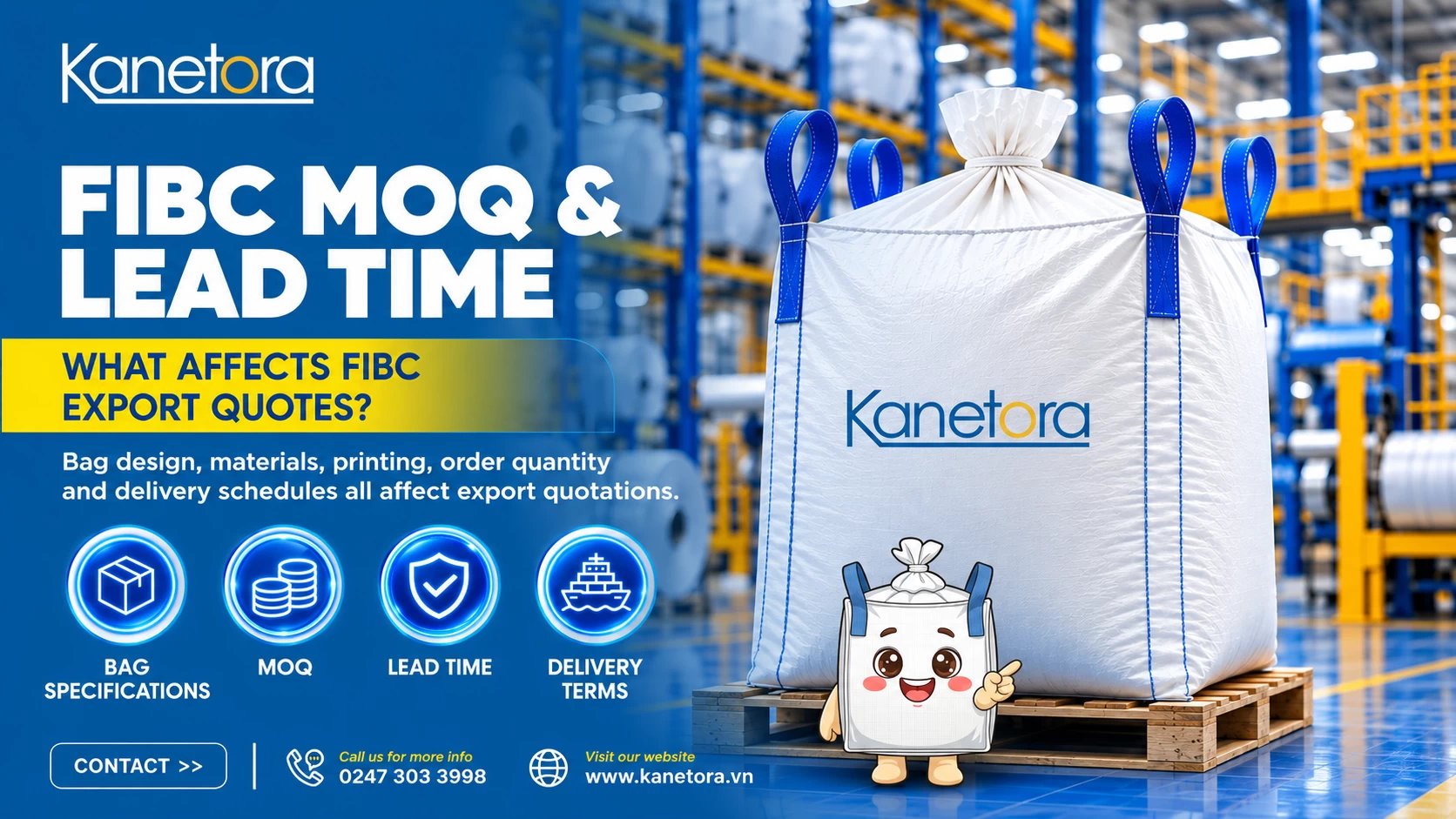
When sourcing FIBC bags (Flexible Intermediate Bulk Containers) for international markets, buyers often begin with two questions:
“What is your minimum order quantity?”
“How long will production and delivery take?”
These questions are essential, but the answers are rarely the same for every order.
Two FIBC bags with identical dimensions and Safe Working Load (SWL) may require different materials, manufacturing processes, testing procedures and production schedules. As a result, their minimum order quantity (MOQ), lead time and export pricing can vary significantly.
For international importers, packaging distributors and industrial manufacturers, understanding these factors is essential for comparing quotations, planning inventory and building a reliable supply chain.
This guide explains what determines FIBC bag MOQ and lead time, how different specifications influence export pricing, and what buyers should prepare before requesting a quotation from a manufacturer in Vietnam.
1. What Are FIBC Bag MOQ and Lead Time?
What Is MOQ in FIBC Manufacturing?
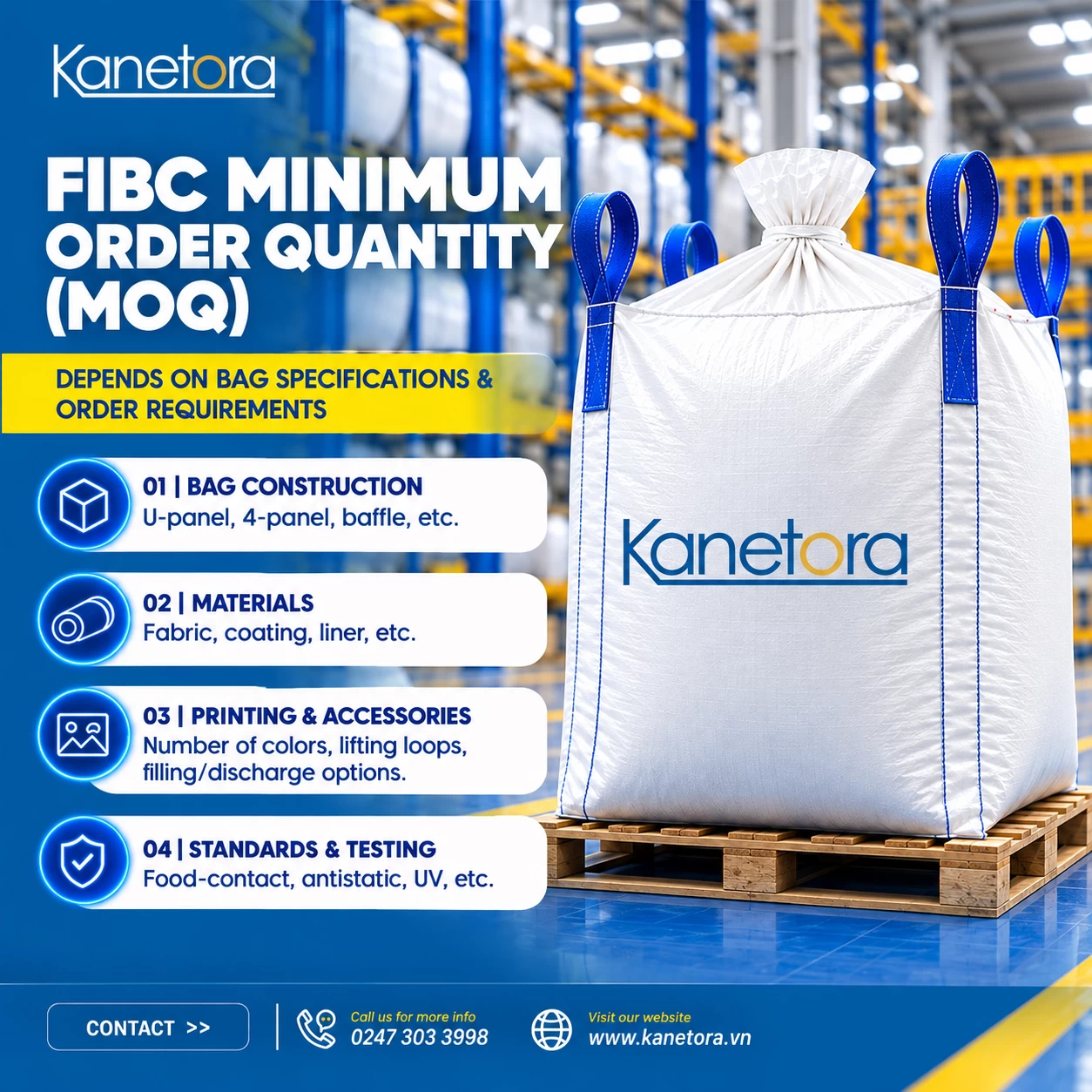
MOQ (Minimum Order Quantity) refers to the smallest order volume a manufacturer can accept under a particular production and commercial arrangement.
In FIBC manufacturing, MOQ is not necessarily a universal number.
It may depend on:
- Bag construction and dimensions
- Standard or custom polypropylene fabric
- Fabric weight (GSM) and coating
- Lifting loop design and webbing specifications
- Inner liner requirements
- Printing and branding
- Safety and testing requirements
- Material availability
- Production scheduling and order frequency
For example, a standard white U-Panel FIBC without printing may be easier to integrate into an existing production schedule than a custom-designed Baffle FIBC with a specialized liner, colored webbing and multiple printing colors.
The second design may require additional preparation, dedicated materials and production changeovers.
Therefore, buyers should request a product-specific MOQ rather than assume that one minimum quantity applies to all bulk bag designs.
What Is FIBC Lead Time?
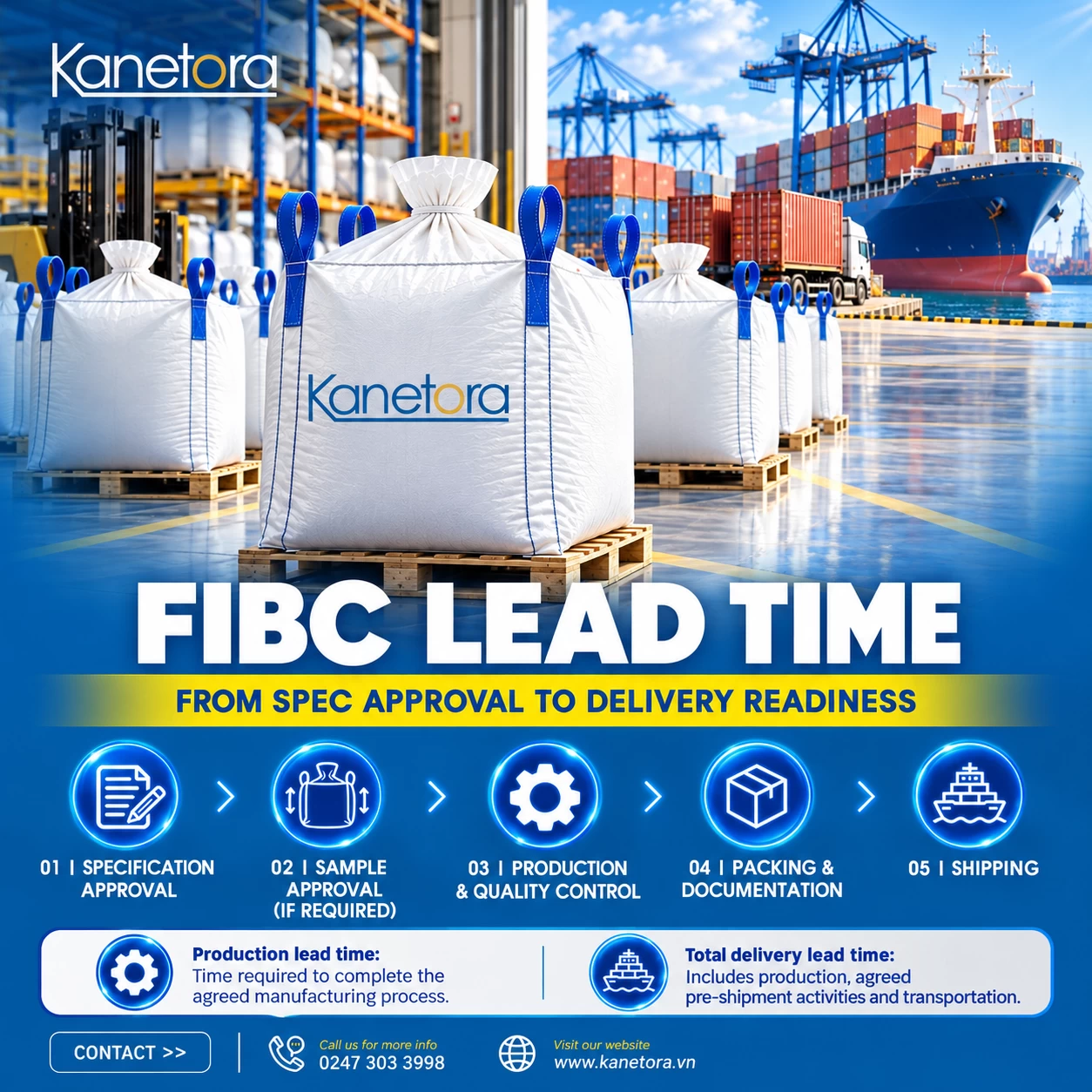
Lead time is the period required to complete a defined stage of an order.
For export FIBCs, buyers should distinguish between:
Sample lead time: Time required to prepare and approve a prototype or pre-production sample.
Production lead time: Time from fulfillment of agreed production-start conditions to completion of manufacturing and agreed inspections.
Shipping lead time: Time required to transport the finished goods to the agreed destination or handover point.
Total procurement lead time: The complete period covering technical clarification, approvals, manufacturing, quality inspection and transport.
Importantly, production lead time and delivery lead time are not interchangeable.
A manufacturer may complete production on schedule, while the shipment can still be affected by vessel availability, export documentation, customs procedures or inland transportation.
For accurate planning, buyers should ask suppliers to define precisely when lead time begins and where it ends.
2. What Factors Affect FIBC Bag Minimum Order Quantity?
2.1 Standard FIBC Designs vs. Custom Specifications
Standard configurations generally offer greater flexibility because their materials and manufacturing methods are more familiar to production teams.
Common FIBC constructions include:
- Circular FIBC
- U-Panel FIBC
- Four-Panel FIBC
- Baffle FIBC
However, even within the same construction type, individual requirements can change production economics.
A custom bag may involve specific dimensions, reinforcement, lifting loops, filling systems, discharge systems or fabric specifications.
For buyers with multiple product requirements, consolidating compatible specifications may help manufacturers organize production more efficiently.
For a broader comparison of bulk packaging structures, see PP Woven Bags vs FIBC Bulk Bags: Which Packaging Fits Your Cargo?.
2.2 Polypropylene Fabric and Material Requirements
Polypropylene (PP) woven fabric is the primary structural material used in most conventional FIBC bags.
Its specifications influence not only strength and safety but also manufacturing requirements and material consumption.
Important variables include:
- Fabric GSM
- Woven fabric dimensions
- Coated or uncoated construction
- UV stabilization
- Fabric color
- Specialized or conductive materials
A manufacturer may already have suitable materials scheduled for a common bag specification.
By contrast, a customized fabric color or unusual fabric width may require a dedicated material run, potentially increasing MOQ or setup costs.
Buyers planning outdoor storage should also consider the material’s resistance to UV exposure.
Related reading: Anti-UV FIBC Bags for Outdoor Storage and Export Transit.
2.3 Inner Liners and Specialized Bag Components
Many FIBC applications require additional components to protect the packed product.
Examples include:
- Standard PE inner liners
- Form-fit or tabbed liners
- Baffle liners
- Specialized barrier liners
- Dust-resistant construction
- Custom document pouches and labels
These components may involve separate material preparation, cutting, sealing, installation or quality inspection.
A custom liner may therefore have its own manufacturing minimum or sourcing requirement, which can affect the MOQ of the complete FIBC.
For chemical powders, moisture-sensitive products and contamination-sensitive materials, buyers should assess liner selection as part of the overall bag design rather than treating it as an optional accessory.
Explore FIBC Bags for Chemical Powders: Safety, Liners and Discharge Options for Export for further technical considerations.
2.4 Printing, Branding and Multiple SKUs
Custom printing can affect the minimum economical production quantity.
The main variables include:
- Number of printing colors
- Printing area
- Artwork complexity
- Fabric background color
- Required color accuracy
- Number of different SKUs
- Frequency of artwork changes
For example, an order of 10,000 bags with one approved artwork is not necessarily equivalent to 10,000 bags divided across ten different designs.
Each SKU may require separate setup, identification, inspection and packing arrangements.
Buyers developing private-label or OEM packaging should consider SKU-level quantities rather than total order volume alone.
For detailed printing requirements, see Custom Printed FIBC Bags: Logo, Specs, MOQ and Lead Time.
3. How Do FIBC Specifications Affect Export Pricing?
The unit price of an FIBC bag reflects more than the cost of polypropylene.
A practical export quotation may include several cost components:
| Cost Component | How It Influences the Quotation |
|---|---|
| PP woven fabric | Material consumption, GSM, coating and dimensions |
| Webbing and lifting loops | Design, reinforcement and lifting requirements |
| Sewing and construction | Number of panels, seams and production complexity |
| Inner liner | Material, thickness, fabrication and installation |
| Printing | Number of colors, panels and setup requirements |
| Testing and inspection | Required tests, sampling and third-party verification |
| Packaging | Bale configuration, labeling and packing method |
| Production setup | Changeovers and dedicated materials |
| Logistics | Inland transport, freight terms and export handling |
Not every cost increases in direct proportion to order quantity.
Some setup-related expenses can be distributed across a larger production volume, reducing their contribution to the unit price.
Other costs, such as specialized raw materials, additional testing or particular quality requirements, may remain significant regardless of order size.
Example: Why Two 1,000 kg FIBC Bags Can Have Different Prices
Consider two hypothetical specifications.
Bag A: Standard Industrial FIBC
- SWL: 1,000 kg
- Standard U-Panel construction
- White PP woven fabric
- Standard lifting loops
- No inner liner
- No custom printing
Bag B: Customized Export FIBC
- SWL: 1,000 kg
- Baffle construction
- Custom fabric specification
- PE inner liner
- Custom printing
- Additional quality documentation
Although both bags share the same nominal Safe Working Load, Bag B involves additional materials, components and production operations.
Its MOQ, unit price and manufacturing schedule may therefore differ.
These are illustrative specifications, not quoted Kanetora products or confirmed prices.
The most reliable comparison is between technically equivalent FIBC specifications, with the same quality requirements, delivery terms and commercial conditions.
4. What Changes FIBC Manufacturing Lead Time?
4.1 Material Availability
Lead time depends partly on whether the required materials and components are available within the factory’s current production plan.
Standard materials may be easier to schedule than customized items such as colored woven fabric, specialized webbing or barrier liners.
If materials must be produced or sourced specifically for an order, additional preparation time may be required.
4.2 Technical Drawing and Sample Approval
Before mass production, the manufacturer and buyer may need to approve:
- Technical drawings
- Bag dimensions and construction
- SWL and Safety Factor
- Fabric and liner specifications
- Lifting loop arrangements
- Filling and discharge dimensions
- Printing artwork
- Product samples
- Testing requirements
Changes during this stage can affect both technical feasibility and production timing.
For example, increasing the required SWL after sample approval may require a review of fabric strength, webbing, seam construction and testing.
Similarly, changing the liner design may affect dimensions, sealing requirements or bag assembly.
Therefore, buyers should complete technical reviews before confirming the production schedule.
4.3 Production Complexity and Factory Scheduling
FIBC manufacturing involves multiple operations, including extrusion, weaving, coating, cutting, printing, sewing, inspection and packing.
A relatively simple design may follow a more established production route.
More complex specifications can require additional operations, specialized handling or dedicated inspection stages.
Production scheduling also depends on confirmed orders, available equipment, labor capacity and material preparation.
As a result, a manufacturer’s total monthly capacity should not be interpreted as guaranteed immediate availability for every FIBC specification.
4.4 Quality Testing and Compliance Documentation
Different applications have different quality and safety requirements.
Depending on the product and intended use, buyers may require evidence relating to:
- Safe Working Load
- Safety Factor
- Top-lift performance
- Fabric and seam tensile strength
- UV resistance
- Liner properties
- Food-contact material compliance
- Electrostatic protection
- UN-certified dangerous goods packaging
For specialized applications, sampling, testing and documentation should be planned before production commitments are finalized.
A bag should not be marketed as UN-certified, food-contact compliant or suitable for a specific hazardous environment without appropriate evidence supporting the actual design and intended application.
These requirements can influence the quotation and the overall project timeline.
5. How Do MOQ and Lead Time Interact?
MOQ and lead time should not be evaluated independently.
A larger order may improve production efficiency, but it does not automatically result in faster delivery.
For example:
| Order Scenario | MOQ Consideration | Lead Time Consideration |
|---|---|---|
| Repeat standard FIBC | Established specification may support flexible planning | Fewer technical approvals may be needed |
| New custom FIBC | Dedicated materials or components may affect MOQ | Drawing, sample and approval stages |
| Multi-SKU order | Minimums may apply by SKU or material | Multiple setups and inspections |
| Food-grade application | Production and material requirements affect feasibility | Hygiene controls and documentation |
| Specialized liner | Component-specific requirements may apply | Liner preparation and integration |
| Large annual contract | Forecasts may support production planning | Scheduled releases can improve predictability |
The best purchasing arrangement depends on the buyer’s consumption pattern and the manufacturer’s operational capabilities.
For recurring export orders, providing a rolling forecast can be more useful than repeatedly placing urgent purchase orders without advance notice.
6. How to Reduce FIBC Procurement Costs Without Compromising Quality
Consolidate Compatible Specifications
Where technically appropriate, buyers can standardize common features across different products.
Examples include using the same approved webbing color, fabric specification or printing layout across compatible SKUs.
However, standardization should never override safety, product compatibility or customer requirements.
Provide a Reliable Order Forecast
A forecast showing monthly, quarterly or annual demand allows manufacturers to evaluate material planning and production scheduling.
An annual forecast is not the same as a binding purchase order, but it can support discussions about:
- Production batches
- Shipment frequency
- Repeated specifications
- Material preparation
- Potential commercial arrangements
Finalize Drawings and Artwork Early
Late-stage design changes can cause rework and scheduling disruption.
Buyers should approve the technical drawing, bag specification, artwork and applicable quality requirements before mass production begins.
Compare Total Landed Cost
A lower ex-factory unit price does not necessarily mean lower total purchasing cost.
Importers should evaluate:
Total Landed Cost = Product Cost + Applicable Transport and Handling + Customs Duties and Taxes + Other Import-Related Costs
Depending on the agreed Incoterm, some cost elements may already be included in the supplier’s quotation.
For operational decisions, buyers should also consider inventory carrying costs, handling efficiency, damage risk and potential costs associated with delayed supply.
Select the Appropriate Packaging System
A low-cost bag that does not fit the filling machine or discharge equipment can create operational inefficiencies.
Similarly, an FIBC with unnecessary customization may increase cost without providing meaningful benefits.
The objective is to select a specification that protects the product, works with the handling system and supports efficient logistics.
7. FIBC Export Quotes: EXW, FOB, CFR or CIF?
When comparing suppliers, buyers must ensure that quotations use equivalent delivery terms.
| Incoterm | General Commercial Meaning |
|---|---|
| EXW | Goods made available at the named premises; buyer takes on extensive transport responsibilities |
| FOB | Seller delivers goods on board the vessel at the named shipment port |
| CFR | Seller pays the cost and freight to the named destination port; risk transfers earlier at shipment |
| CIF | Similar to CFR, with the seller also arranging the required minimum cargo insurance coverage |
These are simplified descriptions under Incoterms 2020. The applicable obligations should be checked against the agreed rule and named place or port.
A quotation of USD X per bag under EXW terms cannot be compared directly with a CIF quotation without accounting for the difference in cost allocation.
Buyers should also confirm:
- Quotation currency
- Product specification and revision
- Quantity by SKU
- Packing configuration
- Named delivery location or port
- Freight inclusion
- Payment terms
- Quote validity
- Production lead time
- Planned shipment date
- Required documentation
- Inspection responsibilities
For containerized shipments, both buyers and suppliers should ensure that the selected Incoterm matches the actual logistics arrangement.
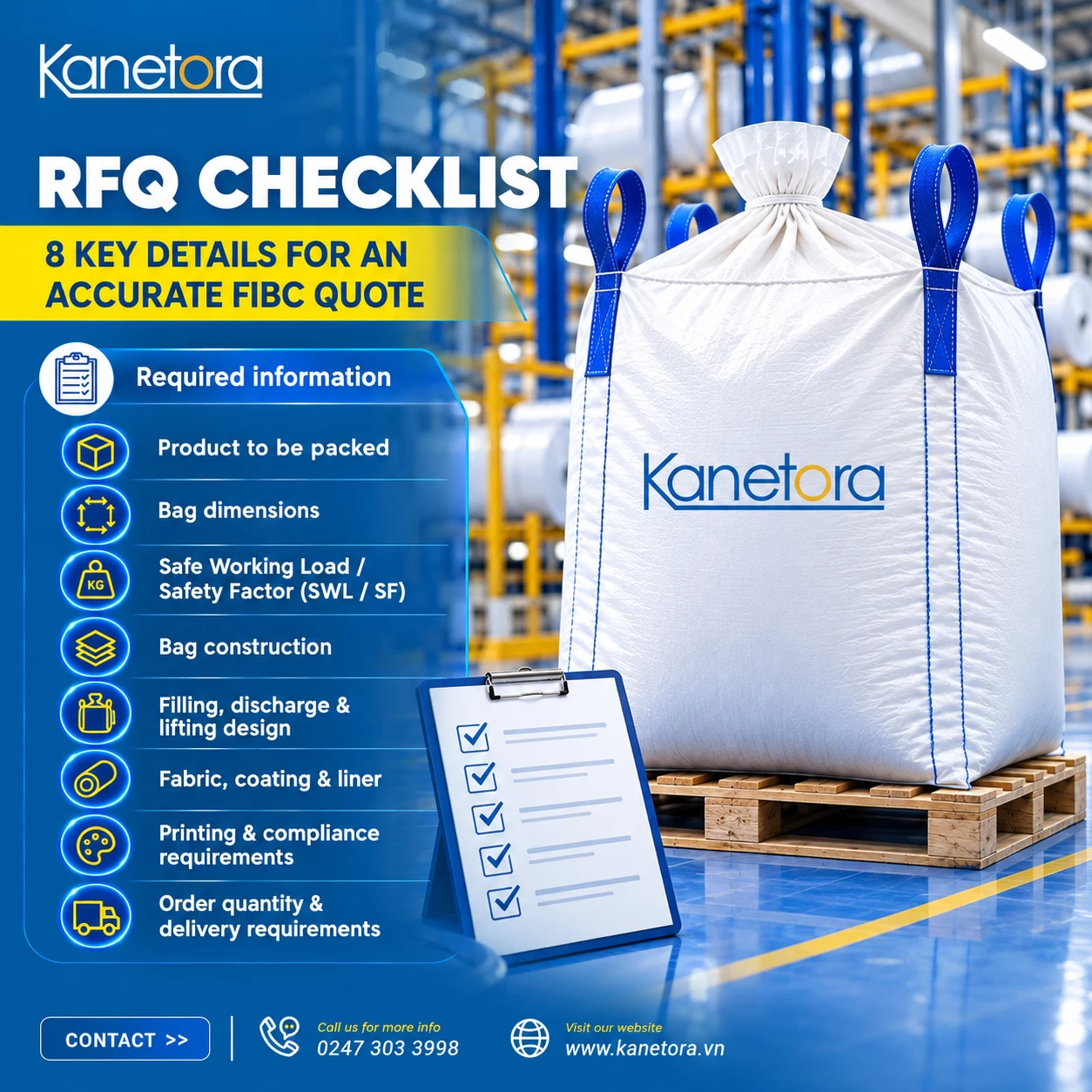
8. How to Prepare an Effective FIBC RFQ
A complete Request for Quotation (RFQ) helps the manufacturer understand technical requirements and assess commercial feasibility.
Instead of requesting only a unit price, buyers should provide the following information.
| RFQ Information | Details to Provide |
|---|---|
| Product application | Food, chemicals, polymers, minerals, agriculture or other |
| Cargo characteristics | Powder, granule, pellet, bulk density and relevant hazards |
| Required capacity | Net filling weight and Safe Working Load |
| Safety Factor | Required design and usage classification |
| Bag construction | Circular, U-Panel, Four-Panel or Baffle |
| Dimensions | Length, width, height or applicable drawing |
| Fabric | GSM, coating, color and technical requirements |
| Filling system | Open top, duffle top, filling spout or custom |
| Discharge system | Flat bottom, discharge spout or alternative |
| Lifting arrangement | Type and dimensions of lifting loops |
| Liner | Material, thickness, structure and barrier requirements |
| Branding | Logo, artwork, printing colors and label requirements |
| Compliance | Applicable testing, documentation and certifications |
| Order volume | Trial quantity, commercial quantity and annual forecast |
| Export details | Destination, Incoterm and required delivery date |
If the exact bag specification is unavailable, buyers can provide an existing bag sample, photographs, application details or a preliminary drawing for technical review.
The better the RFQ, the easier it becomes to compare suppliers on equivalent technical and commercial terms.
9. FIBC Manufacturing and Export Capabilities at Kanetora Bach Dang, Vietnam
Kanetora provides industrial packaging solutions through its manufacturing operations in Vietnam, including Kanetora Bach Dang, located in Ninh Binh Province.
The facility manufactures FIBC/Jumbo Bags and related packaging products for food, agricultural, plastic, chemical, mineral and construction applications.
According to the company’s 2026 manufacturing profile, Kanetora Bach Dang has stated production capabilities of approximately:
- 300,000 FIBC bags per month
- 10 million Block Bottom Valve Bags per month
- 500 tonnes of multilayer plastic film per month
The plant’s FIBC manufacturing process covers eight principal stages:
Extrusion → Webbing Weaving → Fabric Weaving → Lamination → Cutting/Printing → Sewing → Inspection → Packing.
Integrated Manufacturing Supports Flexible Production Planning
One of Kanetora Bach Dang’s manufacturing strengths is its in-house production of key FIBC components.
These include:
- Sling belts and webbings
- Inner liners
- Labels
- Document pouches
- Other semi-finished packaging components
In-house component manufacturing supports material coordination, quality consistency and greater flexibility when developing customized FIBC specifications.
However, final MOQ and lead time remain subject to the actual product design, order quantity, material requirements and confirmed production schedule.
Quality Control and Technical Testing
Kanetora Bach Dang implements quality control during manufacturing and final quality assurance before shipment.
The facility’s stated testing capabilities include equipment for evaluating:
- Tensile strength
- UV resistance
- Top-lift performance
- Liner puncture resistance
- Coefficient of friction
- Heat-seal strength
The factory’s documented certifications include ISO 9001:2015, ISO 14001:2015, ISO 22000:2018 and BRC Grade A.
Buyers should request current certificates and product-specific test documentation where applicable.
These capabilities help Kanetora support the development of FIBC solutions based on technical requirements rather than treating every bulk bag as an interchangeable commodity.
Supporting International FIBC Buyers
For overseas procurement teams, Kanetora can review FIBC requirements covering bag design, material specifications, printing, liners, manufacturing, quality inspection and export packing.
Customers can discuss standard orders, customized specifications, trial quantities and recurring supply requirements with the commercial team.
The confirmed MOQ, production schedule and export quotation are determined after reviewing the complete RFQ and applicable commercial conditions.
10. Frequently Asked Questions About FIBC Bag MOQ and Lead Time
What Is the Standard MOQ for FIBC Bags?
There is no universal MOQ across all FIBC manufacturers or bag designs. Minimum quantities depend on materials, dimensions, construction, custom components and production arrangements. Buyers should request a quotation for the specific bag design.
Can I Order a Small Quantity of Custom FIBC Bags?
Small trial orders may be considered depending on manufacturing feasibility, material availability, sample requirements and commercial conditions. A small order should not be assumed to have the same unit economics as a regular production batch.
How Long Does It Take to Manufacture FIBC Bags?
Production lead time varies by specification, order volume, available materials, factory scheduling and inspection requirements. A supplier should confirm the expected production period after technical review and order acceptance.
Does Custom Printing Increase FIBC Lead Time?
It can. New artwork, printing setup, color matching and buyer approvals may add preparation time. Repeat orders with previously approved artwork may require fewer preparatory steps.
Do PE Liners Affect FIBC MOQ?
They can, particularly when the liner requires customized dimensions, materials or sealing arrangements. The manufacturer should evaluate the MOQ of both the FIBC and its components.
Is a Larger FIBC Order Always Cheaper?
Not necessarily. Larger volumes can distribute certain setup costs more efficiently, but material specifications, testing, production complexity and logistics continue to influence unit pricing.
Can a Manufacturer Guarantee the Same Lead Time for Every Order?
Not without confirming the specific order requirements and production availability. Lead time should be established against an approved specification, quantity, production-start date and agreed delivery conditions.
What Is the Best Way to Request an FIBC Export Quotation?
Provide product characteristics, bag dimensions, SWL, construction, liner, coating, printing, order quantity, destination, delivery terms and target schedule. Include a technical drawing or existing sample whenever available.
Conclusion: Accurate FIBC Quotes Begin With Accurate Specifications
FIBC bag MOQ and lead time are not simply fixed numbers in a supplier’s price list.
They are influenced by the interaction of product specifications, material requirements, production planning, quality controls, order quantities and international shipping arrangements.
For procurement managers and importers, the best approach is to compare technically equivalent quotations, define realistic delivery milestones and communicate expected demand clearly.
Choosing the right FIBC manufacturer means looking beyond the lowest unit price to evaluate manufacturing capabilities, technical support, quality assurance and supply reliability.
Looking for an FIBC manufacturer in Vietnam?
Kanetora supports international buyers seeking industrial FIBC bags, customized bulk packaging and export-oriented manufacturing solutions.
Share your bag specification, expected order quantity, destination and delivery requirements with our team for a product-specific quotation.
KANETORA JOINT STOCK COMPANY
Website: https://kanetora.vn
Email: info@kanetora.vn
Hotline: +84 (0) 247 303 3998
Manufacturing Facility: Kanetora Bach Dang, Cau Mai, My Loc Ward, Ninh Binh Province, Vietnam.