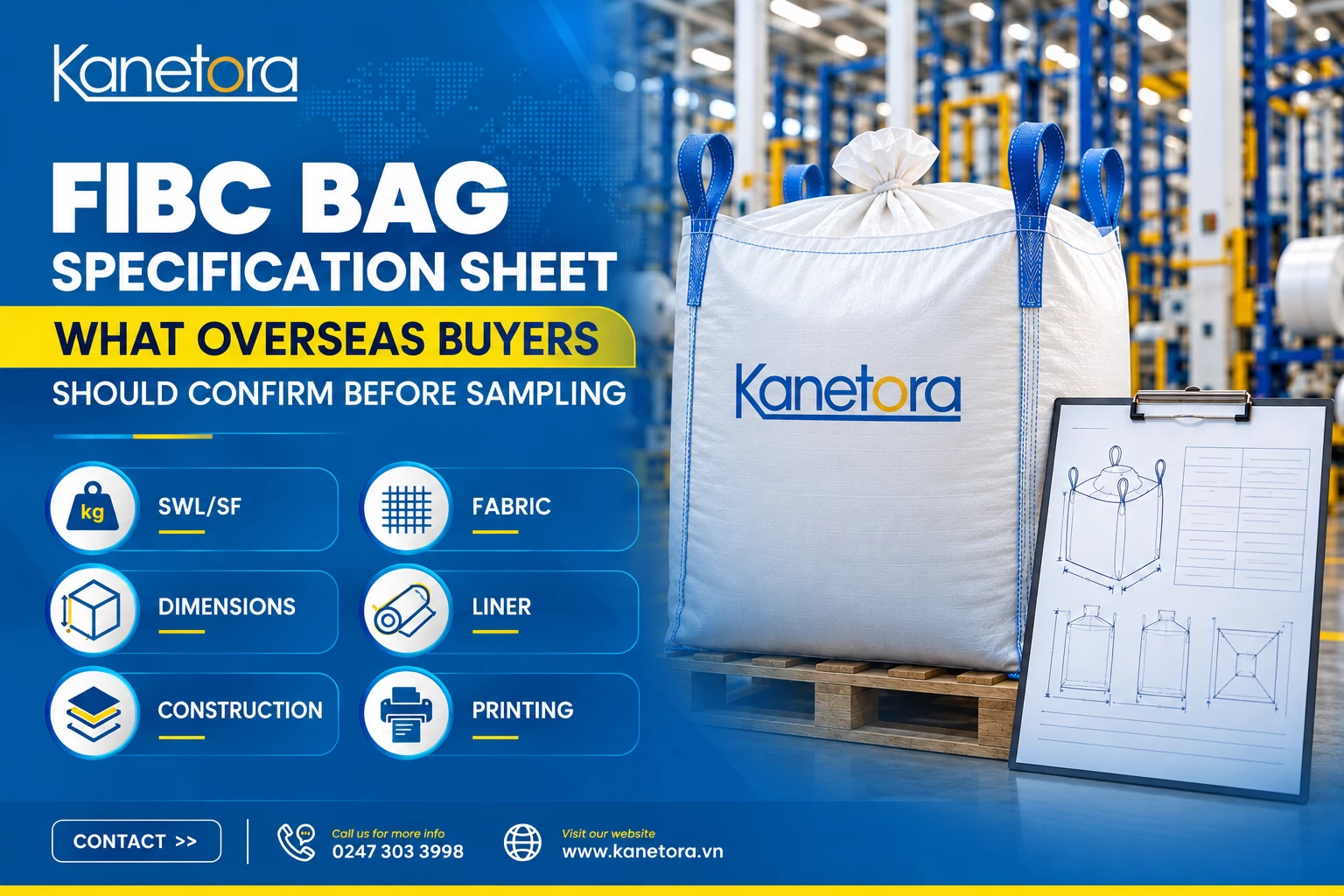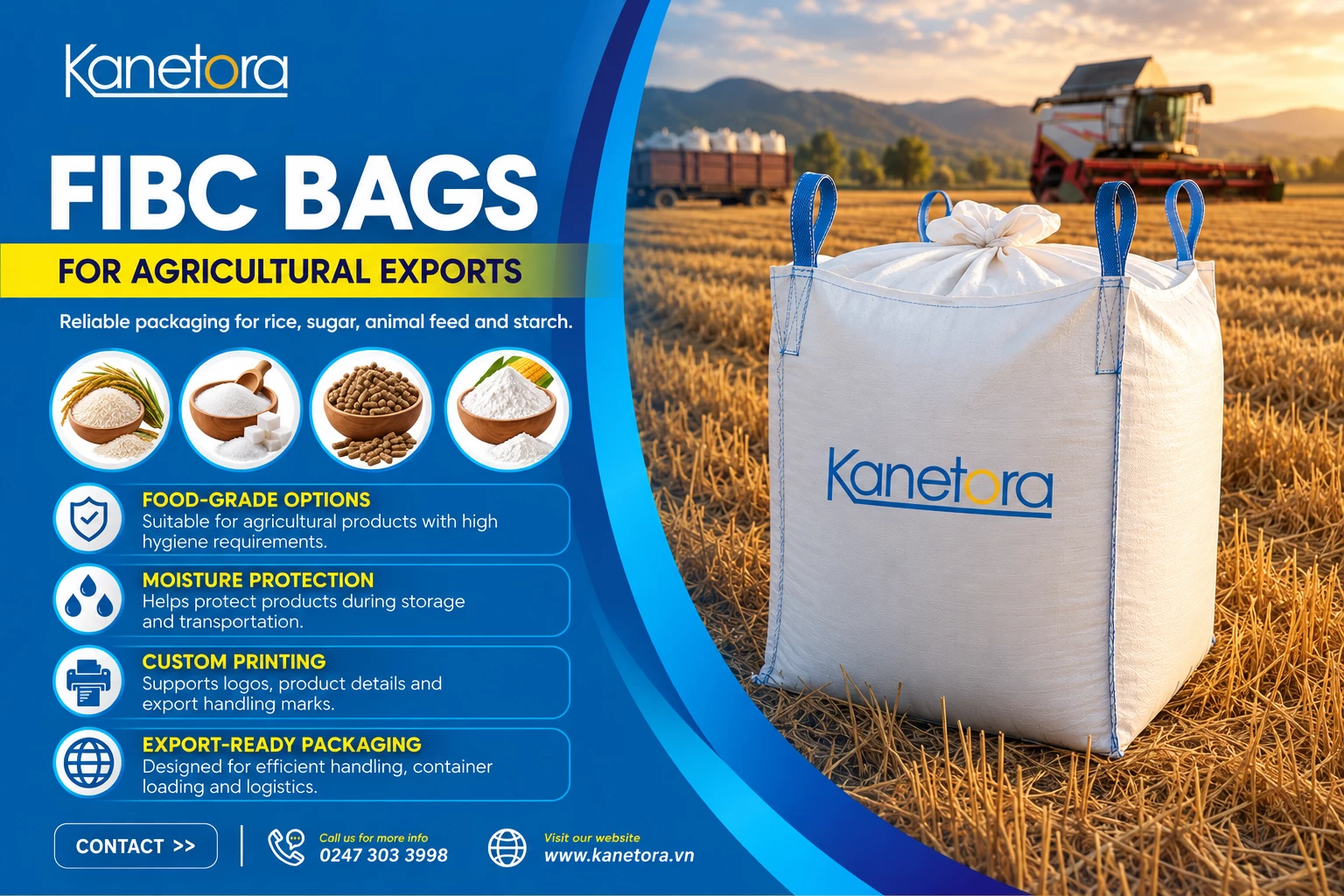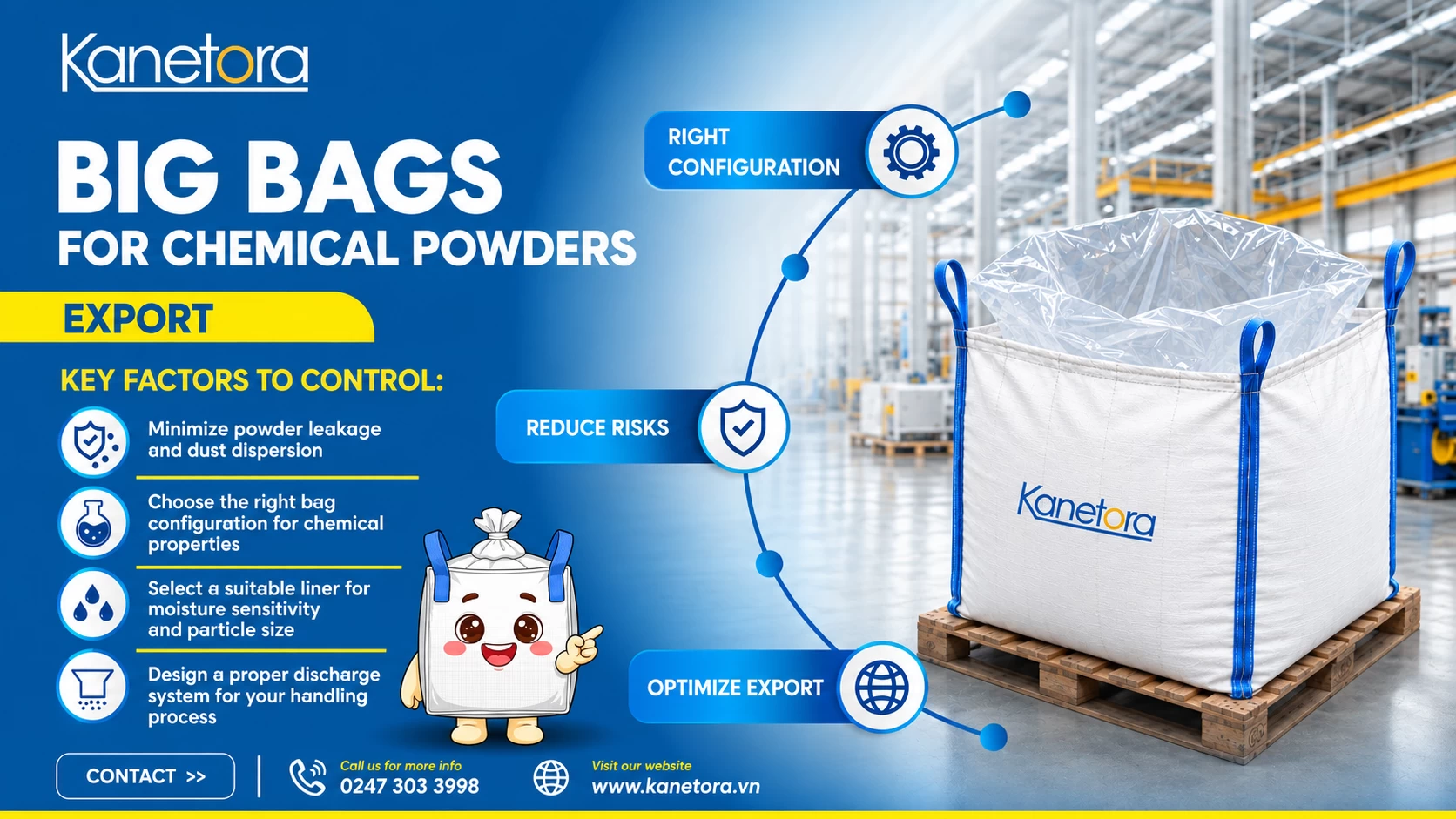


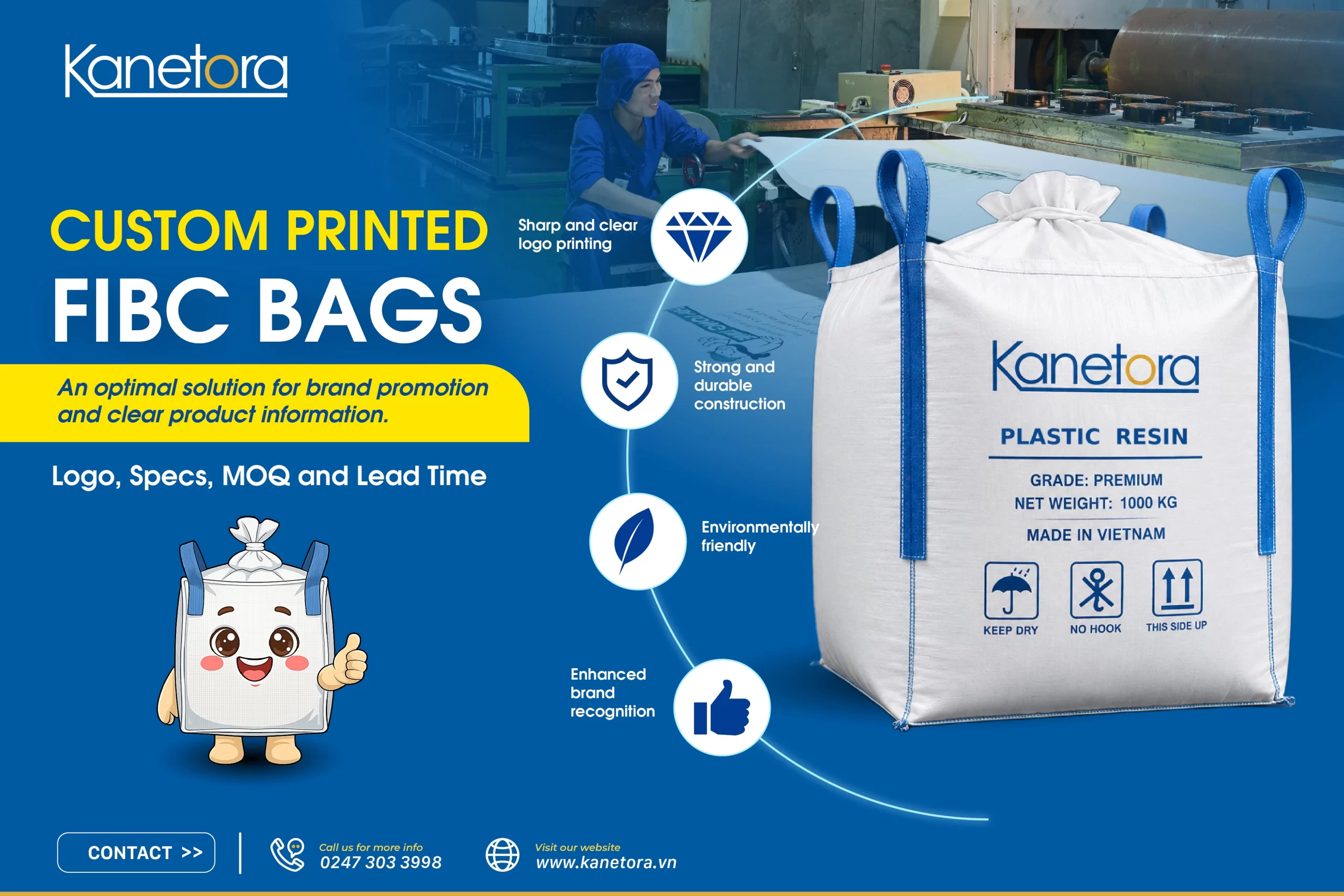
In industrial packaging, an FIBC does more than contain and transport bulk materials.
For exporters and manufacturers, the bulk bag may also carry the company logo, product name, grade, item code, safe working load, handling instructions, importer information and other logistics markings required throughout the supply chain.
This is why Custom Printed FIBC Bags are widely used for plastic resins, chemicals, minerals, food ingredients, agricultural products, fertilizers, construction materials and many other industrial applications.
However, ordering a custom printed FIBC is not as simple as sending a JPEG logo and asking the manufacturer to “match the color on screen.”
Print quality and consistency can be influenced by the woven PP surface, coating, fabric color, number of print colors, artwork complexity, print area, bag construction, order quantity and quality-control requirements.
For buyers developing a new specification, Kanetora’s industrial FIBC and packaging solutions provide an overview of available structures. Buyers can also review our OEM/ODM Jumbo FIBC guide before finalizing the printing artwork.
Quick Answer: What Should Buyers Prepare for a Custom Printed FIBC?
A complete Custom Printed FIBC RFQ should cover both the technical bag specification and the printing specification.
| Requirement | Information to Define |
|---|---|
| Packed product | Product name, powder/granule/flake, bulk density |
| Filling weight | Target weight, SWL, Safety Factor |
| Bag construction | U-panel, circular, 4-panel, baffle |
| Fabric | GSM, coated/uncoated, fabric color |
| Filling system | Open top, filling spout, duffle |
| Discharge system | Flat bottom, discharge spout, full-open bottom |
| Inner liner | No liner, PE liner, barrier liner |
| Printed content | Logo, product name, warnings, handling marks |
| Print sides | One, two or multiple panels |
| Print colors | According to artwork and agreed print capability |
| Color reference | Pantone or agreed spot-color reference |
| Artwork file | AI, EPS, vector PDF or SVG |
| Quantity | Trial quantity and commercial volume |
| Testing | Load, UV, food-contact or buyer-specific requirements |
| Destination | Country, port and labeling requirements |
| Delivery | Incoterms, destination and requested timing |
The more information that is confirmed before sampling, the fewer artwork and specification revisions are usually required later.
What Are Custom Printed FIBC Bags?
Custom Printed FIBC Bags are flexible intermediate bulk containers manufactured and printed according to a buyer-specific specification.
“Custom” does not refer only to the logo.
A project may customize:
Bag dimensions → SWL → fabric GSM → coating → liner → fabric color → webbing color → filling system → discharge system → logo → technical text → handling marks → packing configuration
Custom printing should therefore be treated as part of a broader OEM or engineered FIBC development process, rather than simply a decorative operation.
The bag structure should normally be defined first. The print layout can then be designed around the usable print area of each panel.
Where a square shape and improved presentation after filling are important, buyers may consider Baffle Bulk Bags for improved container loading efficiency.
What Information Can Be Printed on an FIBC?
Printing on an FIBC generally serves two purposes:
Brand communication and operational identification.
Depending on the application, an FIBC may include:
- Company logo
- Brand name
- Product name
- Product grade
- Item code
- Net weight
- Country of origin
- Handling instructions
- Lifting symbols
- Recycling marks
- Manufacturer information
- Importer information
- Safety warnings
- Customer-specific logistics information
However, not all data should necessarily be printed permanently on the bag.
For example, a logo, product name and handling instruction may remain unchanged across production runs.
By contrast:
- Lot number
- Batch number
- Production date
- Variable customer code
- Shipment-specific information
may be better handled using labels, document pouches or another variable-data solution.
Separating fixed and variable information can reduce the need to recreate printing artwork for every production batch.
Which Printing Method Is Commonly Used for FIBC Bags?
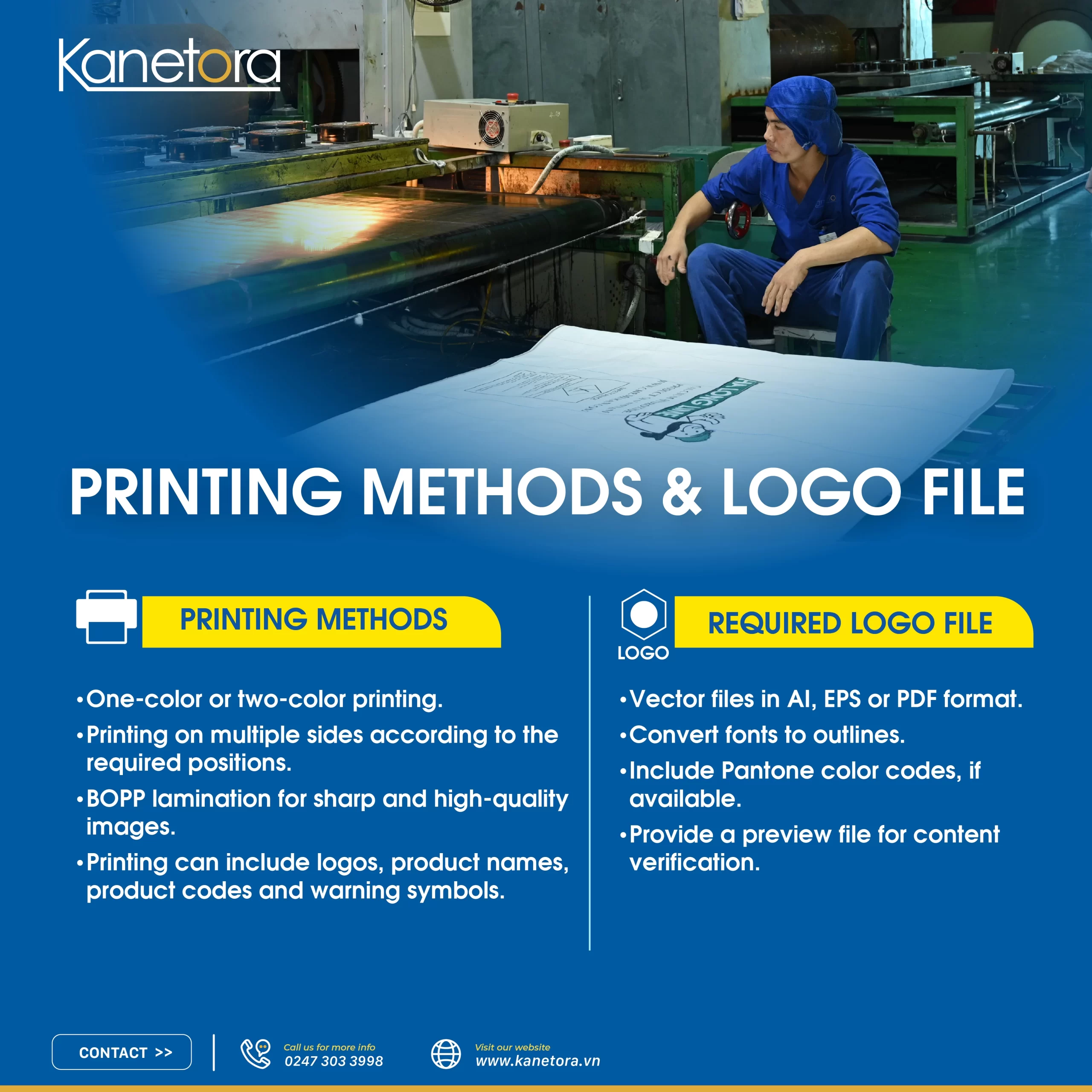
For woven polypropylene packaging, direct industrial printing on the woven PP fabric or coated surface is commonly used.
Flexographic printing is widely used for PP woven bags and FIBCs because it is suitable for:
- Logos
- Text
- Handling symbols
- Product information
- Spot-color graphics
Direct Printing on Woven PP Fabric
This is suitable for straightforward branding and technical information.
Because woven polypropylene has a textured surface, extremely fine artwork, photographic details and complex gradients may not reproduce as effectively as they would on paper or a smooth film.
For industrial bulk packaging, clear identification is usually more valuable than highly detailed artwork.
Printing on Coated FIBC Fabric
A coated surface can provide a more uniform printing substrate than untreated woven fabric, depending on the construction.
However, coating should not be specified only to improve print appearance.
It also affects:
- Dust containment
- Moisture resistance
- Air permeability
- Filling behavior
- Product protection
The coating decision should therefore remain part of the technical packaging specification.
Labels and Document Pouches
Variable information can also be managed using:
- Fabric labels
- Adhesive labels
- Document pouches
- Barcodes
- QR codes
- Traceability labels
This can be particularly useful when information changes between markets, customers or production batches.
Kanetora Bach Dang also manufactures and manages supporting FIBC components such as labels, document pouches, liners and webbing, providing additional flexibility for customized packaging projects.
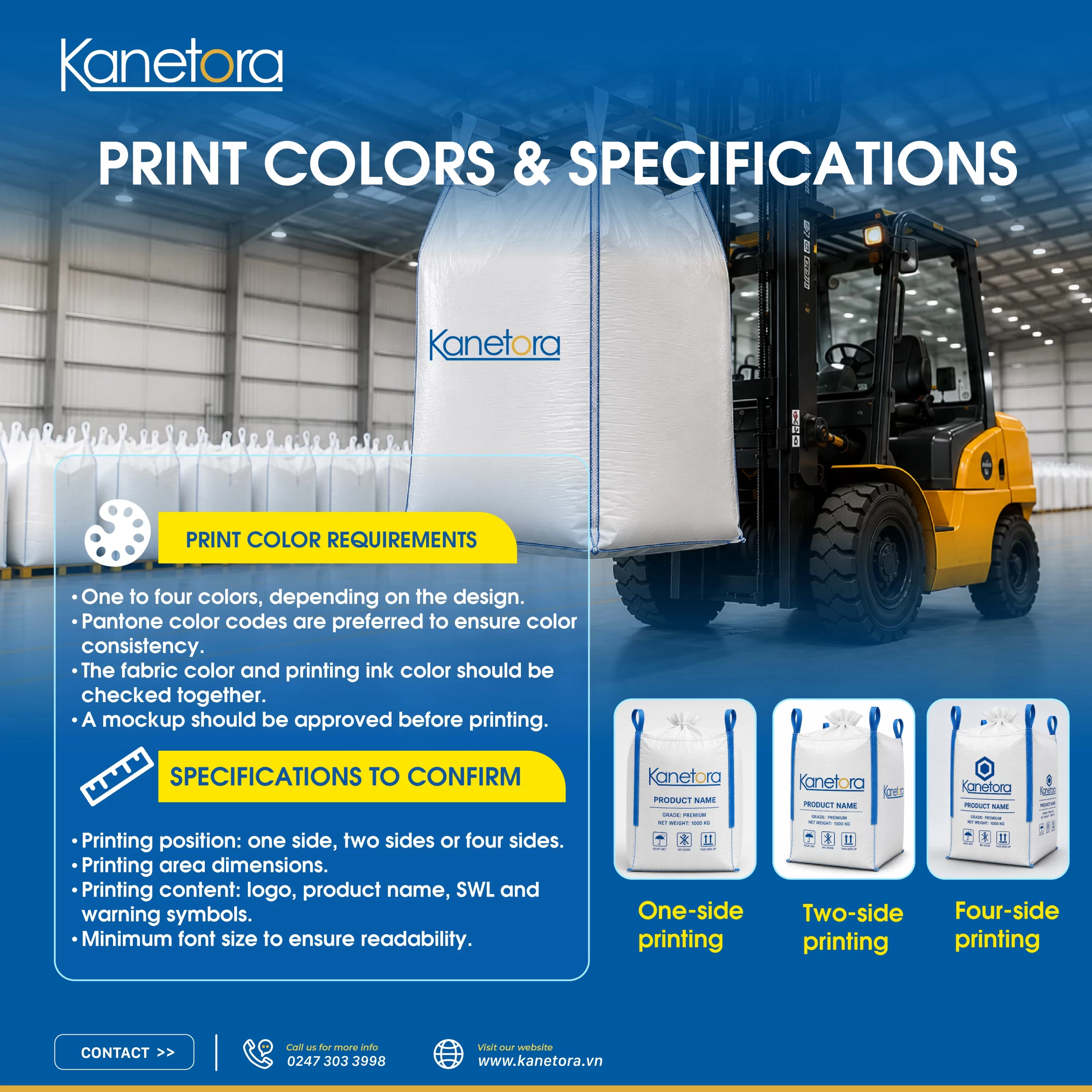
How Many Colors Can Be Printed on an FIBC?
The number of printing colors should not be determined only by the artwork file.
Buyers should consider:
Artwork colors + print sides + fabric construction + fabric color + print area + printing equipment capability
Kanetora Bach Dang currently operates a 4-color printing machine for Jumbo Bags, supporting customized industrial FIBC printing projects.
However, the availability of four-color printing does not mean the artwork should be designed like a magazine advertisement.
For industrial FIBCs, effective artwork usually prioritizes:
- Clear logo
- Strong contrast
- Large, readable text
- Simple color blocks
- Easy-to-recognize symbols
- Limited fine details
- Good visibility from a distance
For warehouse, container and industrial handling environments, fast identification is often more important than graphic complexity.
What Logo File Should Buyers Provide?
Vector artwork is strongly recommended.
Preferred formats include:
AI – EPS – Vector PDF – SVG
Vector files can be scaled without losing edge quality, making them more suitable for industrial artwork preparation.
Low-resolution JPEG or PNG files may create problems such as:
- Blurred edges
- Pixelation
- Incorrect proportions
- Difficult color separation
- Additional artwork preparation
- Longer approval time
If only a PNG or JPEG is available, buyers should provide the highest-resolution version together with the corporate brand guideline.
How Should FIBC Printing Artwork Be Prepared?
A production artwork should contain more than the logo.
The buyer should clearly define:
- Print position
- Print dimensions
- Print panel
- Bag orientation
- Number of colors
- Pantone references
- Required text
- Language versions
- Handling symbols
- Variable information areas
For example:
Front Panel: Logo + Product Name
Back Panel: Handling Instructions
Side Panel 1: Manufacturer / Importer Information
Side Panel 2: Warnings / Recycling Information
If the bag includes a large document pouch, label, filling spout or another component that may overlap the printing area, this should also be shown in the technical drawing.
Buyers do not necessarily need to create a complete engineering drawing themselves.
If the current bag sample, photos, dimensions and operational requirements are available, the manufacturer can help translate them into a workable specification.
For further guidance, see OEM/ODM Jumbo FIBC Bags: What Businesses Need to Prepare.
Why Should Buyers Use Pantone References Instead of Screen Colors?
Colors displayed on laptops, smartphones and monitors are generally generated using RGB.
Printed color on an FIBC depends on physical variables such as:
- Ink system
- Fabric color
- Coating
- Surface texture
- Ink absorption
- Viewing light
- Production conditions
Therefore, an instruction such as:
“Please print the same blue as this image.”
is usually not precise enough for controlled industrial production.
Where brand-color consistency matters, buyers should provide a Pantone or agreed spot-color reference.
A physical approved sample can also be extremely useful for repeat orders.
RGB vs CMYK vs Pantone
| Color System | Most Suitable For |
| RGB | Screens, websites and digital media |
| CMYK | Process printing on many conventional substrates |
| Pantone / Spot Color | Industrial printing and brand-color control |
| Physical Sample | Practical reference for repeat production |
For FIBC printing, Pantone/spot-color references and approved physical samples can often provide better production guidance than RGB values alone.
Does the FIBC Fabric Color Affect the Printed Color?
Yes.
White fabric generally provides a more neutral background.
On beige, blue, black or other custom-colored woven fabric, the substrate can affect:
- Contrast
- Apparent ink color
- Logo visibility
- Overall brand appearance
If a buyer requires:
custom fabric color + custom webbing color + custom logo colors
these elements should be reviewed as one coordinated design system.
Fabric color can also interact with technical requirements.
For outdoor applications, for example, pigment selection and the UV stabilization system should be considered together. Read more in Anti-UV FIBC Bags for Outdoor Storage and Export Transit.
Can Barcodes and QR Codes Be Printed on FIBCs?
They can be incorporated into the packaging design, but scan reliability should be evaluated carefully.
An FIBC surface is not perfectly flat.
After filling, the fabric may:
- Stretch
- Curve
- Wrinkle
- Bulge
- Deform around seams
A barcode or QR code that is too small or positioned in a highly distorted area may become difficult to scan.
If a code is critical for warehouse traceability, a label or document pouch with a more stable surface may be a better solution.
Kanetora Bach Dang also uses QR-code and item-code-based warehouse management and can integrate labels and document pouches into customized FIBC specifications.
Which Technical Information Should Be Verified Before Printing?
This is one of the most important approval steps.
An incorrect logo may create a branding problem.
An incorrect SWL, Safety Factor or handling instruction, however, can create an operational risk.
The buyer and manufacturer should review the full artwork carefully before final approval.
| Printed Information | What to Verify |
| SWL | Does it match the approved technical specification? |
| Safety Factor | Does it match the tested/design configuration? |
| Product Name | Correct grade, spelling and language |
| Net Weight | Is it fixed information or batch-specific? |
| Country of Origin | Does it match commercial requirements? |
| Handling Symbols | Are they appropriate for the handling method? |
| Warnings | Do they match the product and destination market? |
| Manufacturer/Importer | Correct legal name, address and format |
| Food / UN Claims | Only where the specification legitimately supports them |
| Recycling Mark | Appropriate to material and market |
| QR / Barcode | Has scan performance been validated? |
Artwork from an old bag should not automatically be copied to a new specification without technical review.
Does Printing “Food Grade” or “UN” Make an FIBC Certified?
No.
This distinction is essential.
Printing:
“FOOD GRADE”, a UN marking, or another certification-related statement does not itself make an FIBC compliant.
The packaging must actually meet the applicable technical and documentation requirements.
For food applications, compliance may depend on:
- Raw material
- Manufacturing environment
- Hygiene control
- Additives
- Coating
- Inner liner
- Printing ink
- Testing and documentation
Similarly, a UN mark should only be applied where the FIBC design has the appropriate certification for the intended dangerous-goods application.
A marketing claim must always follow the actual approved specification, not replace it.
Should Printing Ink Be Considered for Food-Grade Applications?
Yes.
For projects involving food-contact or tightly controlled packaging, buyers should not evaluate only the PP resin and inner liner.
The complete packaging system may include:
- Printing ink
- Masterbatch
- Coating
- Labels
- Adhesives
- Liners
- Other packaging components
The applicable requirements should therefore be reviewed for the complete specification.
Does a Custom Printed FIBC Need an Inner Liner?
Printing and lining are separate requirements.
The liner should be selected according to the cargo.
For example:
Moisture-sensitive plastic resin → PE liner may be required
Food powder → suitable food-grade liner may be required
Fine chemical powder → suitable containment or barrier liner may be required
Standard non-sensitive material → liner may not be necessary
For more information, see FIBC Bag with Liner: When and Why to Use.
Why Does Bag Shape Affect Logo Placement?
Artwork may look perfectly aligned on a flat technical drawing but change noticeably after the FIBC is filled.
A conventional FIBC tends to bulge outward.
As a result:
- Logos may curve
- Text near seams may distort
- Wide artwork may move into fold areas
- Low-position text may be hidden by the pallet
- A document pouch may overlap the logo
- Different product bulk densities may change the filled shape
If presentation and dimensional stability are particularly important, a Baffle FIBC may help maintain a squarer profile.
Read more about Baffle Bulk Bags and container loading efficiency.
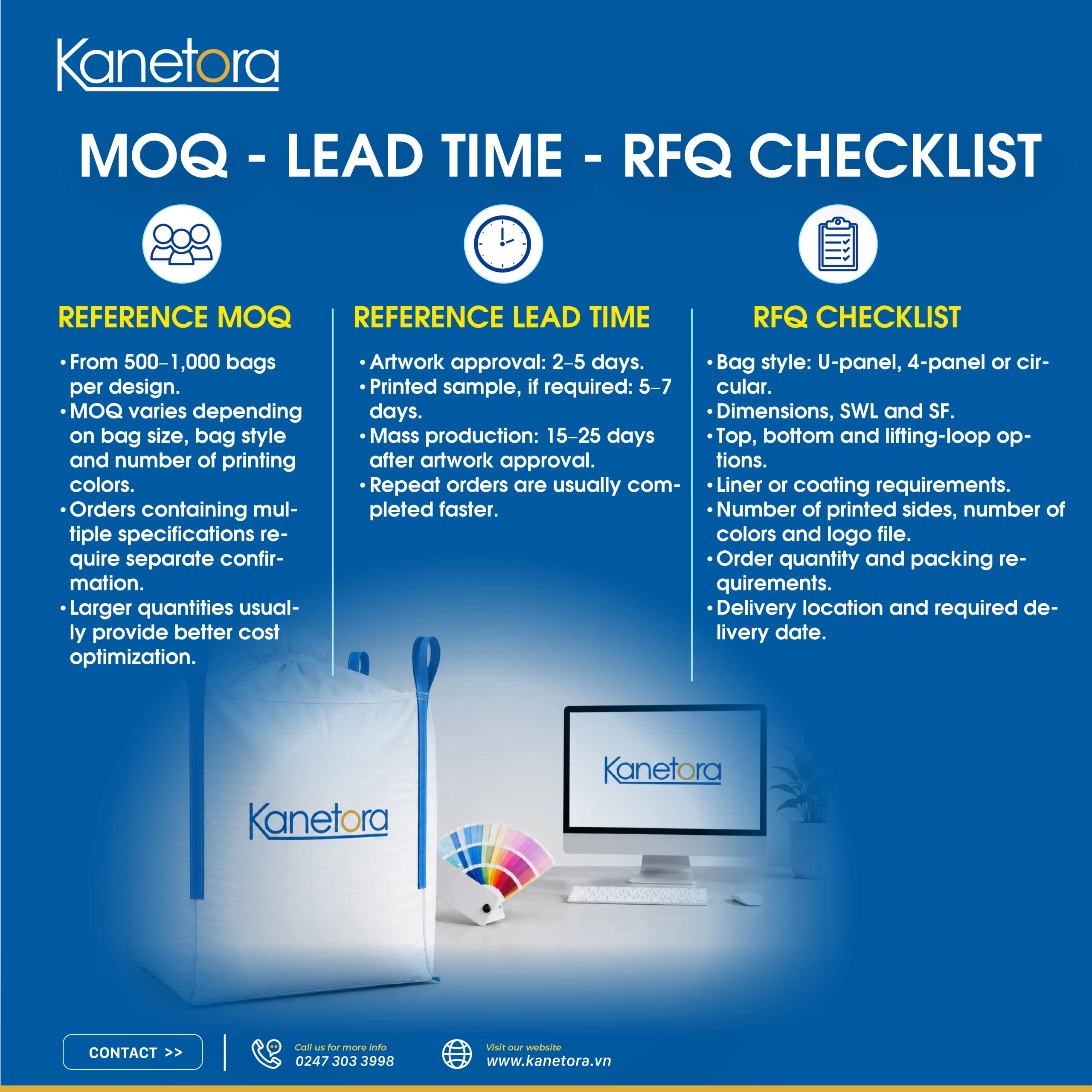
What Is the MOQ for Custom Printed FIBC Bags?
There is no single MOQ that applies to every custom printed FIBC project.
MOQ depends on the specification.
For example, a standard white U-panel FIBC with one-color printing and no liner has very different production economics from a bag requiring:
Baffle construction + PE liner + custom fabric color + custom webbing + four-color printing + food-grade controls
Factors affecting MOQ may include:
| Factor | Potential Impact on MOQ |
| Standard vs custom fabric | Custom material may require a minimum production run |
| Fabric color | Custom pigment can increase minimum requirements |
| Webbing color | Special colors may require separate preparation |
| Number of print colors | More setup and preparation |
| Number of print sides | Additional printing operations |
| Inner liner | Custom liner specification may have its own MOQ |
| Baffle construction | More complex manufacturing |
| Food-grade requirements | Dedicated controls may apply |
| UN requirements | Depends on certified design |
| Number of artworks | More SKUs reduce volume per design |
| Trial order | Different economics from commercial production |
Buyers should therefore provide not only the first-order quantity but also the expected monthly or annual volume.
This allows the manufacturer to evaluate the project as:
trial order → commercial production → long-term forecast
rather than as a single isolated PO.
Why Can a Small Order with Many Artworks Cost More?
Consider two orders:
5,000 bags × 1 artwork
and:
500 bags × 10 different artworks
The total quantity is the same.
The production complexity is not.
Each design may involve separate:
- Artwork preparation
- Printing setup
- Color adjustment
- Changeover
- SKU segregation
- QC checks
- Packing identification
Where many SKUs share the same technical FIBC, buyers may ask whether some variable information can be managed by labels or document pouches instead of creating a completely separate printed bag for every SKU.
What Is the Lead Time for Custom Printed FIBC Bags?
Lead time should not be treated as one fixed number for every project.
A new custom FIBC may go through:
RFQ → Technical Review → Drawing → Artwork → Sample / Approval → Material Planning → Production → Printing → Sewing → QC / QA → Packing → Shipment
A repeat order with an already approved specification and artwork is generally simpler than a completely new development.
Lead time may increase when the project requires:
- Custom fabric color
- New artwork
- Multiple SKUs
- Custom liner
- Baffle construction
- Anti-static FIBC
- Food-grade controls
- UN-certified design
- Third-party inspection
- Additional testing
- Pre-production samples
Buyers should therefore distinguish between:
Sample lead time
and:
Mass-production lead time
rather than simply asking:
“How many days is your lead time?”
What Commonly Extends FIBC Lead Time?
Artwork Is Not Finalized
Changing the logo, Pantone color, wording or print position after approval can interrupt production preparation.
The Technical Specification Changes After Sampling
Changing a bag from:
SWL 1,000 kg
to:
SWL 1,250 kg
may require a review of:
- Fabric
- Webbing
- Sewing
- Design
- Testing
It is not simply a matter of changing the printed number.
Too Many File Versions
Files named:
final.ai
final-new.ai
final-v2.ai
final-approved-new.ai
create unnecessary risk.
A better system is one master artwork with a clear revision number and approval status.
Slow Approval
Waiting for buyer approval of the technical drawing, artwork, color or sample should also be considered part of the total project timeline.
Custom Materials
Special fabric colors, custom webbing, specialty liners or components outside the normal production plan may require additional material preparation.
Should Buyers Request a Pre-Production Sample?
For a new Custom Printed FIBC project, a sample is often worth considering.
Sampling is particularly valuable when:
- The bag has never been produced before
- The artwork is new
- Brand-color accuracy matters
- Multiple warnings are required
- Barcode or QR code scanning is important
- The construction is complex
- The buyer is changing suppliers
- The bag will run through automated filling equipment
- Baffle or liner construction is required
- Destination-market requirements are strict
A sample allows both technical and visual details to be reviewed before mass production.
However, buyers should distinguish between:
Print sample
Empty bag sample
and:
Production-equivalent sample
because these can represent different levels of validation.
What Should Buyers Consider for Printed FIBCs Used for Plastic Resin?
PP, PE, PET, EVA, ABS, masterbatch and compound manufacturers often require strong SKU identification.
Typical printed information may include:
- Resin grade
- Product code
- Net weight
- Manufacturer
- Lot identification area
- Handling marks
- Brand logo
- Export information
For polymer applications, buyers can also review Bulk Bags for Plastic Resin Export: Safe Packaging for PP, PE & PET.
For moisture-sensitive resins, printing requirements should not distract from liner and moisture-protection requirements.
How Should International Buyers Evaluate a Custom Printed FIBC Manufacturer?
Printing capability is only one part of supplier evaluation.
A reliable FIBC manufacturer should control the complete chain:
Fabric → Webbing → Printing → Sewing → Liner → Testing → QC → Packing → Traceability
A supplier may produce attractive printing, but the packaging is still unsuitable if:
- SWL is incorrect
- Webbing is inconsistent
- Seam quality is poor
- The liner does not fit
- The artwork does not match the technical specification
- Batch traceability is weak
For this reason, international buyers should evaluate manufacturing and quality-control capability together with printing capability.
Custom Printed FIBC Capability at Kanetora Bach Dang
Located in Ninh Binh Province, Vietnam, Kanetora Bach Dang manufactures approximately 300,000 FIBC bags per month.
The integrated manufacturing process includes:
Extrusion → Webbing Weaving → Fabric Weaving → Lamination → Cutting & Printing → Sewing → Inspection → Packing
The factory operates a 4-color printing machine for Jumbo Bags and also produces or manages multiple supporting FIBC components, including:
- Labels
- Document pouches
- Inner liners
- Webbing
- Coated fabric
- Customized bag components
This supports customized projects involving:
- Customer logos
- Custom webbing colors
- Custom labels
- Document pouches
- PE liners
- Coated FIBCs
- Baffle bags
- Multiple SKUs
- Export identification requirements
Quality control is performed throughout production, with final QA inspection prior to packing and shipment.
Typical Custom Printed FIBC Development Process at Kanetora
1. Buyer RFQ
The project begins with information about the cargo, target filling weight, bag dimensions, required construction and forecast quantity.
2. Technical Specification
Kanetora evaluates:
- Fabric
- GSM
- Lifting loops
- Filling system
- Discharge system
- Liner
- Coating
- Special technical requirements
3. Artwork Preparation
The buyer provides:
- Logo
- Text
- Pantone references
- Print sides
- Destination-market information
4. Technical Drawing and Artwork Approval
The buyer and manufacturer confirm the bag drawing and printing layout before production.
5. Sampling When Required
Samples may be prepared depending on project complexity and approval requirements.
6. Production
Materials and components are prepared according to the approved specification.
7. Printing and Sewing
The approved artwork is applied under controlled production conditions.
8. QC and QA
The finished FIBC is checked for:
- Dimensions
- Construction
- Sewing
- Printing
- Required technical characteristics
9. Packing and Identification
Finished bags are baled, identified by item/SKU and prepared for shipment.
Custom Printed FIBC RFQ Checklist
To receive a more accurate quotation, buyers should provide the following information whenever available:
- Packed product
- Product form: powder, pellet, granule, flake or other
- Bulk density
- Target filling weight
- SWL
- Safety Factor
- Bag dimensions
- U-panel, circular, 4-panel or baffle construction
- Fabric GSM
- Coated or uncoated fabric
- Filling system
- Discharge system
- Lifting-loop design
- Inner-liner requirement
- Fabric color
- Webbing color
- Vector logo file
- Pantone references
- Number of printed sides
- Number of print colors
- Print dimensions
- Complete printed text
- Barcode or QR code requirement
- UV, food-grade, anti-static or UN requirements where applicable
- Sample requirement
- Trial quantity
- Annual forecast
- Incoterms
- Destination country and port
- Target delivery date
A complete RFQ reduces the number of clarification rounds between the buyer, sales team and technical team.
Frequently Asked Questions About Custom Printed FIBC Bags
Can FIBC bags be printed with a customer logo?
Yes. FIBCs can be customized with company logos, product names, item codes, handling instructions and other agreed commercial or technical information.
Which logo file format is recommended?
AI, EPS, vector PDF or SVG is preferred because vector artwork can be scaled without losing image quality.
Can a PNG or JPEG be used?
It can be used as a reference, but a low-resolution raster image is not ideal for production artwork. Buyers should provide the highest-quality file available.
Should buyers provide RGB or Pantone colors?
Pantone or an approved physical color reference is normally more useful for controlling brand colors in industrial printing than RGB values displayed on a screen.
Can an FIBC be printed in four colors?
Printing capability depends on the bag specification, artwork and equipment. Kanetora Bach Dang currently operates a four-color printing machine for Jumbo Bags.
Can photographic images or complex gradients be printed on FIBCs?
Woven PP is not the same printing surface as paper or smooth film. Logos, text and spot-color graphics are generally better suited to FIBC printing than extremely detailed photographic artwork.
What is the MOQ for custom printed bulk bags?
There is no universal MOQ. It depends on fabric, colors, printing complexity, liner, baffle design, number of SKUs and the degree of customization.
What is the lead time for a custom printed FIBC?
Lead time depends on technical review, artwork approval, sampling, material preparation, production, testing, QC and shipment requirements.
Sample lead time and mass-production lead time should be confirmed separately.
Is a pre-production sample required?
Not always, but it is strongly worth considering for a new artwork, new bag construction, strict brand-color requirement or technically complex project.
Does printing “Food Grade” make a bag food-grade?
No. Food-grade suitability depends on the actual materials, manufacturing controls, additives, liner, printing system and applicable compliance requirements.
Can a UN mark be printed on a custom FIBC?
A UN marking should only be applied to an FIBC design that is appropriately certified for the intended dangerous-goods application.
Can custom printed FIBCs also use liners and baffles?
Yes. Printing, liner and baffle construction perform different functions and can be combined in one FIBC specification when required.
Custom Printed FIBC Is More Than Printing a Logo
A successful Custom Printed FIBC needs to achieve three objectives at the same time:
Contain and handle the cargo safely.
Communicate the correct technical information.
Present the buyer’s brand consistently.
For this reason, artwork should never be managed separately from the FIBC specification.
A small artwork change involving SWL, warnings, colors, barcode placement or destination-market information may sometimes relate directly to the bag design, testing or SKU-management system.
The recommended development sequence is:
Product Requirement → FIBC Specification → Printing Requirement → Artwork Approval → Sample / Testing → Mass Production
rather than designing the artwork first and then searching for a bag that can accommodate it.
With integrated FIBC, liner, label, document-pouch, coating and Jumbo Bag printing capabilities, Kanetora Bach Dang can support international buyers in developing Custom Printed FIBC Bags according to cargo requirements, operating conditions, branding specifications and export markets.
Looking for Custom Printed FIBC Bags with Your Own Logo and Specification?
Send Kanetora the following information:
Packed product + target filling weight + dimensions + FIBC construction + liner/coating + artwork + Pantone colors + quantity + destination
Our team can review the technical specification, printing layout and production requirements before commercial manufacturing.
Kanetora Joint Stock Company
Hotline: +84 (0) 247 303 3998
Email: info@kanetora.vn
Website: www.kanetora.vn