

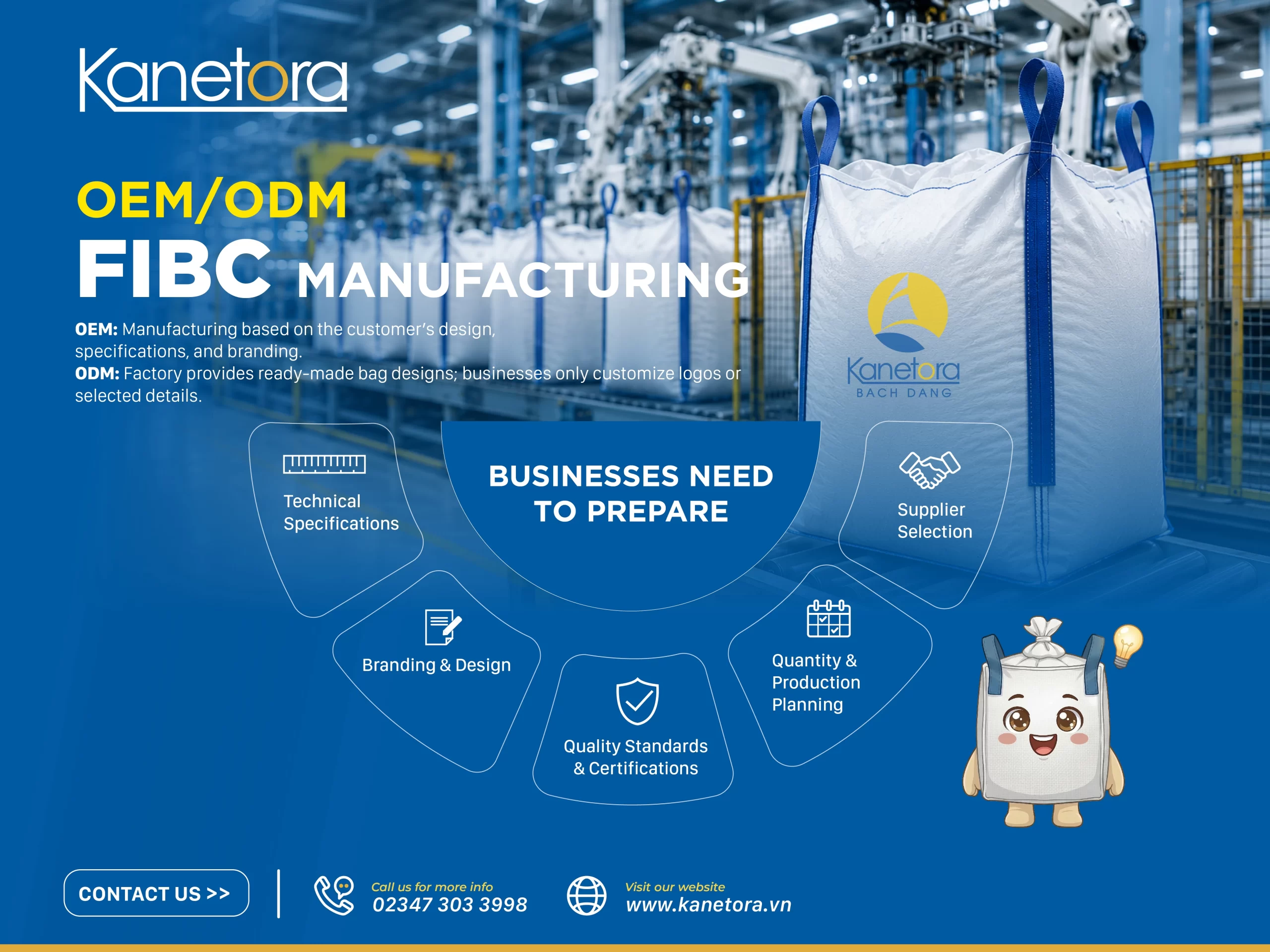
What Are OEM/ODM Jumbo FIBC Bags?
In industrial packaging, OEM/ODM Jumbo FIBC bags refer to Jumbo bags manufactured according to the specific requirements of each business. Instead of using standard ready-made bags, customers can customize the bag structure, dimensions, safe working load, filling and discharge options, inner liner, fabric GSM, lifting loop color, logo printing, and other technical specifications.
For industries such as agriculture, food, minerals, chemicals, plastic resin, and construction materials, a Jumbo bag is not just a packaging item. It is an important part of storage, transportation, export handling, and product quality protection.
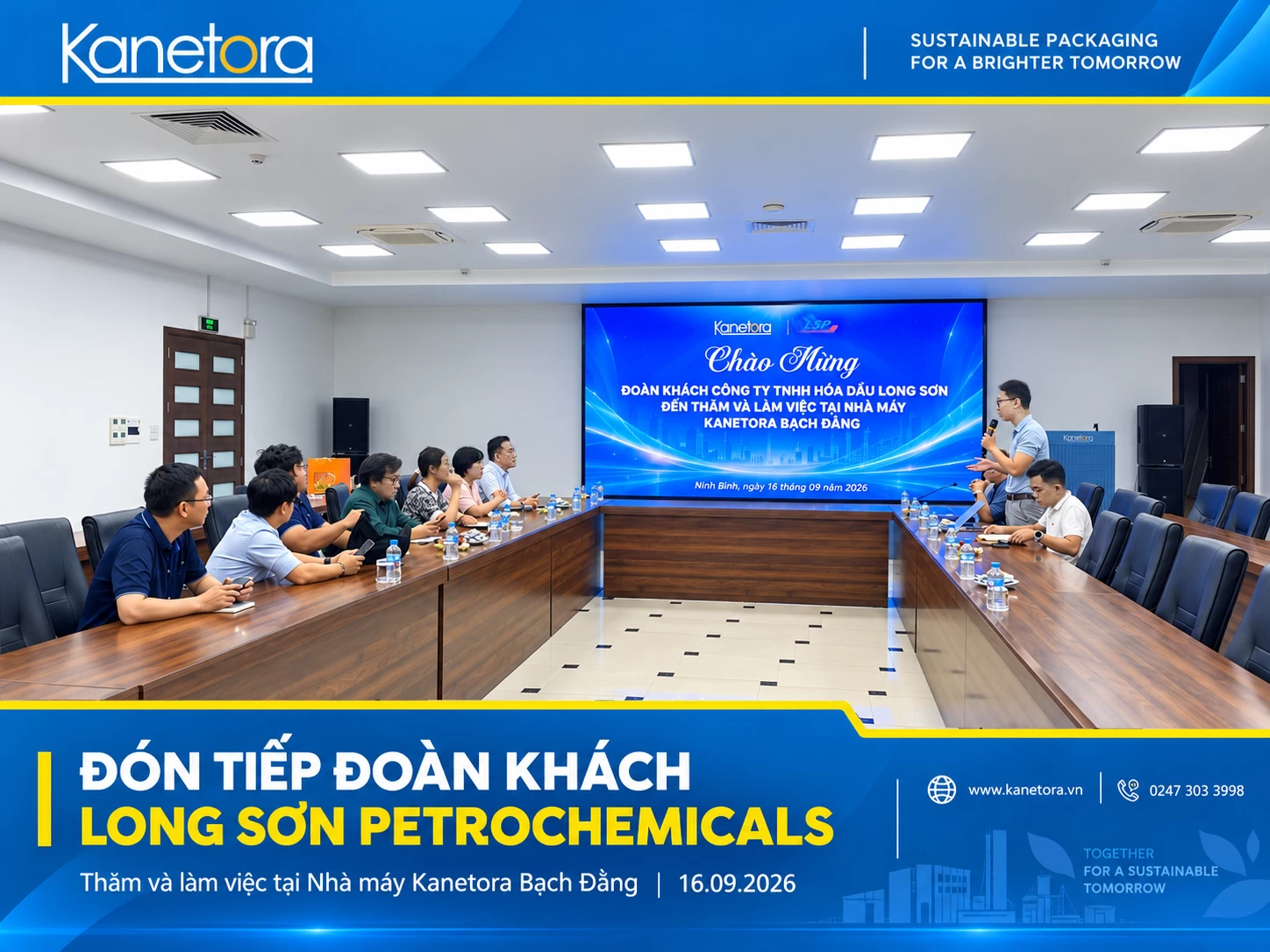
Kanetora Bach Dang is an FIBC manufacturing factory within the Kanetora ecosystem, inheriting manufacturing experience from But Son Packaging, established in 1996. The company currently manufactures FIBC bags, block bottom valve bags, and industrial plastic films, with certifications including BRC Grade A, ISO 9001:2015, ISO 14001:2015, and ISO 22000:2018.
What Is the Difference Between OEM and ODM in the FIBC Industry?
What Is OEM FIBC?
OEM FIBC means that the factory manufactures Jumbo bags based on the design, technical drawing, or sample provided by the customer.
Businesses usually choose OEM when they already have an existing bag design, technical specification sheet, current bag sample, or specific requirements from their end customer. The factory will produce according to the agreed specifications and may provide additional recommendations to optimize material, stitching, lifting loops, inner liner, coating, or packing method.
For example, a plastic resin exporter needs to order 1-ton Jumbo bags with U-panel construction, inlet spout, discharge spout, four lifting loops, and custom logo printing. This is a typical OEM FIBC order.
What Is ODM FIBC?
ODM FIBC means that the factory participates more deeply in the product design and development process. The customer only needs to provide information about the product to be packed, safe working load, handling conditions, transportation method, export market, and required standards. Based on that, the factory will recommend a suitable FIBC structure.
ODM is often suitable for businesses that do not yet have a complete bag design, are developing a new product, want to optimize logistics costs, or need a packaging solution suitable for export requirements.
What Technical Specifications Should Businesses Prepare Before Ordering OEM/ODM Jumbo Bags?
To make the quotation and production process faster and more accurate, businesses should prepare several key technical details in advance.
1. Type of Product to Be Packed
This is the most important information. Each product category requires a different bag structure, strength level, moisture protection, dust control, or food safety standard.
For example:
| Product Category | Common Requirements |
|---|---|
| Food and agricultural products | Food-grade production, dust control, liner, hygiene standards |
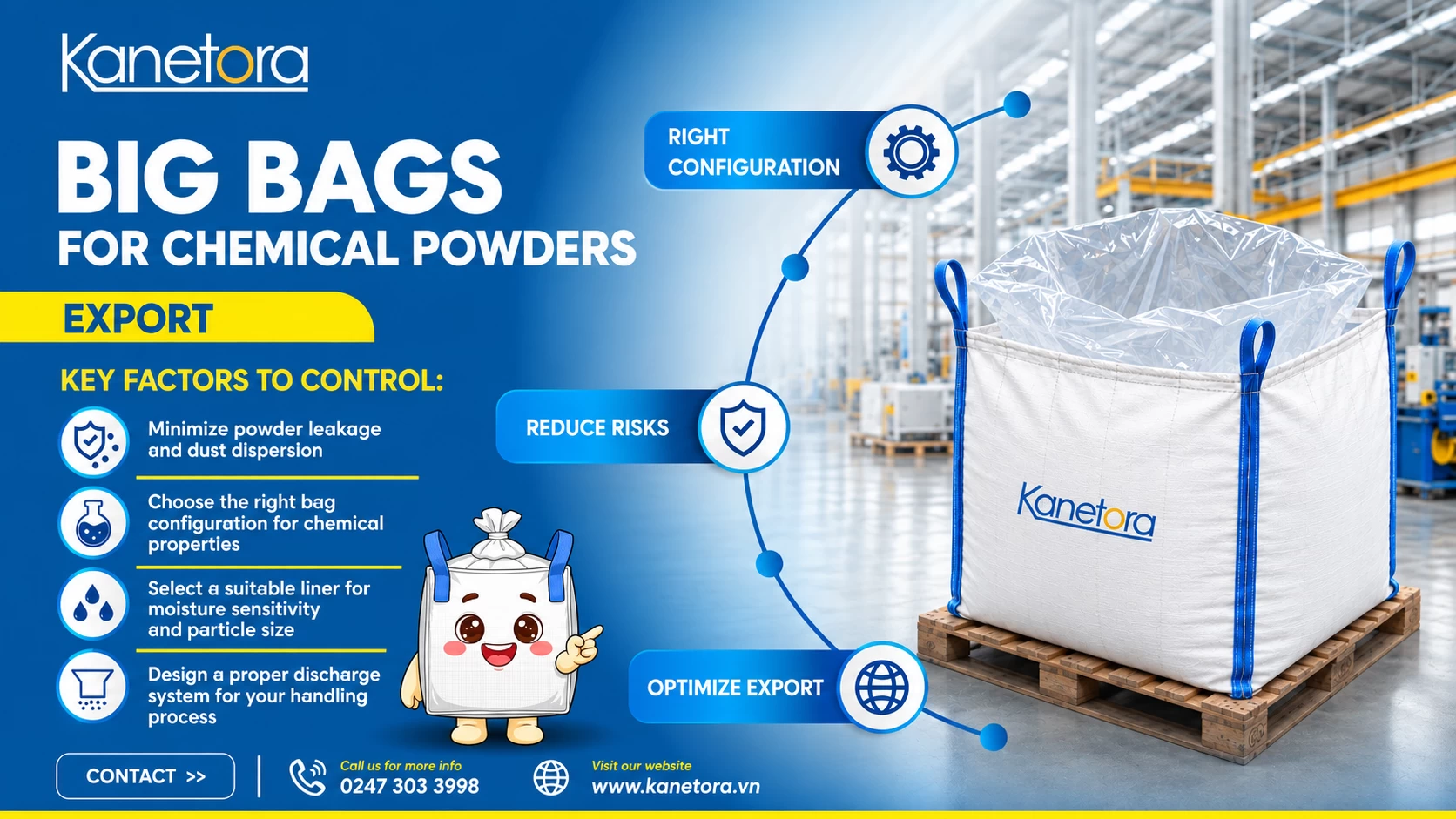
| Plastic resin and chemicals | Moisture protection, leakage prevention, smooth discharge |
| Minerals and construction materials | High load capacity, strong stitching, durable fabric |
| Moisture-sensitive products | Liner, coating, or barrier film |
Kanetora Bach Dang provides FIBC solutions for multiple industries, including food, agriculture, plastics and chemicals, and industrial construction.
2. Safe Working Load and Safety Factor
Businesses need to define the Safe Working Load – SWL, which commonly ranges from 500 kg to 2,000 kg for standard Jumbo bags. Special applications may require higher load capacity.
In addition to SWL, the Safety Factor should also be determined. Common safety factors are 5:1 or 6:1, depending on the intended application. For special use cases, the factory can provide further technical advice based on suitable testing standards.
3. Bag Dimensions
The required information includes:
- Bag width, depth, and height.
- Bottom type: flat bottom, discharge bottom, or full open discharge.
- Top type: open top, duffle top, or inlet spout.
- Requirement for square shape retention or anti-bulging design.
If the customer already has an existing bag sample, they can send the sample or actual measurements for the factory to check and compare.
4. Jumbo Bag Construction
Common FIBC constructions include:
| Bag Construction | Key Features |
|---|---|
| Circular / Tubular | Tubular body with fewer side seams |
| U-panel | One main U-shaped fabric panel combined with two side panels |
| 4-panel | Four side panels sewn together, providing good shape retention |
| Baffle bag | Internal baffle panels help reduce bulging and optimize container space |
For export cargo that requires better container loading efficiency, baffle bags can be a suitable option because they help the bag maintain a more square shape when filled.
5. Filling and Discharge Options
The top and bottom design directly affects filling speed, product protection, and discharge efficiency at the destination.
Common options include:
| Item | Options |
|---|---|
| Top filling | Open top, duffle top, inlet spout |
| Bottom discharge | Flat bottom, discharge spout, conical discharge, full open discharge |
| Closure method | Ties, Velcro, iris closure, petal closure |
For powder, granular, or fine particle products, businesses should describe the filling and discharge process clearly so that the factory can recommend the correct structure.
What Should Businesses Consider When Designing Logo Printing on FIBC Bags?
Jumbo FIBC bags can be printed with logos, item codes, handling instructions, warning symbols, or tracking information based on customer requirements.
When preparing artwork, businesses should provide:
- Logo in vector format: AI, PDF, EPS, or SVG.
- Required printing color.
- Printing position on the bag.
- Printing area size.
- Warning text, product code, or transportation symbols.
- Language requirements for export markets.
For FIBC bags, the printing design should be clear, easy to recognize, and not too detailed. Technical information such as SWL, SF, batch code, lifting instructions, or importer details should be carefully checked before mass production.
What Factors Affect MOQ and Lead Time for Jumbo Bag Production?
MOQ and production lead time are not fixed for every order. They usually depend on the level of customization, material type, bag construction, printing requirements, and factory production schedule.
Factors That Affect MOQ
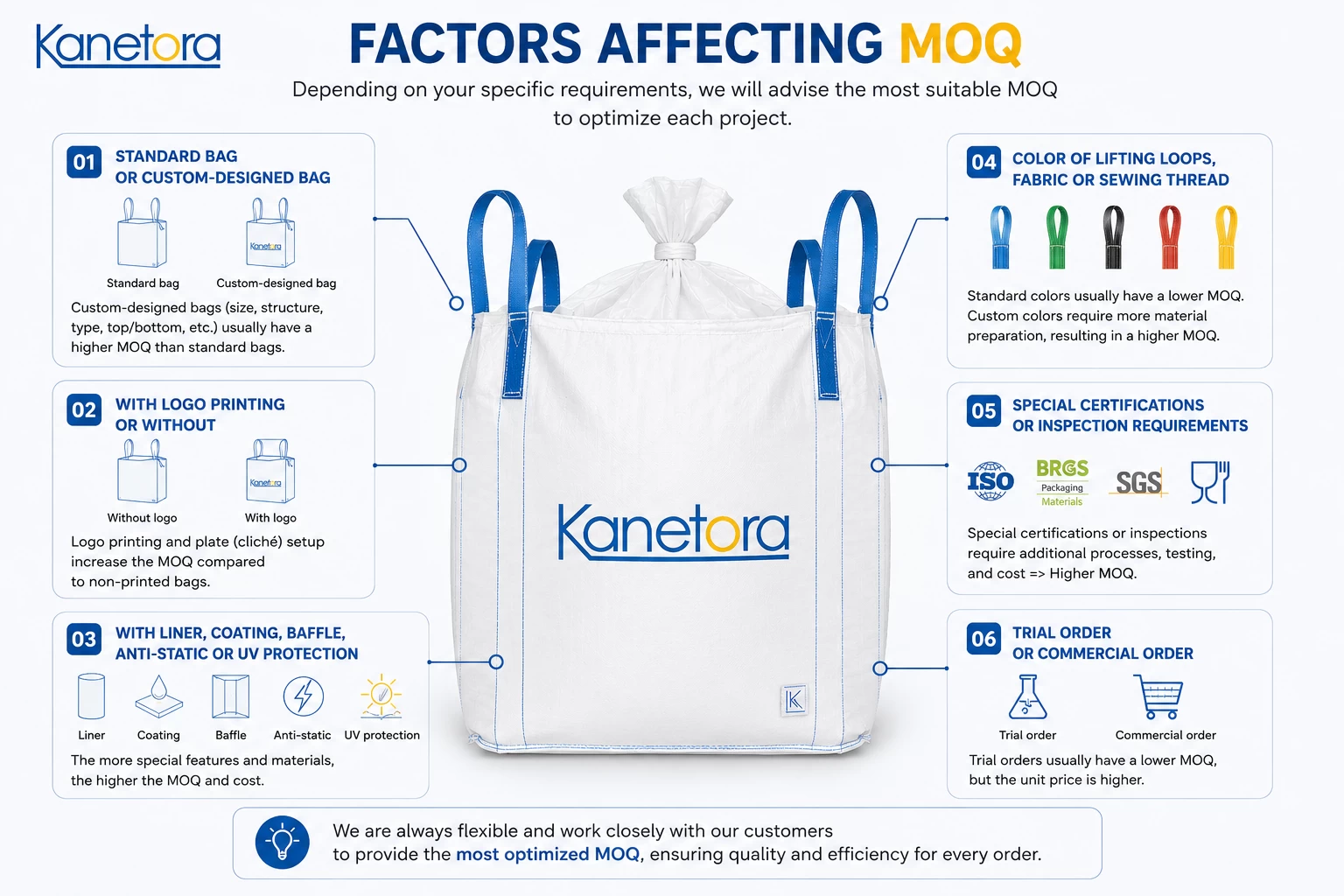
- Standard bag or fully customized bag.
- With or without logo printing.
- With liner, coating, baffle, anti-static, or anti-UV requirements.
- Color requirements for lifting loops, fabric, or stitching thread.
- Special certification or testing requirements.
- Trial order or commercial order.
Factors That Affect Lead Time
- Time required to confirm technical drawings.
- Sample approval process.
- Raw material availability.
- Order quantity.
- Quality inspection requirements.
- Packing method and shipment schedule.
At Kanetora Bach Dang, the factory operates a complete production system covering extrusion, belt weaving, fabric weaving, laminating, cutting/printing, sewing, inspection, and packing. This standardized 8-step production process helps control product quality and improve production flexibility.
How Does the OEM Production Process Work at an FIBC Factory?
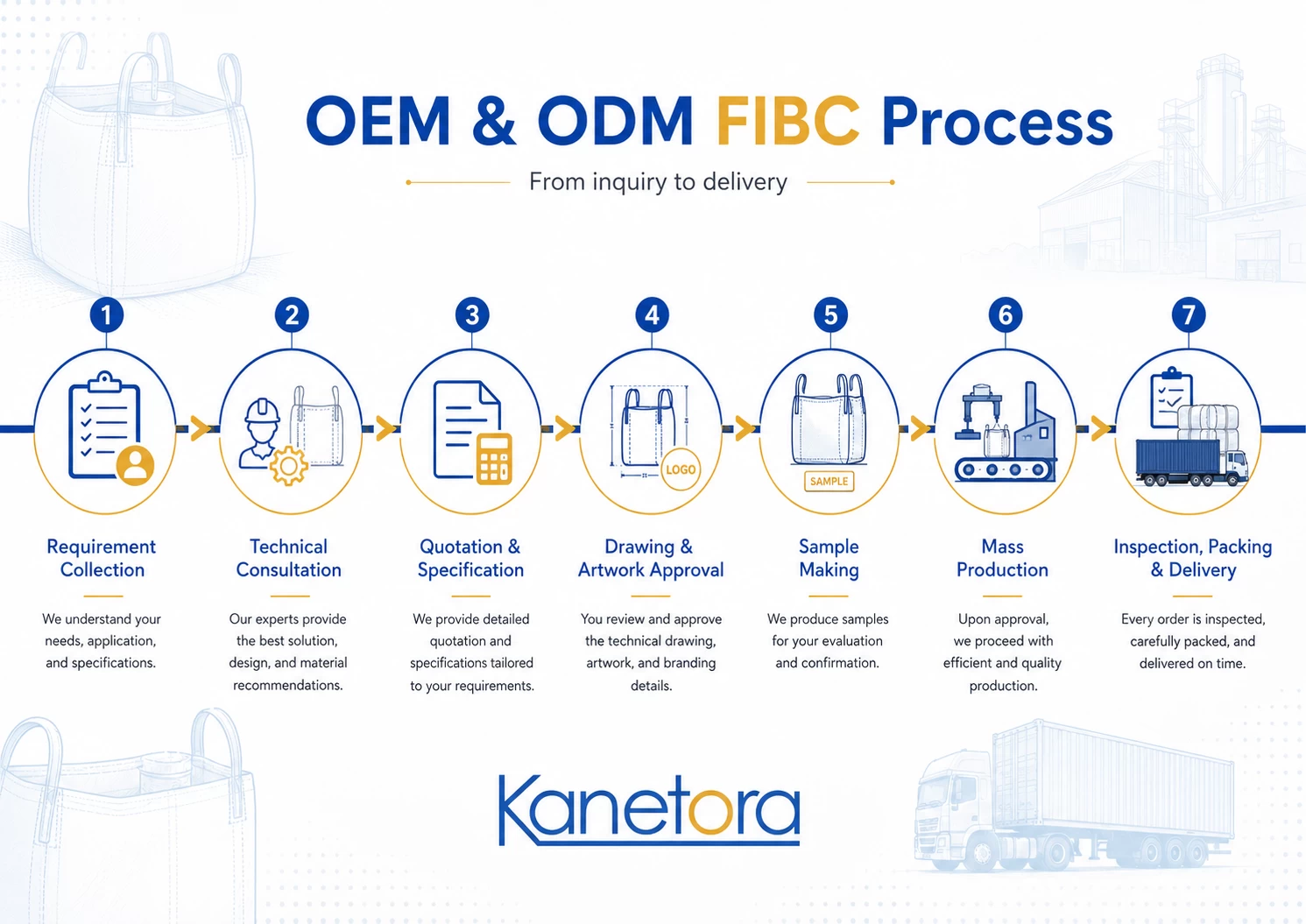
A typical OEM/ODM Jumbo bag production process includes seven main steps.
Step 1: Requirement Collection
The customer provides information about the product to be packed, safe working load, dimensions, export market, and technical requirements.
Step 2: Bag Structure Consultation
The factory recommends a suitable bag type, such as U-panel, 4-panel, circular, baffle, with liner, coating, or other special features.
Step 3: Preliminary Quotation
Based on the initial specifications, the factory provides an estimated price, MOQ, and expected lead time.
Step 4: Technical Drawing Development
Both sides confirm the bag drawing, logo position, lifting loop type, stitching style, filling top, discharge bottom, and packing method.
Step 5: Sample Making and Approval
For new or complex bag designs, sample approval helps reduce risks before mass production.
Step 6: Mass Production
The factory starts production according to the approved specifications, with quality control throughout the process.
Step 7: Inspection, Packing, and Delivery
Finished products are inspected, packed into bales, stored, and shipped according to customer requirements.
Kanetora Bach Dang is equipped with machinery for FIBC production, including weaving machines, sewing machines, automatic cutting machines, coating machines, metal detectors, UV testing machines, tensile testing machines, and top lift testing equipment.
Common Mistakes When Ordering OEM FIBC Bags
When ordering customized Jumbo bags, many problems do not come from production itself but from insufficient technical information at the beginning.
1. Providing Only Dimensions Without Describing the Product
The same bag size may require different designs depending on whether the product is powder, plastic resin, minerals, agricultural products, or food. Without a clear product description, the bag may not perform well in actual use.
2. Not Defining the Filling and Discharge Method
The filling top and discharge bottom must match the customer’s packing line and unloading process. Choosing the wrong design may lead to slower operation, leakage, or difficulty during discharge.
3. Not Checking Export Market Requirements
Some international customers may have specific requirements for food-grade production, metal detection, certification, labeling, or food-contact materials. Businesses should check these requirements before placing an order.
4. Designing a Logo That Is Too Small or Too Detailed
FIBC bags are usually printed on woven PP fabric. Therefore, the design should be large enough, clear, and easy to read.
5. Comparing Only Price and Ignoring Factory Capability
For Jumbo bags, low price should not be the only decision factor. Businesses should also evaluate quality control capability, production experience, certifications, delivery reliability, and technical support.
How to Choose the Right OEM/ODM FIBC Supplier
A suitable FIBC supplier is not only a company that can provide a quick quotation. It should be a partner that understands product requirements, handling conditions, and quality control.
Businesses should evaluate suppliers based on the following criteria:
| Criteria | Why It Matters |
|---|---|
| FIBC manufacturing experience | Helps recommend the right bag structure and reduce technical risks |
| Factory production capability | Ensures stable supply for commercial orders |
| QC/QA system | Controls quality during and after production |
| Certifications | Important for food, export, and high-standard applications |
| Customization capability | Essential for OEM/ODM projects |
| Technical support | Helps optimize bag design and cost |
| Delivery capability | Ensures production and export schedules |
Kanetora Bach Dang manufactures many semi-finished components in-house, including sling belts, webbings, labels, document pouches, liners, and other FIBC components. This helps improve quality consistency, increase flexibility for customized orders, and support faster lead time for customers.
Why Should Businesses Work Directly With an FIBC Manufacturer?
Working directly with a factory gives businesses several advantages compared with ordering through an intermediary.
First, businesses can discuss technical specifications, drawings, samples, and special requirements directly with the manufacturing team.
Second, the factory can provide practical recommendations to optimize the bag structure based on real production experience.
Third, costs may be more competitive because there are fewer intermediary layers.
Fourth, quality control, sample adjustment, and production progress can be monitored more clearly.
Especially for export orders or long-term OEM/ODM projects, choosing the right manufacturer from the beginning helps businesses reduce risks, stabilize quality, and build a more sustainable supply chain.
Quick Checklist Before Requesting a Quotation for OEM/ODM Jumbo FIBC Bags
Before contacting the factory, businesses can prepare the following checklist:
| Information to Prepare | Examples |
|---|---|
| Product to be packed | Powder, granules, agricultural products, food, minerals, chemicals |
| Safe Working Load | 500 kg, 1,000 kg, 1,500 kg, 2,000 kg |
| Bag dimensions | Width × depth × height |
| Bag construction | U-panel, 4-panel, circular, baffle |
| Top design | Open top, duffle top, inlet spout |
| Bottom design | Flat bottom, discharge spout, full open discharge |
| Liner/coating | Required or not required |
| Printing requirements | Logo, item code, warning text, export information |
| Required standards | Food-grade, ISO, BRC, FDA, EU food contact |
| Estimated quantity | Sample order, trial order, or commercial order |
| Export market | USA, EU, Japan, Korea, domestic market |
FAQ – Frequently Asked Questions About OEM/ODM Jumbo FIBC Bags
Is a technical drawing required for OEM FIBC production?
Not always. If the business does not have a technical drawing, it can provide an existing bag sample, photos, basic dimensions, or a description of its application. The factory can support technical consultation and drawing development.
Can Jumbo bags be printed with a private logo?
Yes. Businesses can print logos, item codes, warning information, transportation symbols, or importer details on the bag according to their requirements.
Can FIBC bags be used for food products?
Yes, but businesses should choose food-grade FIBC bags with suitable production and quality control processes. For food or sensitive ingredients, requirements related to certification, hygiene, dust control, and packing should be discussed clearly.
Should businesses choose U-panel, 4-panel, or circular FIBC bags?
It depends on the product type, load capacity, shape retention requirements, and cost target. U-panel bags are flexible and widely used; 4-panel bags provide better shape retention; circular bags have fewer side seams; baffle bags are suitable when businesses need better space optimization and reduced bulging.
When is an inner liner needed for Jumbo bags?
An inner liner is suitable for products that need moisture protection, dust control, leakage prevention, or better protection inside the bag. Powder, fine granules, food products, and some chemical products often require liners.
Conclusion
OEM/ODM Jumbo FIBC bags are suitable for businesses that need customized industrial packaging, especially in export, food, agriculture, chemicals, plastic resin, minerals, and construction material industries.
To place an order effectively, businesses should prepare clear information about the packed product, safe working load, dimensions, bag structure, printing requirements, technical standards, and export market. The more complete the information is, the faster and more accurate the consultation, quotation, sample approval, and production process will be.
With FIBC manufacturing capability, quality control systems, and experience in customized Jumbo bag solutions, Kanetora Bach Dang can support businesses in developing packaging solutions suitable for production, storage, and export.
Contact Kanetora Bach Dang for consultation on OEM/ODM Jumbo FIBC bag solutions tailored to your product requirements, technical standards, and export market needs.