

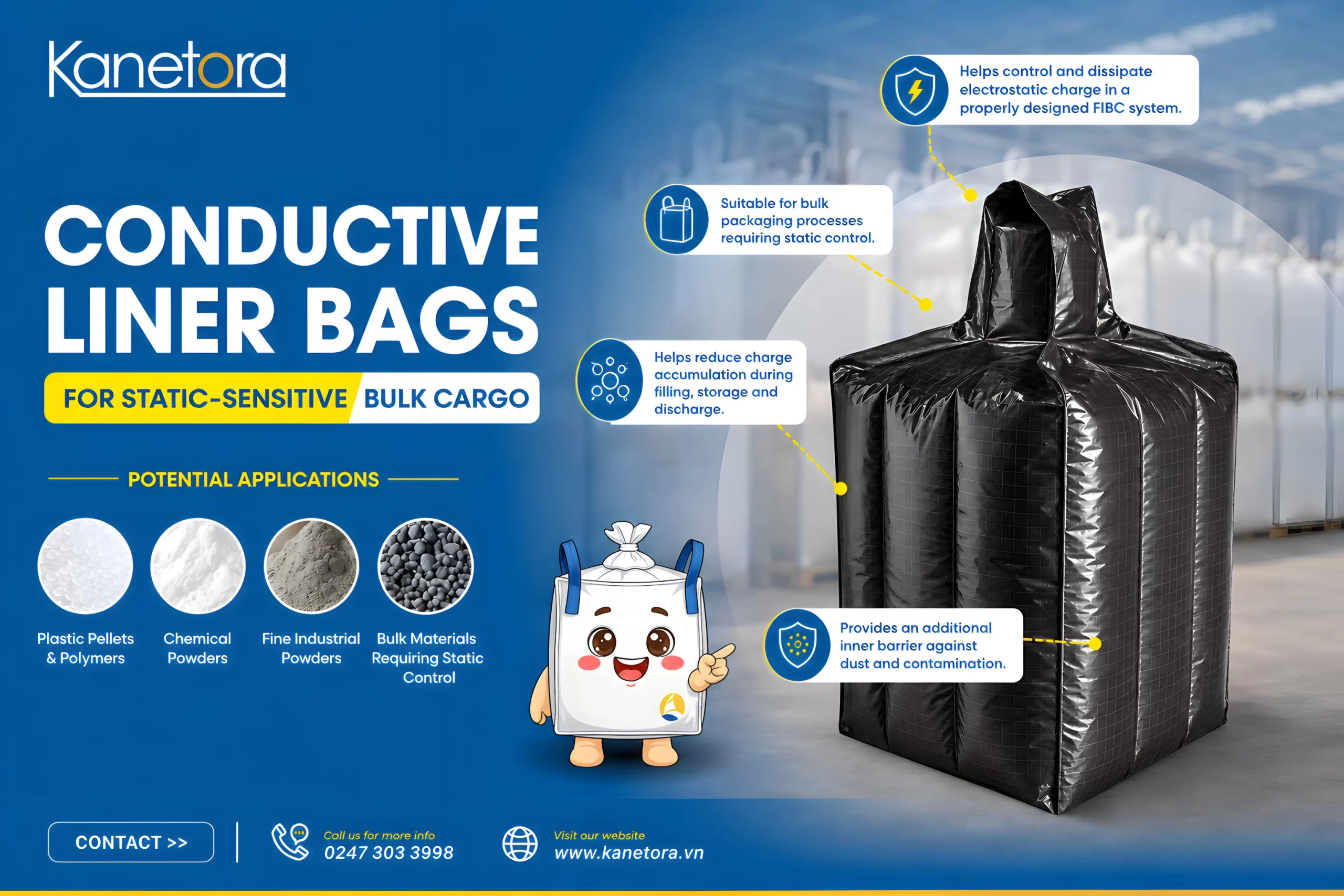
During the filling, handling and discharge of powders, plastic pellets, chemicals and other dry bulk materials, friction between the product, processing equipment and packaging surfaces can generate electrostatic charges.
Under ordinary operating conditions, these charges may not always present a significant hazard. However, where combustible dust, flammable gases or solvent vapors are present, an uncontrolled electrostatic discharge can potentially act as an ignition source.
This is where Conductive Liner Bags, also known as conductive FIBC inner liners, may form part of an electrostatic-control packaging system.
One point is essential from the beginning:
A conductive liner is not a stand-alone electrostatic safety solution.
The liner must be evaluated together with the outer FIBC, cargo characteristics, filling and discharge equipment, grounding arrangement and surrounding operating environment.
Quick Answer: What Is a Conductive Liner Bag?
A Conductive Liner Bag is an inner liner installed inside a Flexible Intermediate Bulk Container (FIBC) and engineered with materials that provide controlled electrical conductivity or electrostatic charge dissipation.
Depending on the liner design, the film may incorporate:
- Polyethylene (PE) or polypropylene (PP);
- Carbon-based conductive materials;
- Specialized conductive additives;
- Single-layer or multi-layer film structures;
- Conductive layers integrated into the film construction.
When incorporated into an appropriately designed FIBC system, a conductive liner may help:
- Control electrostatic charge generated by product movement;
- Reduce charge accumulation on liner surfaces;
- Facilitate charge transfer toward a grounding system where required;
- Protect the cargo from direct contact with woven PP fabric;
- Reduce powder leakage and contamination depending on liner construction.
However, the term “conductive” does not automatically mean that the complete FIBC is suitable for use in a potentially explosive atmosphere.
The entire packaging configuration must be evaluated as a system.
Why Can Bulk Materials Generate Static Electricity?
Static electricity can develop whenever materials contact, rub against and separate from different surfaces.
In an FIBC handling system, electrostatic charge may be generated during:
- Gravity filling;
- Pneumatic conveying;
- High-speed transfer of plastic pellets;
- Powder contact with liner surfaces;
- Product movement through pipelines;
- Discharge through an outlet spout;
- Bag lifting, vibration and handling;
- Processing under low-humidity conditions.
Fine powders deserve particular attention because their large surface area and frequent particle-to-surface interactions can increase charge generation.
The risk does not depend only on the product itself. The surrounding atmosphere also matters.
A material that generates static electricity may pose relatively little ignition risk in one environment but require significantly greater controls where combustible dust or flammable vapor is present.
For a broader comparison of electrostatic-protective FIBC systems, see Kanetora’s guide to Type C vs Type D FIBC Bags for Export Cargo.
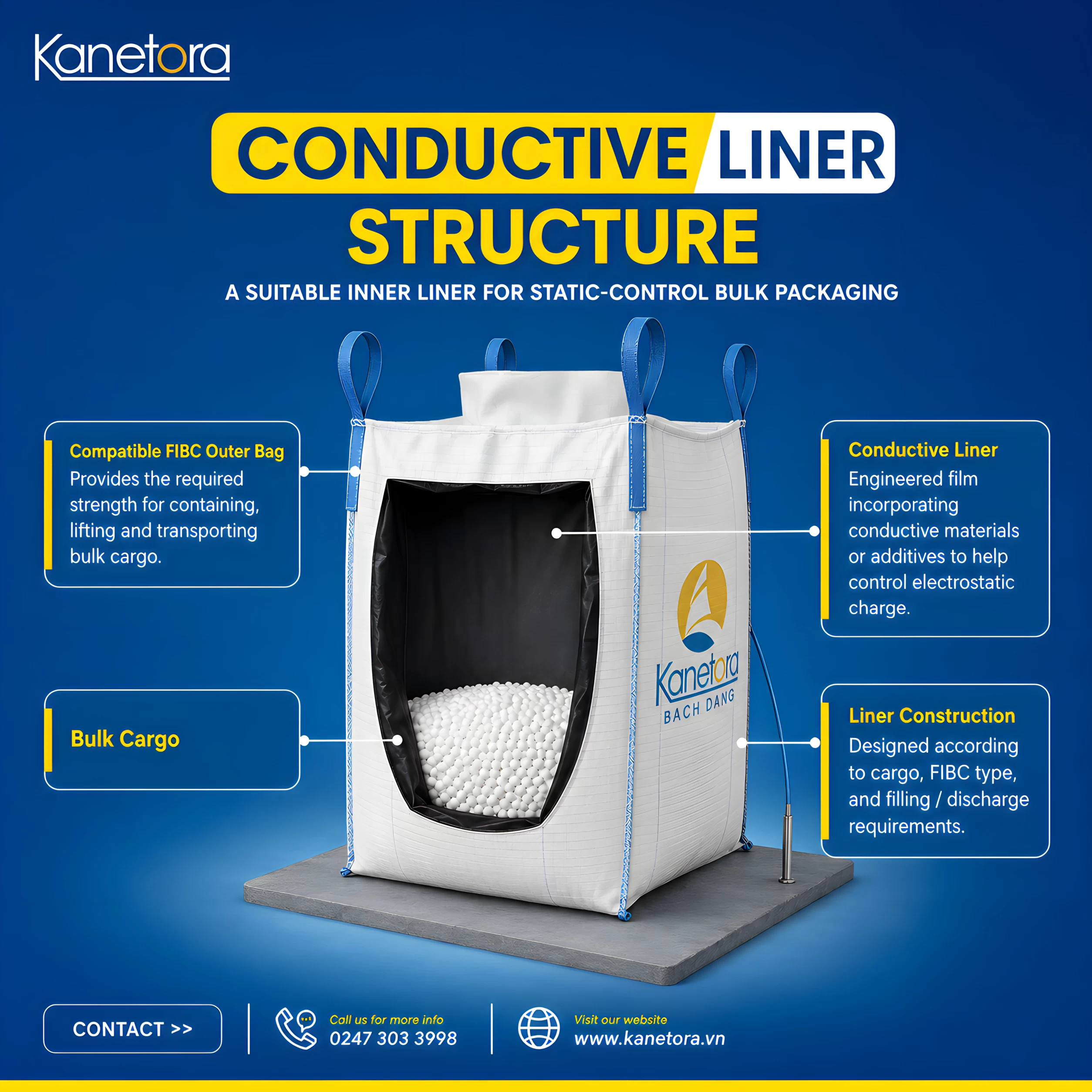
How Does a Conductive FIBC Liner Work?
Standard PE liners generally have relatively high electrical resistance.
A conductive liner is engineered differently. Conductive materials or additives are incorporated into the film structure to provide a controlled path for electrical charge.
Possible constructions may include:
- PE or PP polymer base;
- Carbon-based conductive components;
- Conductive masterbatch or specialized additives;
- Surface conductive layers;
- Conductive layers embedded within a multi-layer film;
- Customized conductive pathways according to the final FIBC design.
Kanetora’s industrial packaging portfolio includes conductive liners manufactured from PE/PP film combined with carbon or specialized conductive additives, alongside standard, baffled, reinforced and barrier liner configurations.
Yet electrical conductivity of the liner alone is only one part of the system.
The key question is not simply:
“Is this liner conductive?”
A technically stronger question is:
“Is this liner electrically classified and verified as compatible with the specific FIBC configuration and operating environment in which it will be used?”
Conductive Liner vs Anti-Static Liner vs Standard PE Liner
These terms are sometimes used interchangeably in commercial discussions, but they should not automatically be treated as technically identical.
| Feature | Standard PE Liner | Static-Dissipative / Anti-Static Liner | Conductive Liner |
|---|---|---|---|
| Main purpose | Moisture, dust and leakage protection | Reduce or dissipate static accumulation | Provide controlled electrical conductivity |
| Electrical behavior | Generally insulating | Controlled charge dissipation | Higher conductivity depending on design |
| Static-sensitive applications | Only when verified as suitable | Used in compatible static-control systems | Commonly used where a conductive path is required |
| Must be assessed with FIBC | Yes | Yes | Yes |
| Can be freely substituted | No | No | No |
For this reason, a commercial description such as “anti-static liner” is not enough to determine whether the liner is suitable for a particular application.
Buyers should clarify technical parameters such as:
- Liner electrical classification;
- Surface or volume resistance where applicable;
- Film construction;
- Static-dissipation mechanism;
- Compatible FIBC type;
- Grounding requirement;
- Final-system testing requirements;
- Cargo and operating environment.
For a broader overview of available inner liner configurations, see FIBC Bag with Liner: When and Why to Use.
Does a Conductive Liner Always Need Grounding?
Not necessarily based on the word “conductive” alone.
Grounding requirements depend on the complete packaging system, including:
- Liner classification;
- Outer FIBC type;
- Electrical connection design;
- Intended use;
- Operating environment;
- Applicable safety standard.
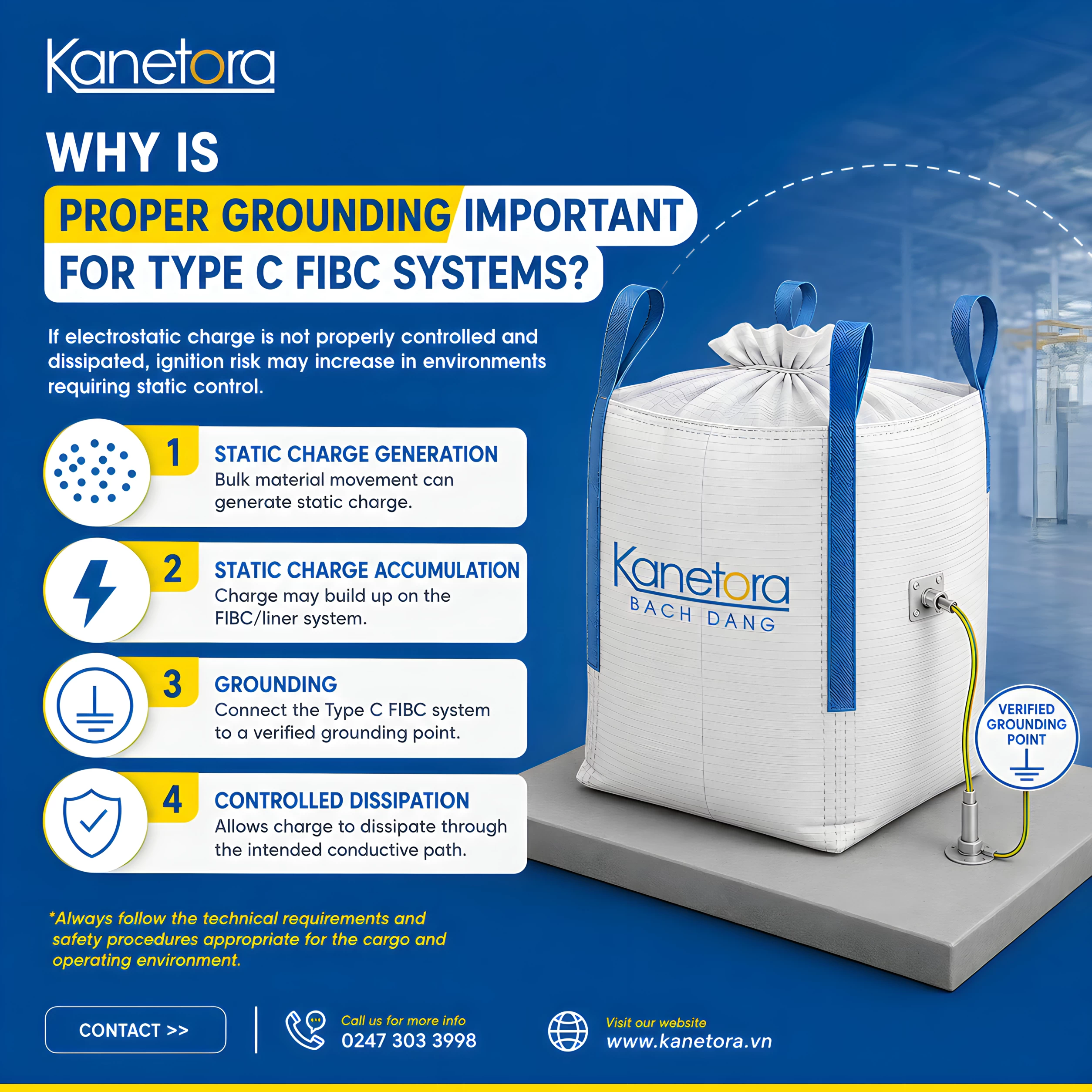
When a conductive liner forms part of a Type C FIBC system, the conductive components must generally be integrated into a grounding arrangement capable of safely transferring electrostatic charge to earth.
For Type C applications, the operating concept is therefore typically:
Conductive FIBC system → verified electrical connection → reliable grounding point
Grounding must be established before product movement begins and maintained throughout filling or discharge.
A Type C system should not be selected where reliable grounding cannot consistently be achieved.
Can a Conductive Liner Be Used with Type D FIBC?
It should not be assumed that any conductive liner can automatically be inserted into a Type D FIBC.
Type D FIBCs use specially engineered static-protective fabric designed to control electrostatic discharge without requiring a physical grounding connection.
Their performance depends on the complete bag construction.
Adding an incompatible liner can alter how electrostatic charge accumulates and dissipates within the system.
Therefore:
Do not purchase a conductive liner separately and install it into a Type C or Type D FIBC without technical confirmation from the FIBC manufacturer or responsible packaging engineer.
Kanetora explains the operating principles and selection considerations in greater detail in Type C vs Type D FIBC Bags for Export Cargo.
Which Bulk Materials May Require Conductive Liner Bags?
Conductive liners may be considered when the cargo can generate significant electrostatic charge or when filling and discharge take place in an environment requiring static control.
1. Chemicals and Petrochemicals
Potential applications include:
- Chemical powders;
- Pigments;
- Additives;
- Resin powders;
- Specialty chemicals;
- Chemical intermediates.
Fine chemical powders can create airborne dust during filling or discharge.
Where flammable gases, vapors or solvents are also present, electrostatic-risk assessment becomes especially important.
2. Plastic Resins and Polymers
Products such as:
- PP;
- PE;
- PET;
- Masterbatch;
- Polymer powders;
- Compounds;
- Engineering plastics;
- Resin pellets
can generate static electricity, particularly during pneumatic conveying or high-speed transfer.
However, not every shipment of plastic pellets requires a conductive liner or Type C/Type D FIBC.
The correct solution depends on the cargo, filling method, transfer speed, discharge operation and surrounding atmosphere.
Resin exporters can also review Kanetora’s Bulk Bags for Plastic Resin Export: Safe Packaging for PP, PE & PET.
3. Fine Industrial Powders
Fine powders can present several packaging challenges simultaneously:
- Electrostatic charge;
- Dust generation;
- Product leakage;
- Contamination;
- Moisture exposure;
- Difficult discharge.
For these applications, the final FIBC may require a combination of:
- Static-control liner;
- Dust-proof seams;
- Closed filling system;
- Suitable discharge spout;
- Appropriate fabric construction;
- Correct grounding arrangement where required.
4. Pharmaceutical and Specialty Ingredients
High-value powders and specialty ingredients may require greater control over:
- Electrostatic behavior;
- Foreign particles;
- Product leakage;
- Cleanliness;
- Traceability;
- Liner integrity.
In these applications, conductivity is only one parameter within a broader packaging specification.
5. Fertilizers and Agricultural Chemicals
Some fertilizer and agrochemical products may be:
- Hygroscopic;
- Dust-generating;
- Chemically reactive;
- Sensitive to contamination;
- Capable of generating electrostatic charge during handling.
Their packaging therefore may need to combine:
- Appropriate inner liner;
- Moisture protection;
- Dust-proof seams;
- Static control;
- Secure filling closure;
- Controlled discharge design.
A Conductive Liner Does Not Replace the Correct FIBC Type
One common misconception is:
“If we put an anti-static or conductive liner inside a normal jumbo bag, the bag becomes static-safe.”
This is not technically correct.
Type A, B, C and D FIBCs are classified according to the design and electrostatic behavior of the complete FIBC system, not simply one individual component.
A conductive liner does not automatically convert a Type A FIBC into a Type C FIBC.
Likewise, installing an unsuitable liner inside a Type C or Type D FIBC may alter the performance of the tested or approved configuration.
FIBC selection should therefore follow a complete system approach:
Cargo → Liner → FIBC → Filling System → Grounding → Operating Environment
Buyers who are still determining the most appropriate FIBC structure can review How to Choose the Right FIBC Bulk Bag for Each Industry.
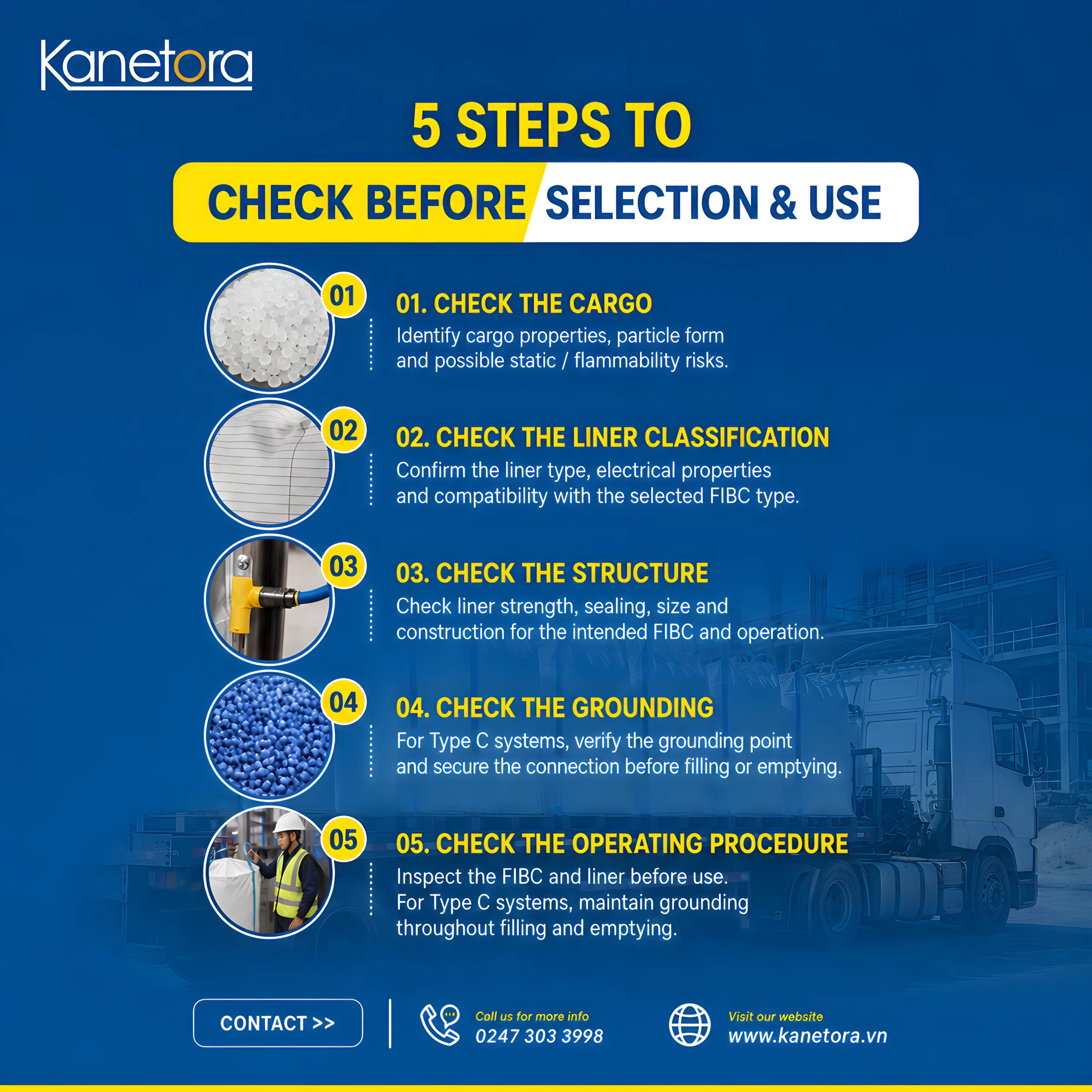
Static Risk Assessment Checklist Before Ordering Conductive Liners
Before specifying a conductive liner, buyers should collect sufficient information about both the product and the handling process.
1. Cargo Information
Useful information includes:
- Product name;
- Chemical composition;
- Powder, pellet, granule or flake form;
- Particle size;
- Bulk density;
- Moisture content;
- Dust-generation characteristics;
- Hygroscopicity;
- Combustibility data where available;
- Minimum ignition energy where applicable;
- Dangerous-goods classification if relevant.
2. Filling Method
The supplier should understand:
- Gravity filling or pneumatic filling;
- Filling speed;
- Product flow rate;
- Product temperature;
- Pipeline material;
- Free-fall distance;
- Filling-spout configuration;
- Nearby conductive equipment.
Pneumatic conveying and high transfer velocities are particularly relevant when evaluating static generation.
3. Discharge Method
Important parameters include:
- Gravity discharge;
- Discharge spout;
- Vacuum discharge;
- Discharge into a silo;
- Discharge into a mixer;
- Open or closed discharge system;
- Discharge rate.
Static electricity can be generated during discharge as well as during filling.
4. Operating Environment
The risk assessment should establish whether the area contains:
- Combustible dust;
- Flammable gases;
- Flammable vapors;
- Solvent vapor;
- Classified hazardous areas;
- Low-humidity conditions;
- Reliable grounding infrastructure;
- Isolated conductive objects.
5. End-User Requirements
For international shipments, the packaging specification should reflect operating conditions at:
- The filling plant;
- Warehouses;
- Transshipment facilities;
- Destination storage facilities;
- The customer’s discharge line.
A configuration that works correctly at the exporter’s plant may not be appropriate if the receiving facility uses a different discharge system or cannot provide the required grounding arrangement.
Safety Checklist for Conductive Liners Used with Type C FIBC
Where the conductive liner forms part of a Type C configuration, operators should follow a clearly defined handling procedure.
Before Filling
Check:
- FIBC condition;
- Inner liner condition;
- Grounding point;
- Grounding clamp;
- Grounding cable;
- Verified earth connection;
- Correct liner specification;
- Correct bag identification.
Do not substitute another liner type without technical approval.
During Filling
Operators should:
- Connect the FIBC to earth before filling begins;
- Maintain grounding continuously;
- Avoid disconnecting the grounding clamp;
- Follow specified filling rates;
- Keep the liner correctly positioned;
- Avoid unauthorized process changes.
During Discharge
Operators should:
- Maintain grounding;
- Use the intended discharge arrangement;
- Prevent liner displacement;
- Prevent the liner from being drawn into downstream equipment;
- Maintain the specified product flow;
- Disconnect grounding only after material movement has stopped.
What Specifications Should Buyers Provide for Conductive FIBC Liners?
A professional RFQ should contain more information than simply:
“Conductive PE liner required.”
A more useful specification may include:
| Specification Area | Information to Confirm |
| Product | Material, particle size and bulk density |
| Electrical Requirement | Conductive or static-dissipative classification |
| FIBC Type | Type C, Type D or other specified system |
| Liner Material | PE, PP or multi-layer structure |
| Construction | Lay-flat, gusseted or form-fit |
| Thickness | According to cargo and mechanical requirements |
| Fixing Method | Loose, tabs, flanges or customized attachment |
| Filling Design | Open top or filling spout |
| Discharge Design | Flat bottom or discharge spout |
| Barrier Requirement | Moisture, oxygen or odor protection where required |
| Static Requirement | Compatibility with complete FIBC system |
| Testing | Applicable electrical and mechanical verification |
| Traceability | Production batch and QC documentation |
This approach reduces ambiguity and helps the manufacturer engineer a solution for the actual operating conditions rather than supplying a generic liner.
Do Tabs, Flanges and Form-Fit Design Matter?
Yes.
Electrical performance is not the only factor determining whether an inner liner performs properly.
The liner must also remain correctly positioned during filling, transportation and discharge.
Top and Bottom Tabs
Fixing tabs can help prevent the liner from:
- Twisting;
- Collapsing;
- Moving downward during filling;
- Being drawn upward during discharge;
- Shifting away from the intended position.
Top and Bottom Flanges
Flanged liner designs can help secure the liner around filling and discharge spouts.
They may be particularly useful where controlled connection between the liner and filling/discharge system is required.
Form-Fit Liners
A form-fit liner is designed to follow the internal geometry of the FIBC more closely.
Potential benefits include:
- Less excess film;
- Reduced folding;
- More predictable filling;
- Improved discharge behavior;
- Better liner positioning.
For conductive applications, mechanical design, fixing method and electrical characteristics should therefore be considered together.
Are Conductive Liners Moisture-Resistant?
They can provide moisture protection, but a conductive liner should not automatically be assumed to deliver the same barrier performance as a dedicated high-barrier liner.
PE and PP liners generally provide additional protection against:
- Moisture;
- Dust;
- Product leakage;
- External contamination.
However, highly moisture-sensitive, oxygen-sensitive, light-sensitive or odor-sensitive materials may require a different multi-layer barrier structure.
Packaging design may therefore need to balance:
Static Control + Moisture Barrier + Mechanical Performance + Filling Efficiency + Discharge Performance
rather than maximizing only one property.
Conductive Liners and Packaging for the European Union
For businesses exporting packaged products to the European Union, liner selection increasingly involves more than mechanical and electrostatic performance.
The EU Packaging and Packaging Waste Regulation (PPWR) introduces a broader framework covering packaging composition, restricted substances, recyclability, recycled content, documentation, traceability and end-of-life considerations.
A liner forms part of the overall packaging configuration.
Therefore, conductive additives, multi-material structures and specialized film designs may need to be considered alongside future recyclability and material-management requirements.
Companies supplying FIBC bags or packaged bulk products to Europe can read Kanetora’s detailed update: EU PPWR Applies from August 2026: What FIBC, Liners and Plastic Film Suppliers Need to Prepare.
Conductive Liner and FIBC Solutions from Kanetora
Kanetora provides an integrated industrial packaging portfolio covering FIBC/Jumbo Bags, FIBC Inner Liners and multi-layer plastic films, allowing packaging structures to be developed according to individual cargo and operating requirements.
Kanetora’s liner portfolio includes:
- Standard liners;
- Lay-flat and gusseted liners;
- Liners with four top and four bottom tabs;
- Top and bottom flange liners;
- Reinforced side-seal liners;
- Baffled liners;
- Conductive liners;
- Aluminum barrier liners.
Conductive liners can be engineered using PE/PP film combined with carbon or specialized conductive additives depending on the required design.
Kanetora Bach Dang’s manufacturing platform also supports FIBC and inner-liner production, with capabilities covering film extrusion, liner sealing, liner insertion and multiple mechanical quality-control processes.
Rather than approaching conductive packaging as an isolated film specification, Kanetora recommends evaluating the complete system:
Cargo → Static Risk → FIBC Type → Liner → Filling/Discharge Design → Grounding → Operating Procedure
This system-based approach is particularly important for chemicals, plastic resins, fine powders and other static-sensitive industrial cargo.
When Should a Business Consider a Conductive Liner?
A conductive or electrostatic-control liner should be considered when:
- The product can generate significant electrostatic charge;
- Fine powders or pellets are transferred at high speed;
- Pneumatic conveying is used;
- Combustible dust may be present;
- Flammable gases or vapors may exist nearby;
- The buyer specifies electrostatic-control requirements;
- A Type C or another engineered static-protective FIBC configuration requires a compatible liner.
A conductive liner should not be selected simply because it appears to provide “extra safety.”
In electrostatic systems, changing one component may change the electrical behavior of the entire configuration.
FAQ: Conductive Liner Bags
What is a Conductive Liner Bag?
A Conductive Liner Bag is an inner liner used inside an FIBC and engineered with conductive materials or additives to help control electrostatic charge during filling, handling and discharge.
Is a conductive liner the same as an anti-static liner?
Not necessarily.
“Conductive,” “static-dissipative” and “anti-static” can describe different electrical characteristics. The exact liner classification and its compatibility with the complete FIBC system should be confirmed.
Does a conductive liner need grounding?
It depends on the system.
When used as part of a Type C FIBC configuration designed to transfer charge to earth, reliable grounding is required throughout filling and discharge.
Can conductive liners be used with Type D FIBC bags?
They should not be combined automatically.
Type D performance depends on the complete static-protective construction, so the liner must be verified as compatible with the specific Type D FIBC design.
Can a conductive liner convert a Type A FIBC into Type C?
No.
Adding a conductive liner does not automatically change the electrostatic classification of the outer FIBC.
Do PP and PE resin pellets require conductive liners?
Not in every application.
The decision depends on charge-generation characteristics, filling method, transfer velocity, surrounding atmosphere, discharge method and end-user requirements.
Are conductive liners moisture-resistant?
PE/PP conductive liners can provide additional moisture and contamination protection, but applications requiring very high moisture, oxygen or odor barriers may need a specialized barrier structure.
What information should be provided when ordering a conductive liner?
Buyers should provide product characteristics, particle size, bulk density, filling and discharge method, operating environment, FIBC type, grounding requirements, liner dimensions, thickness, construction, fixing method and applicable technical requirements.
Conclusion
Conductive Liner Bags can play an important role in packaging static-sensitive bulk cargo, but electrostatic safety depends on the complete FIBC system rather than the liner alone.
For chemicals, plastic resins, masterbatch, industrial powders, specialty ingredients and other bulk materials handled in potentially hazardous environments, buyers should evaluate:
- Cargo electrostatic characteristics;
- Filling and discharge conditions;
- FIBC type;
- Liner electrical classification;
- Grounding requirements;
- Filling and discharge configuration;
- Liner fixing method;
- Testing requirements;
- Operating procedures at both origin and destination.
Instead of selecting a generic “conductive liner,” a safer and more technically reliable approach is to develop a complete packaging specification based on the actual operating conditions.
Kanetora provides customized FIBC and inner-liner solutions for plastics, chemicals, food ingredients, minerals and industrial bulk cargo. For Conductive Liners, Type C FIBC or other electrostatic-control packaging requirements, businesses can work with Kanetora to evaluate the cargo, filling and discharge process, liner construction and operating environment before defining the final packaging specification.