

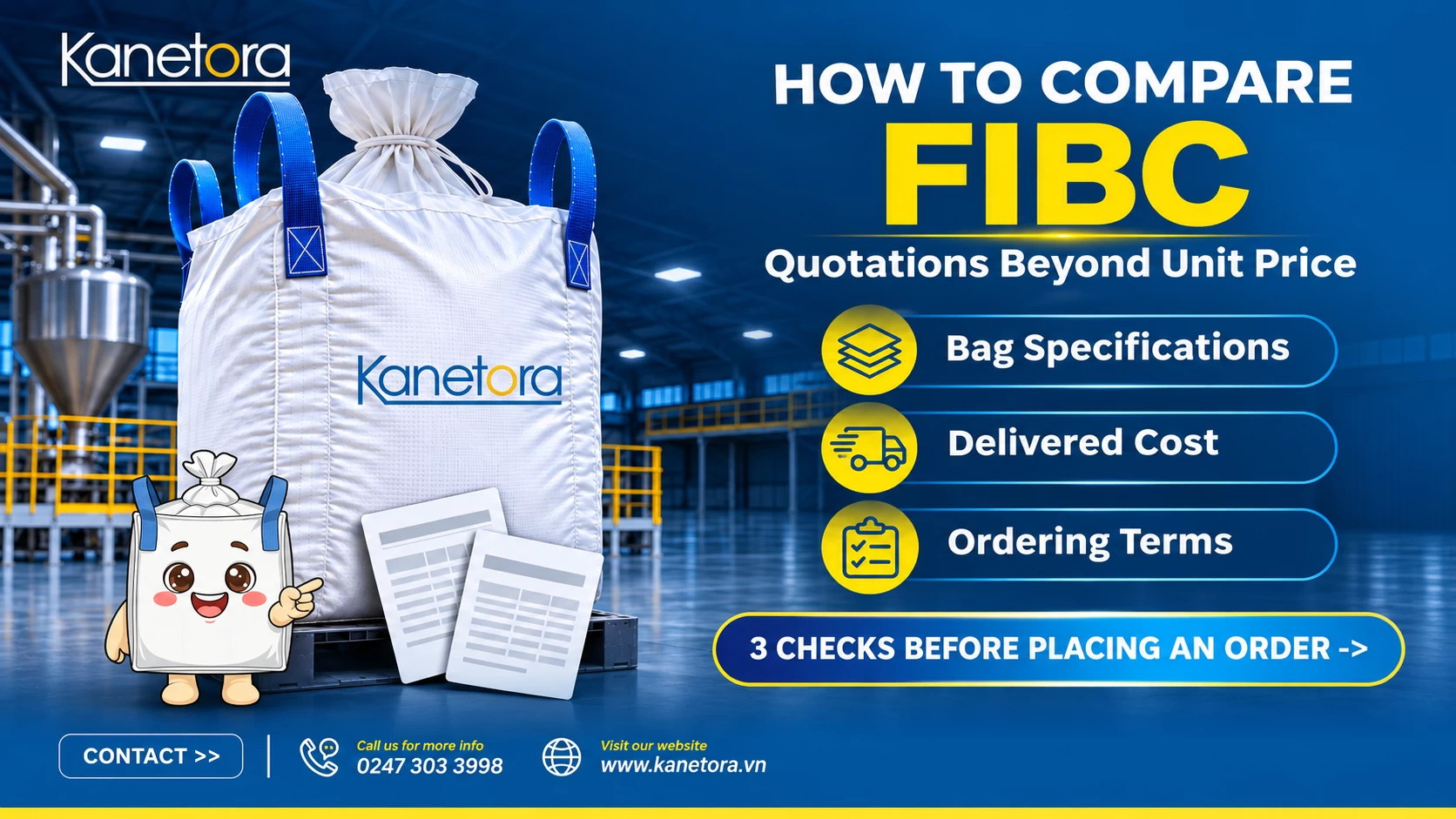
When sourcing Flexible Intermediate Bulk Containers (FIBCs), also known as Jumbo Bags or Bulk Bags, price is often one of the first factors purchasing teams consider. However, comparing FIBC quotations based solely on unit price can lead to misleading conclusions and potentially expensive procurement decisions.
Two suppliers may offer what appears to be the same 1,000 kg bulk bag, yet their quotations can differ significantly in material specifications, construction methods, quality assurance, certifications, packaging efficiency and delivery conditions.
A lower-priced bag may initially reduce purchasing expenditure but introduce additional costs through product damage, operational inefficiencies, shipment delays or inconsistent quality.
For international buyers, the real objective should be to identify the best total value of an FIBC solution, rather than simply selecting the lowest quoted price.
This guide explains how to compare FIBC quotations systematically, evaluate supplier capabilities and make informed procurement decisions based on safety, performance and total cost of ownership.
Quick Answer: How Should Buyers Compare FIBC Quotations?
To compare FIBC quotations accurately, buyers should evaluate seven essential factors:
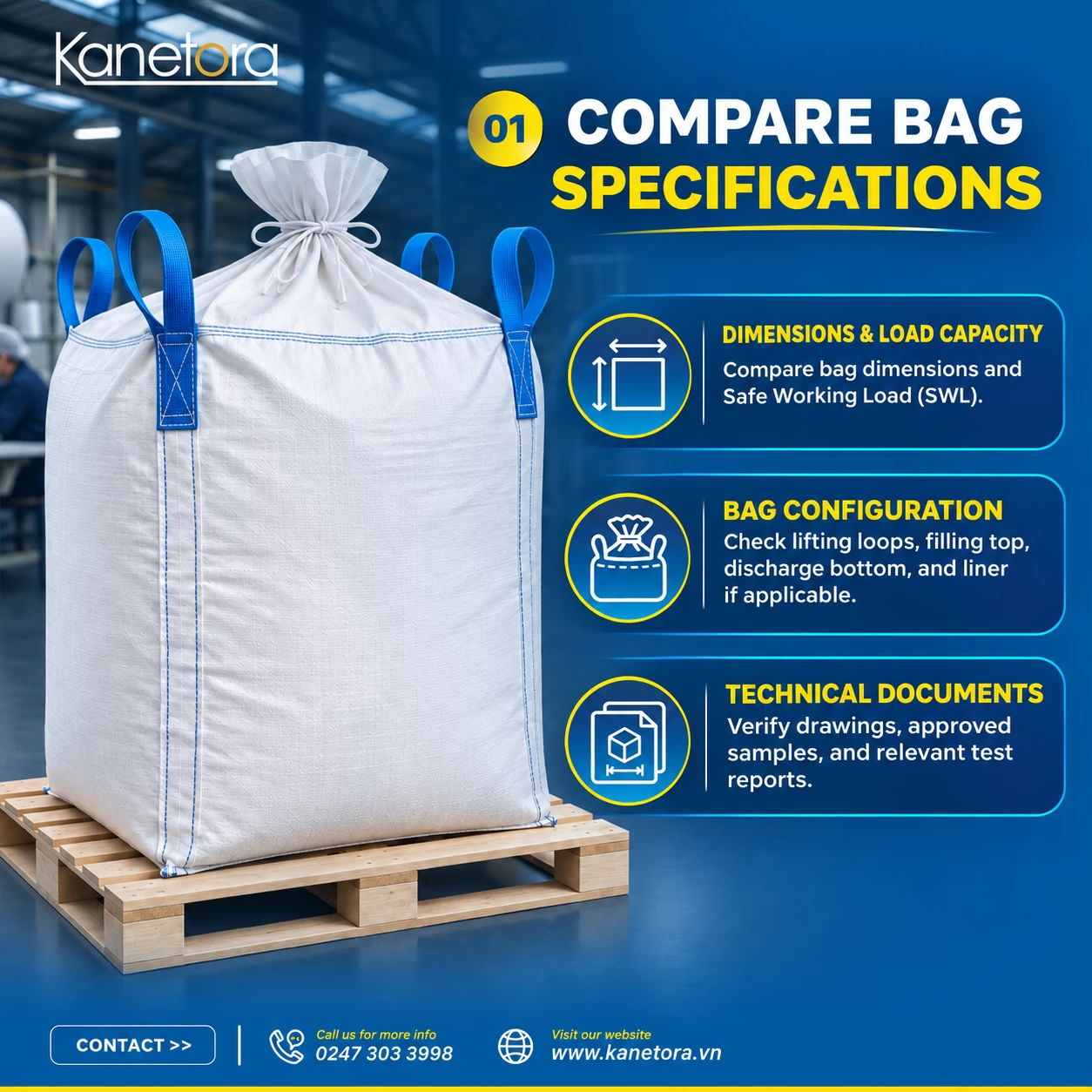
- Technical specifications: Ensure that all suppliers quote against equivalent bag designs, dimensions, materials and Safe Working Loads.
- Safety and compliance: Verify Safety Factor, relevant testing requirements, certifications and application-specific compliance.
- Material and construction quality: Compare fabric specifications, lifting loops, stitching, coating and liner construction.
- Manufacturing and quality control: Assess production capabilities, inspection procedures and product traceability.
- MOQ and lead time: Review minimum order quantities, production schedules and supply reliability.
- Logistics and commercial terms: Compare Incoterms, packing methods, transportation costs and payment conditions.
- Total Cost of Ownership (TCO): Consider the full cost of purchasing, handling and using the bags, including potential operational risks.
A meaningful comparison begins with a standardized technical specification and a consistent commercial basis.
1. Why Comparing FIBC Unit Prices Alone Can Be Misleading
Unlike standardized consumer products, FIBC bags are industrial packaging solutions that can be designed for specific materials, handling conditions and transportation requirements.
For example, two suppliers may quote a nominally identical 1-ton FIBC, but their products may differ in:
- Polypropylene fabric weight and construction
- Safe Working Load (SWL) and Safety Factor (SF)
- Circular, U-panel, 4-panel or baffle design
- Coated or uncoated woven fabric
- Lifting loop dimensions and reinforcement
- Stitching patterns and seam construction
- Inner liner materials and thickness
- Filling and discharge configurations
- Dust-control or electrostatic-protection features
- Quality inspection and testing requirements
These differences directly affect material consumption, production complexity and overall manufacturing costs.
A basic uncoated FIBC intended for non-hazardous mineral products should not be compared directly with a food-grade FIBC manufactured under controlled hygiene conditions.
Similarly, a standard industrial bag may not provide the same functional protection as a specially designed FIBC for chemical powders.
For a deeper technical explanation, see FIBC Bags for Chemical Powders: Safety, Liners and Discharge Options for Export.
Key takeaway: Before evaluating prices, buyers must confirm that suppliers are offering technically comparable products.
2. Compare FIBC Technical Specifications on an Equal Basis
The first step in evaluating quotations is establishing a standardized Request for Quotation (RFQ).
Without clearly defined technical requirements, suppliers may make different assumptions, resulting in quotations that are difficult to compare.
2.1. Safe Working Load and Safety Factor
Safe Working Load (SWL) refers to the maximum load an FIBC is certified to carry under its intended operating conditions.
The Safety Factor (SF) expresses the relationship between the applicable top-lift test performance and the rated SWL.
According to ISO 21898:2024, which covers FIBCs for non-dangerous goods, SWL and SF are fundamental specifications used to evaluate bag performance.
Common FIBC classifications include:
| Specification | Typical application |
|---|---|
| SWL 500 kg | Smaller-volume industrial applications |
| SWL 1,000 kg | Common bulk material handling |
| SWL 1,500–2,000 kg | Higher-capacity industrial applications |
| SF 5:1 | Single-trip FIBC |
| SF 6:1 | Standard-duty reusable FIBC, subject to applicable requirements |
The Safety Factor should not be interpreted as permission to overload a bag during normal operations.
For example, an FIBC marked SWL 1,000 kg and SF 5:1 is not intended to carry 5,000 kg in service.
Buyers should confirm that the quoted FIBC meets the relevant performance requirements and request supporting test documentation where appropriate.
2.2. Fabric Weight and Material Specifications
Fabric specifications influence bag strength, weight, flexibility and manufacturing cost.
Purchasing teams should compare:
- Virgin or recycled polypropylene content, where appropriate
- Fabric weight expressed in grams per square meter (GSM)
- Yarn characteristics and weaving consistency
- Fabric tensile performance
- Coating type and coating weight
- UV stabilization requirements
A higher fabric GSM does not automatically guarantee a better FIBC.
Bag performance depends on the combination of fabric construction, yarn properties, seam strength, lifting systems and overall design.
The correct specification should be determined by the intended application and verified through appropriate testing.
2.3. Bag Construction and Dimensions
FIBC construction affects production costs, filling behavior, stability and handling efficiency.
| FIBC construction | Key characteristics |
|---|---|
| Circular FIBC | Tubular woven body with fewer vertical body seams |
| U-panel FIBC | Main U-shaped fabric panel with two side panels |
| 4-panel FIBC | Four side panels with a separate bottom panel |
| Baffle FIBC | Internal baffles help maintain a more rectangular filled shape |
Buyers should compare both nominal dimensions and actual filled-bag performance.
For export applications, the bag’s final dimensions after filling can influence pallet utilization and container loading.
A slightly more expensive baffle bag may provide operational benefits if its design improves space utilization or load stability.
However, these benefits should be verified against the actual product, filling process and transportation configuration.
For custom FIBC specifications, refer to OEM/ODM Jumbo FIBC Bags: What Businesses Need to Prepare Before Placing a Production Order.
3. Evaluate Liner, Coating and Specialized Protection Requirements
One of the most common reasons for differences in FIBC quotations is the inclusion or exclusion of protective features.
A supplier may quote only the woven outer bag, while another quotation includes a PE liner, coating or specialized protection.
These quotations should not be treated as equivalent.
3.1. Inner Liner Specifications
Inner liners can help protect bulk materials against moisture, dust, contamination or other exposure risks.
Depending on the product, buyers may consider:
- Standard lay-flat PE liners
- Gusseted liners
- Form-fit liners
- Baffle liners
- Conductive or static-protective liners
- Multilayer barrier liners
Important comparison parameters include liner thickness, dimensions, sealing method, material composition and attachment configuration.
For moisture-sensitive powders, the appropriate liner design can be more important than a small difference in the outer bag’s purchase price.
3.2. Coating and Dust-Control Performance
Coated FIBCs can provide additional resistance to dust leakage and moisture penetration compared with certain uncoated constructions.
However, coating alone does not make an FIBC hermetically sealed or suitable for every moisture-sensitive product.
Buyers should assess the complete packaging system, including seams, filling openings, discharge spouts and liners.
3.3. Electrostatic Protection
For powders handled in potentially hazardous environments, electrostatic properties may become a critical safety requirement.
FIBC Type A, B, C and D designs have different electrostatic characteristics and operating requirements.
A Type C or Type D solution should not be selected simply because it appears more advanced.
The appropriate specification depends on the material, minimum ignition energy, operating environment, grounding arrangements and other relevant hazards.
Suppliers should provide evidence supporting the suitability of the proposed packaging system.
Buyer recommendation: Request separate pricing for optional liner, coating, anti-UV and electrostatic-protection features whenever commercially practical.
This makes it easier to distinguish essential technical requirements from optional enhancements.
4. Compare Quality Assurance, Testing and Certifications
Two FIBC manufacturers may offer similar specifications but operate under substantially different quality-management systems.
The ability to manufacture consistently is an important part of supplier evaluation.
4.1. Relevant Testing Capabilities
Depending on the application, buyers may request documentation covering:
- Fabric tensile strength
- Seam strength
- Lifting loop performance
- Top-lift testing
- UV resistance
- Liner tensile and sealing strength
- Puncture resistance
- Product cleanliness
- Final visual inspection
Testing should be appropriate to the bag design, applicable standards and intended operating conditions.
4.2. Manufacturing Certifications
Supplier certifications can help buyers understand the maturity of a manufacturer’s management systems.
Relevant examples include:
| Certification or framework | Main consideration |
|---|---|
| ISO 9001 | Quality management systems |
| ISO 14001 | Environmental management systems |
| ISO 22000 | Food safety management systems |
| BRCGS Packaging Materials | Packaging safety, quality and operational controls |
| ISO 21898 | Requirements for FIBCs intended for non-dangerous goods |
| UN dangerous goods requirements | Applicable approval, testing and marking for regulated dangerous goods packaging |
It is important to distinguish between management-system certifications, product-specific test reports and regulatory packaging approvals.
For instance, an ISO 9001 certificate does not automatically establish that every FIBC produced by a facility meets a particular SWL or Safety Factor.
Likewise, food-contact suitability must be evaluated against the relevant materials, intended use, test results and market requirements.
Buyers sourcing food-related packaging can explore Food Grade FIBC Bags: Standards & Requirements.
For regulated hazardous materials, refer to UN Certified FIBC Bags for Hazardous Materials Export.
5. Evaluate Manufacturing Capability and Supplier Reliability
A competitive FIBC quotation is valuable only if the supplier can consistently manufacture and deliver the required product.
International buyers should therefore evaluate production capability alongside pricing.
Important questions include:
Does the manufacturer control key production stages?
Integrated manufacturing may offer greater visibility over raw materials, woven fabric, webbing, liners, sewing and final inspection.
Can the supplier maintain specification consistency?
Repeat orders should match approved technical drawings, materials and performance requirements.
Does the supplier have sufficient production capacity?
Capacity planning becomes particularly important for recurring orders, multiple SKUs and seasonal demand.
How are quality issues managed?
Buyers should understand the supplier’s inspection procedures, traceability system and corrective-action process.
Can the supplier support customized requirements?
Complex FIBC projects may require technical consultation, sample development and production adjustments.
A manufacturer with strong technical and operational capabilities may provide better long-term value, even when its initial unit quotation is not the lowest.
6. Compare MOQ, Lead Time and Delivery Reliability
Minimum Order Quantity (MOQ) and lead time can materially affect procurement costs.
A lower unit price may require a larger purchase volume, resulting in higher inventory expenditure and additional storage requirements.
Similarly, longer or less reliable production schedules may increase the risk of production interruptions.
Buyers should request clear information about:
- MOQ per design and SKU
- Sample development and approval time
- Production lead time
- Production capacity for recurring orders
- Packing and dispatch schedules
- Lead-time assumptions
- Delivery flexibility during demand fluctuations
For example, Supplier A may offer a lower price with an MOQ of 20,000 bags, while Supplier B offers a slightly higher price with an MOQ of 5,000 bags.
If the buyer requires only 5,000 bags per quarter, Supplier B may offer better inventory flexibility and cash-flow efficiency.
The best option depends on demand forecasts, storage costs, purchasing strategy and supply reliability.
For more information, read FIBC Bag MOQ and Lead Time: Export Quote Factors.
7. Compare Logistics, Packing and Incoterms
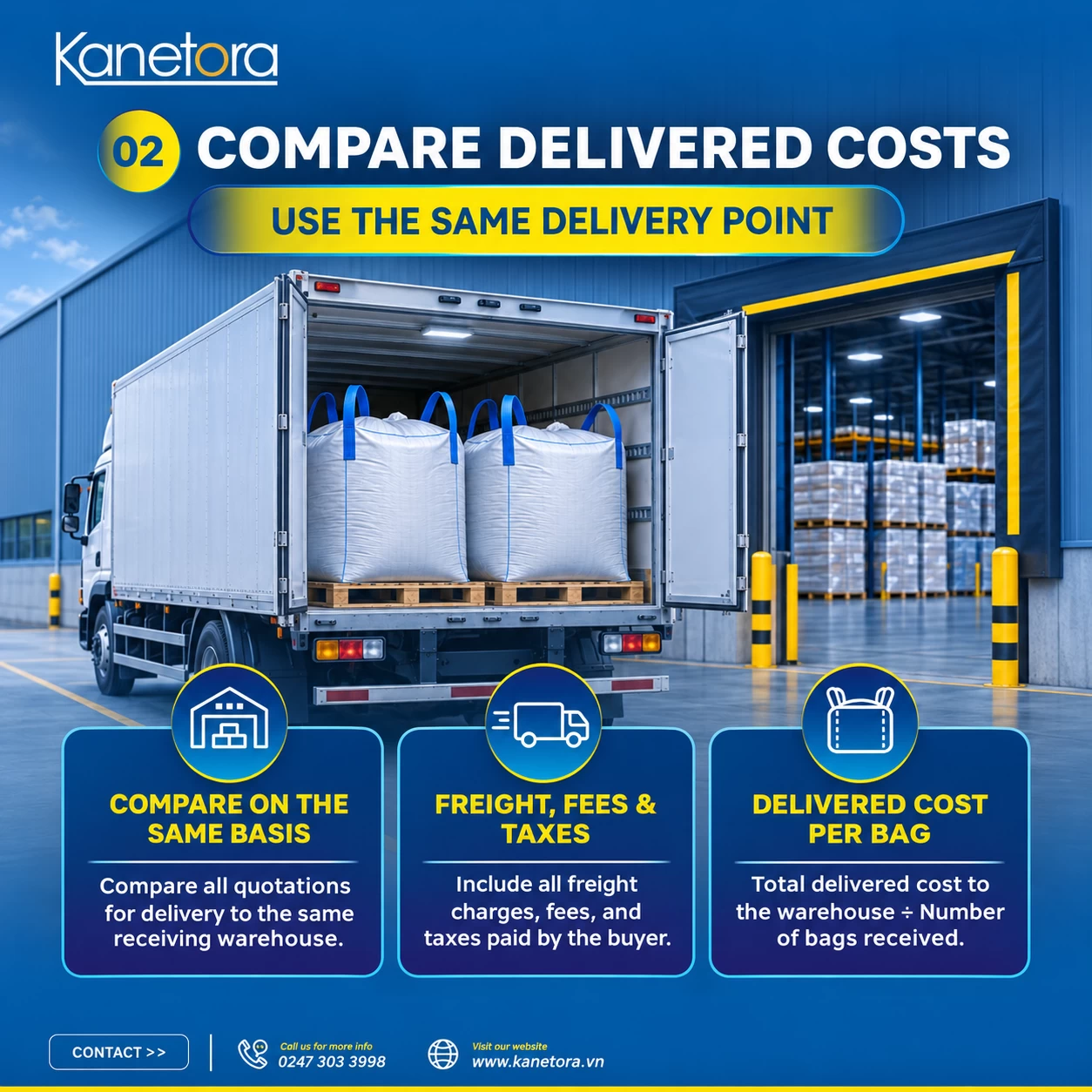
For international FIBC sourcing, the quoted unit price represents only one component of the final procurement cost.
Suppliers may provide quotations under different Incoterms, including EXW, FOB, CIF or DAP.
These terms allocate different transportation responsibilities, costs and risks between buyers and sellers.
A quotation based on EXW cannot be compared directly with one based on CIF without accounting for the relevant logistics arrangements.
Key Logistics Factors to Compare
| Factor | Why it matters |
|---|---|
| Incoterms | Determines which transportation costs and responsibilities are included |
| Export packing | Influences handling efficiency and shipping volume |
| Bags per bale | Affects packaging density and unloading |
| Bales per container | Influences freight cost allocation |
| Container utilization | Determines freight cost per bag |
| Destination charges | May significantly affect landed cost |
| Import duties and taxes | Depend on destination, classification and trade arrangements |
| Delivery location | Determines the final logistics scope |
Buyers should also request the supplier’s standard packing configuration.
Compressed and properly protected FIBC packing may improve shipping efficiency, provided it does not damage the product.
For applications requiring UV protection during outdoor exposure, buyers can also review Anti-UV FIBC Bags for Outdoor Storage and Export Transit.
8. Calculate the Total Cost of Ownership of FIBC Bags
Total Cost of Ownership (TCO) provides a more complete basis for comparing FIBC quotations.
Instead of focusing only on purchase price, TCO considers costs incurred throughout the procurement and operational lifecycle.
A practical calculation can be expressed as:
FIBC Total Cost of Ownership = Purchase Cost + Freight and Import Costs + Handling and Storage Costs + Expected Quality-Related Costs + Other Applicable Operational Costs
For reusable FIBCs, buyers may also consider inspection, cleaning, return logistics and the number of validated use cycles.
Illustrative Example: Comparing Two FIBC Quotations
Assume a manufacturer needs 10,000 FIBC bags for a particular procurement period.
Both suppliers offer bags intended to meet the same approved technical specification.
The following figures are hypothetical and provided solely to demonstrate a comparison methodology.
| Cost component | Supplier A | Supplier B |
|---|---|---|
| Unit price | $4.20 | $4.45 |
| Purchase cost: 10,000 bags | $42,000 | $44,500 |
| Freight and logistics allocation | $3,200 | $2,800 |
| Expected quality-related costs | $2,000 | $500 |
| Total estimated cost | $47,200 | $47,800 |
| Estimated cost per bag | $4.72 | $4.78 |
At first glance, Supplier A offers a unit price that is $0.25 lower.
After incorporating estimated logistics and quality-related costs, the difference falls to only $0.06 per bag.
Supplier A remains slightly less expensive under the stated assumptions.
However, a relatively small change in actual defect rates, handling efficiency or transportation costs could alter the result.
Quality-related costs must be estimated using reasonable evidence rather than assumptions that automatically favor a particular supplier.
The purpose of TCO analysis is not to prove that higher-priced FIBCs are always better. It is to identify the supplier that delivers the best measurable value under equivalent technical and commercial conditions.
9. FIBC Quotation Comparison Matrix for Procurement Teams
A structured comparison matrix can make supplier evaluation more transparent.
The following example uses a weighted scoring approach.
| Evaluation criteria | Suggested weight |
|---|---|
| Technical specification compliance | 25% |
| Product safety and quality assurance | 20% |
| Total landed cost | 20% |
| Production capability and reliability | 15% |
| MOQ and lead time | 10% |
| Documentation, service and technical support | 10% |
| Total | 100% |
Procurement teams can score qualified suppliers from 1 to 5 for each criterion and calculate a weighted result.
However, mandatory safety, regulatory and technical requirements should be treated as pass/fail conditions before commercial scoring.
A supplier that cannot meet a critical safety requirement should not be selected simply because of a lower price or higher aggregate commercial score.
The weighting system should also reflect the actual application.
For food-grade, dangerous goods or safety-critical operations, quality assurance and compliance may require greater emphasis.
For standard industrial applications, logistics efficiency, supply reliability and total landed cost may play a larger role.
10. Common Mistakes When Comparing FIBC Quotations
Even experienced procurement teams may encounter difficulties when quotations contain different assumptions.
Mistake 1: Comparing Bags With Different Specifications
A 1,000 kg SWL label alone does not establish that two FIBCs are technically equivalent.
Dimensions, construction, materials, liners and other performance requirements must also be checked.
Mistake 2: Ignoring Quality Documentation
A low price is less meaningful when essential testing evidence, approved drawings or traceability information is missing.
Mistake 3: Overlooking Liner and Coating Costs
Suppliers may include different protection features within the quoted price.
Mistake 4: Comparing Different Incoterms
Different delivery terms can create significant differences in the total cost of sourcing FIBCs internationally.
Mistake 5: Focusing Only on the First Order
An attractive introductory quotation may not reflect long-term supply consistency, repeat-order pricing or production flexibility.
Mistake 6: Ignoring Packing Efficiency
The number of bags packed into each bale or shipping container can influence the final landed cost per bag.
Mistake 7: Selecting a Supplier Without Validating Samples
For new designs and critical applications, sample evaluation and applicable performance testing should precede mass production approval.
Avoiding these mistakes helps procurement teams reduce uncertainty and establish more reliable supplier relationships.
11. Why Consider Kanetora Bach Dang for FIBC Manufacturing in Vietnam?
Kanetora Bach Dang is part of Kanetora’s industrial packaging manufacturing operations in Vietnam.
Located in Ninh Binh Province, the factory manufactures FIBC/Jumbo Bags for food, agricultural, plastic, chemical, mineral and construction-related applications.
According to its 2026 manufacturing profile, Kanetora Bach Dang has a stated production capacity of approximately 300,000 FIBC bags per month.
The factory operates an integrated manufacturing process covering:
Extrusion → Webbing Weaving → Fabric Weaving → Lamination → Cutting & Printing → Sewing → Inspection → Packing
Integrated Manufacturing Capabilities
Kanetora Bach Dang manufactures or processes multiple key FIBC components, including:
- Polypropylene woven fabric
- Lifting webbings and sling belts
- Inner liners
- Labels and document pouches
- Coated fabric
- Customized FIBC components
Internal production of key components supports specification control, coordination between manufacturing stages and flexibility when developing customized packaging.
Quality Control and Testing
Kanetora Bach Dang operates QC and QA activities across its production process.
Its manufacturing profile identifies testing equipment for:
- Fabric and webbing tensile strength
- Top-lift performance
- UV resistance
- Liner tensile and sealing strength
- Puncture resistance
- Coefficient of friction
- Visual liner inspection
The factory also lists ISO 9001:2015, ISO 14001:2015, ISO 22000:2018 and BRC Grade A among its quality and management certifications.
Specific certificates, product test reports and application-related documentation should be reviewed according to the buyer’s requirements.
Customized FIBC Solutions
Kanetora supports different FIBC constructions and application-specific options, including:
- Circular, U-panel, 4-panel and baffle bags
- Coated and uncoated FIBCs
- FIBCs with inner liners
- Food-grade applications
- Customized lifting and discharge designs
- Industrial and export packaging
- Application-specific technical requirements
Through its manufacturing operations in Vietnam, Kanetora works with customers to align packaging specifications with performance expectations, production requirements and commercial objectives.
Learn more about Kanetora Packaging and its manufacturing capabilities.
12. FIBC RFQ Checklist: What Buyers Should Send to Suppliers
A complete Request for Quotation helps manufacturers provide more accurate technical proposals and commercially comparable prices.
Before requesting a quotation, buyers should prepare the following information.
| RFQ category | Information required |
|---|---|
| Product application | Material name, characteristics and intended use |
| Filling weight | Target filling weight and required SWL |
| Safety requirements | Safety Factor and applicable standards |
| Dimensions | Bag width, length and height |
| Construction | Circular, U-panel, 4-panel or baffle |
| Fabric | Material, GSM, coating and relevant performance requirements |
| Lifting system | Loop type, dimensions and handling method |
| Filling top | Open top, duffle top or inlet spout |
| Discharge bottom | Flat bottom, discharge spout or customized outlet |
| Inner liner | Type, thickness, material and attachment method |
| Special protection | UV, moisture, dust or electrostatic requirements |
| Printing | Artwork, colors, labels and identification |
| Documentation | Certifications, testing and inspection records |
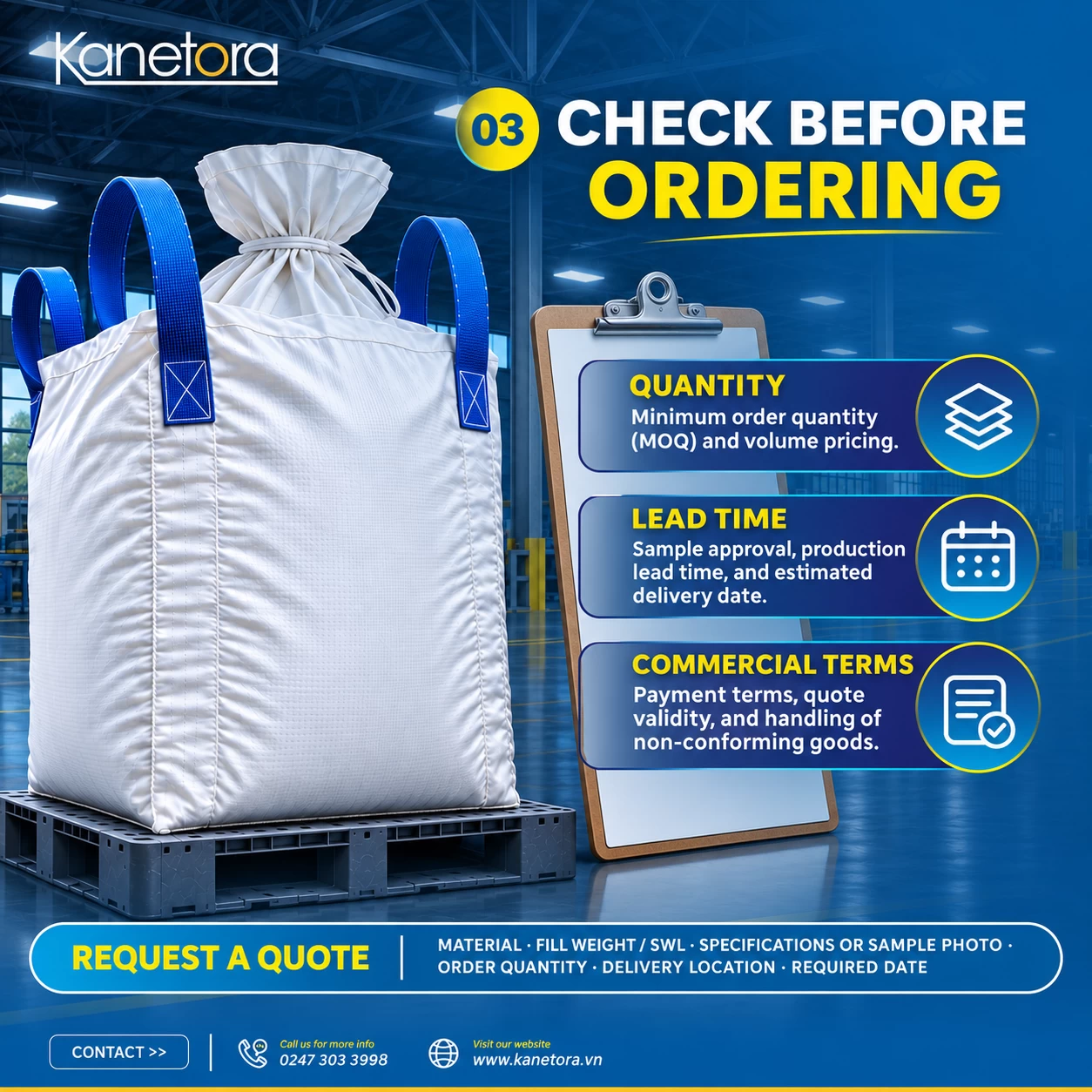
| Order quantity | Initial order, MOQ and forecast annual demand |
| Delivery | Destination, Incoterms and required timeline |
| Sample approval | Technical drawing, prototype and testing requirements |
Where applicable, buyers should also provide the product Safety Data Sheet, hazardous-material classification and details of their filling and discharge equipment.
A well-prepared RFQ reduces assumptions, supports efficient technical communication and improves quotation accuracy.
Frequently Asked Questions About FIBC Quotations
What factors affect FIBC bag prices?
FIBC prices depend on raw materials, bag dimensions, fabric construction, lifting systems, liners, coating, safety requirements, customization, order quantities and production complexity. Shipping terms and lead time also affect the final cost.
Why do FIBC suppliers quote different prices for similar bags?
Suppliers may use different technical specifications, production processes, component sourcing methods, testing procedures and commercial assumptions. Buyers should compare approved specifications and total landed costs before evaluating price differences.
Is the cheapest FIBC supplier always the best option?
Not necessarily. A lower unit price may provide excellent value when specifications, quality and delivery requirements are satisfied. However, buyers should also consider operational efficiency, quality consistency and potential lifecycle costs.
What documents should buyers request from an FIBC manufacturer?
Depending on the product, buyers may request technical drawings, material specifications, applicable test reports, quality-management certificates, product labels, inspection records and traceability documentation. Regulated applications may require additional compliance evidence.
How can buyers reduce FIBC procurement costs without compromising quality?
Buyers can improve purchasing efficiency by standardizing specifications, optimizing bag dimensions, consolidating compatible orders, reviewing packing density, improving demand forecasts and comparing total landed costs. Any design changes should be technically validated before adoption.
Should buyers source FIBC bags directly from manufacturers?
Direct sourcing can offer advantages in technical communication, customization and manufacturing visibility. However, buyers should still evaluate the manufacturer’s capabilities, quality systems, delivery performance and commercial terms.
Can Kanetora Bach Dang provide customized FIBC quotations?
Yes. Kanetora Bach Dang supports customized FIBC manufacturing based on product characteristics, dimensions, Safe Working Load (SWL), construction, liners, filling and discharge systems, printing and other agreed requirements.
Conclusion: Choose the Best FIBC Value, Not Simply the Lowest Price
Comparing FIBC quotations effectively requires a broader understanding of packaging performance, manufacturing quality, logistics and operational cost.
Unit price remains an important procurement metric, but it should be evaluated alongside technical compliance, product safety, manufacturing reliability and total cost of ownership.
A structured evaluation process helps buyers identify suppliers capable of delivering consistent value across repeated orders, rather than focusing exclusively on short-term purchasing savings.
For international businesses sourcing FIBC bags from Vietnam, working with an experienced manufacturer can support more transparent technical discussions and better alignment between packaging specifications and operational requirements.
Looking for a reliable FIBC manufacturer in Vietnam?
Kanetora Bach Dang provides industrial FIBC manufacturing solutions with integrated production capabilities, customized bag designs and quality-control processes.
Contact our team to discuss your technical requirements and request a quotation based on your specific application.
KANETORA JOINT STOCK COMPANY
Website: https://kanetora.vn
Email: info@kanetora.vn
Hotline: +84 (0) 247 303 3998
Manufacturing Location: Cau Mai, My Loc Ward, Ninh Binh Province, Vietnam.