

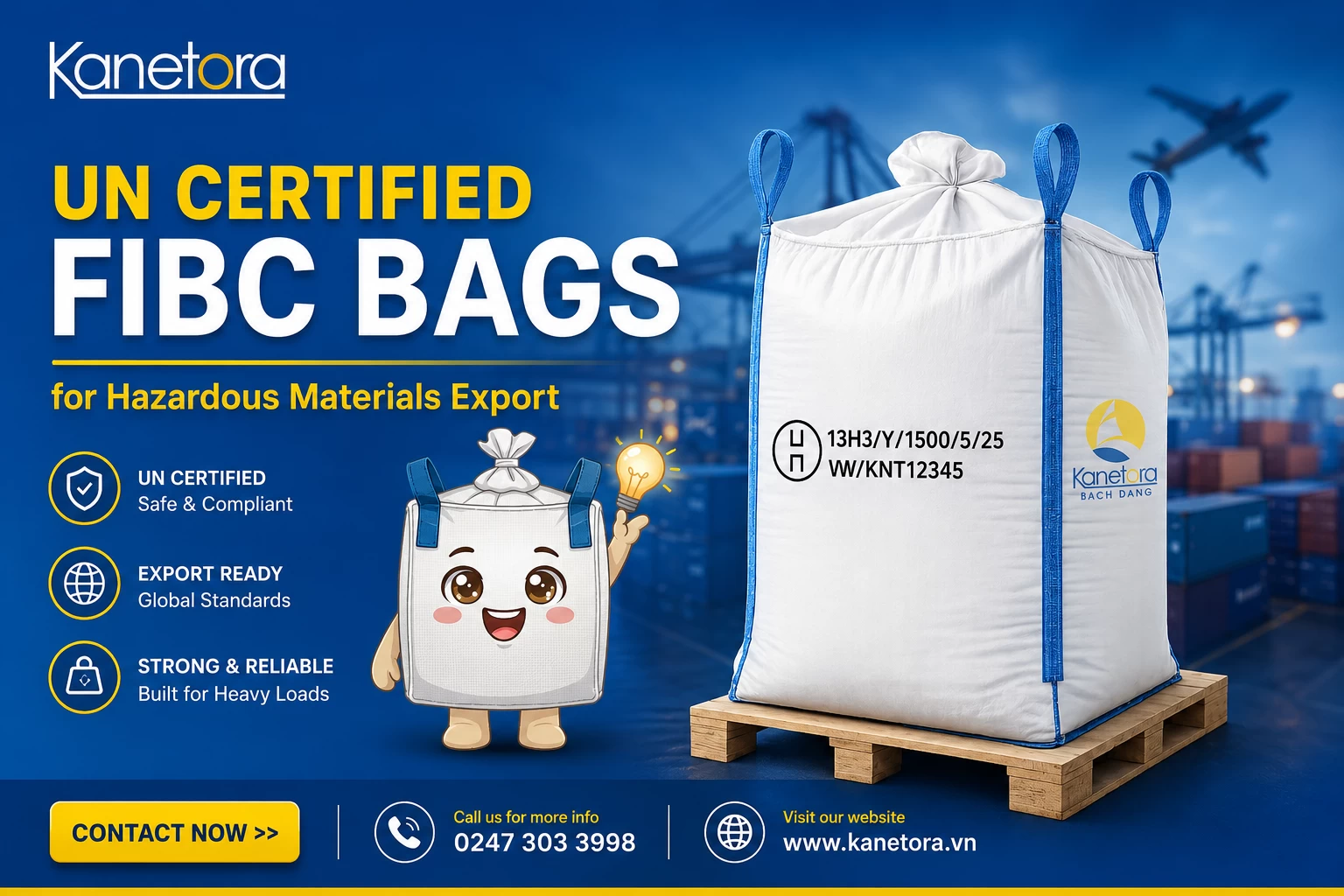
When exporting hazardous materials, packaging is not only a purchasing decision. It is a compliance, safety, logistics, and risk-control decision.
For chemical producers, mineral exporters, industrial material suppliers, and global trading companies, the wrong bulk packaging can lead to shipment rejection, cargo damage, environmental risk, regulatory penalties, and serious safety incidents. That is why UN certified FIBC bags are often required when hazardous solid materials are packed, stored, handled, or transported across borders.
At Kanetora, we provide FIBC packaging solutions for international buyers who need reliable, specification-based bulk bags for demanding export applications. Kanetora Bach Dang’s product portfolio includes UN Certified FIBC Bulk Bags designed for hazardous materials, with applications across chemical, mineral, pharmaceutical, and hazardous material industries.
What Are UN Certified FIBC Bags?
UN certified FIBC bags, also known as UN certified bulk bags or UN FIBCs, are Flexible Intermediate Bulk Containers that have been tested and approved for specific dangerous goods packaging applications.
Unlike standard jumbo bags used for non-hazardous products, UN FIBC bags are designed to meet stricter requirements related to strength, construction, lifting, stacking, impact resistance, leakage prevention, and proper marking.
In official packaging classification, flexible IBCs for solid hazardous materials include woven plastic types such as 13H1, 13H2, 13H3, and 13H4. These codes indicate whether the FIBC is uncoated, coated, fitted with a liner, or both coated and fitted with a liner.
For export buyers, this means one important thing: a UN certified FIBC should be selected based on the actual product, UN number, packing group, filling method, discharge method, transport mode, and destination market.
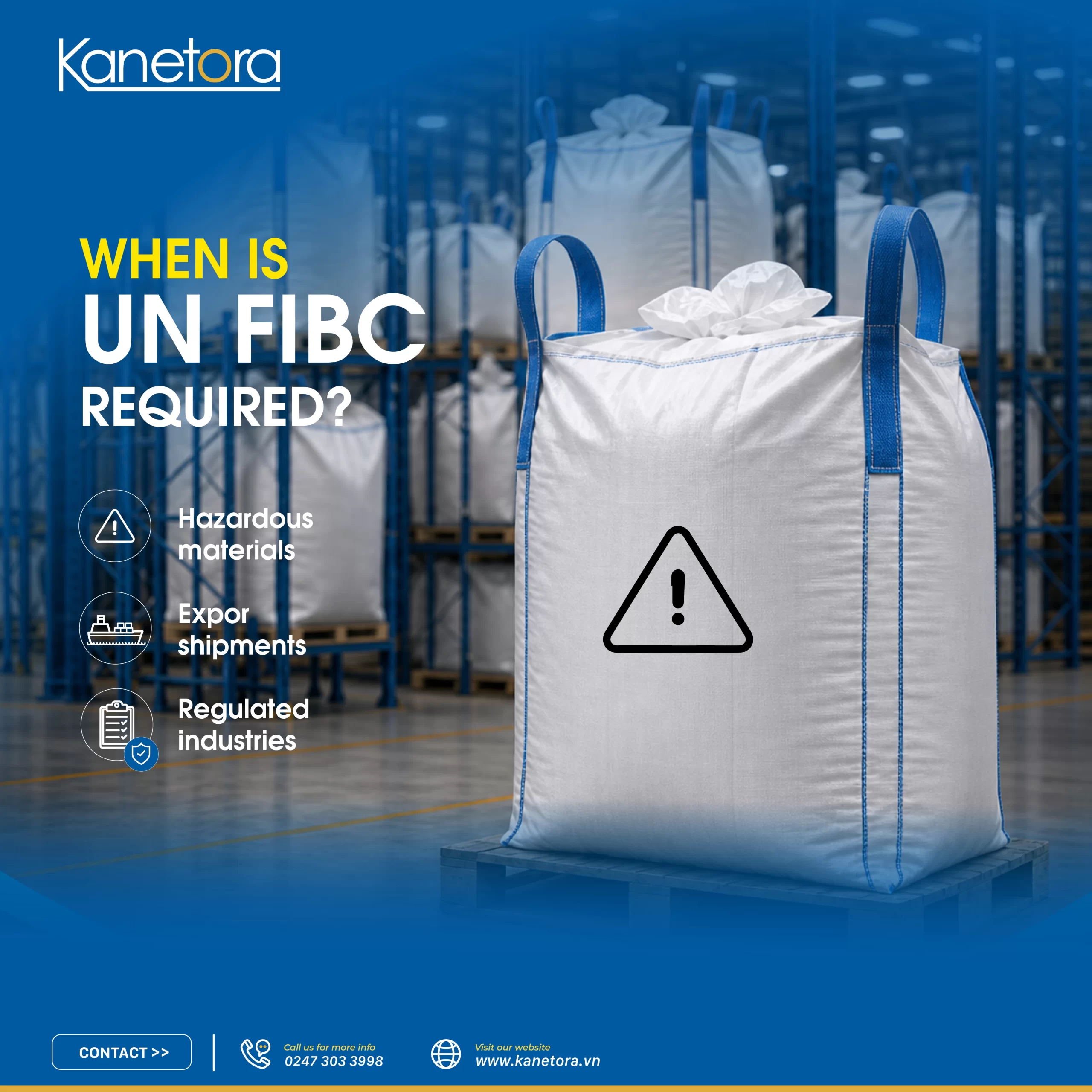
When Are UN Certified FIBC Bags Required?
UN certified FIBC bags are typically required when the material being transported is classified as dangerous goods or hazardous material.
Common examples include:
- Chemical powders and granules
- Certain mineral products
- Industrial additives
- Oxidizing substances
- Environmentally hazardous solids
- Toxic or harmful solid materials
- Specialty compounds used in industrial production
The final requirement depends on the product’s dangerous goods classification, Proper Shipping Name, UN number, packing group, and applicable transport regulation. For air shipment, IATA states that dangerous goods regulations help shippers classify, mark, pack, label, and document hazardous shipments. For sea freight, the IMDG Code sets detailed requirements for dangerous goods in packaged form, including packing, container traffic, stowage, and segregation of incompatible substances.
Because of this, buyers should never choose a UN FIBC based only on bag size or loading weight. The correct packaging must match the dangerous goods profile of the product.
Why Standard FIBC Bags Are Not Enough for Hazardous Materials
A standard FIBC may be suitable for products such as resin pellets, grains, sand, fertilizer, or non-hazardous industrial powders. However, hazardous materials require a higher level of packaging control.
The packaging must be able to withstand normal handling and transport stresses without loss of contents. Official IBC standards require that the strength of material and construction be appropriate to the IBC’s capacity and intended use. Seams must be properly stitched, heat sealed, glued, or formed by an equivalent method, and flexible IBCs must also be resistant to aging and degradation caused by ultraviolet radiation.
For exporters, this is critical because hazardous materials may be handled multiple times before reaching the final customer: factory loading, warehouse storage, container stuffing, port handling, sea or air transport, destination customs, inland trucking, and final unloading.
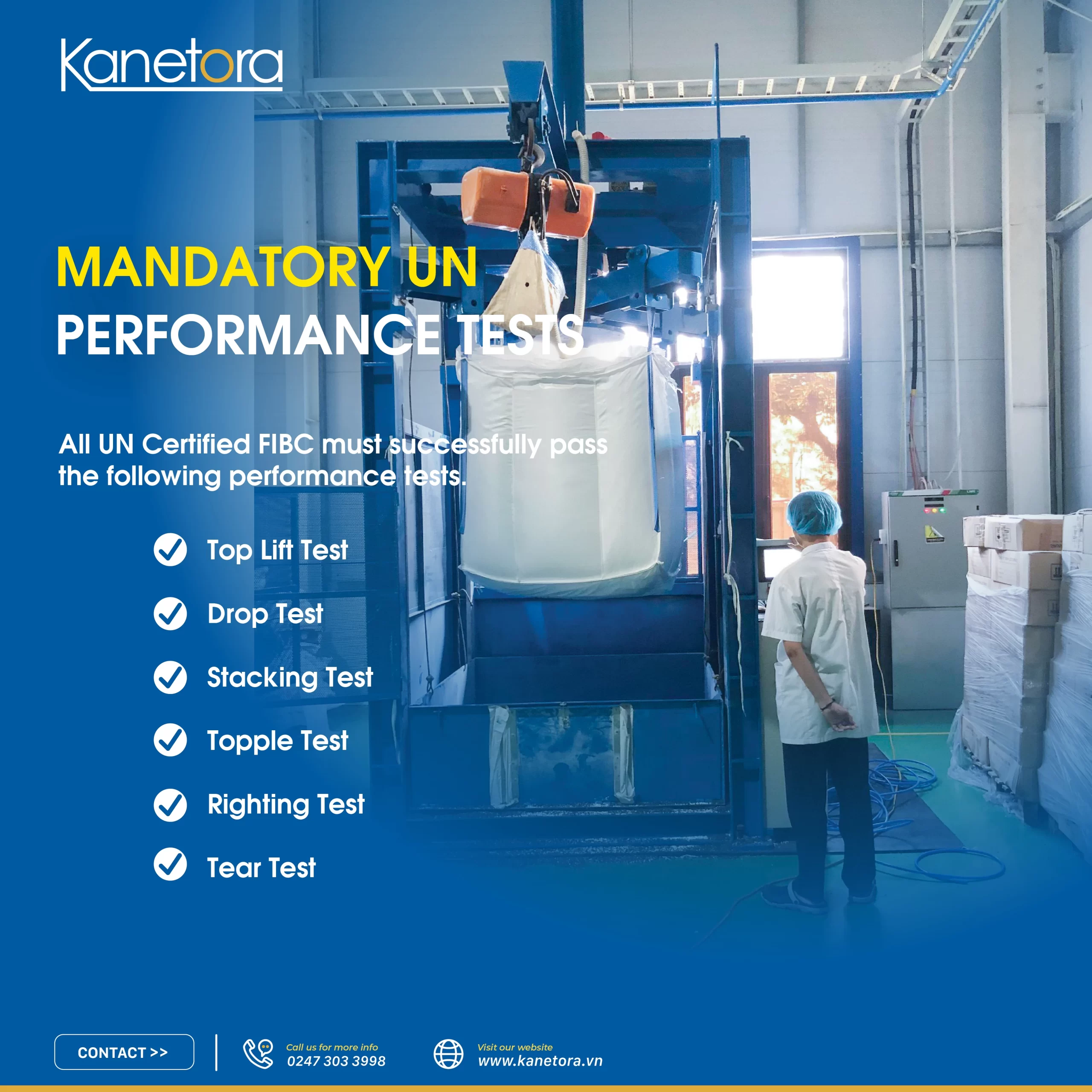
Key Tests for UN Certified FIBC Bags
UN certified FIBC bags are not approved by appearance alone. They must pass performance-based tests for the specific design type.
Depending on the design and intended use, tests may include vibration, top lift, bottom lift, stacking, drop, topple, righting, and tear tests. The applicable test table for IBC certification identifies these tests for flexible IBCs, with certain tests depending on whether the IBC is designed for stacking or specific lifting methods.
1. Drop Test
The drop test checks whether the IBC can withstand impact without becoming unsafe for transport or losing contents. For IBCs, drop heights are linked to packing groups: Packing Group I, II, and III correspond to different danger levels and test heights.
2. Top Lift Test
For FIBCs designed to be lifted from the top or side, the top lift test evaluates the lifting structure and bag integrity. Flexible IBC design types must be filled to six times the maximum net mass, and the test is conducted for a defined period.
3. Stacking Test
If the FIBC is designed for stacking, the stacking test confirms whether the packaging can withstand a superimposed load without deterioration that makes it unsafe for transport or causes loss of contents.
4. Topple and Righting Tests
The topple test evaluates whether a flexible IBC can withstand falling onto its top surface without loss of contents. The righting test checks whether the bag and lifting devices remain safe when the FIBC is lifted from a side position back to upright.
5. Tear Test
The tear test checks whether a cut in the FIBC wall propagates beyond the allowed limit after loading and lifting. This is especially important for woven polypropylene bulk bags used in demanding industrial environments.
Understanding UN Marking on FIBC Bags
A UN certified FIBC must carry proper UN marking. This marking is not decorative. It communicates the approved packaging type, performance level, manufacturing information, stacking test load, and maximum permissible gross mass.
Performance markings use X, Y, and Z to identify the packing group level successfully tested:
- X: suitable for Packing Group I, II, and III
- Y: suitable for Packing Group II and III
- Z: suitable for Packing Group III only
The marking also includes information such as the IBC design type code, month and year of manufacture, country authorizing the mark, manufacturer or approval agency, stacking test load, and maximum permissible gross mass.
For buyers, this makes the UN mark one of the most important items to check before approving production or shipment.
Common UN FIBC Construction Options
The right UN certified FIBC bag depends on the material and handling conditions. Common construction options include:
13H1 – Woven Plastic Without Coating or Liner
This type may be suitable for certain solid materials where moisture protection or fine powder containment is not the main concern.
13H2 – Woven Plastic, Coated
Coating improves moisture resistance and helps reduce sifting for some products.
13H3 – Woven Plastic With Liner
A liner is commonly used when the product requires additional containment, dust protection, or moisture protection.
13H4 – Woven Plastic, Coated and With Liner
This option provides both coating and liner protection, often selected for fine powders, sensitive materials, or products with stricter containment requirements.
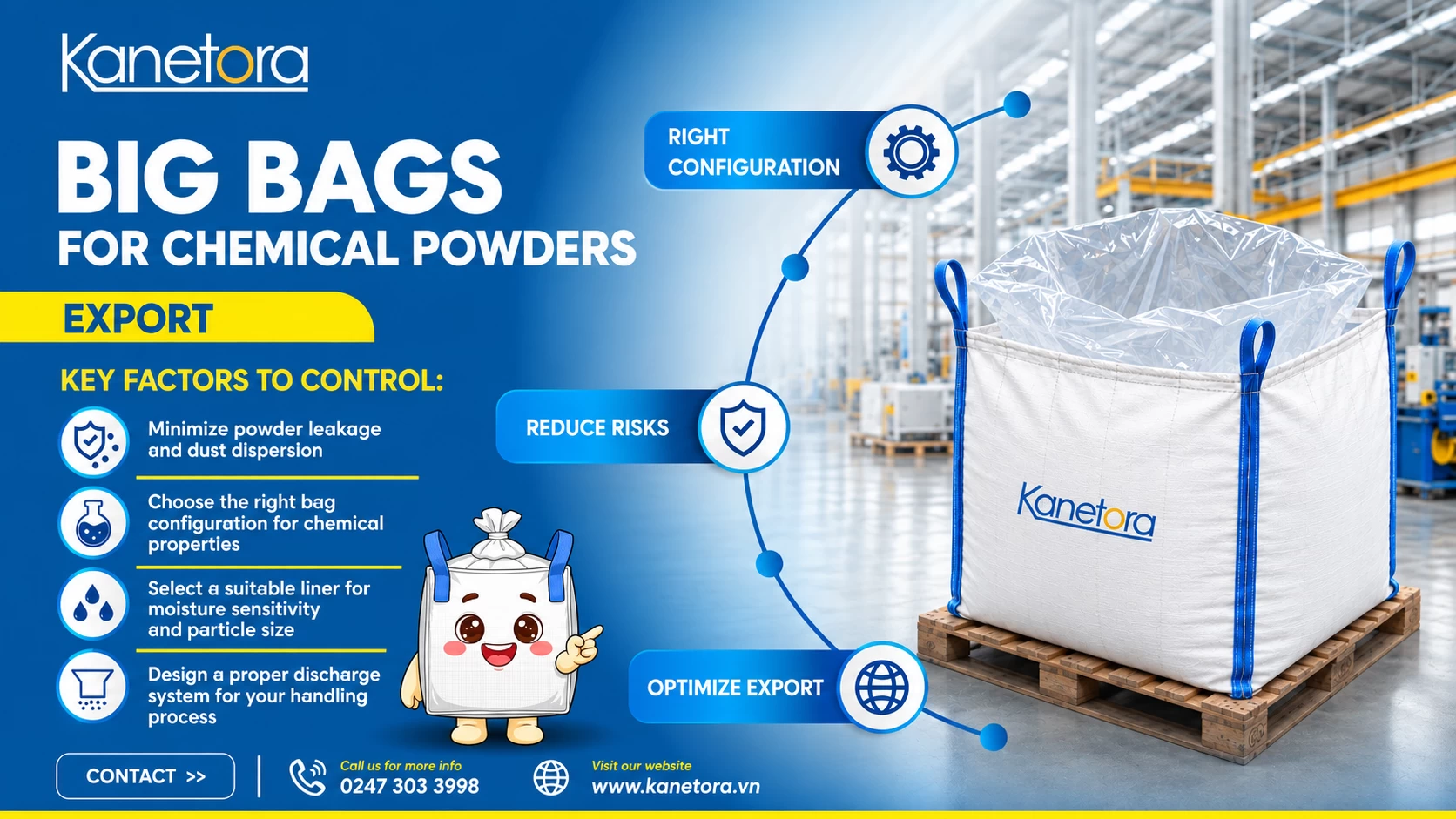
Kanetora offers FIBC configurations including U-Panel, Circular, 4-Panel, and Baffle structures, with customized top filling, bottom discharge, lifting, coating, liner, and safety factor options depending on buyer requirements.
Industries That Use UN Certified FIBC Bags
UN certified FIBC bags are commonly used in industries where safety, compliance, and export documentation are critical.
Chemical Industry
Chemical powders, granules, catalysts, additives, and specialty compounds may require UN certified packaging depending on their hazard classification.
Mineral and Mining Industry
Certain mineral products can require stronger, tested bulk packaging due to density, dust, handling risk, or classification requirements.
Pharmaceutical and Industrial Ingredients
Some pharmaceutical intermediates, raw materials, and controlled industrial ingredients require highly reliable packaging and clear batch identification.
Environmental and Waste-Related Materials
Environmentally hazardous solids or regulated waste-related materials may require UN certified packaging to prevent leakage, contamination, or uncontrolled release during transport.
What Buyers Should Prepare Before Requesting a Quotation
To select the correct UN certified FIBC, buyers should prepare complete technical and logistics information before requesting a quotation.
A strong inquiry should include:
- Product name and material description
- UN number and Proper Shipping Name, if available
- Hazard class and packing group
- Bulk density
- Required Safe Working Load
- Bag dimensions
- Filling method
- Discharge method
- Coated or uncoated fabric requirement
- Liner requirement
- Static control requirement, if any
- Transport mode: sea, air, road, or multimodal
- Destination country
- Required marking, label, and document pouch specification
- Order quantity and shipment schedule
For air shipment, FAA guidance also emphasizes that packaging selection should begin with the Proper Shipping Name or UN ID number, followed by the relevant packing instructions and verification that the package is authorized for the applicable packing group.
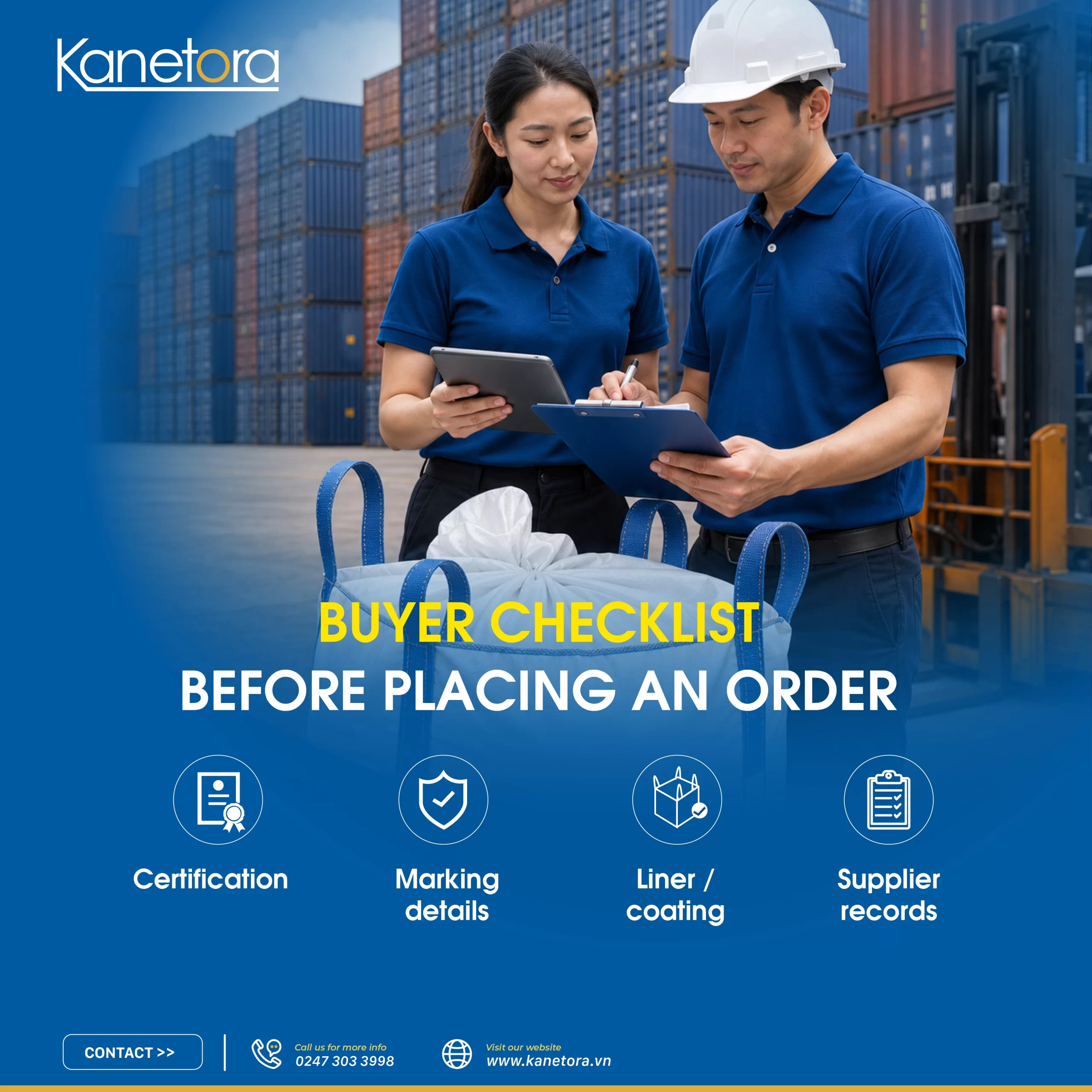
Buyer Checklist Before Approving a UN Certified FIBC Order
Before confirming mass production, buyers should check the following points:
- Is the product classified as dangerous goods?
- What is the correct UN number and Proper Shipping Name?
- What is the packing group: I, II, or III?
- Is FIBC packaging authorized for this product?
- Which FIBC code is required: 13H1, 13H2, 13H3, or 13H4?
- Is coating or liner required?
- Does the bag design match the filling and discharge process?
- Are lifting loops suitable for warehouse and port handling?
- Is the UN marking correct?
- Are test reports and compliance documents available for the approved design?
- Is the supplier capable of consistent production and inspection?
- Has the final specification been confirmed before shipment?
This checklist helps reduce the risk of wrong packaging selection, shipment delay, or non-compliance at the destination market.
Why Work With Kanetora for UN Certified FIBC Bags?
Kanetora combines international trade capability with manufacturing-backed packaging expertise. This is especially valuable for buyers who need not only a bulk bag supplier, but also a partner that understands export packaging, technical specifications, quality consistency, and supply chain requirements.
Kanetora Bach Dang has a production capacity of 300,000 FIBC bags per month and holds certifications including BRC Grade A, ISO 9001:2015, ISO 14001:2015, and ISO 22000:2018. The factory’s equipment system includes PP and mono yarn extruders, loom weaving machines, belt weaving machines, coating machines, automatic cutting machines, sewing machines, cleaning machines, metal detectors, UV testing, tensile testing, and safety factor testing equipment.
The production process follows key stages from extrusion, belt weaving, fabric weaving, laminating, cutting and printing, sewing, inspection, and packing. In addition, Kanetora Bach Dang implements QC and QA controls across production stages, with in-process inspection on sewing lines and final QA inspection before shipment.
For international buyers, these capabilities support more stable quality, better specification control, and more reliable export delivery.
Final Thoughts
UN certified FIBC bags are essential for many hazardous materials export operations. They help ensure that dangerous goods are packed in a tested, marked, and specification-compliant way before entering international transport.
However, choosing the right UN FIBC is not only about selecting a bag model. It requires understanding the product classification, packing group, transport mode, handling process, liner and coating requirements, lifting method, and destination regulations.
Kanetora provides customized FIBC solutions for global buyers who need dependable bulk packaging for demanding industrial and hazardous material applications.
Looking for UN certified FIBC bags for hazardous materials export? Contact Kanetora to discuss your product specification, required UN marking, packing method, and shipment plan.
FAQ Section
What is a UN certified FIBC bag?
A UN certified FIBC bag is a Flexible Intermediate Bulk Container that has passed required performance tests for specific dangerous goods packaging applications. It is marked with a UN code showing the approved packaging type, performance level, manufacturing information, stacking load, and maximum gross mass.
Are all FIBC bags suitable for hazardous materials?
No. Standard FIBC bags are not automatically suitable for hazardous materials. The bag must match the product’s dangerous goods classification, packing group, required packaging instruction, and approved UN design type.
What does 13H4 mean in UN FIBC packaging?
13H4 refers to a woven plastic flexible IBC that is both coated and fitted with a liner. It is commonly considered when additional containment, moisture protection, or powder control is required.
What information should I provide before ordering UN certified FIBC bags?
You should provide the product name, UN number, Proper Shipping Name, packing group, bulk density, Safe Working Load, dimensions, filling and discharge method, coating or liner requirements, static control needs, destination country, and transport mode.
Can Kanetora customize UN certified FIBC bags?
Yes. Kanetora can support customized FIBC specifications based on buyer requirements, including bag construction, lifting loops, top and bottom design, coating, liner, marking, document pouch, and export packing needs.