

What Is Sustainable Industrial Packaging?
Sustainable industrial packaging refers to packaging solutions designed to protect goods during storage, handling, transportation, and export while reducing negative environmental impact across the product lifecycle.
Unlike consumer packaging, industrial packaging is commonly used for large-volume goods in sectors such as agriculture, food, minerals, chemicals, plastic resins, construction materials, and logistics. Therefore, sustainability in industrial packaging is not only about being “eco-friendly.” It also includes load optimization, reduced cargo damage, longer product protection, lower material waste, and better supply chain efficiency.
In 2026, sustainable industrial packaging is becoming an important requirement in global trade. For export businesses, packaging is no longer seen as a supporting material only. It is increasingly becoming part of risk management, ESG compliance, and international buyer evaluation.
For heavy-duty packaging solutions such as FIBC bags, jumbo bags, liners, pallet covers, and stretch hood films, sustainability should be considered through three main layers: material selection, technical design, and logistics performance.
How ESG Is Changing the Packaging Industry
ESG is reshaping how global buyers select packaging suppliers. In the past, price, production capacity, and delivery time were often the main decision-making factors. Today, international buyers are paying closer attention to certifications, traceability, environmental management, product safety, and the supplier’s ability to support carbon reduction across the supply chain.
In the packaging industry, ESG affects supplier selection in five major ways.
Material requirements
Businesses need to demonstrate that their packaging materials are safe, suitable for the intended application, and aligned with sustainability expectations. For FIBC bags, virgin polypropylene still plays an important role in applications requiring strength, load safety, food-contact suitability, and stable technical performance.
Packaging design requirements
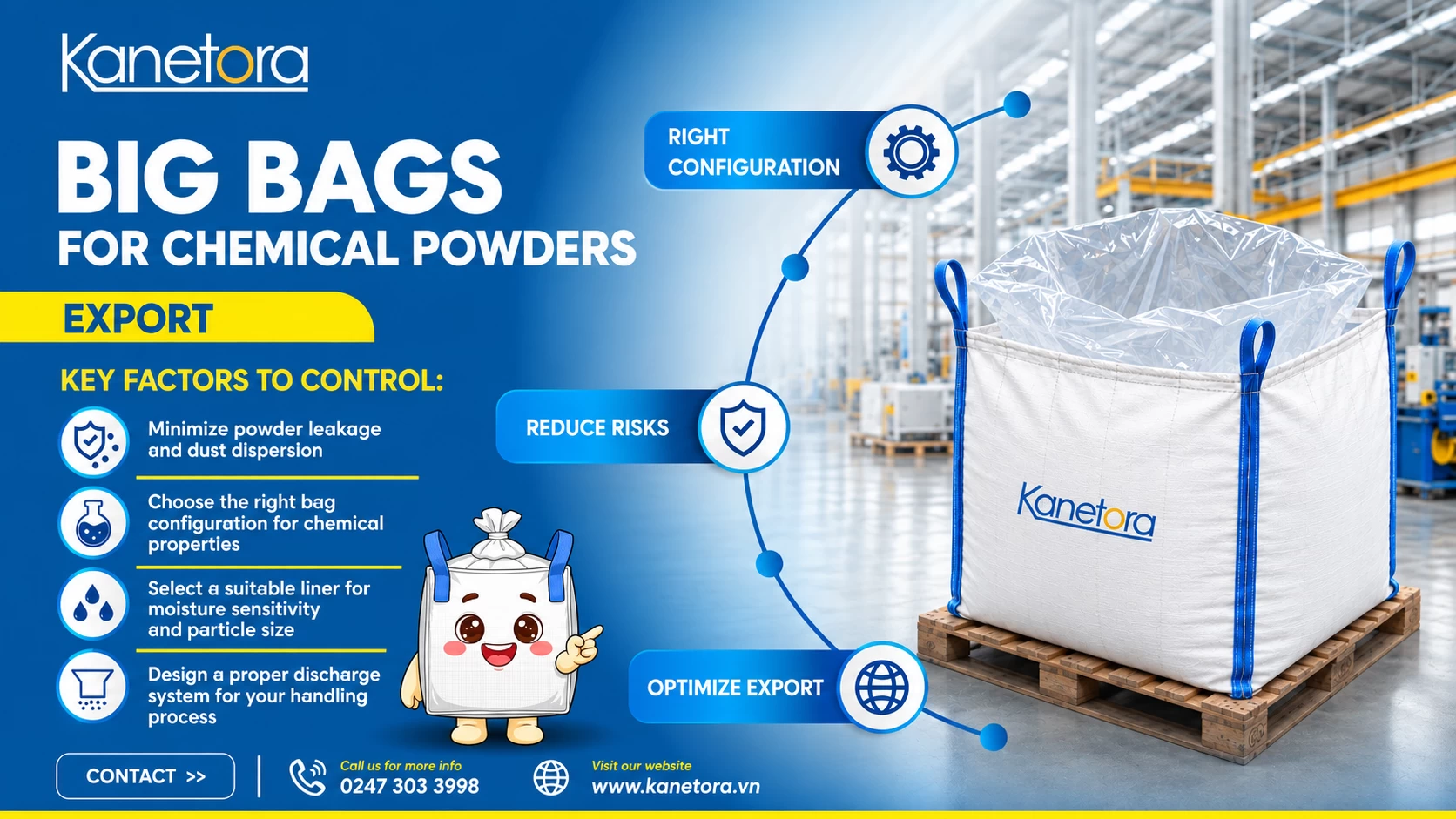
Packaging must be designed according to cargo type, filling method, discharge method, transport route, storage conditions, and handling requirements. A properly designed FIBC bag can help reduce the risk of tearing, bursting, moisture damage, contamination, and cargo loss.
Certification requirements
International buyers often require clear factory certifications and compliance records. Certifications such as ISO 9001, ISO 14001, ISO 22000, BRCGS, and food-contact test reports help buyers assess the production capability and reliability of a packaging manufacturer.
According to Kanetora Bach Dang’s company profile and 2026 introduction, the factory is certified with ISO 9001:2015, ISO 14001:2015, ISO 22000:2018, and BRC Grade A, and has production capabilities for FIBC bags, block-bottom valve bags, and multi-layer plastic films.
Quality control requirements
ESG is not only about environmental reporting. It is also reflected in a company’s ability to reduce defects, minimize product failure, prevent cargo damage, and lower waste throughout the supply chain.
Supply chain transparency
Global buyers increasingly expect suppliers to have clear systems for material control, warehouse management, product identification, quality inspection, and shipment traceability.
In other words, ESG is turning industrial packaging from a simple purchasing item into a strategic part of export management and sustainable business development.
Recycling and Reuse Trends for FIBC Bags
FIBC, also known as flexible intermediate bulk containers or jumbo bags, is one of the most important industrial packaging solutions for bulk cargo. Thanks to its high load capacity, efficient container utilization, and adaptability to various products, FIBC is widely used in agriculture, food ingredients, minerals, chemicals, plastic resins, and construction materials.
From 2026 onward, sustainable FIBC development will focus on three key directions.
1. Designing FIBC Bags for Longer Lifecycle Value
A sustainable FIBC bag is not only a bag made from recyclable material. It must be designed correctly for its intended use.
Important design factors include:
- Safe working load
- Safety factor
- Bag construction
- Top filling option
- Bottom discharge option
- Coated or uncoated fabric
- Inner liner requirement
- Dustproof or moisture-proof performance
- Handling and lifting method
For example, U-panel bags are suitable for many common applications because they use fewer seams than 4-panel bags. 4-panel bags provide better shape retention when filled. Tubular bags have a seamless cylindrical body, reducing side seams and making them suitable for some applications requiring lower leakage risk.
When the packaging design is correct from the beginning, businesses can reduce cargo damage, avoid repacking, improve safety, and optimize logistics costs.
2. Improving Recyclability of FIBC Materials
FIBC bags are commonly made from polypropylene, a recyclable plastic material. However, the actual recyclability of an FIBC bag depends on several factors, including fabric structure, coating, liner, contamination level after use, printing, color, accessories, and the collection system available in the target market.
A growing trend is to simplify packaging structures where possible. This means reducing unnecessary material combinations, limiting hard-to-separate components, and choosing designs that are more compatible with recycling systems.
For export businesses, this does not mean replacing all materials immediately. Instead, it means working with packaging suppliers to review each specification and identify where sustainability improvements can be made without compromising safety and performance.
3. Reusing FIBC Bags in Suitable Supply Chains
Not every FIBC bag should be reused. For food, pharmaceutical ingredients, hazardous chemicals, or products with high contamination risk, safety and hygiene must always come first.
However, in controlled supply chains, FIBC bags may be designed for reuse if they meet inspection, cleaning, load safety, traceability, and regulatory requirements.
The key point is that reuse should not be treated as a marketing claim only. It must be assessed based on the product type, application, transport condition, safety requirements, and buyer standards.
Reducing Carbon in Logistics and Packaging
Industrial packaging has a direct impact on logistics emissions. A well-designed packaging solution can improve container loading efficiency, reduce empty space, prevent cargo damage, and minimize unnecessary transport or repacking.
For export businesses, carbon reduction does not only come from changing materials. It also comes from optimizing the entire packaging and logistics process.
Optimizing bag dimensions for pallet and container loading
FIBC dimensions should be designed according to cargo density, pallet size, container loading plan, and handling method. Proper sizing helps improve container utilization and reduce wasted space during transportation.
Reducing cargo damage caused by moisture, dust, or impact
For moisture-sensitive goods such as agricultural products, powders, minerals, plastic resins, and industrial raw materials, solutions such as coated fabric, PE liners, aluminum barrier films, or other moisture-proof packaging options can help protect product quality during long-distance shipping.
Optimizing packaging weight
Packaging that is too thick may increase material use and cost. Packaging that is too thin may increase the risk of failure. The sustainable approach is to design packaging that is strong enough, technically suitable, and optimized for the actual application.
Connecting packaging design with logistics planning
When a packaging manufacturer understands the shipping route, destination market, storage duration, lifting method, and container loading requirements, it can recommend a more practical and reliable packaging solution.
This is why sustainable industrial packaging should not be viewed only from the production side. It should be evaluated across the entire supply chain.
What Are Global Buyers Looking For?
International buyers are becoming more comprehensive in how they evaluate industrial packaging suppliers. Price remains important, but it is no longer the only factor.
Common requirements from global buyers include:
Clear factory certifications
Buyers want to see quality management, environmental management, food safety, product safety, or material testing certifications depending on the application.
Stable production capacity
For industrial packaging, buyers need suppliers that can handle large-volume production, maintain consistent quality, and deliver on schedule.
Technical customization capability
Different industries require different specifications for load capacity, moisture protection, dust control, static protection, liner type, filling method, discharge method, and lifting options.
Transparent technical documentation
Buyers often require clear information on material, GSM, coating, SWL, safety factor, dimensions, sewing structure, and usage conditions.
Solution-oriented mindset
A reliable packaging supplier should not only quote based on a drawing or specification sheet. It should also be able to advise on the most suitable packaging structure according to the cargo type, export route, handling method, and target market requirements.
This creates a strong opportunity for packaging manufacturers in Vietnam that have real production capacity, international certifications, quality control systems, and technical consulting capability.
Vietnam’s Role in the New Industrial Packaging Supply Chain
Vietnam has strong potential to become an important industrial packaging supply hub in Asia. With its manufacturing capacity, export experience, competitive production environment, and improving logistics infrastructure, Vietnam is well-positioned to serve global buyers looking for reliable packaging alternatives.
In the FIBC and industrial packaging sector, Vietnam has opportunities in three major areas.
Supply chain diversification
Many international buyers are looking to diversify their sourcing strategy and reduce dependence on a single manufacturing market. This creates opportunities for qualified Vietnamese packaging manufacturers.
Growing demand for export-standard packaging
Industries such as agriculture, food ingredients, minerals, chemicals, plastic resins, and construction materials all require strong, safe, and export-ready packaging solutions.
Rising ESG and sustainability requirements
As buyers add ESG criteria to supplier evaluation, Vietnamese factories with clear certifications, quality control systems, and flexible production capability can gain a stronger competitive position.
Kanetora Bach Dang is an example of a Vietnamese industrial packaging manufacturer with export-oriented capability. According to the company profile, the factory produces FIBC bags, block-bottom valve bags, and multi-layer plastic films, supported by an eight-step production process including extrusion, belt weaving, fabric weaving, laminating, cutting/printing, sewing, inspecting, and packing.
Packaging Trends from 2026 to 2030
The period from 2026 to 2030 will mark a shift in industrial packaging. Businesses will move from the mindset of “packaging for transportation” to “packaging for supply chain optimization.”
Here are the key trends to watch.
1. Packaging Designed for Recycling
More markets will prioritize packaging that can be recycled, uses fewer unnecessary components, and avoids overly complex material structures. For industrial packaging, this means reviewing fabric, coating, liner, labels, printing, and accessories from a lifecycle perspective.
2. Moisture-Proof Packaging for Export Cargo
Climate variation, sea freight, long storage periods, and container condensation make moisture protection increasingly important. For FIBC bags, coated fabric, inner liners, aluminum barrier films, and other specialized liner solutions will continue to gain attention.
3. Packaging Optimized for Logistics
Businesses will care more about bag dimensions, stacking stability, lifting safety, container utilization, and damage reduction. Packaging design will become more closely connected with logistics planning.
4. Packaging Supporting Traceability and Warehouse Management
QR codes, item labels, document pouches, batch numbers, and warehouse management systems will become more important in industrial packaging. These tools help reduce mix-ups, improve inventory accuracy, and support traceability in case of quality issues.
5. Packaging Suppliers Becoming Technical Partners
Global buyers will increasingly prefer suppliers that can provide technical advice, not just production quotations. Factories with R&D capability, testing equipment, QA/QC systems, and logistics understanding will have a clear advantage.
Kanetora Bach Dang: Industrial Packaging Solutions for a More Sustainable Supply Chain
As export standards continue to rise, businesses need packaging partners with real manufacturing capability, reliable quality control, and the ability to customize solutions for different industries.
Kanetora Bach Dang provides industrial packaging solutions including FIBC bags, block-bottom valve bags, FIBC liners, and multi-layer plastic films. Its products serve a wide range of sectors such as food, agriculture, plastics and chemicals, minerals, construction materials, and logistics.
With nearly 30 years of packaging experience inherited from But Son Packaging, production capacity in Vietnam, and international certifications, Kanetora Bach Dang aims to be more than a packaging manufacturer. The company positions itself as a solution partner for export businesses seeking safe, reliable, and sustainable industrial packaging.
Conclusion
Sustainable industrial packaging trends in 2026 are not only about green materials or environmental messaging. They reflect a broader transformation in how businesses design, produce, use, and manage packaging across the supply chain.
For export businesses, choosing the right industrial packaging solution can help reduce cargo risk, meet ESG expectations, optimize logistics, and strengthen credibility with global buyers.
From 2026 to 2030, packaging suppliers with stable production capacity, clear certifications, strong quality control, technical expertise, and a solution-oriented mindset will have a major advantage in the new global supply chain.
FAQ
What is sustainable industrial packaging?
Sustainable industrial packaging refers to packaging designed to protect goods effectively while reducing waste, improving logistics efficiency, and minimizing environmental impact across the product lifecycle.
Are FIBC bags recyclable?
FIBC bags are commonly made from polypropylene, which is recyclable. However, actual recyclability depends on the bag structure, coating, liner, contamination level, accessories, color, printing, and local recycling systems.
How does ESG affect packaging selection?
ESG makes buyers pay closer attention to certifications, material sourcing, environmental management, quality control, recyclability, traceability, and the role of packaging in logistics efficiency.
Why is moisture-proof packaging important for export cargo?
Moisture-proof packaging helps protect goods from humidity, condensation, mold, caking, contamination, and quality degradation during long-distance shipping and storage.
How should businesses choose the right FIBC bag?
Businesses should choose FIBC bags based on cargo type, safe working load, storage conditions, transport route, moisture protection needs, discharge method, lifting method, and target market standards.