

What Are Moisture-Proof FIBC Bags?
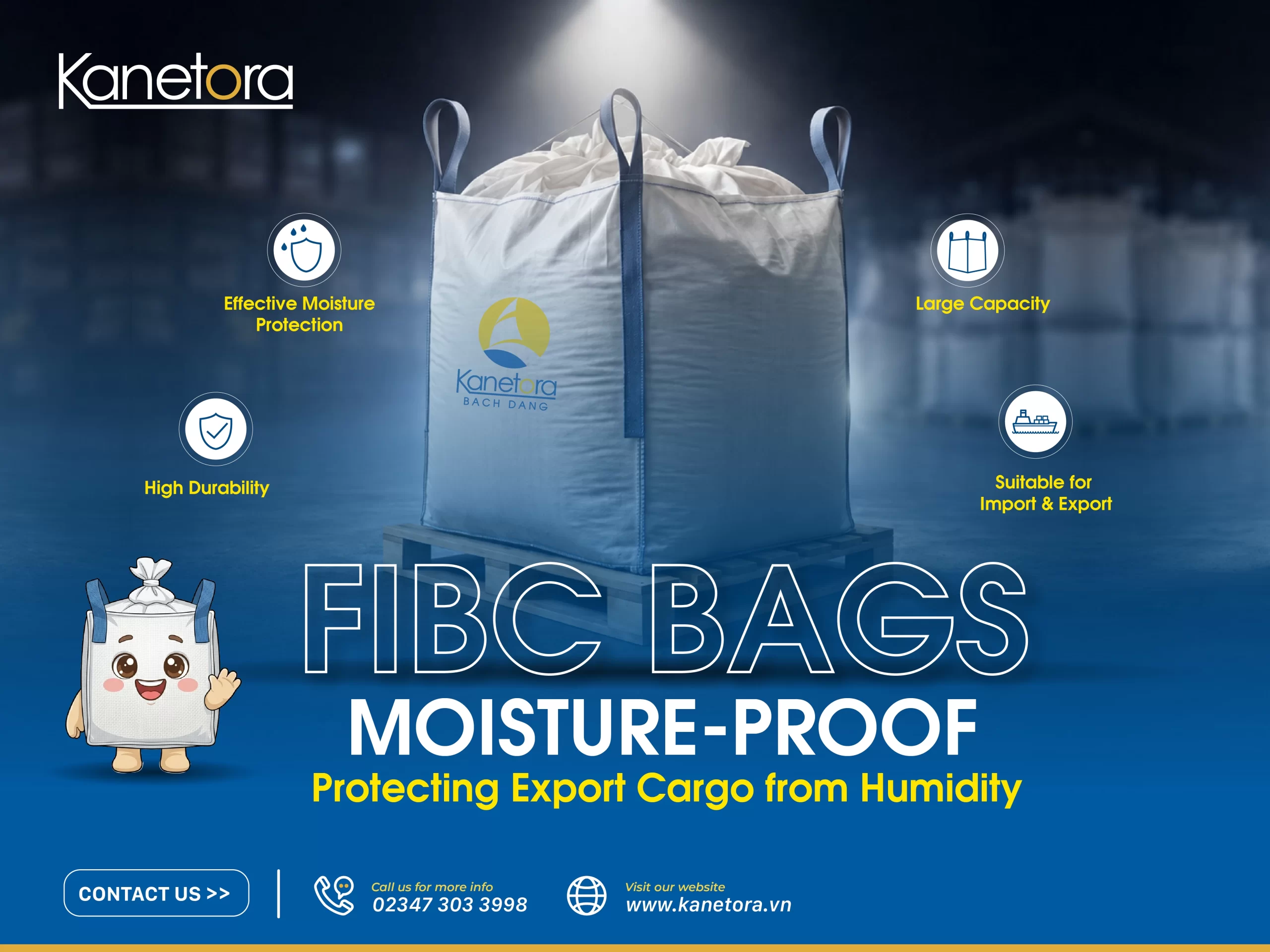
Moisture-proof FIBC bags, also known as moisture-resistant jumbo bags or FIBC bags with liners, are bulk packaging solutions designed to reduce the impact of humidity, water vapor, condensation, and environmental moisture during storage, handling, and export transportation.
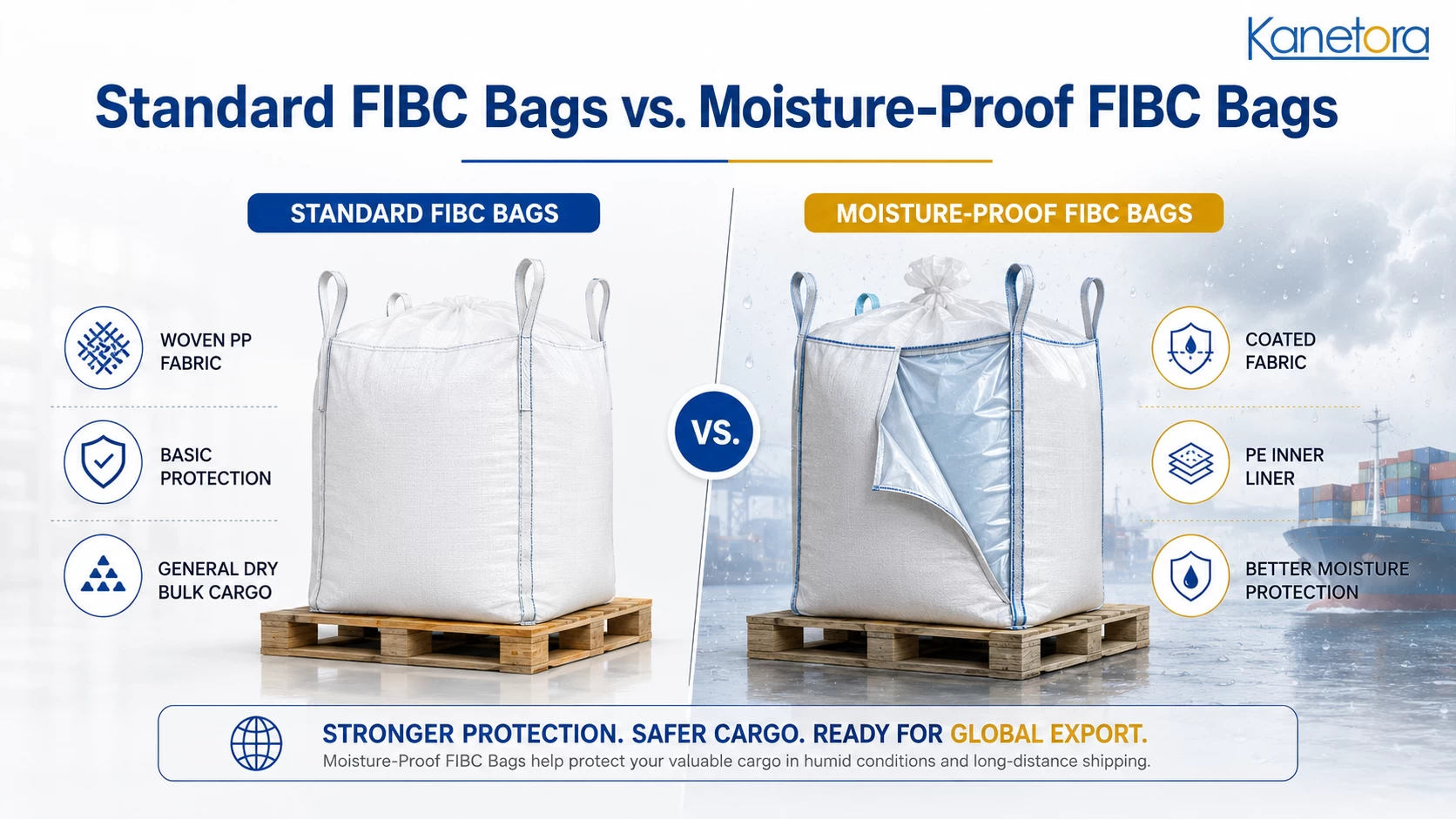
Unlike standard jumbo bags made mainly from woven polypropylene fabric, moisture-proof FIBC bags are usually combined with additional protective layers such as:
- Coated or laminated PP woven fabric;
- PE/PP inner liner bags;
- Multi-layer aluminum barrier liners;
- Tighter filling and discharge structures;
- Additional pallet protection such as Stretch Hood Film, PE Shrink Film, or Pallet Cover Bags.
For export cargo, especially shipments transported by sea, humidity is one of the most common packaging risks. Products may go through different climate zones, experience temperature changes between day and night, stay at ports or warehouses, and remain inside closed containers for several weeks.
When water vapor condenses inside the container or packaging system, the cargo may suffer from caking, mold, discoloration, contamination, loss of quality, or failure to meet import standards.
Therefore, for industries such as food ingredients, agriculture, chemicals, plastics, minerals, construction materials, and other moisture-sensitive products, choosing the right moisture-proof FIBC structure is not only a packaging decision. It is also an important part of supply chain quality control.
Why Is Humidity a Major Risk for Export Cargo?
Humidity can affect bulk cargo in many different ways. For powder, granular, or pelletized products, moisture can cause caking, clumping, sticking, or changes in physical condition. For agricultural and food products, moisture can increase the risk of mold, microbial growth, and sensory quality deterioration. For chemicals, minerals, and industrial materials, moisture may trigger reactions, reduce purity, or affect processing performance.
During export transportation, cargo is usually exposed to three major sources of moisture.
The first source is external humidity. When containers are opened at factories, ports, or warehouses, moisture from the air can enter the packaging if the bag structure is not sufficiently sealed.
The second source is moisture inside the product itself. Some products, such as agricultural materials, starches, minerals, and powders, may contain a certain level of internal moisture. If not properly controlled, this moisture can cause condensation inside the bag or container.
The third source is container rain. This happens when water vapor inside a container rises and condenses on the ceiling or side walls due to temperature differences. The condensed water may then drip onto pallets, bags, or cartons, damaging the cargo during long-distance sea freight.
For this reason, moisture-proof FIBC packaging should be viewed as a complete protection system. It involves not only the outer jumbo bag, but also fabric coating, inner liner, sewing structure, filling and discharge design, pallet protection, and export handling conditions.
The Role of PE Liners in Moisture-Proof FIBC Bags
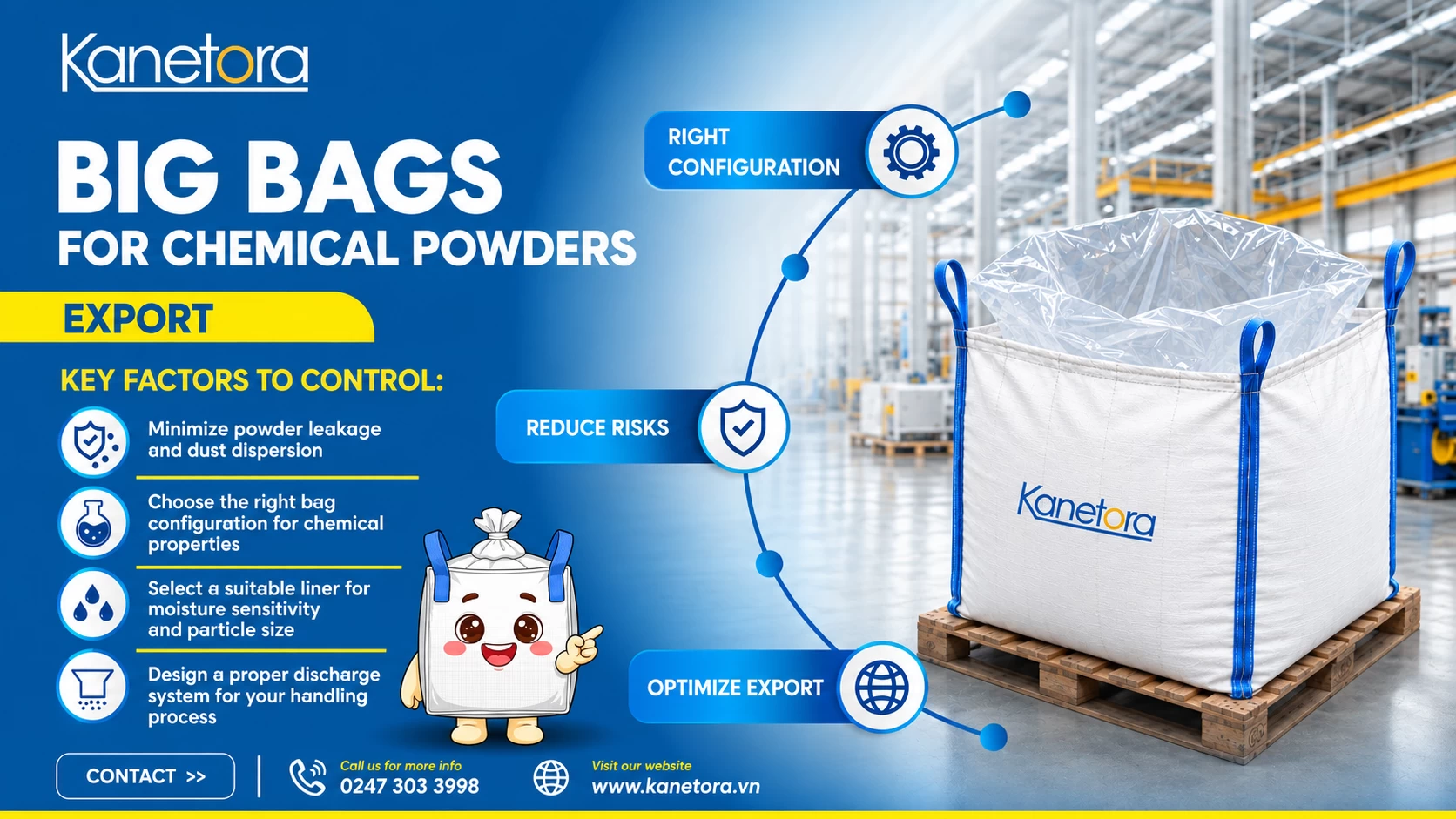
In moisture-proof FIBC packaging, the PE liner bag is one of the most important components. It is a plastic inner bag placed inside the FIBC to create an additional protective layer between the product and the outside environment.
Depending on the product and application, FIBC liners can be designed in different formats, including lay-flat liners, gusseted liners, liners with fixing tabs, top and bottom flange liners, conductive liners, baffle liners, or high-barrier liners.
Kanetora Bach Dang’s product profile includes multiple liner solutions such as standard liners, liner top & bottom flanges, reinforced side seal flanges, conductive liners, and aluminum barrier films for different levels of cargo protection.
For moisture-sensitive cargo, PE liners can help:
- Reduce moisture penetration into the bag;
- Protect products from dust and contamination;
- Improve product stability during storage and transportation;
- Support export packaging requirements;
- Improve hygiene and quality protection for international shipments.
However, not all liners offer the same moisture barrier performance. For standard products, a PE liner may be sufficient. But for high-value products that are sensitive to humidity, oxygen, odor, or light, companies may need a multi-layer aluminum barrier liner or other advanced barrier film structures.
Common Structures of Moisture-Proof FIBC Bags
An effective moisture-proof FIBC bag usually depends on the combination of multiple packaging details, not just one material layer.
1. Coated or Laminated FIBC Bags
Coated FIBC bags are one of the basic solutions for improving dust protection and reducing moisture exposure. A lamination layer makes the woven PP fabric less porous than uncoated fabric, making it more suitable for powder, fine granules, and products that require better containment.
Kanetora Bach Dang offers different lamination styles, including gloss lamination, matte lamination, and anti-skid lamination. Coating can range from 15gsm to 60gsm and can be applied inside or outside the bag, on one side or both sides, depending on customer requirements.
2. FIBC Bags with PE Inner Liners
This is one of the most common solutions for export cargo that requires better moisture protection. The PE liner creates an inner barrier that reduces direct exposure between the product and the external environment.
Depending on the cargo characteristics, the liner can be loose inserted, attached with fixing tabs, designed with filling and discharge spouts, or combined with baffle structures to maintain a more stable square shape.
3. FIBC Bags with Aluminum Barrier Liners
For products that are highly sensitive to humidity, oxygen, UV light, or odor, companies may use multi-layer barrier liners. Aluminum barrier film is usually made from aluminum foil laminated with PE, PA, PET, or other technical films, providing stronger protection against moisture, oxygen, light, and odor transmission compared with standard PE liners.
This solution is suitable for high-value products such as food additives, pharmaceutical ingredients, specialty chemicals, refined mineral powders, and products that require strict quality control during long-distance transportation.
4. FIBC Bags Combined with Stretch Hood Film or Pallet Cover
In many export cases, moisture protection should not stop at the individual bag level. When cargo is shipped on pallets, companies can combine FIBC bags with Stretch Hood Film, PE Shrink Film, or Pallet Cover Bags to protect the entire palletized unit.
Kanetora Bach Dang has invested in multi-layer co-extrusion blown film technology, which supports the production of industrial films such as FIBC liner bags, Stretch Hood Film, Pallet Cover Bags, PE Shrink Film, and other flexible film solutions.
This combined packaging approach helps improve protection during warehousing, inland transportation, port handling, container loading, and international shipping.
Which Industries Need Moisture-Proof FIBC Bags?
Moisture-proof FIBC bags are widely used across industries where products are sensitive to moisture, prone to caking, or subject to strict import quality checks.
Food and Food Ingredient Industry
Products such as flour, starch, sugar, rice, whey protein, milk powder, food additives, and powdered ingredients require clean, protective, and moisture-resistant packaging. For this segment, FIBC bags must not only protect against humidity but also support hygiene, safety, and contamination control.
Kanetora Bach Dang provides food-grade FIBC solutions for sensitive products such as flour, sugar, whey protein, and rice. The company profile also highlights certifications including ISO 22000, BRCGS, ISO 9001, and ISO 14001 as part of its quality and safety commitment.
Agriculture Industry
Agricultural products, seeds, animal feed, fertilizers, and raw agricultural materials can be strongly affected by humidity. Moisture-proof jumbo bags help reduce the risk of mold, fermentation, caking, and quality loss during storage and transportation.
Plastics and Chemicals Industry
Plastic resins, engineering plastics, plastic additives, powdered chemicals, and granular chemicals need to be protected from moisture to maintain stability before production. For some materials, even a small amount of moisture can affect extrusion, molding, processing performance, or final product quality.
Minerals and Construction Materials Industry
Cement, calcium carbonate, bentonite, gypsum, stone powder, mineral powders, and construction additives can become lumpy or unstable when exposed to moisture. Moisture-proof FIBC bags help reduce quality loss and support more efficient handling, storage, and export.
Pharmaceutical, Cosmetic, and Technical Ingredient Industry
Some pharmaceutical ingredients, cosmetic raw materials, technical additives, and high-value industrial materials require higher protection levels. These products may require barrier liners, conductive liners, dust control, or strict contamination control throughout the packaging process.
Standard FIBC Bags vs. Moisture-Proof FIBC Bags
| Criteria | Standard FIBC Bags | Moisture-Proof FIBC Bags |
|---|---|---|
| Main structure | Woven PP fabric | Woven PP fabric + coating/liner/barrier layer |
| Moisture protection | Basic | Higher, depending on structure |
| Dust protection | Medium | Better |
| Suitability for sea export | Depends on cargo type | More suitable for moisture-sensitive export cargo |
| Cost | Lower | Higher, but helps reduce cargo damage risk |
| Common applications | General industrial cargo | Food, chemicals, plastics, agriculture, minerals, construction materials |
The key point is that companies should not select moisture-proof FIBC bags based only on general assumptions. One product may only require a basic PE liner, while another product may require an aluminum barrier liner, heat-sealed liner, double-sided lamination, or additional pallet protection with Stretch Hood Film.
The correct structure should be based on product characteristics, transportation conditions, moisture sensitivity, export route, storage time, and destination market standards.
Key Considerations When Choosing Moisture-Proof FIBC Bags
Identify the Moisture Sensitivity of the Product
Not every product needs the highest level of moisture protection. For less sensitive cargo, coated FIBC bags or basic PE liners may be sufficient. For high-value or highly sensitive cargo, companies should consider multi-layer barrier liners or aluminum barrier liners.
Understand the Transportation Route
Domestic delivery, short-distance export, and long-distance sea freight require different levels of packaging protection. For long routes, multiple climate zones, or extended container storage time, the risk of condensation is higher.
Check the Filling and Discharge Design
A moisture-proof FIBC bag must be carefully designed at potential leakage points, such as the filling spout, discharge spout, seams, closures, and liner fixing positions. If the liner shifts, folds incorrectly, or does not match the outer bag structure, the protection performance may be reduced.
Consider Pallet-Level Protection
If the cargo is shipped on pallets, companies should consider additional outer protection such as Stretch Hood Film, PE Shrink Film, or Pallet Cover Bags. This extra layer helps protect the entire pallet against dust, splashing water, and environmental exposure during handling and transportation.
Work with a Manufacturer Capable of Customization
Moisture-proof FIBC bags should not be treated as a one-size-fits-all packaging product. A qualified manufacturer should be able to recommend the right structure based on product type, export conditions, filling process, discharge process, and customer quality standards.
Kanetora Bach Dang’s Capability in Moisture-Proof FIBC Packaging
Kanetora Bach Dang is part of the Kanetora ecosystem and continues the packaging experience of But Son Packaging, which was established in 1996. According to the 2026 company introduction, Kanetora Bach Dang is among the leading FIBC manufacturing facilities in Vietnam, with an FIBC capacity of approximately 300,000 pieces per month and a multi-layer PE film capacity of approximately 500 tons per month.
One of Kanetora Bach Dang’s key advantages is its ability to manufacture multiple components related to moisture-proof bulk packaging, including FIBC bags, coated fabric, PE liners, liner blowing, liner insertion, and multi-layer PE films.
By producing many semi-finished components in-house, Kanetora Bach Dang can maintain better quality control, improve production flexibility, and respond faster to customized requirements. The company’s internal semi-finished product range includes sling belts, webbings, labels, document pouches, liners, and other components used in FIBC production.
Kanetora Bach Dang also applies a standardized 8-step production process to ensure product durability, safety, and international quality compliance, including extrusion, belt weaving, fabric weaving, laminating, cutting/printing, sewing, inspection, and packing.
In addition, the factory is equipped with testing and quality control systems for both FIBC bags and inner liners, including tensile strength testers, UV accelerated weathering tester, top lift test machine, light inspection table, puncture resistance tester, coefficient of friction tester, and heat sealing strength tester.
These capabilities provide a strong foundation for Kanetora Bach Dang to develop moisture-proof FIBC solutions for industries that require high durability, clean packaging, export protection, and stable product quality.
Suggested Moisture-Proof FIBC Structures by Application
| Application Need | Suggested Packaging Structure |
|---|---|
| General industrial cargo with low moisture sensitivity | Coated woven PP FIBC |
| Powder or fine granular products | Coated FIBC + PE inner liner |
| Food-grade or clean ingredients | Food-grade FIBC + suitable liner + contamination control |
| Products sensitive to humidity, oxygen, odor, or light | FIBC + aluminum barrier liner |
| Long-distance sea export cargo | FIBC + liner + Stretch Hood Film/Pallet Cover |
| Cargo requiring stable pallet shape | Baffle bag + baffle liner + Stretch Hood Film |
| Products requiring static control | Type C/Type D FIBC or conductive liner depending on handling conditions |
Conclusion
Moisture-proof FIBC bags are an important packaging solution for protecting export cargo from humidity, water vapor, condensation, contamination, and product quality loss during storage and transportation.
For industries such as food ingredients, agriculture, plastics, chemicals, minerals, construction materials, pharmaceutical ingredients, and technical raw materials, selecting the right FIBC structure can help reduce damage risks and maintain product stability until the cargo reaches international customers.
Instead of choosing FIBC bags only by load capacity or price, companies should evaluate the entire logistics chain, including product characteristics, moisture sensitivity, storage conditions, export route, container environment, and import market standards.
Based on these factors, the right packaging structure may include coated FIBC fabric, PE inner liners, aluminum barrier liners, baffle liners, conductive liners, or additional pallet protection with Stretch Hood Film.
With its integrated production capability for FIBC bags, inner liners, and multi-layer PE films, Kanetora Bach Dang can support businesses in developing customized moisture-proof packaging solutions for different industries and export markets.
Looking for moisture-proof FIBC bags for export cargo?
Kanetora Bach Dang can support your business with customized FIBC structures, PE liners, aluminum barrier liners, and pallet protection solutions based on your product characteristics, logistics conditions, and destination market requirements.
Contact Kanetora Bach Dang today for professional consultation on industrial bulk packaging solutions.
FAQ – Moisture-Proof FIBC Bags
Are moisture-proof FIBC bags completely waterproof?
Not all moisture-proof FIBC bags are completely waterproof. Coated FIBC bags and PE liners can reduce moisture exposure and light water splashes, but for higher protection requirements, companies should consider barrier liners or additional pallet protection such as Stretch Hood Film.
Is a PE liner required for every moisture-proof FIBC bag?
A PE liner is not required for every application, but it is highly recommended for moisture-sensitive cargo, powder products, fine granules, and sea export shipments. The liner adds an internal protection layer between the product and the outside environment.
What is the difference between coated FIBC bags and FIBC bags with liners?
Coated FIBC bags have a lamination layer on the woven PP fabric, which helps reduce dust leakage and basic moisture exposure. FIBC bags with liners have an additional plastic inner bag, offering better internal protection for the product. For moisture-sensitive cargo, liners are usually more effective than coating alone.
When should companies use aluminum barrier liners?
Aluminum barrier liners are recommended for products that are highly sensitive to humidity, oxygen, UV light, or odor. They are often used for high-value materials, technical ingredients, specialty chemicals, pharmaceutical ingredients, and long-distance export cargo.
Can Stretch Hood Film replace PE liners?
Stretch Hood Film should not be considered a direct replacement for PE liners. PE liners protect the product inside the FIBC bag, while Stretch Hood Film protects the palletized cargo from the outside. In many export cases, both solutions can be combined for better overall protection.
Which industries commonly use moisture-proof FIBC bags?
Moisture-proof FIBC bags are commonly used in food ingredients, agriculture, plastics, chemicals, minerals, construction materials, pharmaceutical ingredients, cosmetics raw materials, and other industries where products are sensitive to humidity during storage or transportation.