

Introduction: Are You Optimizing Your Packaging — or Losing Money Without Realizing It?
In the plastic manufacturing industry, most businesses focus heavily on optimizing raw material costs. However, one critical factor is often overlooked: how plastic resin is packaged and transported.
Many companies still rely on traditional 25kg bags — a familiar but inefficient solution that creates hidden costs across the entire supply chain:
- High labor costs for manual handling
- Slow loading and unloading processes
- Risk of contamination and material loss
- Inefficient container utilization
Meanwhile, global manufacturers are rapidly shifting toward bulk packaging solutions, with FIBC bags (jumbo bags) becoming the industry standard.
FIBC is no longer just a packaging option — it is a strategic solution that helps businesses:
- Reduce logistics costs
- Protect material quality
- Improve operational efficiency
At Kanetora Bach Dang, with nearly 30 years of experience in industrial packaging, FIBC solutions are designed not as generic products, but as customized systems tailored to each material and supply chain requirement
👉 So what makes FIBC the ideal solution for plastic resin, and how can you choose the right specifications?
1. Why Plastic Resin Requires Specialized Packaging
Plastic resin (PP, PE, PET, masterbatch…) is a critical raw material, but it comes with specific challenges:
- Highly sensitive to moisture
- Easily contaminated by dust or foreign particles
- Risk of loss during transportation
- Requires efficient bulk handling
👉 Poor packaging directly impacts product quality, operational efficiency, and overall cost structure.
2. What is an FIBC Bag & Why It’s Ideal for Plastic Resin?
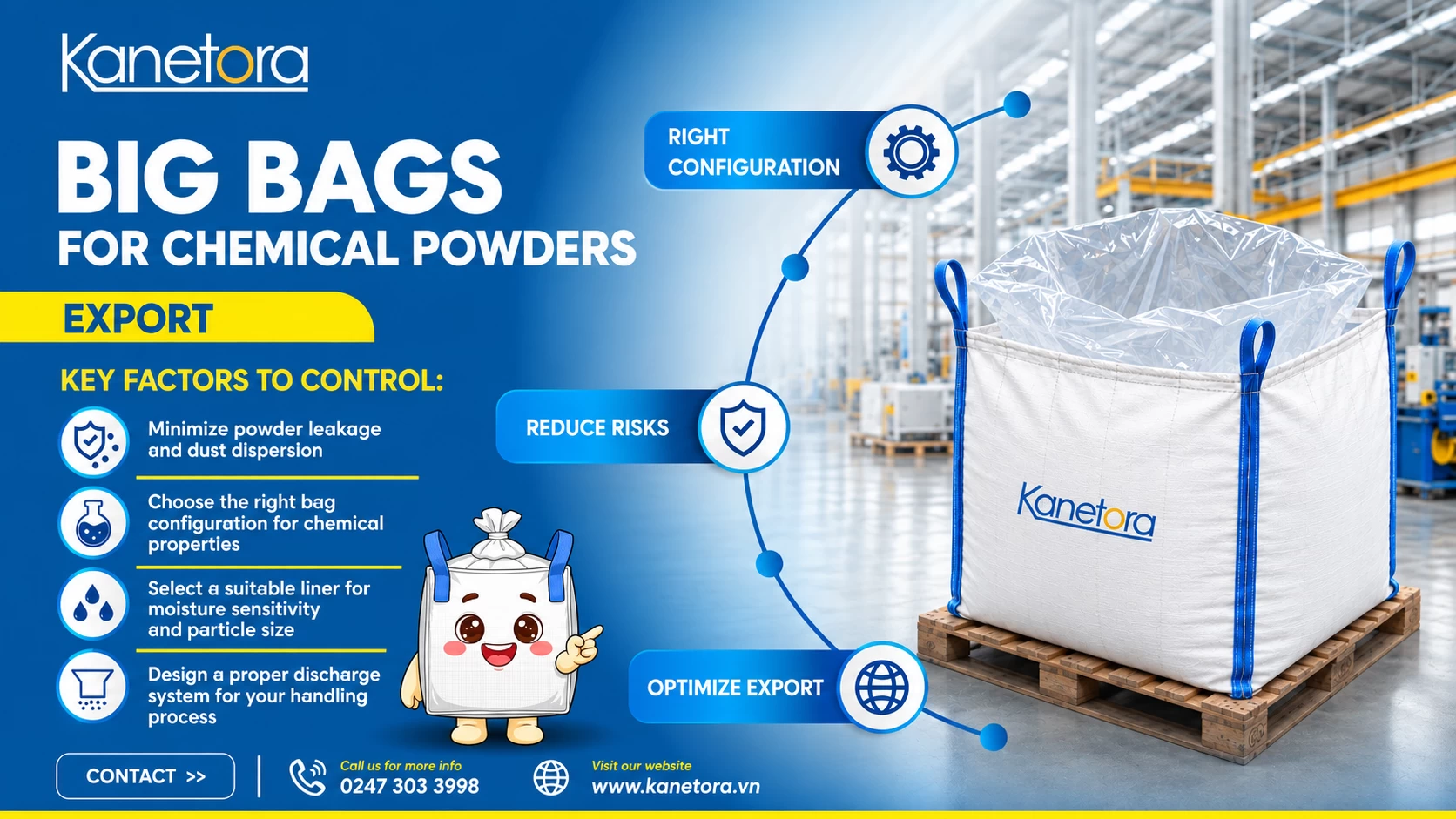
FIBC (Flexible Intermediate Bulk Container), commonly known as a jumbo bag, is designed to carry 500kg to 2000kg per bag.
Key advantages:
- High capacity → fewer units → lower packaging cost
- Easy handling with forklifts → reduced labor
- Optimized container loading → lower shipping cost
- Customizable design based on material type
Kanetora uses 100% virgin polypropylene in production, ensuring high durability, cleanliness, and consistency in every bag.
3. Types of FIBC Bags for Plastic Resin Applications
Type A – Standard FIBC
- No electrostatic protection
- Suitable for general plastic resin
- Most cost-effective
Type B – Low Breakdown Voltage
- Limits spark discharge
- Suitable for low-risk environments
Type C – Conductive FIBC
- Requires grounding
- Used in hazardous environments
Type D – Anti-static FIBC
- Dissipates static without grounding
👉 In most plastic resin applications, Type A with inner liner is the standard solution.
4. The Role of Inner Liners in Plastic Resin Packaging
Inner liners play a crucial role in protecting material quality.
Key benefits:
- Prevent moisture and contamination
- Maintain product purity
- Enable food-grade or high-standard packaging
- Improve discharge efficiency
Common liner types:
- Standard PE/PP liners
- Anti-static liners
- Multi-layer barrier liners (moisture, oxygen, UV protection)
5. Key Technical Specifications to Consider
Choosing the right FIBC is not about price — it’s about technical suitability.
✔ Fabric (Woven PP)
- 140 – 220 GSM
- Determines durability and load capacity
✔ Safe Working Load (SWL)
- 500 – 2000 kg
- Safety factor: 5:1 – 8:1
✔ Coating / Lamination
- 15 – 60 GSM
- Enhances moisture and dust resistance
✔ Sewing Technology
- Lock stitch → high strength
- Chain stitch → flexibility
✔ Quality Control Process
- Dual-layer QC & QA system
- Metal detection
- Cleanroom packaging for sensitive products
Kanetora applies strict quality control across all production stages to ensure consistency and reliability.
6. Cost Optimization: Why FIBC is More Efficient than Small Bags
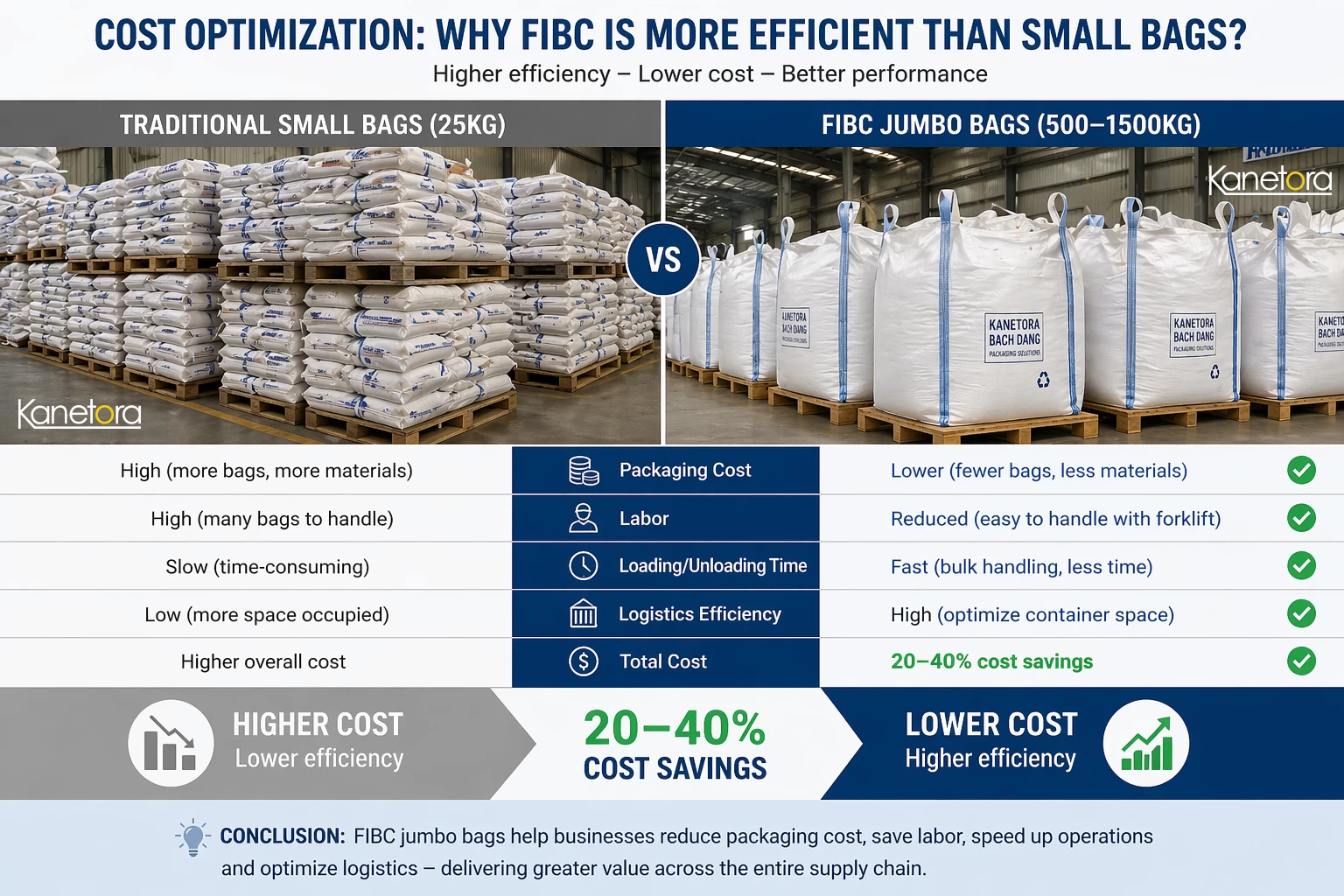
Compared to traditional 25kg bags, FIBC offers significant advantages:
| Criteria | Small Bags | FIBC |
|---|---|---|
| Packaging cost | High | Lower |
| Labor | High | Reduced |
| Handling time | Slow | Fast |
| Logistics efficiency | Low | High |
| Total cost | High | Optimized |
👉 Businesses can achieve 20–40% cost savings by switching to FIBC.
7. Industry Applications of FIBC for Plastic Resin
FIBC bags are widely used across:
- Virgin plastic resin (PP, PE)
- Masterbatch
- Plastic compounds
- Recycled plastic
The plastic & chemical sector represents a significant portion of global FIBC demand.
8. Why Choose Kanetora Bach Dang?
Kanetora is not just a manufacturer — it is a packaging solution provider.
Key strengths:
- Top 3 FIBC manufacturers in Vietnam
- Capacity: ~300,000 bags/month
- Certifications: BRC Grade A, ISO 9001, ISO 14001
- Fully integrated production (yarn → fabric → sewing → liner)
- Custom design based on customer requirements
👉 This ensures consistent quality, faster lead time, and better cost control.
9. The New Trend: Integrated Packaging Solutions
The market is shifting:
Businesses no longer buy bags — they buy solutions.
Examples:
- FIBC + inner liner
- FIBC + stretch hood film
- Packaging optimized for container loading
👉 Integrated packaging is becoming the new standard for global supply chains.
FIBC bags are more than just packaging — they are a strategic tool for:
- Reducing operational costs
- Protecting material quality
- Optimizing supply chain efficiency
For plastic resin businesses, choosing the right packaging solution can create a long-term competitive advantage.
Looking for a reliable FIBC solution for your plastic resin?
👉 Contact Kanetora Bach Dang today for customized packaging solutions tailored to your materials and logistics needs.